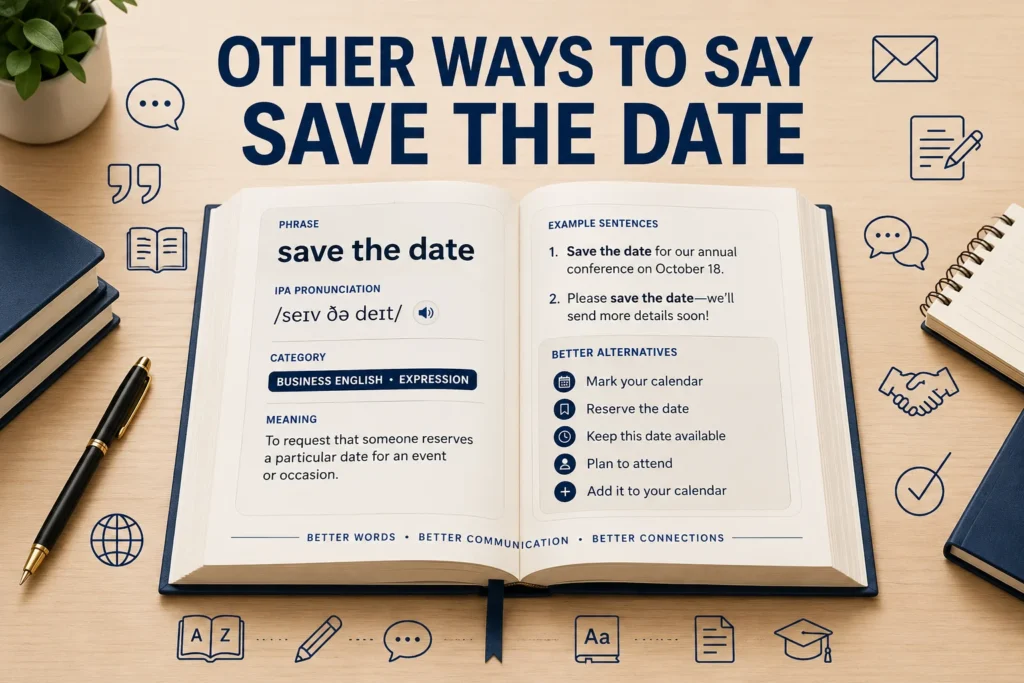
If you’re looking for other ways to say “save the date,” you’ve come to the right place. Whether you’re writing a business email, inviting clients to a conference, announcing a company event, or planning a networking session, using a fresh and professional alternative can make your invitation more engaging.
The phrase “save the date” is widely used to notify people about an upcoming event before sending the official invitation. While it’s clear and effective, repeating it in every email or announcement can sound predictable. Choosing the right alternative helps you match your audience, improve workplace communication, and maintain proper email etiquette.
In this guide, you’ll discover 30 professional, formal, friendly, and email-ready alternatives to “save the date,” complete with meanings, use cases, and practical examples.
What Does “Save the Date” Mean?
“Save the date” is a phrase used to ask someone to reserve a specific day for an upcoming event. It serves as an early notice so recipients can keep their schedule free before receiving full event details.
It is commonly used for:
- Business conferences
- Corporate meetings
- Client appreciation events
- Webinars
- Networking sessions
- Product launches
- Company celebrations
- Training workshops
Literal Meaning
The phrase means:
- Keep this date available.
- Reserve time on your calendar.
- Avoid making other plans.
- Expect more event details later.
Examples
- Save the date for our annual leadership summit.
- Please save the date for our customer appreciation event.
- Save the date for our virtual product launch next month.
Tone
“Save the date” has a tone that is:
- Friendly
- Professional
- Welcoming
- Positive
- Informative
It creates anticipation while giving recipients enough time to plan ahead.
Purpose
People use “save the date” to:
- Announce an important event early
- Increase attendance
- Help guests plan their schedules
- Build excitement before the official invitation
- Reduce scheduling conflicts
Emotional Context
Unlike a formal invitation, “save the date” feels relaxed and encouraging. It tells people that their presence is valued without asking for an immediate response.
Example:
Save the date for our annual client networking dinner on October 18.
This message feels welcoming while remaining professional.
Professional Usage
Although “save the date” works well in many situations, there are times when a more specific or formal phrase creates a stronger impression.
Business Emails
Professional alternatives help emails sound polished.
Example:
Please reserve this date for our annual strategy meeting.
Workplace Communication
Managers often use calendar-friendly phrases for internal events.
Example:
Mark your calendar for next Friday’s department meeting.
Client Communication
Formal wording shows professionalism.
Example:
We invite you to reserve the date for our exclusive client appreciation event.
Networking Events
Networking invitations should feel welcoming while encouraging attendance.
Example:
Please keep this date available for our annual networking reception.
Customer Service
Customer invitations should sound informative and helpful.
Example:
Mark your calendar for our free customer training webinar.
15 Professional & Polite Alternatives to “Save the Date”
1. Mark Your Calendar
Tone: Professional
Best Use: Business meetings, conferences, and company events
Example:
Mark your calendar for our annual sales conference on September 15.
2. Reserve the Date
Tone: Formal
Best Use: Client events and executive meetings
Example:
Please reserve the date for our leadership summit.
3. Keep This Date Available
Tone: Professional
Best Use: Business emails and corporate announcements
Example:
Please keep this date available for our quarterly planning session.
4. Hold the Date
Tone: Formal
Best Use: Conferences and official company events
Example:
Hold the date for our annual shareholder meeting.
5. Add It to Your Calendar
Tone: Friendly and modern
Best Use: Digital invitations and workplace emails
Example:
Add it to your calendar so you don’t miss our product launch.
6. Block Off Your Calendar
Tone: Workplace-friendly
Best Use: Team meetings and internal planning sessions
Example:
Block off your calendar for Tuesday’s strategy workshop.
7. Set Aside This Date
Tone: Formal
Best Use: Seminars, workshops, and corporate events
Example:
Set aside this date for our annual leadership conference.
8. Plan to Attend
Tone: Encouraging
Best Use: Conferences, webinars, and training sessions
Example:
Plan to attend our free digital marketing webinar next month.
9. Be Sure to Attend
Tone: Professional
Best Use: Mandatory meetings and training events
Example:
Be sure to attend Friday’s compliance workshop.
10. Make Time for This Event
Tone: Friendly
Best Use: Networking events and public seminars
Example:
Make time for this exciting networking opportunity.
11. Keep Your Schedule Open
Tone: Professional
Best Use: Executive meetings and client events
Example:
Please keep your schedule open for our annual planning retreat.
12. Put This on Your Agenda
Tone: Workplace-friendly
Best Use: Team meetings and business discussions
Example:
Put this on your agenda for next week’s department meeting.
13. Pencil It In
Tone: Casual
Best Use: Informal office communication
Example:
Pencil it in for now—we’ll confirm the details later.
14. Watch for Your Invitation
Tone: Professional
Best Use: Event announcements before formal invitations
Example:
Watch for your invitation to our annual client appreciation dinner.
15. Stay Tuned for Event Details
Tone: Informative
Best Use: Product launches, conferences, and promotional campaigns
Example:
Stay tuned for event details about our upcoming innovation summit.
Part 1 Summary
The phrase “save the date” is an excellent way to notify people about future events, but using professional alternatives can make your communication more engaging and tailored to your audience. Whether you’re inviting clients, colleagues, customers, or business partners, phrases like “Mark your calendar,” “Reserve the date,” “Keep this date available,” “Plan to attend,” and “Add it to your calendar” help create polished, professional invitations while encouraging recipients to plan ahead.
16. Kindly Keep This Date Free
Tone: Formal and respectful
Best Use: Executive meetings, client events, and corporate functions
Example:
Kindly keep this date free for our annual executive forum.
17. Reserve Time in Your Schedule
Tone: Professional
Best Use: Business meetings and training sessions
Example:
Please reserve time in your schedule for our leadership workshop.
18. We Hope You Can Join Us
Tone: Warm and welcoming
Best Use: Networking events, customer gatherings, and company celebrations
Example:
We hope you can join us for our annual customer appreciation event.
19. Please Set This Date Aside
Tone: Formal
Best Use: Conferences, seminars, and official invitations
Example:
Please set this date aside for our international business summit.
20. Keep Your Calendar Open
Tone: Professional
Best Use: Workplace announcements and project meetings
Example:
Keep your calendar open for our planning session next month.
21. Reserve Your Calendar
Tone: Business-friendly
Best Use: Corporate events and webinars
Example:
Reserve your calendar for our annual innovation conference.
22. We’d Love to See You There
Tone: Friendly
Best Use: Team events, networking sessions, and social gatherings
Example:
We’d love to see you there as we celebrate another successful year.
23. Don’t Make Other Plans
Tone: Casual
Best Use: Informal office events and community activities
Example:
Don’t make other plans—we’ve got something exciting coming soon.
24. Put This Date on Your Planner
Tone: Friendly
Best Use: School events, workshops, and community programs
Example:
Put this date on your planner so you don’t miss the workshop.
25. We Invite You to Reserve the Date
Tone: Professional
Best Use: Client invitations and VIP events
Example:
We invite you to reserve the date for our exclusive leadership dinner.
26. Mark the Occasion
Tone: Elegant
Best Use: Company anniversaries and celebrations
Example:
Mark the occasion as we celebrate 20 years of innovation.
27. Prepare to Join Us
Tone: Promotional
Best Use: Product launches, conferences, and webinars
Example:
Prepare to join us for an unforgettable product launch.
28. Keep an Eye on This Date
Tone: Friendly
Best Use: Event announcements and newsletters
Example:
Keep an eye on this date because registration opens soon.
29. Anticipate Our Invitation
Tone: Formal
Best Use: Luxury events, corporate functions, and executive gatherings
Example:
Anticipate our invitation to this year’s executive networking reception.
30. Make a Reminder
Tone: Casual and practical
Best Use: Internal emails and digital calendar reminders
Example:
Make a reminder for our monthly project review meeting.
Quick Comparison Table
| Alternative | Tone | Best Use |
| Mark Your Calendar | Professional | Meetings and conferences |
| Reserve the Date | Formal | Client events |
| Keep This Date Available | Professional | Business emails |
| Hold the Date | Formal | Corporate events |
| Plan to Attend | Encouraging | Webinars and seminars |
| Kindly Keep This Date Free | Formal | Executive invitations |
| Reserve Time in Your Schedule | Professional | Training sessions |
| Keep Your Calendar Open | Professional | Workplace meetings |
| We’d Love to See You There | Friendly | Team events |
| We Invite You to Reserve the Date | Professional | VIP invitations |
| Prepare to Join Us | Promotional | Product launches |
| Make a Reminder | Casual | Internal communication |
Email Examples
1. Client Invitation
Subject: Reserve the Date for Our Annual Leadership Forum
Dear Mr. Williams,
Please reserve the date of October 18 for our Annual Leadership Forum. We are excited to share valuable industry insights and look forward to welcoming you.
Best regards,
The Events Team
2. Email to a Manager
Hello Sarah,
Please keep your calendar open for next Wednesday’s planning session. Your input will be valuable as we finalize the quarterly strategy.
Thank you.
3. Email to a Colleague
Hi Emma,
Just a quick reminder to mark your calendar for Friday’s brainstorming workshop. It should be a productive session.
See you there!
4. Customer Invitation
Dear Customer,
We hope you can join us for our free online product demonstration next month. Additional registration details will be shared shortly.
5. Networking Invitation
Hello James,
Please set this date aside for our annual networking breakfast. It will be a great opportunity to connect with professionals across the industry.
6. Meeting Follow-up
Thank you for your interest.
Please reserve time in your schedule for our follow-up discussion on Tuesday. The meeting invitation will arrive later today.
Common Mistakes
Using “Save the Date” Too Frequently
Repeating the same phrase in every invitation can make your communication sound repetitive. Mix in professional alternatives for variety.
Sending It Too Close to the Event
A save-the-date notice should provide enough advance notice.
Suggested timing:
- Conferences: 3–6 months
- Corporate events: 1–3 months
- Webinars: 2–4 weeks
- Team meetings: 1–2 weeks
Forgetting Important Details
Even an early announcement should include:
- Event name
- Date
- General location
- Purpose
- A note that additional details will follow
Using Casual Language with Executives
Avoid phrases like:
Don’t make other plans!
Instead write:
Kindly keep this date free.
Forgetting the Next Step
Always explain what happens next.
Examples:
- Registration opens soon.
- Formal invitations will follow.
- RSVP details will be shared shortly.
- Calendar invitations will be emailed next week.
Related Phrases
| Phrase | Meaning | Example |
| Mark Your Calendar | Remember the date | Mark your calendar for July 10. |
| Hold the Date | Reserve the day | Hold the date for our conference. |
| Reserve the Date | Keep the day free | Reserve the date for our summit. |
| Plan to Attend | Expect to participate | Plan to attend our webinar. |
| Keep This Date Free | Don’t schedule anything else | Keep this date free for our workshop. |
| Block Your Calendar | Reserve time | Block your calendar for Monday. |
| Add to Your Calendar | Create a reminder | Add this to your calendar today. |
| RSVP | Confirm attendance | Please RSVP by Friday. |
| Register Early | Sign up in advance | Register early to secure your place. |
| Save Your Seat | Reserve attendance | Save your seat before registration closes. |
| Join Us | Attend our event | Join us for the conference. |
| We Look Forward to Seeing You | Warm closing | We look forward to seeing you next month. |
| Event Reminder | Notification | Here’s your event reminder. |
| Upcoming Event | Future occasion | Don’t miss our upcoming event. |
| Calendar Reminder | Digital reminder | Set a calendar reminder today. |
| Official Invitation | Formal invitation | You’ll receive the official invitation next week. |
Phrase Comparison
| Phrase | Formality | Tone | Best Use |
| Save the Date | Medium | Friendly | General announcements |
| Reserve the Date | High | Formal | Client events |
| Mark Your Calendar | Medium | Professional | Meetings |
| Hold the Date | High | Professional | Conferences |
| Keep This Date Free | High | Professional | Corporate emails |
| Reserve Time in Your Schedule | High | Business | Executive meetings |
| We’d Love to See You There | Low | Friendly | Team celebrations |
| Prepare to Join Us | Medium | Promotional | Launch events |
| Anticipate Our Invitation | High | Elegant | VIP events |
| Make a Reminder | Low | Casual | Internal communication |
Part 2 Summary
Professional alternatives to “save the date” make your invitations sound more polished and appropriate for different audiences. Whether you’re inviting clients, coworkers, business partners, or customers, choosing phrases such as “Reserve Time in Your Schedule,” “Kindly Keep This Date Free,” “Please Set This Date Aside,” or “We Invite You to Reserve the Date” helps create a stronger first impression while encouraging recipients to plan ahead.
Cultural Usage
The phrase “save the date” is widely recognized in English-speaking countries, but the preferred wording can vary depending on the audience, region, and level of formality. Choosing the right alternative helps your invitation sound natural and professional.
1. US English
In American English, “save the date” is commonly used for both personal and business events. Companies often pair it with friendly, action-oriented language.
Popular Alternatives
- Mark your calendar
- Reserve the date
- Add it to your calendar
- Plan to attend
- Save your spot
Example
Mark your calendar for our Annual Innovation Summit on September 18.
2. UK English
British English generally favors a more formal and courteous style, especially in corporate communication.
Popular Alternatives
- Kindly keep this date free
- Please reserve the date
- We would be delighted by your attendance
- Please set this date aside
- We hope you can attend
Example
Kindly keep this date free for our Annual Business Conference.
3. Corporate Communication
In business settings, invitations should be clear, concise, and respectful. Avoid slang or overly casual wording.
Recommended Alternatives
- Reserve the date
- Keep this date available
- Reserve time in your schedule
- Please plan to attend
- We invite you to attend
Example
Please reserve time in your schedule for our quarterly strategy meeting.
4. Customer Service
Customer-facing communication should be welcoming and encourage participation without sounding too formal.
Recommended Alternatives
- Mark your calendar
- Save your spot
- We hope you’ll join us
- Don’t miss this event
- Stay tuned for more details
Example
Save your spot for our free customer success webinar.
5. Networking Events
Networking invitations should sound inviting, professional, and engaging.
Recommended Alternatives
- We hope you can join us
- We’d love to see you there
- Reserve the date
- Plan to attend
- Keep this date available
Example
We hope you can join us for an evening of networking and industry discussions.
(FAQs)
What is the most professional way to say “save the date”?
Some of the best professional alternatives include:
- Reserve the date
- Mark your calendar
- Kindly keep this date free
- Keep this date available
- Reserve time in your schedule
These phrases work well in business emails, workplace announcements, and client invitations.
What is a formal alternative to “save the date”?
Formal alternatives include:
- Kindly keep this date free
- Please reserve the date
- Please set this date aside
- We invite you to reserve the date
- Hold the date
These options are ideal for executive meetings, conferences, and formal business events.
Is “save the date” appropriate for business emails?
Yes. It is widely accepted in professional communication, particularly for conferences, workshops, webinars, and company events. However, using alternatives can make your writing sound more polished and varied.
What can I say instead of “save the date” in an email?
You can use:
- Mark your calendar
- Reserve the date
- Keep this date available
- Plan to attend
- Save your spot
These alternatives are suitable for both internal and external emails.
Which phrase is best for inviting clients?
Professional client invitations often use:
- Reserve the date
- Kindly keep this date free
- We invite you to attend
- Please set this date aside
- We hope you can join us
These expressions show courtesy while maintaining a professional tone.
What is the best alternative for webinars?
For webinars and online events, consider:
- Save your spot
- Register today
- Plan to attend
- Add it to your calendar
- Don’t miss this event
These phrases encourage early registration and participation.
How far in advance should I send a save-the-date email?
The timing depends on the event:
- Conferences: 3–6 months in advance
- Corporate events: 1–3 months
- Webinars: 2–4 weeks
- Team meetings: 1–2 weeks
Sending an early notice helps attendees plan their schedules.
Is “mark your cal*ndar” more casual than “save the date”?
Yes. “Mark your calendar” sounds slightly more conversational, while “save the date” is a traditional phrase commonly used in both personal and professional invitations.
Can I use “save the date” for internal company meetings?
Absolutely. It’s appropriate for important meetings, training sessions, annual events, and company-wide announcements. For routine meetings, phrases like “block off your calendar” or “keep this date available” may sound more natural.
Why should I use alternatives to “save the date”?
Using different expressions improves readability, avoids repetition, and allows you to match the tone of your audience. It also helps your em*ils and invitations feel more personalized and professional.
Final Summary
Choosing the right alternative to “save the date” depends on your audience and the type of event you’re promoting.
Best Pr*fessional Options
- Reserve the date
- Keep this date available
- Reserve time in your schedule
- Mark your calendar
- Please plan to attend
Best Formal Opti*ns
- Kindly keep this date free
- Please set this date aside
- Hold the date
- We invite you to reserve the date
- Please reserve the date
Best Friendly Options
- We’d love to see you there
- We hope you can join us
- Save your spot
- Don’t miss this event
- Keep your calendar open
Best Email Options
- Mark your calendar
- Reserve the date
- Keep this date available
- Add it to your calendar
- Stay tuned for more details
Conclusion
Using professional alternatives to “save the date” helps your invitations sound more engaging, polished, and audience-focused. While the original phrase is clear and widely recognized, varying your language keeps your communication fresh and appropriate for different situations. Expressions such as “Reserve the Date,” “Mark Your Calendar,” “Kindly Keep This Date Free,” “Reserve Time in Your Schedule,” and “Plan to Attend” are excellent choices for business emails, workplace announcements, client invitations, webinars, and networking events. Selecting the right phrase strengthens professional communication, improves email etiquette, encourages early planning, and increases the likelihood that recipients will attend your event.