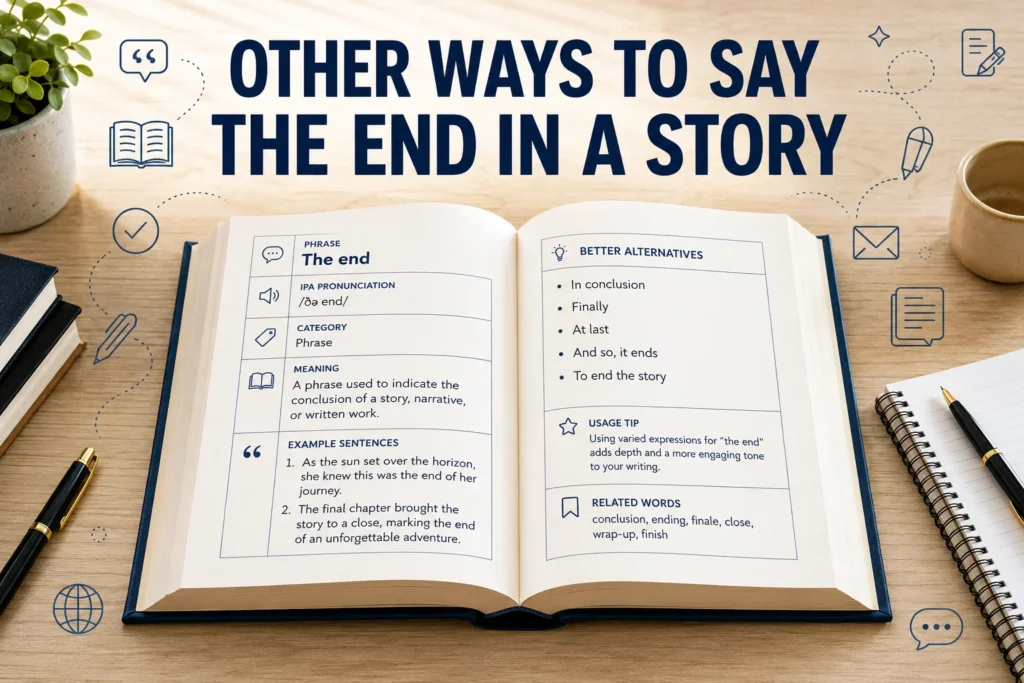
Every story deserves a memorable ending. While “The End” has been a classic closing phrase for generations, many modern writers look for fresh, creative, or genre-specific alternatives. Whether you’re writing a novel, children’s book, short story, screenplay, fairy tale, or school assignment, choosing the right ending phrase can leave readers with a stronger final impression.
If you’ve searched for other ways to say “the end” in a story, you’re probably looking for a phrase that matches your story’s tone. A fantasy novel may need a magical closing, while a mystery might benefit from a suspenseful finish. Likewise, a children’s bedtime story often sounds warmer with a playful ending.
In this guide, you’ll discover professional and creative alternatives to “The End,” learn when to use each one, compare their tone, and see practical examples. By the end, you’ll have plenty of options to make your story’s conclusion feel natural, memorable, and satisfying.
What Does “The End” Mean in a Story?
“The End” is a traditional phrase placed at the conclusion of a written work. It tells readers that the narrative has finished and there is nothing more to follow.
Although simple, these two words have carried emotional weight for centuries. They signal closure, resolution, and completion after readers have invested time in the characters and plot.
Literal Meaning
“The End” simply means:
- The story is complete.
- The narrative has concluded.
- The reader has reached the final page.
Purpose
Writers use “The End” to:
- Mark the official conclusion.
- Provide a sense of closure.
- Separate the story from any notes or acknowledgments.
- Reinforce that the adventure has finished.
Emotional Context
The feeling created by “The End” depends on the story itself.
It can feel:
- Happy after a cheerful ending
- Emotional after a tragedy
- Hopeful after a character’s journey
- Mysterious if questions remain
- Peaceful after conflicts are resolved
Examples
Children’s story
The princess hugged the dragon, and peace returned to the kingdom.
The End.
Adventure story
Jake smiled as the treasure chest finally opened.
The End.
Mystery
The detective quietly closed the case file.
The End.
Although effective, many authors now prefer alternatives that better match their story’s style and genre.
When Should You Use “The End”?
“The End” works well in many situations, but it isn’t always the best choice.
Children’s Books
Young readers often appreciate a clear signal that the story has finished.
Example:
The little rabbit fell asleep beside his family.
The End.
Fairy Tales
Traditional fairy tales commonly end with phrases such as:
- The End
- Happily Ever After
- And they lived happily ever after
These endings reinforce the classic storytelling style.
Short Stories
Many modern short stories omit an ending phrase entirely. However, adding “The End” can still work if you want a traditional or nostalgic feel.
School Assignments
Students sometimes include “The End” in creative writing projects, especially at elementary and middle school levels.
Personal Storybooks
Family storybooks, homemade books, and bedtime stories often end with “The End” because it feels familiar and comforting.
When to Skip “The End”
Professional novels, literary fiction, magazines, and most published books usually end after the final sentence without adding any closing phrase.
Instead of writing:
The End.
The story simply finishes naturally.
Example:
She smiled as the sunrise painted the sky in gold.
The blank page that follows tells readers the story is over.
Not every story should finish the same way. Below are creative alternatives grouped by style and purpose.
Classic Ending Phrases
1. The Story Ends Here
Tone: Neutral
Best for: School projects, educational writing, simple fiction
Example
The Story Ends Here.
2. Finis
Tone: Classic, literary
Best for: Historical fiction, vintage-style books
Example
Finis.
3. End of Story
Tone: Direct
Best for: Humorous writing, memoirs
Example
End of Story.
4. That’s All
Tone: Friendly
Best for: Children’s books
Example
That’s All!
5. Story Complete
Tone: Modern
Best for: Online fiction and digital stories
Example
Story Complete.
Fairy Tale Endings
6. Happily Ever After
Tone: Warm, magical
Best for: Fairy tales and romance
Example
The prince and princess ruled wisely. Happily Ever After.
7. And They Lived Happily Ever After
Tone: Traditional
Best for: Classic fairy tales
Example
The kingdom celebrated for days, and they lived happily ever after.
8. Peace Returned to the Kingdom
Tone: Fantasy
Best for: Medieval adventures
Example
Peace Returned to the Kingdom.
9. Their Adventure Was Complete
Tone: Heroic
Best for: Fantasy novels
Example
Their Adventure Was Complete.
10. The Legend Lives On
Tone: Epic
Best for: Mythology and fantasy
Example
The Legend Lives On.
Modern Fiction Endings
11. Until Next Time
Tone: Hopeful
Best for: Book series
Example
Until Next Time…
12. To Be Continued
Tone: Suspenseful
Best for: Series fiction
Example
To Be Continued…
13. The Journey Continues
Tone: Inspirational
Best for: Adventure stories
Example
The Journey Continues.
14. A New Beginning
Tone: Optimistic
Best for: Character-driven novels
Example
A New Beginning.
15. Their Story Lives On
Tone: Emotional
Best for: Family stories
Example
Their Story Lives On.
Dramatic and Emotional Ending Phrases
16. The Adventure Ends, but the Memories Remain
Tone: Heartfelt
Best for: Adventure novels, memoirs, coming-of-age stories
Example
They returned home wiser than ever. The Adventure Ends, but the Memories Remain.
17. Every Ending Marks a New Beginning
Tone: Inspirational
Best for: Personal journeys and uplifting fiction
Example
They closed one chapter of life, ready to begin another. Every Ending Marks a New Beginning.
18. The Final Chapter
Tone: Dramatic
Best for: Historical fiction, biographies, novels
Example
The Final Chapter.
19. Curtain Falls
Tone: Theatrical
Best for: Plays, scripts, stage performances
Example
Curtain Falls.
20. Fade to Black
Tone: Cinematic
Best for: Screenplays, film-inspired fiction
Example
The city lights disappeared into the night. Fade to Black.
Mystery and Thriller Endings
21. The Truth Was Finally Revealed
Tone: Suspenseful
Best for: Detective stories and mysteries
Example
The hidden letter exposed everything. The Truth Was Finally Revealed.
22. Case Closed
Tone: Confident
Best for: Crime fiction and detective stories
Example
The detective smiled and locked the file. Case Closed.
23. Mystery Solved
Tone: Clear
Best for: Children’s mysteries and detective novels
Example
The missing necklace was found. Mystery Solved.
Fantasy and Adventure Endings
24. The Kingdom Was Safe Once More
Tone: Heroic
Best for: Fantasy novels
Example
The dragon bowed before the young queen. The Kingdom Was Safe Once More.
25. Destiny Was Fulfilled
Tone: Epic
Best for: Mythology and fantasy
Example
The chosen hero completed the ancient prophecy. Destiny Was Fulfilled.
26. A New Quest Awaits
Tone: Exciting
Best for: Adventure series
Example
Their next journey had already begun. A New Quest Awaits.
Children’s Story Endings
27. Sweet Dreams
Tone: Gentle
Best for: Bedtime stories
Example
The little bear curled up beside his mother. Sweet Dreams.
28. Goodnight
Tone: Warm
Best for: Bedtime books
Example
The moon smiled down on the sleepy village. Goodnight.
29. And Everyone Smiled
Tone: Cheerful
Best for: Young readers
Example
The friends celebrated together, and everyone smiled.
30. Thanks for Reading
Tone: Friendly
Best for: Self-published books, classroom stories, online fiction
Example
Thanks for Reading!
Quick Comparison Table
| Alternative | Tone | Best Use |
| The Story Ends Here | Neutral | School writing |
| Finis | Literary | Classic novels |
| End of Story | Direct | Humor, memoirs |
| That’s All | Friendly | Children’s books |
| Story Complete | Modern | Digital stories |
| Happily Ever After | Magical | Fairy tales |
| And They Lived Happily Ever After | Traditional | Classic fairy tales |
| Peace Returned to the Kingdom | Fantasy | Medieval stories |
| Their Adventure Was Complete | Heroic | Adventure fiction |
| The Legend Lives On | Epic | Fantasy |
| Until Next Time | Hopeful | Series |
| To Be Continued | Suspenseful | Sequels |
| The Journey Continues | Inspirational | Adventure |
| A New Beginning | Optimistic | Character stories |
| Their Story Lives On | Emotional | Family fiction |
| The Adventure Ends, but the Memories Remain | Heartfelt | Adventure |
| Every Ending Marks a New Beginning | Inspirational | Personal journeys |
| The Final Chapter | Dramatic | Novels |
| Curtain Falls | Theatrical | Plays |
| Fade to Black | Cinematic | Screenplays |
| The Truth Was Finally Revealed | Suspenseful | Mystery |
| Case Closed | Confident | Detective fiction |
| Mystery Solved | Clear | Children’s mysteries |
| The Kingdom Was Safe Once More | Heroic | Fantasy |
| Destiny Was Fulfilled | Epic | Mythology |
| A New Quest Awaits | Exciting | Adventure series |
| Sweet Dreams | Gentle | Bedtime stories |
| Goodnight | Warm | Children’s books |
| And Everyone Smiled | Cheerful | Picture books |
| Thanks for Reading | Friendly | Online stories |
Examples of Ending Phrases in Different Types of Stories
Example 1: Children’s Story
Oliver tucked his favorite teddy bear under the blanket and closed his eyes with a smile.
Sweet Dreams.
Example 2: Fairy Tale
The enchanted forest bloomed once again, and the kingdom celebrated for many years.
And They Lived Happily Ever After.
Example 3: Adventure Story
Maya placed the ancient map inside her backpack, knowing another adventure would soon begin.
A New Quest Awaits.
Example 4: Mystery Novel
Detective Harper quietly turned off the office lights after solving the town’s biggest mystery.
Case Closed.
Example 5: Fantasy Novel
The final crystal returned balance to the realm, and the people welcomed a new era of peace.
The Kingdom Was Safe Once More.
Example 6: Science Fiction
As the spaceship disappeared among the stars, another unexplored galaxy appeared on the navigation screen.
The Journey Continues.
When Should You Use an Alternative Instead of “The End”?
Choosing the right closing phrase depends on your audience, genre, and writing style.
Use a creative alternative when:
- You want the ending to match your story’s mood.
- You’re writing fantasy, romance, mystery, or adventure.
- Your story belongs to a series.
- You want readers to remember the final line.
- You are writing for children and want a warm, comforting close.
- You want to reinforce the theme of hope, growth, or mystery.
Stick with “The End” when:
- You’re writing a traditional children’s story.
- Your audience expects a classic ending.
- You want a simple, familiar conclusion.
- The story doesn’t need a dramatic closing statement.
Common Mistakes When Ending a Story
1. Choosing an Ending That Doesn’t Match the Genre
A funny ending can weaken a serious drama, while a dramatic ending may feel out of place in a lighthearted children’s book.
Better Approach
Match the ending phrase to the overall tone of the story.
2. Overusing “To Be Continued”
Only use this phrase if another installment is actually planned.
Avoid
To Be Continued…
when the story is complete.
3. Ending Too Abruptly
Readers need enough information to feel that the story has reached a satisfying conclusion.
Instead of stopping immediately after the climax, include a brief resolution.
4. Repeating the Same Ending in Every Story
Using the same closing phrase repeatedly can make your writing predictable.
Experiment with different endings that suit each story.
5. Forgetting Your Audience
Children often enjoy obvious ending phrases, while adult readers usually prefer subtle conclusions that let the final sentence speak for itself.
6. Adding an Ending Phrase After a Powerful Final Line
Sometimes the strongest ending is no ending phrase at all.
For example:
She smiled as the first sunrise of spring filled the valley.
This final sentence creates a natural sense of closure without needing “The End.”
Related Story Ending Expressions
| Expression | Meaning | Example |
| All’s Well That Ends Well | Everything turned out successfully. | After many challenges, all’s well that ends well. |
| The Journey Ends Here | The adventure has reached its conclusion. | The Journey Ends Here. |
| One Chapter Closes | One phase of life has ended. | One Chapter Closes, Another Begins. |
| A New Chapter Begins | A fresh start follows the ending. | A New Chapter Begins. |
| Until Our Paths Cross Again | Suggests another meeting in the future. | Until Our Paths Cross Again. |
| Farewell for Now | A temporary goodbye. | Farewell for Now. |
| The Adventure Lives On | The spirit of the story continues. | The Adventure Lives On. |
| The Tale Comes to a Close | A formal literary ending. | The Tale Comes to a Close. |
| The Last Page | Indicates the narrative is complete. | The Last Page. |
| Our Story Ends Here | A warm, personal conclusion. | Our Story Ends Here. |
| The Curtain Closes | Suitable for theatrical works. | The Curtain Closes. |
| Mission Accomplished | The main goal has been achieved. | Mission Accomplished. |
| Victory at Last | Success after hardship. | Victory at Last. |
| Home at Last | Characters safely return home. | Home at Last. |
| Until the Next Adventure | Leaves room for future stories. | Until the Next Adventure. |
Phrase Comparison: “The End” vs. Other Ending Phrases
Choosing the right closing phrase depends on your audience, genre, and the feeling you want readers to experience.
| Phrase | Tone | Formality | Best For |
| The End | Classic | Neutral | Children’s books, traditional stories |
| Finis | Literary | High | Historical fiction, vintage books |
| Happily Ever After | Magical | Neutral | Fairy tales, romance |
| To Be Continued | Suspenseful | Neutral | Series and sequels |
| Until Next Time | Friendly | Casual | Episodic stories |
| Fade to Black | Cinematic | Neutral | Screenplays and film-inspired fiction |
| Case Closed | Confident | Neutral | Detective stories |
| The Final Chapter | Dramatic | Medium | Novels and memoirs |
| A New Beginning | Hopeful | Neutral | Inspirational fiction |
| Thanks for Reading | Friendly | Casual | Blogs, online stories, classroom writing |
Which Phrase Should You Choose?
- For children’s books: The End, Goodnight, Sweet Dreams
- For fairy tales: Happily Ever After
- For mysteries: Case Closed, Mystery Solved
- For fantasy: The Kingdom Was Safe Once More, Destiny Was Fulfilled
- For adventure stories: The Journey Continues, A New Quest Awaits
- For literary fiction: Often no closing phrase is needed—the final sentence provides the ending.
Cultural and Genre Usage
Although “The End” is understood by English speakers around the world, different genres and publishing styles use ending phrases differently.
American English
In modern American fiction, authors rarely place “The End” after the final paragraph. Instead, the story usually ends with a memorable closing sentence.
However, children’s books, classroom projects, and self-published stories still commonly use “The End.”
British English
British writers follow a similar approach. Contemporary novels generally omit a closing phrase, while traditional fairy tales and children’s books often include one.
Children’s Literature
Young readers appreciate a clear ending because it signals that the story is complete. Simple phrases such as “The End,” “Goodnight,” or “Sweet Dreams” work especially well.
Novels and Literary Fiction
Most professionally published novels finish with the final line of the story rather than an explicit ending phrase. This approach feels more natural and immersive.
Screenplays
Scripts often conclude with cinematic directions such as:
- Fade Out
- Fade to Black
- Cut to Black
These indicate the visual end of the scene rather than adding a literary closing phrase.
Fairy Tales
Traditional fairy tales frequently end with uplifting expressions like:
- Happily Ever After
- And They Lived Happily Ever After
These endings reinforce themes of hope, love, and lasting peace.
Frequently Asked Questions
What is another way to say “The End” in a story?
Popular alternatives include Finis, End of Story, Happily Ever After, The Final Chapter, Fade to Black, Case Closed, and Until Next Time.
Is it okay to write “The End” in a novel?
Yes, but most modern novels simply stop after the final sentence. “The End” is more common in children’s books and traditional storytelling.
What is the best ending phrase for a children’s story?
The End, Goodnight, Sweet Dreams, and And Everyone Smiled are warm, simple choices that young readers easily understand.
What can I use instead of “The End” in a fairy tale?
The most popular options are:
- Happily Ever After
- And They Lived Happily Ever After
- Peace Returned to the Kingdom
- The Legend Lives On
What is the most professional way to end a fictional story?
For novels and literary fiction, the most professional approach is often to end with a strong final sentence instead of adding a closing phrase.
Should every story end with “The End”?
No. Many successful books end naturally without any additional wording. Choose the style that best fits your audience and genre.
What is a literary synonym for “The End”?
Finis, The Final Chapter, The Tale Comes to a Close, and The Last Page are literary alternatives.
What ending works best for a mystery story?
Case Closed, Mystery Solved, or The Truth Was Finally Revealed reinforce the resolution of the investigation.
Can I invent my own ending phrase?
Absolutely. A custom ending can make your story more memorable, especially if it reflects your characters, setting, or theme.
Should I use different ending phrases for different genres?
Yes. Matching the ending phrase to the genre creates a more satisfying reading experience. A fairy tale, thriller, and science fiction story each benefit from a different style of conclusion.
Conclusion
Finding other ways to say “the end” in a story gives you more flexibility as a writer and helps your ending match the tone of your work. While “The End” remains a timeless classic, modern storytelling offers many creative alternatives—from “Happily Ever After” for fairy tales to “Case Closed” for mysteries and “Fade to Black” for cinematic fiction. In many professionally published novels, the strongest choice is to let the final sentence stand on its own without any closing phrase. By selecting an ending that suits your genre, audience, and message, you can leave readers with a memorable and satisfying final impression that stays with them long after they turn the last page.