
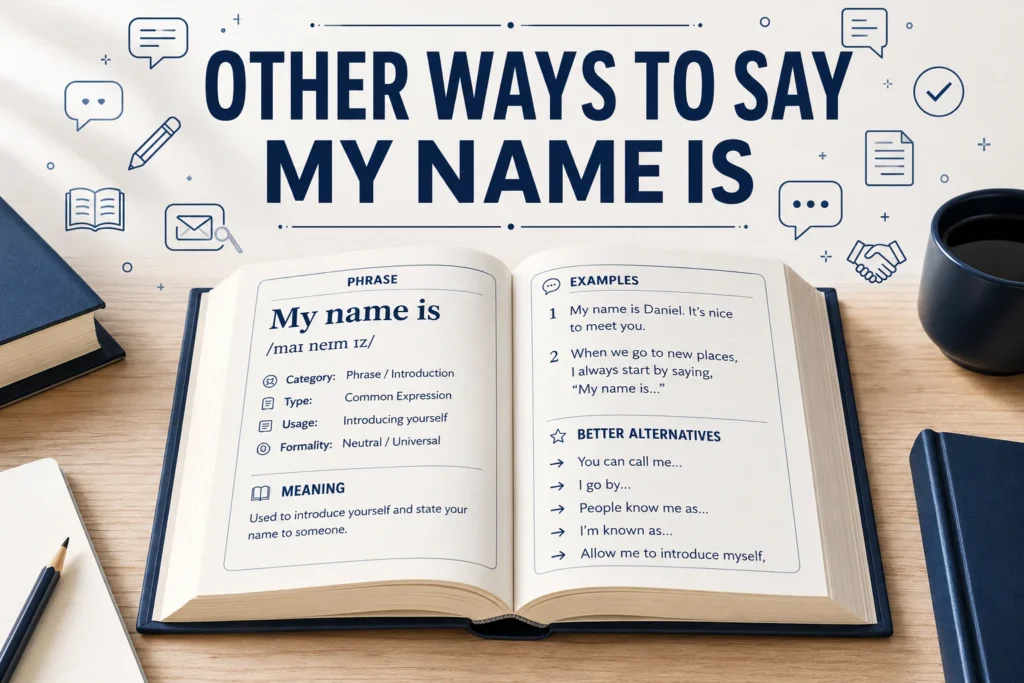
The phrase “my name is” is one of the most common ways to introduce yourself in English. While it is simple, clear, and universally understood, many professionals look for alternative ways to introduce themselves in emails, meetings, networking events, customer interactions, and workplace communication.
Using different expressions can help you sound more professional, confident, friendly, or formal depending on the situation. Whether you are writing a business email, introducing yourself to a client, joining a virtual meeting, or networking with industry professionals, knowing other ways to say “my name is” can improve your communication skills.
In this guide, you’ll discover more than 50 professional, formal, friendly, and email-ready alternatives, along with examples, usage tips, comparison tables, and practical business communication advice.
What Does “My Name Is” Mean?
Literal Meaning
“My name is” is an introductory phrase used to tell others what people call you.
Example:
My name is Sarah Johnson.
Tone
The phrase is:
- Neutral
- Polite
- Direct
- Universally accepted
Purpose
People use it to:
- Introduce themselves
- Start conversations
- Build relationships
- Establish professional communication
Emotional Context
Depending on delivery, it can sound:
- Friendly
- Professional
- Formal
- Confident
- Welcoming
Examples
Formal:
My name is Michael Carter, and I am the project manager.
Friendly:
Hi, my name is Jake.
Professional:
My name is Emma Wilson, and I will be assisting you today.
When Is “My Name Is” Appropriate?
Emails
Excellent for first-time introductions.
Example:
My name is Rebecca Taylor, and I recently joined the marketing team.
Workplace Communication
Useful when meeting coworkers or new employees.
Example:
My name is Daniel, and I look forward to working with everyone.
Client Communication
Professional and clear.
Example:
My name is Lisa Grant, and I will be your account manager.
Networking Events
Helps start conversations naturally.
Example:
Hello, my name is Robert.
Customer Service
Creates trust and professionalism.
Example:
My name is Jennifer, and I’ll be helping you today.
Professional Alternatives to “My Name Is”
1. I Am
Tone: Professional
Best Use: Meetings
Example:
I am Sarah Thompson from the finance department.
2. This Is
Tone: Professional
Best Use: Calls and emails
Example:
This is David Brown from ABC Company.
3. Allow Me to Introduce Myself
Tone: Professional
Best Use: Formal introductions
Example:
Allow me to introduce myself. I am Mark Evans.
4. I Go By
Tone: Professional but approachable
Example:
I go by Alex.
5. You Can Call Me
Tone: Friendly professional
Example:
You can call me Chris.
6. I’d Like to Introduce Myself
Example:
I’d like to introduce myself. I’m Emily Foster.
7. I Am Known As
Example:
I am known as Dr. Patel in professional settings.
8. My Colleagues Know Me As
Example:
My colleagues know me as Brian.
9. People Call Me
Example:
People call me Jen.
10. I Represent
Example:
I represent the customer success team.
11. Speaking Is
Example:
Speaking is Amanda Green.
12. This Is [Name] Speaking
Example:
This is John speaking.
13. I’m Reaching Out As
Example:
I’m reaching out as Karen Mitchell from the HR department.
14. I Serve As
Example:
I serve as Michael Lee, Director of Operations.
15. I’m Part Of
Example:
I’m part of the sales team at XYZ Corporation.
Formal Alternatives
16. Permit Me to Introduce Myself
Example:
Permit me to introduce myself. I am Richard Wilson.
17. I Wish to Introduce Myself
Example:
I wish to introduce myself as the new department manager.
18. May I Introduce Myself?
Example:
May I introduce myself? I am Catherine Hughes.
19. I Have the Pleasure of Introducing Myself
Example:
I have the pleasure of introducing myself as your new advisor.
20. My Full Name Is
Example:
My full name is Benjamin Carter.
21. I Am Pleased to Introduce Myself
Example:
I am pleased to introduce myself.
22. Kindly Allow Me to Introduce Myself
Example:
Kindly allow me to introduce myself.
23. I Would Like to Present Myself
Example:
I would like to present myself as your point of contact.
24. I Am Writing to Introduce Myself
Example:
I am writing to introduce myself as the new project coordinator.
25. Let Me Introduce Myself
Example:
Let me introduce myself.
Friendly Alternatives
26. Hi, I’m
Example:
Hi, I’m Jessica.
27. Hello, I’m
Example:
Hello, I’m Kevin.
28. Hey, I’m
Example:
Hey, I’m Noah.
29. Nice to Meet You, I’m
Example:
Nice to meet you, I’m Olivia.
30. The Name’s
Example:
The name’s Ryan.
31. Everyone Calls Me
Example:
Everyone calls me Sam.
32. You May Know Me As
Example:
You may know me as Tony.
33. Most People Call Me
Example:
Most people call me Katie.
34. I’m Known As
Example:
I’m known as Rob.
35. Call Me
Example:
Call me Ben.
Email Alternatives
36. I Am Writing to Introduce Myself
Example:
I am writing to introduce myself as the newest member of the team.
37. Please Allow Me to Introduce Myself
Example:
Please allow me to introduce myself.
38. My Name Is [Name], and I…
Example:
My name is Lisa, and I will be managing your account.
39. I Recently Joined
Example:
I recently joined the company as a business analyst.
40. I Will Be Your Point of Contact
Example:
I will be your point of contact moving forward.
41. I Wanted to Briefly Introduce Myself
Example:
I wanted to briefly introduce myself and explain my role.
42. I’m Reaching Out to Introduce Myself
Example:
I’m reaching out to introduce myself.
43. I Am Contacting You As
Example:
I am contacting you as your new account representative.
44. I Work As
Example:
I work as a software engineer at ABC Company.
45. I Have Recently Taken Over
Example:
I have recently taken over this account.
Workplace Alternatives
46. I’m the New
Example:
I’m the new project manager.
47. I Recently Joined the Team
Example:
I recently joined the team as a designer.
48. I’ll Be Working With You
Example:
I’ll be working with you on this project.
49. I Lead the
Example:
I lead the customer support department.
50. I’m Responsible For
Example:
I’m responsible for vendor management.
51. I Oversee
Example:
I oversee company operations.
52. I Manage
Example:
I manage the marketing team.
53. I’m Part of the
Example:
I’m part of the development team.
54. I’ll Be Assisting You
Example:
I’ll be assisting you with onboarding.
55. I Handle
Example:
I handle customer success initiatives.
Quick Comparison Table
| Alternative | Tone | Best Use |
| I am | Professional | Meetings |
| This is | Professional | Calls |
| Allow me to introduce myself | Formal | Business introductions |
| Hi, I’m | Friendly | Casual conversations |
| I am writing to introduce myself | Professional | Emails |
| You can call me | Friendly | Networking |
| Let me introduce myself | Formal | Presentations |
| I recently joined | Workplace | Team introductions |
| I will be your point of contact | Professional | Client communication |
| Nice to meet you, I’m | Friendly | Networking |
Email Examples
Client Email
Hello,
I am writing to introduce myself as your new account manager.
Manager Email
My name is Sarah Thompson, and I recently joined the operations team.
Colleague Email
Hi everyone,
I’m James, and I’ll be working with you on upcoming projects.
Customer Email
My name is Emma, and I’ll be assisting you today.
Networking Email
I’d like to introduce myself. I’m Daniel Roberts from XYZ Consulting.
Meeting Follow-Up Email
It was great meeting you earlier. I’m Olivia Smith, and I look forward to staying in touch.
Common Mistakes
1. Overusing “My Name Is”
Repeating the phrase in every introduction sounds repetitive.
2. Using Casual Language in Formal Emails
Avoid:
Hey, I’m Mike.
Use:
I am writing to introduce myself as Michael Davis.
3. Being Too Formal
Avoid sounding overly stiff in casual workplace settings.
4. Ignoring Email Etiquette
Always include:
- Role
- Company
- Purpose
5. Providing Too Much Information
Keep introductions concise.
Related Phrases
| Phrase | Meaning | Example |
| I am | Direct introduction | I am Sarah. |
| This is | Phone introduction | This is Tom speaking. |
| I go by | Preferred name | I go by Jake. |
| You can call me | Nickname | You can call me Jen. |
| I’m from | Organization introduction | I’m from ABC Corp. |
| I work for | Employer introduction | I work for XYZ Ltd. |
| I represent | Business representation | I represent the sales team. |
| I’m reaching out | Email opener | I’m reaching out regarding your inquiry. |
| I serve as | Professional role | I serve as Director. |
| I manage | Leadership role | I manage operations. |
| I lead | Team leadership | I lead the project team. |
| I’m part of | Team membership | I’m part of HR. |
| I’ll be assisting | Support role | I’ll be assisting you. |
| I oversee | Supervisory role | I oversee logistics. |
| I handle | Responsibility introduction | I handle client relations. |
Phrase Comparison
| Phrase | Formality | Best Use |
| My name is | Neutral | General introductions |
| I am | Professional | Workplace |
| Hi, I’m | Casual | Friendly conversations |
| Allow me to introduce myself | Formal | Business events |
| I am writing to introduce myself | Formal | Email communication |
| You can call me | Friendly | Networking |
| I go by | Informal-professional | Modern workplaces |
| This is | Professional | Phone calls |
| I recently joined | Workplace | Internal communication |
| I will be your point of contact | Professional | Client communication |
Cultural Usage
US English
Americans commonly use:
Hi, I’m Sarah.
It sounds approachable and professional.
UK English
British professionals often prefer:
Hello, I’m Sarah Jones.
This sounds polite and slightly more formal.
Corporate Communication
Often uses role-based introductions.
Example:
I am the new project manager for the account.
Customer Service
Typically combines name and role.
Example:
My name is Rebecca, and I’ll be helping you today.
Networking
Usually favors friendly introductions.
Example:
Nice to meet you. I’m Daniel.
Frequently Asked Questions (FAQs)
1. What is a professional way to say “my name is”?
“I am,” “I’d like to introduce myself,” and “I am writing to introduce myself.”
2. What is a formal alternative to “my name is”?
“Permit me to introduce myself.”
3. What can I say instead of “my name is” in an email?
“I am writing to introduce myself.”
4. Is “my name is” professional?
Yes, it is professional and widely accepted.
5. How do I introduce myself to a client?
Mention your name, role, and purpose.
6. What is the best networking introduction?
“Hi, I’m [Name].”
7. What should I use in customer service?
“My name is [Name], and I’ll be assisting you today.”
8. Is “I go by” professional?
Yes, in modern workplaces.
9. Is “you can call me” appropriate?
Yes, for friendly business communication.
10. What is best for formal meetings?
“Allow me to introduce myself.”
11. What phrase works best on phone calls?
“This is [Name] speaking.”
12. What is best for LinkedIn networking?
“Hi, I’m [Name], and I work in…”
13. Should I include my role when introducing myself?
Yes, especially in professional settings.
14. How long should an introduction be?
Usually one to three sentences.
15. What is the most versatile alternative?
“I am [Name].”
Conclusion
Choosing alternatives to “my name is” helps improve professional communication, workplace interactions, networking conversations, and business email etiquette. While “my name is” remains a clear and effective introduction, alternatives such as “I am,” “I’d like to introduce myself,” “I am writing to introduce myself,” “I recently joined the team,” and “I will be your point of contact” can make introductions sound more polished and context-appropriate. For formal situations, phrases like “Permit me to introduce myself” work best. For casual networking, “Hi, I’m” and “Nice to meet you, I’m” feel natural and approachable. Selecting the right introduction helps build credibility, establish rapport, and create a positive first impression in every professional interaction.