
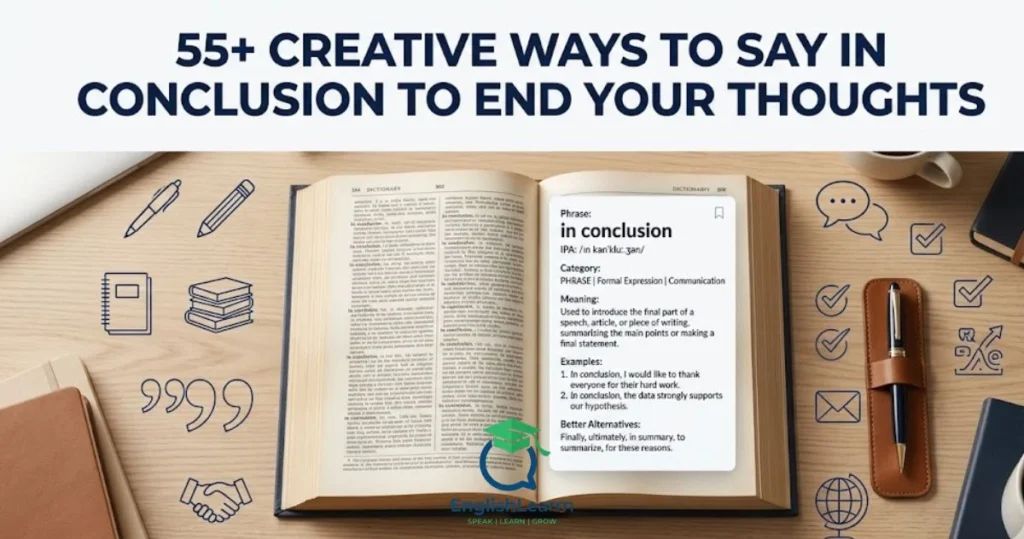
Finding creative ways to say “in conclusion” to end your thoughts can make your communication sound more natural, professional, and engaging. While the phrase “in conclusion” is widely understood, using it repeatedly in emails, presentations, reports, and workplace conversations can sound repetitive.
Many professionals search for alternatives because they want their writing to feel polished and modern. Whether you are writing a business email, summarizing a meeting, preparing a presentation, or communicating with clients, choosing the right closing phrase improves clarity and professionalism.
This guide covers the best professional, formal, friendly, and email-ready alternatives to “in conclusion,” complete with meanings, tones, use cases, and examples.
What Does “In Conclusion” Mean?
Literal Meaning
“In conclusion” signals that you are about to summarize or finalize your thoughts.
Tone
The phrase is generally:
- Formal
- Clear
- Direct
- Structured
Purpose
It helps readers or listeners understand that the discussion is ending and that key points are being summarized.
Emotional Context
Depending on usage, it can sound:
- Professional
- Academic
- Authoritative
- Sometimes overly formal in casual communication
Examples
Formal Report
In conclusion, the project achieved all its primary objectives.
Business Email
In conclusion, we recommend proceeding with the proposed strategy.
Presentation
In conclusion, customer satisfaction increased significantly during the quarter.
When Is It Appropriate to Use “In Conclusion”?
Emails
Useful when summarizing recommendations or decisions.
Example:
In conclusion, the revised timeline remains the best option for project completion.
Workplace Communication
Helpful for reports, updates, and proposals.
Example:
In conclusion, the team exceeded expectations this quarter.
Client Communication
Useful when presenting findings.
Example:
In conclusion, our analysis supports expanding into the new market.
Networking
Less common but acceptable in professional summaries.
Example:
In conclusion, I look forward to future collaboration opportunities.
Customer Service
Can help reinforce solutions.
Example:
In conclusion, your issue has been resolved and the replacement is on the way.
50 Creative Ways to Say “In Conclusion” to End Your Thoughts
Professional Alternatives
1. To summarize
Meaning: Briefly review key points.
Tone: Professional
Best Use: Reports
Example:
To summarize, the campaign delivered strong results.
2. In summary
Meaning: Present a concise overview.
Tone: Professional
Best Use: Business writing
Example:
In summary, the proposal offers long-term value.
3. To conclude
Meaning: End a discussion formally.
Tone: Professional
Best Use: Presentations
Example:
To conclude, the data supports our recommendation.
4. Overall
Meaning: Looking at everything collectively.
Tone: Neutral
Best Use: Emails
Example:
Overall, the project was successful.
5. Ultimately
Meaning: Final result or judgment.
Tone: Professional
Best Use: Strategic discussions
Example:
Ultimately, customer needs should guide the decision.
6. All things considered
Meaning: After evaluating everything.
Tone: Professional
Example:
All things considered, this option offers the best value.
7. Taking everything into account
Meaning: Considering all factors.
Tone: Professional
Example:
Taking everything into account, we recommend moving forward.
8. In the final analysis
Meaning: After detailed evaluation.
Tone: Executive-level
Example:
In the final analysis, the investment remains worthwhile.
9. Looking at the bigger picture
Meaning: Considering the broader perspective.
Tone: Professional
Example:
Looking at the bigger picture, the partnership makes sense.
10. The bottom line is
Meaning: Most important conclusion.
Tone: Business-focused
Example:
The bottom line is that productivity increased by 20%.
11. In short
Example:
In short, the strategy is working.
12. In brief
Example:
In brief, the proposal meets our objectives.
13. As a final point
Example:
As a final point, customer feedback remains positive.
14. In closing
Example:
In closing, thank you for your continued support.
15. To wrap up
Example:
To wrap up, we achieved all project milestones.
Formal Alternatives
16. Therefore
Example:
Therefore, implementation should begin immediately.
17. Hence
Example:
Hence, additional investment is justified.
18. Accordingly
Example:
Accordingly, we approve the proposal.
19. Thus
Example:
Thus, the evidence supports our findings.
20. Consequently
Example:
Consequently, operational costs decreased.
21. On balance
Example:
On balance, the benefits outweigh the risks.
22. Given these considerations
Example:
Given these considerations, expansion is recommended.
23. For these reasons
Example:
For these reasons, the proposal should proceed.
24. As a result
Example:
As a result, revenue increased significantly.
25. In light of the above
Example:
In light of the above, approval is requested.
Friendly Alternatives
26. So
Example:
So, that’s where things currently stand.
27. At the end of the day
Example:
At the end of the day, customer satisfaction matters most.
28. When all is said and done
Example:
When all is said and done, teamwork made the difference.
29. In the end
Example:
In the end, the effort paid off.
30. That’s the takeaway
Example:
That’s the takeaway from this discussion.
31. To put it simply
Example:
To put it simply, the process works.
32. Long story short
Example:
Long story short, we met the deadline.
33. The key point is
Example:
The key point is that demand is increasing.
34. The main thing is
Example:
The main thing is that everyone understands the plan.
35. What it comes down to
Example:
What it comes down to is trust.
Email Alternatives
36. Thank you for your time
Example:
Thank you for your time and consideration.
37. I appreciate your attention
Example:
I appreciate your attention to this matter.
38. Moving forward
Example:
Moving forward, we will implement the recommendations.
39. Going forward
Example:
Going forward, we will monitor performance closely.
40. With that said
Example:
With that said, I welcome your feedback.
41. To reiterate
Example:
To reiterate, the deadline remains Friday.
42. As discussed
Example:
As discussed, the next phase begins next week.
43. In closing
Example:
In closing, thank you for your partnership.
44. Before we finish
Example:
Before we finish, I want to highlight one final point.
45. As a final reminder
Example:
As a final reminder, please submit your reports by Monday.
Workplace Alternatives
46. Based on our findings
Example:
Based on our findings, expansion is recommended.
47. From our analysis
Example:
From our analysis, customer retention improved.
48. Looking ahead
Example:
Looking ahead, we anticipate growth.
49. The conclusion is clear
Example:
The conclusion is clear: automation improves efficiency.
50. The evidence suggests
Example:
The evidence suggests that the strategy is effective.
Quick Comparison Table
| Alternative | Tone | Best Use |
|---|---|---|
| To summarize | Professional | Reports |
| In summary | Professional | Business writing |
| To conclude | Formal | Presentations |
| Overall | Neutral | Emails |
| Ultimately | Professional | Decision-making |
| In closing | Professional | Emails |
| The bottom line is | Business | Executive communication |
| Looking ahead | Workplace | Planning |
| Thank you for your time | Polite | Client emails |
| At the end of the day | Friendly | Conversations |
Email Examples
Client
In summary, our recommended solution offers the strongest return on investment.
Manager
To conclude, all deliverables have been completed on schedule.
Colleague
To wrap up, let’s finalize the presentation tomorrow.
Customer
In closing, thank you for choosing our services.
Networking
Looking ahead, I hope we can stay connected.
Meeting Follow-Up
As discussed, the next steps are outlined below.
Common Mistakes
1. Overusing the Same Phrase
Repeating “in conclusion” throughout multiple emails can feel robotic.
Better
Alternate with:
- In summary
- To wrap up
- Overall
2. Using an Overly Formal Tone
Some alternatives may sound too academic.
Less Effective
Hence, the matter is resolved.
Better
Overall, the issue has been resolved.
3. Mismatching Formality
Use audience-appropriate language.
Client email:
In closing
Friendly coworker chat:
To wrap up
4. Forgetting Email Etiquette
Always maintain professionalism.
Avoid:
Anyway, that’s it.
Use:
Thank you for your time and consideration.
Related Phrases
| Phrase | Meaning | Example |
|---|---|---|
| To summarize | Review points | To summarize, sales increased. |
| In short | Brief conclusion | In short, the launch succeeded. |
| In brief | Concise summary | In brief, costs declined. |
| Overall | General assessment | Overall, performance improved. |
| Ultimately | Final judgment | Ultimately, customers benefited. |
| Therefore | Logical conclusion | Therefore, action is required. |
| Thus | Result statement | Thus, goals were met. |
| Consequently | Outcome | Consequently, profits rose. |
| In closing | End remarks | In closing, thank you. |
| To wrap up | Finish discussion | To wrap up, here are next steps. |
| Looking ahead | Future focus | Looking ahead, growth is expected. |
| The bottom line is | Main point | The bottom line is efficiency improved. |
| In the end | Final outcome | In the end, quality prevailed. |
| As a result | Outcome | As a result, sales increased. |
| On balance | Overall judgment | On balance, benefits outweigh risks. |
Phrase Comparison
| Phrase | Formality | Tone | Best Use |
|---|---|---|---|
| In Conclusion | High | Formal | Reports |
| To Summarize | Medium | Professional | Emails |
| In Summary | Medium | Professional | Business writing |
| To Wrap Up | Low | Friendly | Meetings |
| In Closing | High | Polite | Client communication |
| Ultimately | Medium | Strategic | Decision-making |
| Overall | Medium | Neutral | General communication |
| The Bottom Line Is | Medium | Direct | Executive summaries |
Cultural Usage
US English
Professionals often prefer:
- In summary
- Overall
- The bottom line is
UK English
Common alternatives include:
- In closing
- On balance
- Taking everything into account
Corporate Communication
Preferred options:
- To summarize
- Ultimately
- Based on our findings
Customer Service
Preferred options:
- In closing
- Thank you for your time
- Moving forward
Networking
Preferred options:
- Looking ahead
- With that said
- I appreciate your time
Frequently Asked Questions
1. What is a professional way to say “in conclusion”?
To summarize, in summary, or ultimately.
2. What is the best formal alternative to “in conclusion”?
“In closing” is among the most formal options.
3. What can I say instead of “in conclusion” in an email?
Try “in summary” or “thank you for your time.”
4. Is “to wrap up” professional?
Yes, in workplace settings.
5. Is “overall” a good replacement?
Yes, especially in reports and emails.
6. What phrase sounds most executive-level?
“The bottom line is.”
7. Is “ultimately” formal?
It is professional and moderately formal.
8. Can I use “in closing” in business emails?
Yes, it is widely accepted.
9. What is a friendly alternative?
“At the end of the day.”
10. What is a concise synonym?
“In short.”
11. Which alternative works best for presentations?
“To conclude.”
12. Which phrase is best for reports?
“In summary.”
13. Which phrase sounds least formal?
“So.”
14. Which phrase works best with clients?
“In closing.”
15. Should I always use a conclusion phrase?
No. Sometimes a direct final statement is more effective.
Conclusion
Choosing creative ways to say “in conclusion” to end your thoughts can instantly improve your professional communication. While “in conclusion” remains correct, modern workplace communication often benefits from alternatives that sound more natural and audience-focused. For professional settings, phrases such as “to summarize,” “in summary,” and “ultimately” work exceptionally well. For formal situations, “in closing,” “therefore,” and “in light of the above” provide a polished tone. For casual workplace conversations, “to wrap up,” “overall,” and “at the end of the day” feel approachable and engaging. Selecting the right phrase helps strengthen email etiquette, workplace communication, and overall professional communication effectiveness.