
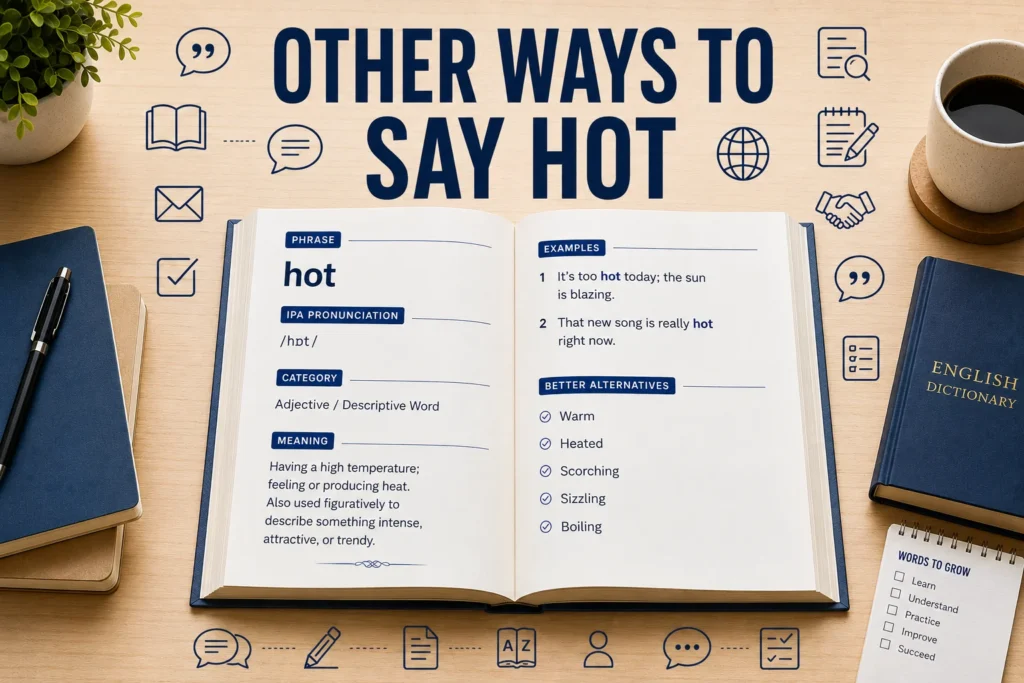
Searching for other ways to say “hot” can be surprisingly challenging because the word has multiple meanings. It can describe temperature, popularity, trends, urgency, demand, performance, appearance, or even emotions. In professional communication, business emails, workplace discussions, and client conversations, using a more precise alternative often improves clarity and professionalism.
For example, instead of saying a market is “hot,” you might say it’s high-demand or rapidly growing. Instead of saying coffee is “hot,” you could say it’s warm, heated, or steaming. Choosing the right synonym helps your message sound polished and appropriate for the situation.
This guide provides 55 professional, formal, friendly, email-ready, and workplace alternatives to “hot,” along with meanings, examples, and best-use scenarios.
What Does “Hot” Mean?
Literal Meaning
Most commonly, hot refers to something having a high temperature.
Examples
- The coffee is hot.
- The weather is hot today.
Figurative Meaning
The word can also mean:
- Popular
- Trending
- In demand
- Successful
- Intense
- Attractive
- Urgent
Examples
- That’s a hot topic in the industry.
- The company operates in a hot market.
- The product is hot right now.
Tone
Depending on context, “hot” can sound:
- Casual
- Conversational
- Professional
- Informal
- Descriptive
Purpose
People use “hot” to describe:
- Temperature
- Market demand
- Industry trends
- Popular products
- Urgent issues
- Strong performance
Professional Usage
In Emails
Replace vague uses of “hot” with precise wording.
Example
Instead of:
This is a hot opportunity.
Use:
This is a high-potential opportunity.
In the Workplace
Useful when discussing trends and priorities.
Example
Artificial intelligence remains a rapidly growing sector.
With Clients
Professional alternatives build credibility.
Example
The product is currently in high demand.
Networking
Use precise terms to sound knowledgeable.
Example
Cybersecurity is a rapidly expanding industry.
Customer Service
Use clear temperature descriptions.
Example
The meal is served warm and fresh.
55 Alternatives to “Hot”
Professional Alternatives
1. High-Demand
Meaning: Wanted by many people.
Tone: Professional
Example: This product remains in high demand.
2. Popular
Meaning: Widely liked.
Tone: Professional
Example: It’s one of our most popular services.
3. Trending
Meaning: Growing in popularity.
Tone: Professional
Example: AI tools are currently trending.
4. Rapidly Growing
Meaning: Expanding quickly.
Tone: Professional
Example: We operate in a rapidly growing market
5. In Demand
Meaning: Frequently requested.
Tone: Professional
Example: These skills are in demand.
6. Prominent
Example: The issue has become prominent.
7. Relevant
Example: This remains a highly relevant topic.
8. Significant
Example: The company plays a significant role in the industry.
9. Competitive
Example: We operate in a highly competitive market.
10. Active
Example: The market remains active.
11. Dynamic
Example: Technology is a dynamic sector.
12. Emerging
Example: This is an emerging trend.
13. Sought-After
Example: These certifications are sought-after.
14. Fast-Moving
Example: We work in a fast-moving industry.
15. High-Potential
Example: This represents a high-potential investment.
Formal Alternatives
16. Elevated
Example: Temperatures remain elevated.
17. Heated
Example: The discussion became heated.
18. Intensified
Example: Competition has intensified.
19. Pressing
Example: This is a pressing concern.
20. Critical
Example: The matter is critical.
21. Urgent
Example: The request is urgent.
22. Exceptional
Example: Demand has reached exceptional levels.
23. Noteworthy
Example: The trend is noteworthy.
24. Influential
Example: The topic remains influential.
25. Highly Visible
Example: The issue is highly visible across the industry.
Friendly Alternatives
26. Warm
Example: The soup is warm
27. Steaming
Example: The coffee arrived steaming.
28. Toasty
Example: The room feels toasty.
29. Buzzing
Example: The event was buzzing with energy.
30. Exciting
Example: This is an exciting opportunity.
31. Popular Right Now
Example: This product is popular right now.
32. On Fire
Example: The sales team is on fire this quarter.
33. Thriving
Example: The business is thriving
34. Booming
Example: The housing market is booming.
35. Packed With Interest
Example: The webinar was packed with interest.
Email Alternatives
36. High Priority
Example: This remains a high-priority issue.
37. Time-Sensitive
Example: This request is time-sensitive.
38. Urgent Matter
Example: We need to address this urgent matter.
39. Immediate Concern
Example: This is an immediate concern.
40. Current Focus
Example: This remains our current focus.
41. Key Topic
Example: This is a key topic for discussi
42. Important Issue
Example: This is an important issue.
43. Strong Opportunity
Example: This presents a strong opportunity.
44. Valuable Prospect
Example: The lead appears to be a valuable prospect.
45. High-Interest Area
Example: Sustainability is a high-interest area.
Workplace Alternatives
46. Top Priority
47. Strategic Focus
48. Major Concern
49. Active Project
50. Growing Trend
51. Business-Critical
52. High-Impact
53. Fast-Growing
54. Important Initiative
55. Core Objective
Example: Customer retention remains a core objective.
Quick Comparison Table
| Alternative | Tone | Best Use |
| High-Demand | Professional | Sales |
| Trending | Professional | Marketing |
| In Demand | Professional | Recruitment |
| Rapidly Growing | Professional | Business reports |
| Urgent | Formal | Emails |
| Pressing | Formal | Management |
| Warm | Friendly | Temperature |
| Booming | Friendly | Market discussions |
| High Priority | Business communication | |
| Strategic Focus | Workplace | Leadership discussions |
Email Examples
Client Email
Demand for this service remains exceptionally strong, making this an excellent time to move forward.
Manager Email
This issue remains a high-priority matter for the department.
Colleague Email
AI continues to be a rapidly growing area of focus.
Customer Email
Your meal will be served warm and fresh.
Networking Email
Renewable energy remains one of the fastest-growing sectors.
Meeting Follow-Up
Customer retention remains a strategic focus for the next quarter.
Common Mistakes
1. Using “Hot” Too Broadly
Weak
That’s a hot market.
Better
That’s a rapidly growing market.
2. Using Slang in Professional Settings
Informal
Sales are on fire.
Professional
Sales have grown significantly.
3. Confusing Temperature With Popularity
Always choose an alternative that matches the intended meaning.
4. Using Overly Casual Language in Emails
Casual
This topic is super hot right now.
Better
This topic is attracting significant attention.
Related Phrases
| Phrase | Meaning | Example |
| In Demand | Popular | The service is in demand. |
| Trending | Growing popularity | The topic is trending. |
| Fast-Growing | Expanding rapidly | The industry is fast-growing. |
| Booming | Thriving | The market is booming. |
| Warm | Moderately hot | The meal is warm. |
| Heated | Intense | The debate became heated. |
| Urgent | Needs attention | The issue is urgent. |
| Pressing | Important | The concern is pressing. |
| Dynamic | Active | The sector is dynamic. |
| Competitive | Strong rivalry | The market is competitive. |
| High-Priority | Important | The task is high-priority. |
| Significant | Important | The trend is significant. |
| Emerging | Developing | It’s an emerging field. |
| Active | Ongoing | The market is active. |
| High-Potential | Promising | It’s a high-potential opportunity. |
Phrase Comparison
| Phrase | Formality | Tone | Best Use |
| Hot | Neutral | Casual | General use |
| Warm | Casual | Friendly | Temperature |
| High-Demand | Professional | Business | Products |
| Trending | Professional | Modern | Marketing |
| Urgent | Formal | Serious | Emails |
| Pressing | Formal | Important | Leadership |
| Booming | Casual | Positive | Markets |
| Fast-Growing | Professional | Positive | Industry reports |
| Strategic Focus | Workplace | Formal | Business planning |
| High-Priority | Professional | Direct | Workplace communication |
Cultural Usage
US English
Common alternatives include:
- Trending
- Booming
- High-demand
- Fast-growing
UK English
Frequently used alternatives include:
- Pressing
- Significant
- Competitive
- Influential
Corporate Communication
Preferred terms:
- Strategic focus
- High-priority
- Business-critical
- Emerging trend
Customer Service
Common choices:
- Warm
- Freshly prepared
- Ready to serve
Networking
Popular alternatives:
- Fast-growing industry
- Emerging market
- High-interest topic
Frequently Asked Questions (FAQs)
What is a professional way to say hot?
High-demand, trending, or rapidly growing.
What is a formal alternative to hot?
Elevated, pressing, or urgent.
What is a synonym for hot in business?
High-demand or fast-growing.
What is another word for hot weather?
Warm, scorching, sweltering, or sunny.
What is another word for a hot topic?
Trending topic, key issue, or major discussion point.
What is another word for a hot market?
Booming market or rapidly growing market.
What is a professional replacement for hot lead?
High-potential prospect.
Is trending professional?
Yes, especially in marketing and business contexts.
What is a workplace synonym for hot issue?
High-priority issue.
What is another word for hot coffee?
Warm, steaming, or freshly brewed.
What is another word for hot industry?
Fast-growing industry.
What is another word for hot debate?
Heated debate.
What is another word for hot opportunity?
Strong opportunity.
What is another word for hot demand?
Exceptional demand.
Why should I avoid repeating hot?
Using precise alternatives improves clarity and professional communication.
Final Summary
The best alternative to “hot” depends entirely on context. For professional communication, use high-demand, in demand, trending, fast-growing, or high-potential. For formal situations, choose urgent, pressing, critical, or elevated. When describing temperature, warm, steaming, and heated work well. In workplace communication, phrases like high-priority, strategic focus, business-critical, and important initiative sound more polished and precise. Selecting the right synonym helps improve clarity, strengthens professional communication, and ensures your message matches the audience and situation.