
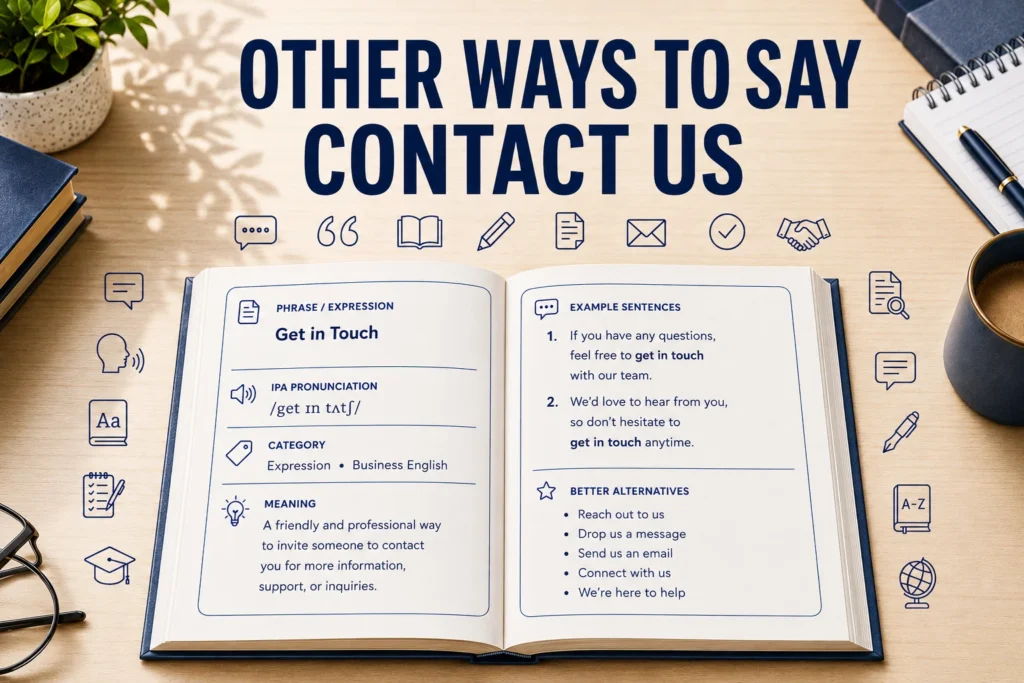
The phrase “contact us” is one of the most common calls to action in business communication. You’ll find it on websites, emails, customer service pages, marketing materials, and professional correspondence. While it’s clear and effective, repeating the same phrase can make communication feel generic or impersonal.
That’s why many professionals search for other ways to say contact us. They want alternatives that sound more professional, friendly, formal, customer-focused, or engaging depending on the situation.
Whether you’re writing a business email, creating a website contact page, communicating with clients, or managing customer service interactions, choosing the right wording can improve response rates and strengthen professional relationships.
This guide provides more than 55 alternatives, practical examples, email templates, workplace applications, and expert communication tips.
What Does “Contact Us” Mean?
Literal Meaning
“Contact us” means:
Reach out to our organization, team, company, or representative for assistance, information, support, or discussion.
Tone
The phrase is generally:
- Professional
- Direct
- Neutral
- Helpful
Purpose
People use it to encourage communication.
Common goals include:
- Answering questions
- Providing support
- Generating leads
- Building relationships
- Resolving problems
- Offering assistance
Emotional Context
The phrase often conveys:
- Availability
- Accessibility
- Openness
- Willingness to help
Examples
- Contact us for additional information.
- Contact us if you have any questions.
- Contact us to request a consultation.
- Contact us for customer support.
When Is “Contact Us” Appropriate?
Emails
Perfect for inviting replies.
Example:
Please contact us if you require further clarification.
Workplace Communication
Useful when encouraging collaboration.
Example:
Contact us if your department requires assistance.
Client Communication
Creates an open channel of communication.
Example:
Contact us anytime regarding project updates.
Networking
Encourages relationship-building.
Example:
Feel free to contact us to discuss partnership opportunities.
Customer Service
One of the most common support phrases.
Example:
Contact us if you’re experiencing technical issues.
Professional Alternatives to “Contact Us”
1. Reach Out to Us
Meaning: Initiate communication
Tone: Professional and approachable
Best Use: Business websites
Example:
Reach out to us for more information.
2. Get in Touch
Meaning: Make contact
Tone: Professional
Best Use: Customer service
Example:
Get in touch if you need assistance.
3. Connect With Us
Meaning: Establish communication
Tone: Modern and professional
Best Use: Networking
Example:
Connect with us to learn more.
4. Speak With Our Team
Meaning: Communicate directly
Tone: Professional
Example:
Speak with our team about your requirements.
5. Contact Our Team
Meaning: Reach staff members
Tone: Business-focused
Example:
Contact our team for support.
6. Request Assistance
Example:
Request assistance whenever needed.
7. Reach Our Support Team
Example:
Reach our support team for technical help.
8. Communicate With Us
Example:
Communicate with us regarding your inquiry.
9. Discuss Your Needs With Us
Example:
Discuss your needs with us today.
10. Start a Conversation
Example:
Start a conversation with our specialists.
11. Request Information
Example:
Request information about our services.
12. Consult With Us
Example:
Consult with us before making a decision.
13. Submit an Inquiry
Example:
Submit an inquiry through our online form.
14. Schedule a Consultation
Example:
Schedule a consultation with our advisors.
15. Talk to Our Experts
Example:
Talk to our experts for personalized guidance.
Formal Alternatives
16. Kindly Contact Us
Tone: Formal and polite
Example:
Kindly contact us for additional details.
17. Please Reach Out
Example:
Please reach out at your earliest convenience.
18. We Invite You to Contact Us
Example:
We invite you to contact us regarding your inquiry.
19. Please Communicate With Us
Example:
Please communicate with us concerning this matter.
20. Direct Your Inquiries To Us
Example:
Direct your inquiries to us for assistance.
21. Please Consult Our Team
Example:
Please consult our team for guidance.
22. Feel Free to Correspond With Us
Example:
Feel free to correspond with us regarding your concerns.
23. Please Request Further Information
Example:
Please request further information if needed.
24. Contact Our Representatives
Example:
Contact our representatives for support.
25. Please Submit Your Questions
Example:
Please submit your questions through the form below.
Friendly Alternatives
26. We’d Love to Hear From You
Example:
We’d love to hear from you.
27. Let’s Talk
Example:
Let’s talk about your goals.
28. Say Hello
Example:
Say hello and introduce yourself.
29. Drop Us a Message
Example:
Drop us a message anytime.
30. Send Us a Note
Example:
Send us a note if you have questions.
31. Chat With Us
Example:
Chat with us online.
32. Reach Out Anytime
Example:
Reach out anytime for support.
33. We’d Be Happy to Help
Example:
We’d be happy to help with your request.
34. Let Us Know
Example:
Let us know if you need assistance.
35. Start a Chat
Example:
Start a chat with our team.
Email-Friendly Alternatives
36. Please Feel Free to Reach Out
Example:
Please feel free to reach out if you have questions.
37. Let Me Know
Example:
Let me know if you need anything further.
38. Reply to This Email
Example:
Reply to this email with any questions.
39. Email Us
Example:
Email us for more information.
40. Get Back to Us
Example:
Get back to us at your convenience.
41. Follow Up With Us
Example:
Follow up with us regarding your application.
42. Send Us Your Questions
Example:
Send us your questions anytime.
43. Write to Us
Example:
Write to us for additional assistance.
44. Reach Out Directly
Example:
Reach out directly if you need support.
45. Respond at Your Convenience
Example:
Respond at your convenience.
Workplace Alternatives
46. Coordinate With Our Team
Example:
Coordinate with our team regarding implementation.
47. Connect With the Department
Example:
Connect with the department for approval.
48. Consult the Team
Example:
Consult the team before proceeding.
49. Engage With Us
Example:
Engage with us to discuss solutions.
50. Contact the Appropriate Representative
Example:
Contact the appropriate representative for guidance.
51. Raise Your Inquiry
Example:
Raise your inquiry with our team.
52. Request Support
Example:
Request support through the help desk.
53. Collaborate With Us
Example:
Collaborate with us on future projects.
54. Speak to a Specialist
Example:
Speak to a specialist about your requirements.
55. Reach the Relevant Team
Example:
Reach the relevant team for assistance.
Quick Comparison Table
| Alternative | Tone | Best Use |
| Reach Out to Us | Professional | Business websites |
| Get in Touch | Friendly Professional | General communication |
| Connect With Us | Modern | Networking |
| Kindly Contact Us | Formal | Corporate communication |
| We’d Love to Hear From You | Friendly | Marketing |
| Let Me Know | Casual Professional | Emails |
| Reply to This Email | Direct | Email communication |
| Talk to Our Experts | Professional | Sales |
| Schedule a Consultation | Professional | Service businesses |
| Chat With Us | Friendly | Customer support |
Email Examples
Client Email
Please feel free to reach out if you require additional information regarding the proposal.
Manager Email
Let me know if any revisions are needed.
Colleague Email
Reach out directly if you need assistance with the project.
Customer Email
Get in touch with our support team if you experience any issues.
Networking Email
I’d be delighted to connect with you to discuss potential opportunities.
Meeting Follow-Up
Please reach out if any questions arise following today’s discussion.
Common Mistakes
1. Overusing “Contact Us”
Repeating the phrase throughout a website can sound robotic.
Instead, vary your language.
2. Using Overly Formal Alternatives
Avoid phrases like:
Kindly correspond with us immediately.
unless the audience expects formal communication.
3. Being Too Casual
Avoid:
Hit us up.
in professional settings.
4. Unclear Instructions
Bad:
Contact us.
Better:
Contact our support team for billing questions.
5. Ignoring Email Etiquette
Always tell readers:
- Who to contact
- Why to contact
- How to contact
| Phrase | Meaning | Example |
| Reach Out | Initiate communication | Reach out today |
| Get in Touch | Make contact | Get in touch anytime |
| Connect With Us | Build communication | Connect with us online |
| Email Us | Send an email | Email us for details |
| Call Us | Telephone communication | Call us today |
| Chat With Us | Live chat support | Chat with us now |
| Schedule a Call | Arrange discussion | Schedule a call |
| Request Information | Ask for details | Request information |
| Submit an Inquiry | Send questions | Submit an inquiry |
| Speak With Us | Verbal communication | Speak with us today |
| Consult Our Team | Seek guidance | Consult our team |
| Ask Us | Request answers | Ask us anything |
| Reach Our Team | Contact staff | Reach our team |
| Follow Up | Continue discussion | Follow up later |
| Start a Conversation | Begin communication | Start a conversation |
Related Phrases and Expressions
Phrase Comparison
| Phrase | Formality | Best Use |
| Contact Us | Neutral | General use |
| Reach Out to Us | Professional | Business |
| Get in Touch | Friendly Professional | Websites |
| Kindly Contact Us | Formal | Corporate |
| Let’s Talk | Casual Professional | Marketing |
| Connect With Us | Networking | Social media |
| Email Us | Direct | Support |
| Schedule a Consultation | Professional | Services |
| Talk to Our Experts | Sales | Consulting |
| Start a Conversation | Friendly | Lead generation |
Cultural Usage
US English
Common phrases include:
- Reach out to us
- Get in touch
- Let’s talk
- Contact us
UK English
Frequently used alternatives include:
- Get in touch
- Please contact us
- Kindly contact us
Corporate Communication
Preferred phrases include:
- Reach out to our team
- Contact our representatives
- Schedule a consultation
Customer Service
Most common options:
- Get in touch
- Reach our support team
- Contact customer support
Networking
Professionals often use:
- Connect with us
- Let’s talk
- Reach out anytime
Frequently Asked Questions (FAQs)
1. What is a professional way to say “contact us”?
“Reach out to us” and “get in touch” are excellent professional alternatives.
2. What is a formal alternative to “contact us”?
“Kindly contact us” and “please communicate with us” work well.
3. What is the best phrase for a business website?
“Get in touch” is one of the most effective choices.
4. Is “reach out to us” professional?
Yes. It is widely accepted in business communication.
5. What sounds friendlier than “contact us”?
“We’d love to hear from you.”
6. What should I use in emails?
“Please feel free to reach out.”
7. What is best for customer support?
“Get in touch with our support team.”
8. What is best for networking?
“Connect with us.”
9. What works well for service businesses?
“Schedule a consultation.”
10. Is “get in touch” professional?
Yes, it is professional and approachable.
11. What phrase encourages responses?
“We’d love to hear from you.”
12. What is a strong call to action?
“Start a conversation today.”
13. Should I always use “contact us”?
No. Rotating alternatives improves engagement.
14. What is best for corporate communication?
“Please reach out” or “contact our team.”
15. What is the most versatile alternative?
“Get in touch” works in almost every professional setting.
Final Summary
Using other ways to say “contact us” helps make your communication more engaging, professional, and audience-focused. While “contact us” remains a clear and effective phrase, alternatives such as reach out to us, get in touch, connect with us, and please feel free to reach out often sound more natural and welcoming. Formal environments may benefit from phrases like kindly contact us or please communicate with us, while customer-focused messaging works well with we’d love to hear from you and start a conversation. Choosing the right phrase for emails, websites, workplace communication, and customer service can improve engagement, strengthen relationships, and create a more positive communication experience.