
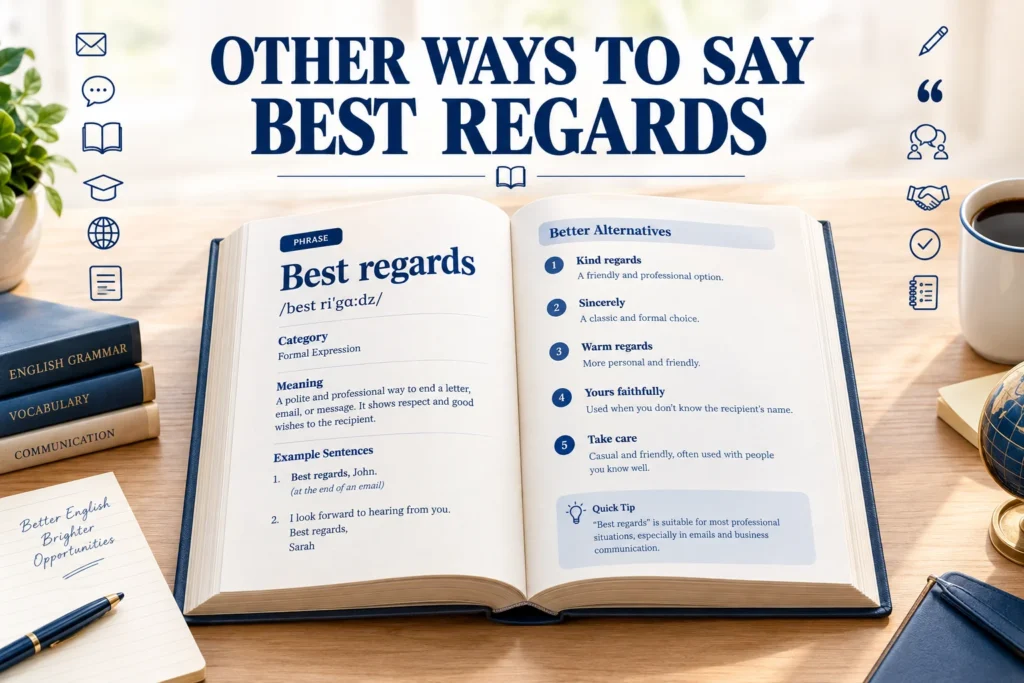
“Best regards” is a polite and professional email closing that shows respect and goodwill. It works well in business emails, workplace communication, client messages, networking, and many other professional situations. However, using the same closing in every message can make your emails feel repetitive.
If you are looking for other ways to say best regards, you have many options. Some alternatives sound more formal, while others feel warmer, friendlier, or more personal. The right choice depends on your relationship with the reader, the purpose of your message, and the level of formality you need.
A professional email closing should feel natural rather than forced. For example, “Kind regards” works well for everyday business communication, while “Sincerely” suits more formal correspondence. “Thanks again” can work better when someone has helped you.
This guide explains 50 practical alternatives to “best regards,” with meanings, tones, use cases, and examples.
What Does “Best Regards” Mean?
“Best regards” is a courteous way to end a written message. It communicates respect, goodwill, and professionalism before your name.
Literal Meaning
“Regards” means good wishes, respect, or consideration toward another person. Adding “best” makes the expression warmer and more positive.
For example:
Thank you for reviewing the proposal.
Best regards,
Sarah
The sender is expressing goodwill while keeping the tone professional.
Tone
“Best regards” usually has a:
- Professional tone
- Polite tone
- Neutral-to-warm feeling
- Moderately formal style
- Business-friendly quality
It does not usually sound overly personal or emotional.
Purpose
People commonly use “best regards” to:
- End business emails politely
- Maintain a professional relationship
- Show respect to clients
- Close workplace messages
- Follow up after meetings
- Communicate with new contacts
- End networking emails
Emotional Context
The phrase is friendly enough for everyday professional communication but restrained enough for formal situations.
For example:
I appreciate your help with this matter.
Best regards,
Michael
This sounds professional and appreciative without becoming overly personal.
When Should You Use “Best Regards”?
“Best regards” fits many professional situations, but it is not always the strongest choice.
In Emails
Use it when you want a safe, professional closing.
Example:
Thank you for your time. I look forward to hearing from you.
Best regards,
Daniel
It works especially well when you have an established but professional relationship with the recipient.
In the Workplace
“Best regards” can work when communicating with:
- Managers
- Supervisors
- Colleagues
- Human resources teams
- Other departments
- External business contacts
For a quick internal message, however, it may sound more formal than necessary.
With Clients
“Best regards” is a reliable choice for client communication because it shows respect without sounding excessively formal.
Example:
Please let me know if you have any questions about the proposal.
Best regards,
Emma
In Networking
It works well when contacting someone you do not know personally.
Example:
Thank you for sharing your insights during the conference. I enjoyed our conversation.
Best regards,
James
In Customer Service
“Best regards” can close a helpful customer-service message professionally.
Example:
Please contact us if you need any further assistance.
Best regards,
Customer Support Team
Professional Alternatives
1. Kind regards
Meaning: A polite expression of goodwill.
Tone: Professional, warm, and respectful.
Best use case: Everyday business emails, clients, colleagues, and professional contacts.
Example:
Thank you for your assistance.
Kind regards,
Olivia
“Kind regards” is one of the most natural alternatives to “best regards.”
2. Warm regards
Meaning: A warmer expression of goodwill.
Tone: Professional but friendly.
Best use case: Clients, colleagues, networking contacts, and people you know reasonably well.
Example:
I appreciate your continued support.
Warm regards,
David
3. Regards
Meaning: A simple expression of respect and goodwill.
Tone: Neutral and professional.
Best use case: Short business emails.
Example:
Please let me know if you need anything else.
Regards,
Emily
4. With appreciation
Meaning: Shows gratitude toward the recipient.
Tone: Professional and appreciative.
Best use case: When someone has provided help, information, or support.
Example:
Thank you for your valuable feedback.
With appreciation,
James
5. With thanks
Meaning: Expresses gratitude before signing off.
Tone: Professional and courteous.
Best use case: Requests, assistance, and follow-up emails.
Example:
Thank you for handling this request.
With thanks,
Maria
6. Thank you
Meaning: Ends the email with direct appreciation.
Tone: Friendly and professional.
Best use case: Emails involving a request or favor.
Example:
Thank you for reviewing the document.
Thank you,
Daniel
7. Many thanks
Meaning: A stronger expression of gratitude.
Tone: Warm and professional.
Best use case: Workplace emails and business relationships.
Example:
Many thanks for sending the updated file.
Many thanks,
Sophie
8. All the best
Meaning: Expresses good wishes.
Tone: Friendly, professional, and relaxed.
Best use case: Colleagues, networking contacts, and people you already know.
Example:
I enjoyed speaking with you today.
All the best,
Alex
9. Best wishes
Meaning: Sends positive wishes to the recipient.
Tone: Warm and polite.
Best use case: Professional relationships that have a friendly element.
Example:
I wish you success with the upcoming project.
Best wishes,
Laura
10. With best wishes
Meaning: A slightly more formal version of “best wishes.”
Tone: Polite and moderately formal.
Best use case: Professional correspondence and formal messages.
Example:
I hope everything goes well with the launch.
With best wishes,
Robert
11. Yours truly
Meaning: A courteous sign-off traditionally used in letters.
Tone: Formal.
Best use case: Formal correspondence, although it is less common in modern business email.
Example:
Thank you for considering my request.
Yours truly,
Daniel Smith
12. With gratitude
Meaning: Clearly communicates appreciation.
Tone: Warm and sincere.
Best use case: Thank-you messages and supportive professional relationships.
Example:
I truly appreciate your help with the project.
With gratitude,
Anna
13. With sincere thanks
Meaning: Communicates genuine appreciation.
Tone: Warm and professional.
Best use case: When someone has provided significant help.
Example:
Thank you for going above and beyond to assist us.
With sincere thanks,
Mark
14. Respectfully
Meaning: Shows respect toward the recipient.
Tone: Formal and serious.
Best use case: Official or sensitive professional correspondence.
Example:
Thank you for considering the information provided.
Respectfully,
John Smith
15. With appreciation and thanks
Meaning: Combines appreciation and gratitude.
Tone: Warm and professional.
Best use case: Important business relationships or helpful assistance.
Example:
We appreciate your continued cooperation.
With appreciation and thanks,
Rachel
Formal Alternatives
16. Sincerely
“Sincerely” is one of the most established formal email and letter closings.
Tone: Formal and respectful.
Best use: Job applications, official correspondence, formal requests.
Example:
Thank you for considering my application.
Sincerely,
Daniel Brown
17. Yours sincerely
Tone: Formal and traditional.
Best use: Formal correspondence, especially in British English.
Example:
I look forward to your response.
Yours sincerely,
Emily Carter
18. Yours faithfully
Tone: Very formal.
Best use: Formal letters when the recipient’s name is unknown, particularly in traditional British correspondence.
Example:
I would appreciate your response at your earliest convenience.
Yours faithfully,
Customer Relations Team
19. Respectfully yours
Tone: Formal and respectful.
Best use: Official or sensitive communication.
Example:
Thank you for your consideration.
Respectfully yours,
Michael Lee
20. With respect
Tone: Formal and reserved.
Best use: Official communication or serious professional matters.
Example:
Thank you for reviewing this request.
With respect,
Sarah
21. With sincere appreciation
Tone: Formal, warm, and appreciative.
Best use: Important professional thank-you messages.
Example:
Your support has been extremely valuable.
With sincere appreciation,
David
22. With gratitude and respect
Tone: Formal and sincere.
Best use: Significant professional acknowledgments.
Example:
Thank you for your guidance throughout this process.
With gratitude and respect,
Laura
23. Cordially
Tone: Formal and courteous.
Best use: Formal business correspondence.
Example:
I look forward to continuing our discussion.
Cordially,
James
24. Respectfully submitted
Tone: Highly formal.
Best use: Official documents, applications, and formal submissions.
Example:
Thank you for reviewing my proposal.
Respectfully submitted,
Robert Smith
25. Yours respectfully
Tone: Formal and traditional.
Best use: Official correspondence where respect is important.
Example:
Thank you for your consideration.
Yours respectfully,
Maria Johnson
Friendly Alternatives
26. All the best
Tone: Friendly and professional.
Best use: Colleagues, former coworkers, clients you know well, and networking contacts.
Example:
It was great catching up with you.
All the best,
Chris
27. Best wishes
Tone: Warm and friendly.
Best use: Friendly professional relationships.
Example:
I hope your new project goes well.
Best wishes,
Emma
28. Take care
Tone: Friendly and personal.
Best use: Colleagues or contacts you know well.
Example:
Thanks again for your help.
Take care,
Alex
29. Have a great day
Tone: Friendly and casual.
Best use: Customer service, colleagues, and everyday emails.
Example:
Please let me know if you have any other questions.
Have a great day,
Olivia
30. Have a wonderful week
Tone: Warm and friendly.
Best use: Casual professional communication.
Example:
I hope the information helps.
Have a wonderful week,
Daniel
31. Enjoy your weekend
Tone: Friendly and relaxed.
Best use: Friday emails and familiar workplace contacts.
Example:
I’ll send the final version on Monday.
Enjoy your weekend,
Sarah
32. Looking forward to staying in touch
Tone: Friendly and professional.
Best use: Networking and relationship building.
Example:
I enjoyed our conversation at the event.
Looking forward to staying in touch,
James
33. Speak soon
Tone: Friendly and informal.
Best use: People with whom you already have an established relationship.
Example:
Let’s discuss the details tomorrow.
Speak soon,
Mark
34. Until next time
Tone: Friendly and conversational.
Best use: Familiar professional contacts.
Example:
It was great working with you.
Until next time,
Laura
35. Keep in touch
Tone: Warm and friendly.
Best use: Networking, former colleagues, and professional relationships.
Example:
I hope our paths cross again soon.
Keep in touch,
David
Email-Ready Alternatives
36. Thank you again
Use this when the email involves help, support, or a request.
Thank you again for your assistance.
Thank you again,
Rachel
37. I appreciate your time
This works well after meetings, interviews, or consultations.
I appreciate your time and insights.
I appreciate your time,
Michael
38. I appreciate your help
This is ideal when the recipient has helped you.
I appreciate your help with this matter.
I appreciate your help,
Emily
39. Thank you for your consideration
Use this for applications, proposals, requests, and formal business communication.
Thank you for considering our proposal.
Thank you for your consideration,
Daniel
40. I look forward to hearing from you
This works well when you expect a response.
I look forward to hearing from you.
Sarah Johnson
41. I look forward to working with you
Use this when starting a new professional relationship.
I look forward to working with you.
Kind regards,
James
42. I look forward to staying in touch
Use this for networking and relationship building.
I enjoyed meeting you at the conference. I look forward to staying in touch.
Best wishes,
Olivia
43. Please feel free to reach out
This invites further communication.
Please feel free to reach out if you have any questions.
Kind regards,
David
44. Thank you for your continued support
Use this with clients, partners, and long-term contacts.
Thank you for your continued support.
Warm regards,
Emma
45. Thank you for your cooperation
Use this for workplace and business matters requiring cooperation.
Thank you for your cooperation throughout the process.
Regards,
Mark
Workplace Alternatives
46. Thanks again
Tone: Friendly and professional.
Best use: Colleagues and internal communication.
Thanks again for helping with the report.
Thanks again,
Alex
47. Appreciate your support
Tone: Warm and professional.
Best use: Team communication.
Appreciate your support on this project.
Regards,
Sarah
48. Many thanks
Tone: Warm and appreciative.
Best use: Workplace requests and assistance.
Many thanks for sending this over.
Emma
49. Speak with you soon
Tone: Friendly and conversational.
Best use: Ongoing workplace discussions.
I’ll review the document before our call. Speak with you soon.
Daniel
50. Looking forward to our continued collaboration
Tone: Professional and positive.
Best use: Clients, partners, vendors, and colleagues.
Thank you for your partnership. I look forward to our continued collaboration.
Warm regards,
Michael
Quick Comparison Table
| Alternative | Tone | Best Use |
| Kind regards | Professional, warm | Business emails |
| Warm regards | Warm, professional | Clients and contacts |
| Regards | Neutral | Short business emails |
| Sincerely | Formal | Official communication |
| Yours sincerely | Formal | Formal letters |
| Yours faithfully | Very formal | Traditional formal letters |
| Respectfully | Formal | Official matters |
| With appreciation | Appreciative | Thank-you emails |
| With gratitude | Warm | Significant thanks |
| All the best | Friendly | Colleagues and contacts |
| Best wishes | Warm | Friendly professional emails |
| Take care | Casual | Familiar contacts |
| Many thanks | Appreciative | Requests and assistance |
| Thank you again | Warm | Follow-ups |
| I appreciate your time | Professional | Meetings and interviews |
| Thank you for your consideration | Formal | Applications and proposals |
| Thanks again | Friendly | Workplace communication |
| Speak soon | Casual | Familiar contacts |
| Keep in touch | Friendly | Networking |
| Looking forward to working with you | Professional | New relationships |
Email Examples
1. Client Email
Thank you for reviewing the proposal. Please let me know if you have any questions or would like to discuss the next steps.
Kind regards,
Sarah
2. Manager Email
Thank you for your feedback on the report. I’ll make the requested changes and send the revised version tomorrow.
Kind regards,
Daniel
3. Colleague Email
Thanks for sending the updated figures. I’ll add them to the presentation before the meeting.
Thanks again,
Alex
4. Customer Email
We have processed your request and will send the updated information shortly. Please contact us if you need further assistance.
Best wishes,
Customer Support Team
5. Networking Email
It was great meeting you at the conference. I enjoyed our conversation about industry trends and hope we can stay connected.
Looking forward to staying in touch,
Olivia
6. Meeting Follow-Up
Thank you for taking the time to meet today. I appreciate your insights and look forward to discussing the next steps.
Best regards,
Michael
Common Mistakes When Using Email Sign-Offs
1. Using the Same Closing Every Time
“Best regards” is useful, but repeating it in every email can make your communication feel mechanical.
Instead, match your closing to the purpose of the email.
For example:
- Thank-you email → “With appreciation”
- Formal request → “Sincerely”
- Friendly workplace email → “Thanks again”
- Networking email → “Looking forward to staying in touch”
2. Choosing the Wrong Level of Formality
A very formal sign-off can sound unnatural in a casual workplace conversation.
For example, “Yours faithfully” may feel excessive for a quick message to a colleague.
Likewise, “Take care” may feel too casual for a first email to a senior executive.
3. Using Emotional Closings in Business Emails
Some closings can sound too personal if you do not know the recipient well.
Keep your relationship and purpose in mind.
4. Adding Too Many Closing Phrases
Avoid combinations such as:
Thank you again. I really appreciate your help. Looking forward to hearing from you. Best regards. Kind regards. Sarah
One clear closing is enough.
5. Forgetting the Email Context
Your closing should support the purpose of your email.
If you are asking for something, gratitude may work well.
If you are ending a formal application, “Sincerely” may be more appropriate.
If you are networking, a relationship-focused closing can feel more natural.
Related Business Email Phrases
Here are related expressions that can strengthen professional communication.
1. Thank you for your time
Shows appreciation for someone’s attention.
2. Thank you for your consideration
Useful for formal requests and applications.
3. I appreciate your assistance
A professional way to recognize someone’s help.
4. I appreciate your support
Useful with colleagues, clients, and partners.
5. I look forward to hearing from you
Shows that you expect a response.
6. I look forward to working with you
Useful when beginning a professional relationship.
7. I look forward to our meeting
Appropriate before a scheduled meeting.
8. Please let me know
A simple way to invite a response.
9. Please feel free to contact me
Invites additional communication.
10. Please don’t hesitate to reach out
A polite invitation to contact you.
11. Thank you for your cooperation
Useful when someone is helping with a process.
12. Thank you for your patience
Appropriate after a delay or extended process.
13. Thank you for your understanding
Useful when explaining an inconvenience or difficult situation.
14. I appreciate your feedback
Useful after receiving comments or suggestions.
15. I value your input
Shows respect for someone’s opinion.
16. I hope to hear from you soon
A slightly warmer alternative to requesting a response.
17. I look forward to staying in touch
Especially useful in networking.
18. Thank you again for your assistance
A strong closing for help-related emails.
“Best Regards” vs. Other Alternatives
Best Regards vs. Kind Regards
Both are professional and polite.
“Best regards” sounds neutral and widely accepted. “Kind regards” often feels slightly warmer.
Best regards: General business communication.
Kind regards: Professional emails where you want a slightly warmer tone.
Best Regards vs. Sincerely
“Sincerely” has a more formal and traditional tone.
Use “Sincerely” for formal correspondence, applications, official requests, and similar situations.
Use “Best regards” for routine professional emails.
Best Regards vs. Warm Regards
“Warm regards” expresses more warmth and personal goodwill.
Use it when you have an established relationship with the recipient.
Best Regards vs. Regards
“Regards” is shorter and more neutral.
It works well for brief business messages, although some readers may perceive it as less warm.
Best Regards vs. All the Best
“All the best” sounds friendlier and more conversational.
It works especially well with colleagues, networking contacts, and people you already know.
Best Regards vs. Thank You
“Thank you” is more purpose-specific.
Use it when the email involves a request, assistance, cooperation, or appreciation.
Cultural Usage
US English
In American business communication, “Best regards,” “Kind regards,” “Best,” “Sincerely,” and “Thanks” are common choices.
The best option depends heavily on the relationship and context.
“Best” is particularly common in shorter professional emails, while “Sincerely” generally feels more formal.
UK English
British professional correspondence commonly uses expressions such as “Kind regards,” “Best wishes,” “Yours sincerely,” and “Yours faithfully.”
Traditional letter conventions also distinguish between “Yours sincerely” and “Yours faithfully” based on whether you know the recipient’s name.
Corporate Communication
Large organizations often prefer short, predictable sign-offs.
“Kind regards” and “Best regards” remain useful because they balance professionalism and friendliness.
Customer Service
Customer-service emails should sound helpful without becoming overly personal.
Good options include:
- Kind regards
- Best regards
- Best wishes
- Thank you
- Have a great day
Networking
Networking messages benefit from a slightly warmer closing.
Useful choices include:
- Looking forward to staying in touch
- Best wishes
- All the best
- Warm regards
- Keep in touch
FAQs
What is the best professional alternative to “best regards”?
“Kind regards” is one of the most natural professional alternatives. It has a similar level of politeness while sounding slightly warmer.
What is a formal alternative to “best regards”?
“Sincerely,” “Yours sincerely,” and “Respectfully” are formal alternatives. The best choice depends on the type of correspondence and the relationship with the recipient.
What is a friendly alternative to “best regards”?
“All the best” and “Best wishes” are friendly options that still work in professional communication.
Can I use “kind regards” instead of “best regards”?
Yes. “Kind regards” is widely used in professional emails and can replace “Best regards” in many situations.
Is “best regards” too formal for an email?
Usually, no. “Best regards” has a professional but relatively neutral tone. It works well for most business emails.
Is “best regards” professional?
Yes. “Best regards” is a standard professional email closing.
Can I use “best regards” with my manager?
Yes. It is appropriate when communicating with a manager, especially when the email has a professional or formal purpose.
Can I use “best regards” with a client?
Yes. It is a safe and professional closing for most client emails.
What can I say instead of “best regards” in a casual email?
You can use “Thanks,” “Thanks again,” “All the best,” “Take care,” or “Speak soon,” depending on your relationship with the recipient.
What is the best email sign-off for networking?
“Looking forward to staying in touch,” “Best wishes,” and “All the best” work well for networking because they encourage continued professional contact.
Is “warm regards” professional?
Yes. “Warm regards” is professional but more personal and friendly than “Best regards.”
Is “regards” rude?
“Regards” is not inherently rude. It is a neutral professional closing. However, some readers may find it less warm than “Kind regards” or “Best regards.”
Is “all the best” appropriate for work emails?
Yes. “All the best” works well for colleagues and professional contacts, particularly when you already have an established relationship.
What is a good closing after asking for help?
“Thank you,” “Thank you again,” “With thanks,” or “I appreciate your help” can work particularly well because they connect the closing with the purpose of the email.
What is the best sign-off for a formal business email?
“Sincerely” is a dependable formal option. “Yours sincerely,” “Yours faithfully,” and “Respectfully” can also suit specific formal contexts.
Final Summary
There is no single replacement for “Best regards” that works perfectly in every situation. The right closing depends on your relationship with the recipient, the purpose of the email, and the tone you want to create.
Best Professional Options
- Kind regards
- Best regards
- Regards
- Warm regards
- With appreciation
- Many thanks
Best Formal Options
- Sincerely
- Yours sincerely
- Yours faithfully
- Respectfully
- With sincere appreciation
- Cordially
Best Friendly Options
- All the best
- Best wishes
- Take care
- Speak soon
- Keep in touch
- Have a great day
Best Email Options
- Thank you
- Thank you again
- I appreciate your time
- I appreciate your help
- Thank you for your consideration
- I look forward to hearing from you
The most important part of professional communication is matching your closing to the situation. Choose a formal sign-off for official communication, a warm option for relationship-building, and a simple thank-you when your message centers on appreciation.
Conclusion
“Best regards” remains a reliable choice for professional emails, but using alternatives can make your communication more natural and purposeful. Choose “Kind regards” for everyday business emails, “Sincerely” for formal messages, “All the best” for friendly professional relationships, and “Thank you” when appreciation matters most. For networking, try “Looking forward to staying in touch.” The strongest business email phrases match the recipient, relationship, and purpose of the message. Good email etiquette is not about using complicated language; it is about choosing a clear, respectful closing that fits the conversation.




