
Introduction
If you are looking for other ways to say “I was referred to you by” someone, you are probably staring at a blank email and thinking the phrase sounds stiff. You are right — it does. “I was referred to you by John” is correct, polite, and completely forgettable. It reads like a form letter, and in a busy inbox, form letters get ignored.
The good news: you can say the same thing in dozens of warmer, sharper, more human ways. Whether you are writing to a client, your manager, a new colleague, or a stranger at another company, the right opening line sets the tone for everything that follows. A referral is a gift — someone trusted you enough to connect you — so your first sentence should honor that trust instead of burying it in corporate language.
This guide gives you 25 professional and polite alternatives, grouped by situation: professional, formal, friendly, email-ready, and workplace-specific. Each one comes with a quick note on tone and a short example you can copy today. You will also find full email examples, common mistakes to avoid, and answers to the questions people ask most about referral language.
Meaning
“I was referred to you by [name]” is a polite way to tell someone that a third person suggested you contact them. It names your connection, builds instant trust, and explains why a stranger is writing to them. People use it in job applications, sales emails, networking messages, and customer requests.
That is the dictionary-level meaning, but the real meaning is social. The phrase does three jobs at once: it borrows credibility from someone the reader already trusts, it answers the silent question “why are you emailing me?”, and it signals that you are not a random spammer. Tone-wise, it is neutral and safe — neither warm nor cold. That neutrality is both its strength and its weakness. It never offends, but it never impresses either.
Emotionally, the phrase sits in an interesting spot. The writer often feels nervous — they are reaching out to a stranger and hoping the shared connection smooths the way. The reader feels mild curiosity mixed with caution: “Who is this, and what do they want?” A better phrasing lowers the reader’s guard faster because it sounds like a real person wrote it.
Consider the difference in feeling:
- “I was referred to you by Sarah.” — Fine. Slightly robotic. The reader registers the name and moves on.
- “Sarah Kim recommended I contact you.” — Warmer. The reader pictures Sarah saying something nice about them.
Both sentences carry the same facts. The second one carries a feeling. In business communication, feeling is what gets replies.
Professional usage
A referral opener works anywhere you contact someone new through a shared connection. But the exact wording should shift with the setting. Here is how to match the phrase to the moment.
In emails
Email is where this phrase lives most. Cold and warm outreach emails both benefit from naming the referrer in the first two lines — never bury it in paragraph three. Put the name early, then state your reason for writing in the next sentence. When you are reaching out to offer help, a referral line like “Tom Baker suggested I reach out” turns a cold email into a warm one instantly.
In the workplace
Inside a company, referrals travel through managers, HR, and teammates. “Our manager suggested I loop you in” works better than the stiff “I was referred to you by our manager” because it sounds like normal office speech. Keep it casual but respectful — you work with these people, so sound like it.
With clients
Clients respond to confidence and clarity. Name the mutual contact, then get to the point fast. “Your colleague Maria Lopez recommended I contact you about the Q3 proposal” tells the client exactly who, what, and why in one line. After they respond helpfully, close the loop gracefully and let them know you appreciate it — gratitude keeps the relationship warm for next time.
In networking
Networking runs on introductions. At events, on LinkedIn, or in follow-up emails, referral language is your social proof. “We met briefly at the conference — Jessica told me you’re the person to talk to about partnerships” blends a shared event with a shared contact. That double connection makes people far more likely to reply.
In customer service
Support teams refer customers to specialists all the time, and customers repeat that referral when they write in. “The support team referred me to you about my refund” is clear and functional. It tells the agent this is a handoff, not a brand-new complaint, which usually speeds things up.
Alternatives
Here are 25 alternatives, grouped by tone and setting. Each entry gives you the line, a note on when it fits, and a short example.
Professional
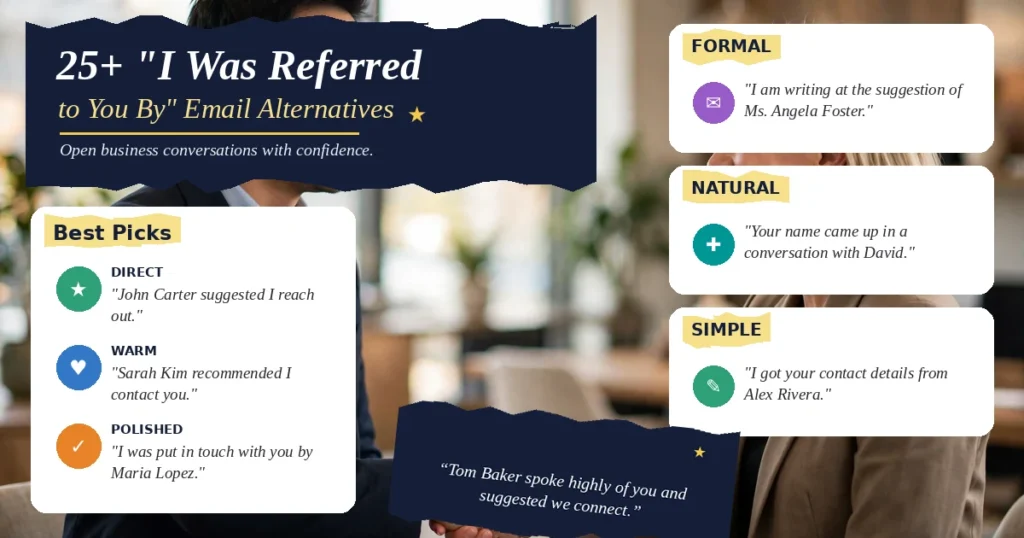
1. “John Carter suggested I reach out.” — Direct and name-first; best when the referrer is well known to the reader. Example: “John Carter suggested I reach out about the marketing role.”
2. “I was put in touch with you by Maria Lopez.” — Polished and slightly formal; best for first-time introductions. Example: “I was put in touch with you by Maria Lopez regarding the vendor contract.”
3. “Sarah Kim recommended I contact you.” — Clear and warm; best when the referral carries genuine praise. Example: “Sarah Kim recommended I contact you about your team’s design process.”
4. “Your name came up in a conversation with David.” — Soft and natural; best for casual professional intros. Example: “Your name came up in a conversation with David at the trade show.”
5. “I got your contact details from Alex Rivera.” — Simple and straightforward; best for no-nonsense business emails. Example: “I got your contact details from Alex Rivera — I’d like to discuss pricing.”
6. “Tom Baker spoke highly of you and suggested we connect.” — Complimentary; best when you want the reader to feel valued. Example: “Tom Baker spoke highly of you and suggested we connect about the partnership.”
Formal
7. “I am writing at the suggestion of Ms. Angela Foster.” — Very formal; best for cold outreach to senior executives. Example: “I am writing at the suggestion of Ms. Angela Foster concerning the audit.”
8. “Mr. James Wright referred me to you regarding the proposal.” — Formal and specific; best for business inquiries. Example: “Mr. James Wright referred me to you regarding the proposal deadline.”
9. “I have been directed to you by Dr. Emily Chen.” — Official in tone; best for academic or institutional contexts. Example: “I have been directed to you by Dr. Emily Chen about the research grant.”
10. “It was on the recommendation of the board that I contact you.” — Weighty and serious; best for high-stakes introductions. Example: “It was on the recommendation of the board that I contact you about the merger.”
11. “A mutual colleague, Robert Hill, advised me to get in touch.” — Formal but neutral; best for corporate emails. Example: “A mutual colleague, Robert Hill, advised me to get in touch about compliance.”
Friendly
12. “Jessica told me you’re the person to talk to.” — Warm and casual; best for peer-to-peer messages. Example: “Jessica told me you’re the person to talk to about the software rollout.”
13. “Mike said you’d be the perfect person to ask.” — Complimentary and relaxed; best for advice requests. Example: “Mike said you’d be the perfect person to ask about data migration.”
14. “I heard great things about you from Lisa.” — Enthusiastic; best for networking and introductions. Example: “I heard great things about you from Lisa — I’d love to pick your brain.”
15. “Sam mentioned your name, and I had to reach out.” — Eager and genuine; best for warm leads. Example: “Sam mentioned your name, and I had to reach out about the open role.”
16. “Your friend Chris thought we should meet.” — Personal; best when the social link matters most. Example: “Your friend Chris thought we should meet at next week’s mixer.”
17. “I’m following up on an introduction from Nina Patel.” — Purposeful; best for follow-up emails. Example: “I’m following up on an introduction from Nina Patel about the consulting project.”
18. “Per my conversation with Greg, I’m writing to you directly.” — Business-like; best for sales or partnership emails. Example: “Per my conversation with Greg, I’m writing to you directly about distribution.”
19. “Karen Doyle passed along your information.” — Efficient; best for quick cold emails. Example: “Karen Doyle passed along your information — do you have ten minutes this week?”
20. “I’m connecting at the request of Brian Moss.” — Direct and action-oriented; best when you need a fast answer. Example: “I’m connecting at the request of Brian Moss to finalize the invoice.”
21. “You came highly recommended by Olivia Grant.” — Confident; best for job or service inquiries. Example: “You came highly recommended by Olivia Grant, so I’m writing about the analyst position.”
Workplace
22. “Our manager, Diane, suggested I loop you in.” — Internal and natural; best for team emails. Example: “Our manager, Diane, suggested I loop you in on the launch plan.”
23. “HR pointed me in your direction.” — Neutral; best for internal requests. Example: “HR pointed me in your direction about the benefits paperwork.”
24. “The support team referred me to you.” — Functional; best for help-desk style requests. Example: “The support team referred me to you about ticket #4521.”
25. “Mark from accounting said you’re the expert on this.” — Specific; best for cross-department emails. Example: “Mark from accounting said you’re the expert on expense approvals.”
Quick comparison table
| Alternative | Tone | Best use |
|---|---|---|
| “John Carter suggested I reach out.” | Professional, direct | Warm outreach when the referrer is known |
| “I am writing at the suggestion of Ms. Angela Foster.” | Very formal | Cold emails to senior executives |
| “Sarah Kim recommended I contact you.” | Warm, clear | Referrals that carry genuine praise |
| “Jessica told me you’re the person to talk to.” | Friendly, casual | Peer-to-peer messages |
| “I’m following up on an introduction from Nina Patel.” | Purposeful | Follow-up emails |
| “Per my conversation with Greg, I’m writing to you directly.” | Business-like | Sales or partnership outreach |
| “You came highly recommended by Olivia Grant.” | Confident | Job or service inquiries |
| “Our manager, Diane, suggested I loop you in.” | Internal, natural | Team and cross-department emails |
| “Tom Baker spoke highly of you and suggested we connect.” | Complimentary | Networking and partnerships |
| “I got your contact details from Alex Rivera.” | Simple, direct | Quick, no-nonsense business emails |
Email examples
Client email
Subject: Introduction via Maria Lopez — Q3 proposal
Hi Daniel,
I was put in touch with you by Maria Lopez regarding the Q3 proposal. She mentioned you’re leading the vendor review, and I’d love to share how we’ve helped similar teams cut onboarding time in half.
Would you have 20 minutes next week for a quick call?
Best,
Anna
Manager email
Subject: Following up on Diane’s suggestion
Hi Mr. Thompson,
Our manager, Diane, suggested I loop you in on the launch plan. I’ve attached the timeline draft — could you review the milestones for your team when you get a chance?
Thanks,
Rachel
Colleague email
Subject: Quick question — Mark pointed me your way
Hi Priya,
Mark from accounting said you’re the expert on expense approvals. I’m submitting my first report and want to make sure I follow the right steps. Could you point me to the current policy doc?
Thanks so much,
Leo
Customer email
Subject: Help with ticket #4521 — referred by support
Hello,
The support team referred me to you about ticket #4521. I’ve tried the standard troubleshooting steps twice, and the issue is still blocking our checkout page. If you need to ask your help desk team for help internally, I’m happy to provide logs.
I can show that I understand the delay on your end — just let me know a realistic timeline.
Regards,
Chris
Networking email
Subject: Great meeting you — Jessica suggested we connect
Hi Sofia,
We met briefly at last week’s conference — Jessica told me you’re the person to talk to about partnerships. I run growth at a SaaS startup, and I think there’s real overlap in our audiences.
Coffee next Thursday?
Cheers,
Ben
Meeting follow-up email
Subject: Following up — introduction from Nina Patel
Hi James,
I’m following up on an introduction from Nina Patel about the consulting project. I know inboxes pile up, so please be patient with my nudge — I’d love to lock in 30 minutes before Friday if your calendar allows.
Best,
Maya
Common mistakes
1. Name-dropping without permission
Never use someone’s name as your opener unless they actually agreed to the referral. A quick “mind if I mention your name?” text takes ten seconds and protects the relationship.
2. Burying the referrer’s name in paragraph three
Put the name in the first two lines. If the reader has to hunt for why you’re writing, many will stop reading before they find it.
3. Using the stiff original in a friendly context
“I was referred to you by Sam” sounds odd in a casual Slack message. Match the tone to the channel — friendly settings deserve friendly phrasing.
4. Forgetting to say what you want
A referral explains who sent you, not what you need. Always follow the opener with one clear sentence stating your request.
5. Vague referrals with no name
“Someone told me to contact you” helps nobody. Name the person. An unnamed referral carries zero trust and can feel suspicious.
6. Skipping the thank-you to the referrer
The person who connected you did you a favor. Send them a short note afterward — and if they ever need an introduction in return, thank them for the clarification they gave you and pay it forward.
Related phrases
- Warm introduction — An introduction made through a trusted mutual contact. Example: “Thanks for the warm introduction, Lisa!”
- Mutual connection — A person both parties know. Example: “We have a mutual connection in David.”
- Word of mouth — Recommendations spread by people talking. Example: “We found them through word of mouth.”
- Name-drop — Mentioning an important person’s name to gain attention. Example: “I don’t want to name-drop, but the CEO suggested I call.”
- Recommendation — A formal suggestion that someone is good for a role or task. Example: “She wrote me a strong recommendation.”
- Referral — The act of directing someone to a person or service. Example: “This referral came from our biggest client.”
- Reach out — To contact someone, usually for the first time. Example: “I’ll reach out to her tomorrow.”
- Get in touch — To make contact with someone. Example: “Let’s get in touch next week.”
- Touch base — To briefly contact someone, often to check in. Example: “I’ll touch base with him on Monday.”
- Follow up — To contact someone again about a previous message. Example: “I’m following up on yesterday’s email.”
- Circle back — To return to a topic later. Example: “Let’s circle back after the holidays.”
- Loop in — To include someone in a conversation or email thread. Example: “Let me loop in our designer.”
- Pass along — To forward information or a contact to someone else. Example: “She passed along your number.”
- Point in the right direction — To guide someone toward the right person. Example: “HR pointed me in the right direction.”
- Put in a good word — To speak positively about someone to a third party. Example: “He put in a good word for me with the hiring manager.”
- Vouch for — To personally guarantee someone’s credibility. Example: “I can vouch for her work ethic.”
- Introduction — The formal act of presenting one person to another. Example: “I’d like an introduction to your supplier.”
Phrase comparison
“I was referred to you by” is the safe default: neutral, passive, and slightly stiff. It works everywhere but shines nowhere. “John Carter suggested I reach out” keeps the same facts but adds motion — the word “suggested” feels active and human, and leading with the name grabs attention faster.
Formal options like “I am writing at the suggestion of Ms. Angela Foster” trade warmth for authority. They suit executives, legal contexts, and first contact with senior people, but they would feel overdressed in a Slack DM. Friendly versions like “Jessica told me you’re the person to talk to” do the opposite: they trade authority for approachability, which is perfect for peers and networking but risky with a formal audience.
The pattern is simple. The more senior or formal the reader, the more structure your opener needs — full names, titles, complete sentences. The more casual the setting, the more you can relax into contractions and conversational word order. None of the 25 alternatives is universally best; the best one is the one that matches your reader’s expectations while still sounding like you.
Cultural usage
United States
Americans favor direct, first-name referrals: “John suggested I reach out.” Titles like Mr. and Ms. are rare outside law and finance. Speed matters — US readers expect the ask within the first three sentences.
United Kingdom
British business writing leans slightly more formal. “I am writing at the suggestion of Ms. Foster” feels normal in the UK, where titles still carry weight. Understatement is common: “David mentioned you might be able to help” instead of “David said you’re the expert.”
Corporate communication
Large companies run on chain-of-command referrals: “Our manager suggested I loop you in” or “HR pointed me in your direction.” These signal that the contact is legitimate internal business, not a personal favor.
Customer service
Support referrals are functional, not social. “The support team referred me to you” tells the agent this is a handoff. Customers should include a ticket number or case reference alongside the referral line so the agent can pick up where the last one left off.
Networking culture
In networking, the referral IS the message. “You came highly recommended by Olivia Grant” works because it flatters and legitimizes at once. Event-based openers (“We met at the conference — Jessica suggested we connect”) layer two trust signals, which is why they get the highest reply rates.
Frequently asked questions
Is it okay to say “I was referred to you by” in a formal email?
Yes. It is grammatically correct and universally understood. But in formal emails, stronger options exist — “I am writing at the suggestion of Ms. Angela Foster” sounds more polished and carries more weight with senior readers.
What is a more professional way to say “I was referred to you by”?
“I was put in touch with you by [name]” and “[Name] recommended I contact you” both sound more professional. They use active, confident language instead of the passive original, which makes your opener feel intentional rather than templated.
How do you mention a referral in a cold email?
Put the referrer’s name in the first line, then state your reason for writing in the second. For example: “Tom Baker suggested I reach out. I’m writing because our tool cuts reporting time by 40%.” Never bury the name — it is your strongest asset in a cold email.
Should I ask permission before using someone’s name as a referral?
Always. A quick message — “Mind if I mention your name to Daniel?” — takes seconds and protects the relationship. Using someone’s name without permission can embarrass them if the recipient follows up with questions they cannot answer.
What if the referrer is not well known to the reader?
Be specific about the connection: “Your former colleague Sam Rivera mentioned your name” works better than just “Sam mentioned your name.” Context helps the reader place the referrer and trust the introduction.
Can I use these phrases on LinkedIn?
Yes — most of them transfer perfectly. LinkedIn messages should be even shorter, so pick the punchy ones: “Jessica told me you’re the person to talk to” or “Sam mentioned your name, and I had to reach out.” Keep the whole message under 100 words.
What is the difference between a referral and a recommendation?
A referral directs someone to contact a person (“Talk to Daniel about this”). A recommendation endorses someone’s quality (“Daniel is excellent at this”). Referrals open doors; recommendations convince people to walk through them. Many great introductions include both.
How do you follow up if a referred email gets no reply?
Wait 4–5 business days, then send a short nudge that repeats the referral: “Just floating this back up — Nina Patel suggested we connect about the consulting project. Still open to a brief call?” One polite follow-up is professional; three is pushy.
Is “name-dropping” rude in business emails?
Name-dropping is rude when the name is irrelevant or exaggerated. It is perfectly fine — expected, even — when the person genuinely referred you. The difference is honesty: mention real connections, never invent them.
What should I do after a referral introduction succeeds?
Thank the referrer. A two-line message — “Just wanted you to know I connected with Daniel. Really appreciate the intro!” — keeps the relationship strong. People who feel appreciated make more introductions.
Can I say “referred by” instead of “I was referred to you by”?
“I was referred by John” is shorter and common in casual contexts, but it can sound abrupt in formal writing. In professional emails, the fuller phrasings in this guide land better because they feel complete and courteous.
How formal should a referral email to a CEO be?
Very. Use full names and titles: “I am writing at the suggestion of Ms. Angela Foster concerning the audit.” Keep the email under 150 words, state your ask clearly, and let your referrer’s credibility do the heavy lifting.
What if I was referred by a company, not a person?
Name the company and add context: “Your support team referred me to you” or “I was directed here by the partnerships team at Acme Corp.” If you know an individual there, name them too — people trust people more than departments.
Should the referral line go in the subject line?
It can help. Subject lines like “Introduction via Maria Lopez” or “Following up — referred by Tom Baker” boost open rates because the reader recognizes a name before opening. Keep the subject under 50 characters so it displays fully on mobile.
How many times can I mention the referrer in one email?
Once is enough — twice at most. Mention the name in your opener, then focus on your message. Repeating the referrer’s name in every paragraph looks desperate and dilutes the trust it was meant to build.
Conclusion
The shortlist, if you only remember a few:
- Professional: “Sarah Kim recommended I contact you.” and “Tom Baker spoke highly of you and suggested we connect.”
- Formal: “I am writing at the suggestion of Ms. Angela Foster.” and “A mutual colleague, Robert Hill, advised me to get in touch.”
- Friendly: “Jessica told me you’re the person to talk to.” and “Sam mentioned your name, and I had to reach out.”
- Email: “I’m following up on an introduction from Nina Patel.” and “You came highly recommended by Olivia Grant.”
- Workplace: “Our manager, Diane, suggested I loop you in.” and “Mark from accounting said you’re the expert on this.”
A referral is borrowed trust — spend it well. Pick the line that fits your reader, put the name up front, say what you want in the next sentence, and always thank the person who opened the door. Do that consistently, and your cold emails will stop feeling cold.
For the dictionary definition of the core word, see Cambridge Dictionary’s entry on “refer”.




