
Introduction
If you are searching for other ways to say “at the end of the day,” you are not alone. The phrase shows up everywhere — in meetings, emails, presentations, and performance reviews — and after the fiftieth hearing, it starts to sound like filler instead of a conclusion. The good news is that English gives you dozens of sharper options, from crisp one-word swaps like “ultimately” to warm, email-ready closers like “in light of everything.”
This guide collects 56 professional, formal, friendly, and email-tested alternatives to “at the end of the day.” Each one comes with a quick note on tone and best use, plus a short example sentence, so you can pick the right phrase for every situation. You will also find email examples, common mistakes to avoid, related idioms, and answers to the questions people ask most about this overused expression.
Why does the swap matter? Because strong workplace communication runs on small choices. The same care that goes into reaching out with the right tone applies when you close an argument: the final phrase is the one people remember, so make it count.
Meaning
“At the end of the day” is an idiom meaning “when everything is taken into account” or “all things considered.” Speakers use it to signal a final judgment after weighing the facts — for example, “At the end of the day, the customer is always right.” Its tone is conversational and slightly informal, which is why it fits speech far better than formal writing.
The literal meaning is simple: the close of a day. But almost nobody uses it literally anymore. When someone says it in a meeting, they are not talking about 5 PM. They are wrapping up a discussion and delivering the bottom-line verdict.
The phrase carries a practical, no-nonsense tone. It says, “We have talked through the details, and here is what actually matters.” That is useful in conversation. In writing, though, it often reads as lazy — a filler phrase people reach for when they have not chosen a sharper conclusion. Editors and hiring managers notice the repetition, which is exactly why learning a professional way to say “at the end of the day” pays off.
Emotionally, the idiom feels reassuring. It promises clarity after complexity: strip away the noise, and the answer is simple. Used once, it lands well. Used five times in one meeting, it becomes the noise.
Professional usage
The idiom is common in spoken business English but risky in writing. Here is where it fits — and where a stronger alternative wins.
Emails
In emails, “at the end of the day” reads as chatty. It works in a quick note to a colleague you know well, but it weakens formal messages to clients or executives. Swap in “in light of everything” or “taking all of this into account” for the same meaning with a more polished feel. When a client is waiting on your verdict, ask them to be patient while you gather the facts — then close with a crisp alternative instead of the cliché.
The workplace
Spoken workplace settings — standups, one-on-ones, team huddles — tolerate the phrase. It sounds natural out loud. Still, leaders who want to sound decisive often prefer “the bottom line is” or “when all is said and done,” which carry the same finality without the worn-out feel.
Client conversations
With clients, every word shapes trust. “At the end of the day” can sound like you are brushing past their concerns to rush to a conclusion. Alternatives like “all things considered” or “when everything is taken into account” show the same thoroughness while sounding more careful and client-focused.
Networking
In networking chats and follow-up messages, warmth matters more than punch. “What matters most is” or “the way I see it” keeps the friendly tone while avoiding a phrase the other person has heard a hundred times this week.
Customer service
Support conversations need clarity and empathy, not idioms. “Ultimately” and “in summary” deliver the conclusion cleanly. Save the conversational fillers for small talk, and keep resolution messages crisp.
Alternatives
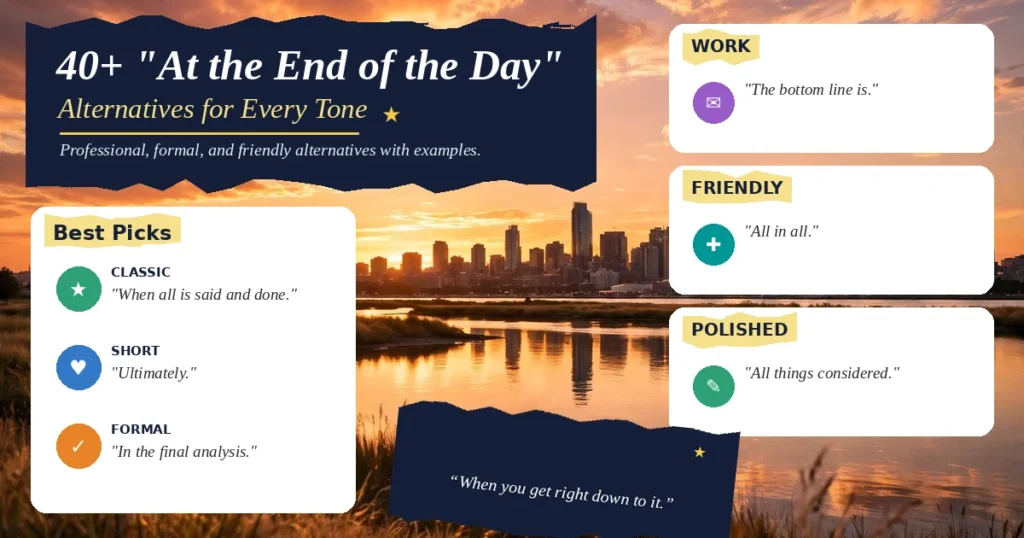
Here are 56 alternatives grouped by tone. Each entry gives the phrase, its tone and best use, and a short example.
Professional
- “When all is said and done.” — Balanced and reflective; best for wrap-up statements. Example: “When all is said and done, the client chose the simpler design.”
- “Ultimately.” — Crisp and neutral; best for reports and summaries. Example: “Ultimately, the data supported the second option.”
- “In the final analysis.” — Analytical; best for presentations and reports. Example: “In the final analysis, costs outweighed the benefits.”
- “All things considered.” — Measured and fair; best for balanced judgments. Example: “All things considered, the launch went well.”
- “When everything is taken into account.” — Thorough; best for formal reviews. Example: “When everything is taken into account, the risk is acceptable.”
- “The bottom line is.” — Direct; best for meetings and memos. Example: “The bottom line is we need two more weeks.”
- “Taking everything into consideration.” — Careful and complete; best for decision summaries. Example: “Taking everything into consideration, we approved the budget.”
- “All in all.” — Light and conversational; best for spoken updates. Example: “All in all, it was a productive quarter.”
- “In the long run.” — Forward-looking; best for strategy talk. Example: “In the long run, this investment will pay off.”
- “When you get right down to it.” — Plain-spoken; best for honest assessments. Example: “When you get right down to it, customers want speed.”
- “The reality is.” — Candid; best for tough conversations. Example: “The reality is we cannot meet that deadline.”
- “In essence.” — Concise and smart; best for simplifying complex points. Example: “In essence, the policy protects both sides.”
- “Fundamentally.” — Strong and confident; best for core arguments. Example: “Fundamentally, this is a trust issue.”
- “At its core.” — Focused; best for defining what matters. Example: “At its core, the project is about safety.”
- “The net result is.” — Outcome-focused; best for performance reviews. Example: “The net result is a 12 percent increase in sales.”
- “Boiled down.” — Informal-professional; best for quick recaps. Example: “Boiled down, we need a clearer plan.”
Formal
- “In conclusion.” — Classic; best for reports and speeches. Example: “In conclusion, the committee recommends approval.”
- “In summary.” — Tidy; best for executive summaries. Example: “In summary, all three goals were met.”
- “To summarize.” — Efficient; best for meeting recaps. Example: “To summarize, we agreed on the timeline.”
- “In the final reckoning.” — Weighty; best for serious evaluations. Example: “In the final reckoning, quality mattered more than speed.”
- “After careful consideration.” — Deliberate; best for official decisions. Example: “After careful consideration, we have declined the offer.”
- “In the final assessment.” — Evaluative; best for appraisals. Example: “In the final assessment, she exceeded expectations.”
- “All factors considered.” — Comprehensive; best for formal findings. Example: “All factors considered, the merger is advisable.”
- “In the grand scheme of things.” — Big-picture; best for strategic writing. Example: “In the grand scheme of things, this delay is minor.”
- “The long and short of it is.” — Traditional; best for formal letters. Example: “The long and short of it is that we must cut costs.”
- “Upon reflection.” — Thoughtful; best for retrospective writing. Example: “Upon reflection, the training was worth the time.”
Friendly
- “When push comes to shove.” — Spirited; best for casual team talk. Example: “When push comes to shove, I’ll back your idea.”
- “Truth be told.” — Honest and warm; best for personal conversations. Example: “Truth be told, I enjoyed the challenge.”
- “If I’m being honest.” — Disarming; best for candid chats. Example: “If I’m being honest, the first draft was better.”
- “The way I see it.” — Personal; best for sharing opinions. Example: “The way I see it, we have two good options.”
- “Long story short.” — Breezy; best for quick storytelling. Example: “Long story short, we got the contract.”
- “To be fair.” — Even-handed; best for friendly debates. Example: “To be fair, they did warn us about the delay.”
- “At the end of it all.” — Gentle; best for heartfelt closings. Example: “At the end of it all, I’m glad we tried.”
- “When it really matters.” — Earnest; best for sincere moments. Example: “When it really matters, she always delivers.”
- “Let’s be real.” — Casual and direct; best for peer conversations. Example: “Let’s be real, nobody read the full manual.”
- “Here’s the thing.” — Conversational; best for friendly explanations. Example: “Here’s the thing: the plan still works.”
- “In closing.” — Polished; best for formal sign-offs. Example: “In closing, thank you for your continued support.”
- “To wrap up.” — Neat; best for recap emails. Example: “To wrap up, here are the three action items.”
- “In light of everything.” — Reflective; best for thoughtful updates. Example: “In light of everything, I suggest we pause the rollout.”
- “Considering all of this.” — Logical; best for proposal emails. Example: “Considering all of this, the new timeline makes sense.”
- “Taking all of this into account.” — Thorough; best for detailed responses. Example: “Taking all of this into account, I agree with your plan.”
- “The key takeaway is.” — Sharp; best for summary emails. Example: “The key takeaway is that engagement doubled.”
- “What matters most is.” — Warm and clear; best for reassuring emails. Example: “What matters most is that the client feels heard.”
- “The main point is.” — Straightforward; best for clarifying emails. Example: “The main point is we need your approval by Friday.”
- “In the final count.” — Precise; best for results emails. Example: “In the final count, we hit 98 percent of the target.”
- “All considered.” — Brief; best for short professional emails. Example: “All considered, I’m confident in this approach.”
Workplace
- “After everything is weighed.” — Practical; best for team decisions. Example: “After everything is weighed, option B wins.”
- “At the close of business.” — Time-specific; best for end-of-day summaries. Example: “At the close of business, all tickets were resolved.”
- “When results are in.” — Outcome-based; best for performance talk. Example: “When results are in, we’ll review the strategy.”
- “After weighing everything.” — Decisive; best for standup updates. Example: “After weighing everything, we’re moving forward.”
- “Once everything is on the table.” — Open; best for brainstorming recaps. Example: “Once everything is on the table, the choice is clear.”
- “When all the facts are in.” — Evidence-based; best for data discussions. Example: “When all the facts are in, the trend is obvious.”
- “In the final tally.” — Numbers-focused; best for sales and metrics. Example: “In the final tally, the team beat its quota.”
- “When the numbers come in.” — Metric-driven; best for finance chats. Example: “When the numbers come in, we’ll adjust the forecast.”
- “When things shake out.” — Relaxed; best for uncertain situations. Example: “When things shake out, we’ll know where we stand.”
- “Once the dust has settled.” — Settled and reflective; best for retrospectives. Example: “Once the dust has settled, the lessons will be clear.”
Quick comparison
| Alternative | Tone | Best use |
|---|---|---|
| Ultimately | Neutral, crisp | Reports, summaries, any professional writing |
| All things considered | Balanced, fair | Judgments and reviews |
| In the final analysis | Analytical | Presentations and formal reports |
| The bottom line is | Direct | Meetings and memos |
| In light of everything | Thoughtful | Email updates |
| When all is said and done | Reflective | Spoken wrap-ups |
| In conclusion | Classic formal | Reports, speeches, official documents |
| Long story short | Casual, breezy | Friendly chats and storytelling |
| The key takeaway is | Sharp | Summary emails |
| At the close of business | Time-specific | End-of-day workplace summaries |
Email examples
Emailing a client
“Thank you for walking me through the requirements. Taking all of this into account, I believe the phased approach serves you best. I have attached the revised timeline for your review.” A closing like this sounds careful and client-focused. If they sent extra details that changed your recommendation, take a moment to thank them for the clarification before delivering your verdict.
Emailing your manager
“Hi Sara, I compared both vendors on price, support, and delivery time. In the final analysis, Vendor B offers the better value. I recommend we move forward with them this week.”
Emailing a colleague
“Hey Dan, I read through the draft. All considered, I’m happy with the direction — just a few small tweaks on page two. Nice work pulling this together so fast.”
Replying to a customer
“Thanks for your patience while we looked into this. In summary: your refund has been approved and should reach your account within five business days. Let us know if anything else comes up.”
Networking emails
“It was great meeting you at the conference. The way I see it, our teams could do strong work together on the spring campaign. Would you be open to a quick call next week?”
Meeting follow-up
“Team, thanks for a productive session. To wrap up: Ali owns the design mockups, Priya handles the client call, and we reconvene Friday. The key takeaway is that we are one week ahead of schedule.”
Common mistakes
1. Using it to open instead of close
“At the end of the day” signals a conclusion, so opening with it confuses readers. Never start a paragraph or email with the phrase — place it where the verdict belongs, near the end.
2. Repeating it three times in one email
One idiom per message is plenty. Repeating it makes the writing feel careless. If you catch yourself typing it twice, replace the second one with “ultimately” or “in summary.”
3. Dropping it into formal reports
Annual reports, contracts, and academic papers need formal closers like “in conclusion” or “all factors considered.” The idiom sounds out of place next to serious data.
4. Confusing it with the literal evening
The phrase rarely means “tonight” anymore. Writing “at the end of the day, please send the file” puzzles readers — do you mean after weighing everything, or by 6 PM? Use “by end of day” (or EOD) for the time meaning.
5. Stacking it with other filler
“At the end of the day, basically, honestly, the thing is…” piles filler on filler. Pick one framing phrase and delete the rest. Clean sentences need no padding.
6. Using it to dodge a clear answer
Vague closers hide weak thinking. If you are tempted to write the idiom instead of stating the decision, stop and show you understand their frustration with waiting — then give the actual answer plainly.
Related phrases
- “In a nutshell.” — A very brief summary. Example: “In a nutshell, we need more time.”
- “By and large.” — Generally speaking. Example: “By and large, customers are happy.”
- “For the most part.” — Mostly, with small exceptions. Example: “For the most part, the event ran smoothly.”
- “All told.” — When everything is counted. Example: “All told, we saved forty hours.”
- “When you add it all up.” — Summing everything together. Example: “When you add it all up, the deal favors us.”
- “At the close of play.” — British idiom for the end of proceedings. Example: “At the close of play, both sides had agreed.”
- “The upshot is.” — The final result. Example: “The upshot is we hired two engineers.”
- “The moral of the story is.” — The lesson learned. Example: “The moral of the story is to test early.”
- “At the final whistle.” — Sports metaphor for when something ends. Example: “At the final whistle, the underdogs had won.”
- “After all.” — In spite of everything; when considered. Example: “After all, she was right about the budget.”
- “In the wash.” — Informal; after everything settles. Example: “In the wash, it all worked out fine.”
- “At the end of the road.” — When a process finishes. Example: “At the end of the road, we still had funding.”
- “The sum of it is.” — The total result. Example: “The sum of it is a stronger partnership.”
- “Everything taken together.” — A combined view. Example: “Everything taken together, the year was a success.”
- “On balance.” — After weighing both sides. Example: “On balance, I support the proposal.”
- “In the round.” — British; considering everything. Example: “In the round, the policy is fair.”
Phrase comparison
“At the end of the day” is the casual all-rounder — warm, conversational, and slightly tired from overuse. It suits speech and informal writing, but it carries no precision; it gestures at a conclusion rather than delivering one.
“Ultimately” is its sharpest one-word replacement. It is neutral, compact, and welcome everywhere from board reports to text messages. Where the idiom rambles, “ultimately” lands. If you only memorize one synonym for “at the end of the day,” make it this one.
“In the final analysis” sits a rung higher on the formality ladder. It tells the reader that real evaluation happened — numbers were checked, options were weighed. Use it in presentations, proposals, and any document where the conclusion must feel earned rather than asserted.
“All things considered” is the most even-handed of the group. It signals fairness: every angle got its due before the verdict. That makes it the safest pick for client-facing writing, performance reviews, and any message where the reader needs to feel heard. Pair it with a human touch — a quick note that you appreciate their time — and the conclusion lands softly.
The practical rule: match the phrase to the room. Speech tolerates the idiom; writing rewards the upgrade.
Cultural usage
US English
Americans use “at the end of the day” constantly — in offices, on podcasts, in political speeches. It is one of the most recognized business clichés in the country, which also makes it one of the most mocked. US business writing guides routinely list it under “phrases to avoid,” pushing writers toward “ultimately” and “the bottom line.”
UK English
British speakers use the idiom just as often, alongside homegrown cousins like “at the close of play” and “in the round.” British business culture tends to be slightly more tolerant of idioms in semi-formal writing, but the same advice holds: in documents that matter, choose the sharper alternative.
Corporate communication
Large companies often train the phrase out of official writing. Corporate style guides prefer measurable closers — “the net result is,” “in the final tally” — because they sound accountable. If your company has a style guide, check it; many now flag this exact idiom.
Customer service
Support teams need conclusions without jargon. “In summary” and “ultimately” work best in resolution messages because customers scan for the outcome. Skip the idiom here — a frustrated customer does not want folksy phrasing; they want the answer. Close instead with warmth, such as “my pleasure to help” with anything else they need.
Networking
Networking runs on memorable language, and clichés are forgettable by definition. “The way I see it” and “what matters most is” keep things personal and fresh in follow-up notes. The goal is to sound like yourself, not like everyone else’s inbox.
Frequently asked questions
What does “at the end of the day” mean?
It is an idiom meaning “when everything is taken into account” or “all things considered.” People use it to deliver a final judgment after discussing the details. For example: “At the end of the day, quality matters more than speed.”
Is “at the end of the day” too informal for business emails?
Usually, yes. It sounds conversational, which is fine for a quick note to a close colleague but weak in messages to clients or executives. In formal emails, use “in light of everything,” “ultimately,” or “taking all of this into account” instead.
What is the most professional alternative to “at the end of the day”?
“Ultimately” is the safest professional pick — short, neutral, and accepted everywhere. For longer formal writing, “in the final analysis” or “all things considered” work well. The best choice depends on your audience and the document.
Can I say “at the end of the day” in a job interview?
You can, but it is better to avoid it. Interviewers hear clichés as filler, and this phrase is one of the most overused in professional settings. Saying “ultimately” or “when all is said and done” makes the same point and sounds more polished.
What is a formal synonym for “at the end of the day”?
“In conclusion,” “in the final analysis,” and “all factors considered” are strong formal options. For official decisions, “after careful consideration” is even better. Match the synonym to the document — a report wants “in conclusion,” while a decision memo wants “after careful consideration.”
How do you end an email instead of saying “at the end of the day”?
Use a clean closer tied to your message: “In closing, thank you for your time” for formal notes, “To wrap up, here are the next steps” for recaps, or “The key takeaway is…” for summaries. These sound intentional, while the idiom sounds like habit.
Is “ultimately” a good replacement?
Yes — it is the best one-word replacement. It means the same thing, fits any level of formality, and never sounds like filler. If you want to break the habit fast, do a find-and-replace of the idiom with “ultimately” in your next draft and see how much cleaner it reads.
What is the difference between “ultimately” and “in the final analysis”?
“Ultimately” is short and neutral — it simply states the final outcome. “In the final analysis” is longer and more formal, suggesting a real process of evaluation happened. Use “ultimately” for everyday writing and “in the final analysis” when the conclusion needs to feel earned.
Can I use “at the end of the day” in academic writing?
No. Academic writing avoids idioms and conversational fillers. Use “in conclusion,” “in summary,” or “ultimately” instead. Most academic style guides flag idioms as inappropriate for scholarly work.
What do British speakers say instead?
British English offers “at the close of play,” “in the round,” and “on balance” as local alternatives. That said, Brits use “at the end of the day” itself very often too. The same upgrade advice applies on both sides of the Atlantic.
How do you say it in a meeting without sounding clichéd?
Try “the bottom line is” for directness, “when all is said and done” for reflection, or “after weighing everything” for decisions. These carry the same finality without triggering the “not this phrase again” reaction that the idiom now gets.
Is “bottom line” too casual for a client email?
“The bottom line is” works in spoken client conversations and internal memos, but it can feel blunt in a formal client email. For written client communication, prefer “all things considered” or “when everything is taken into account,” which sound more considerate.
What is a short alternative for “at the end of the day”?
“Ultimately” (one word) is the shortest true synonym. “All considered” and “in summary” are also compact. For casual speech, “long story short” does the job in three words.
How do you use “all things considered” in a sentence?
Place it where the verdict belongs: “All things considered, the project was a success.” It also works mid-sentence: “The timeline was tight, but all things considered, the team delivered.” It signals a fair judgment after weighing the facts.
Why do people overuse “at the end of the day”?
Because it feels like a conclusion without requiring one. It lets speakers sound decisive while staying vague, which is comfortable in meetings. The habit spreads because everyone hears it constantly. Breaking it takes conscious swaps — pick two or three alternatives from this guide and use them deliberately for a week.
Conclusion
The best picks by category:
- Professional: “Ultimately” and “All things considered”
- Formal: “In conclusion” and “In the final analysis”
- Friendly: “Long story short” and “The way I see it”
- Email: “In light of everything” and “The key takeaway is”
- Workplace: “The bottom line is” and “When all is said and done”
Strong closers are a habit, not a talent. Pick two alternatives that fit your daily writing, use them on purpose for a week, and the cliché will fade on its own. Your readers will notice the difference even if they cannot name it — clear endings make everything before them sound smarter.
For the dictionary definition of the idiom, see Cambridge Dictionary’s entry on “at the end of the day”.




