
Introduction
“That doesn’t make sense” is honest, but it can sound blunt — especially in a work email or a client call. If you are hunting for other ways to say doesnt make sense that sound professional, polite, or just friendlier, this guide gives you 55 alternatives grouped by situation: professional, formal, friendly, email-ready, and workplace picks. Each one comes with a tone note and a short example, so you can steal the right line for the right moment today.
The phrase pops up everywhere: meetings, emails, classrooms, family chats. It is the go-to line when logic breaks down — but repeating it ten times a day makes you sound stuck. A sharper alternative does two jobs at once: it flags the confusion and keeps the conversation moving.
Meaning
“Doesn’t make sense” means something is illogical, unclear, or impossible to understand — the pieces do not fit together. People use it to flag confusion, challenge weak reasoning, or admit they are lost. Its tone is direct and neutral by default, but it turns blunt in writing, where the reader cannot see your face.
The phrase works in two directions. Sometimes you mean the idea itself is flawed: “That pricing doesn’t make sense.” Other times you mean your own understanding is the problem: “I’m sorry, that doesn’t make sense to me.” The second version is always safer, because it takes the blame off the other person. Most of the alternatives in this guide use that same trick — they keep the door open instead of slamming it.
Professional usage
In emails
Emails strip away tone of voice, so “doesn’t make sense” reads harsher than you intend. Use a softened alternative like “Could you clarify?” or “That part is unclear to me.” You get the same information without sounding like you are grading their logic.
In the workplace
Meetings reward curiosity over criticism. Saying “Walk me through the logic” invites explanation; saying “That doesn’t make sense” invites defensiveness. The goal is the same — understanding — but the first version keeps the room on your side.
With clients
Clients pay for your judgment, not your judgment of them. “I want to make sure I understand” tells a client you are being thorough. It also buys you time to figure out whether the problem is their reasoning or your reading of it.
In networking
New contacts remember how you made them feel. A confused face plus “That doesn’t make sense” can end a conversation fast. Try “That’s interesting — could you say more?” instead. You stay engaged without pretending you followed everything.
In customer service
Customers arrive frustrated. Telling them “That doesn’t make sense” pours fuel on the fire — they hear “you’re wrong.” Service pros flip it: “Help me understand what happened.” Same request, completely different temperature. When a support ticket involves someone reaching out for assistance, the soft version keeps the exchange productive.
Alternatives
Here are 55 alternatives, grouped by vibe. Each entry shows the tone and the best situation, plus a quick example.
Professional
- “This doesn’t add up.” — Direct but measured; best for numbers, timelines, and budgets. Example: “These totals don’t add up — could you recheck the invoice?”
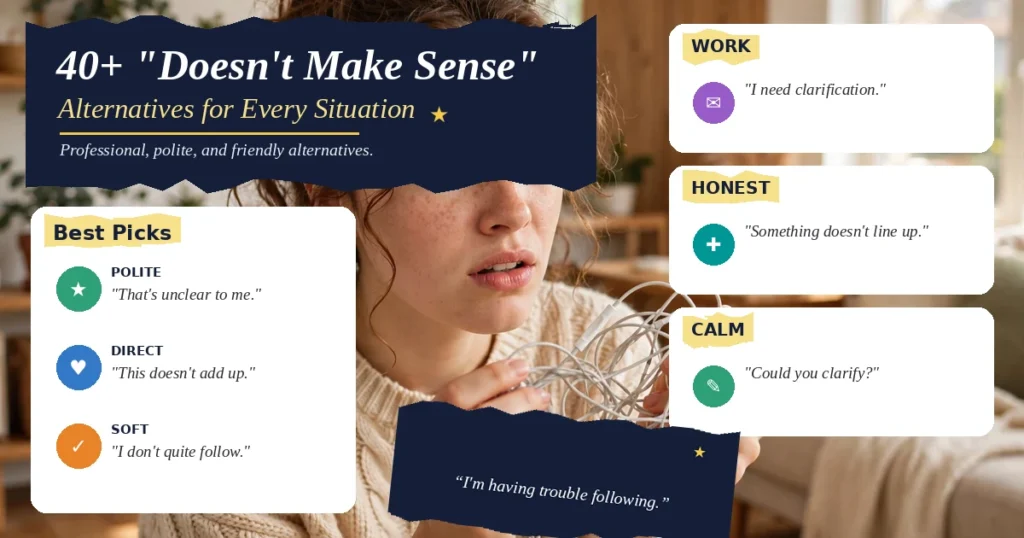
- “That’s unclear to me.” — Neutral and safe; best for emails and reports. Example: “The second paragraph is unclear to me.”
- “I can’t reconcile that.” — Thoughtful and precise; best for data conflicts. Example: “I can’t reconcile that with last quarter’s numbers.”
- “That seems inconsistent.” — Diplomatic; best for pointing out contradictions. Example: “That seems inconsistent with the policy you mentioned.”
- “I’m having trouble following.” — Humble; best for long explanations. Example: “I’m having trouble following — could you slow down a bit?”
- “That’s not quite clear.” — Soft; best for polite disagreement. Example: “The handoff plan is not quite clear yet.”
- “Something doesn’t line up.” — Investigative; best for audits and reviews. Example: “Something doesn’t line up between the two spreadsheets.”
- “I don’t quite follow.” — Conversational-professional; best for calls. Example: “Sorry, I don’t quite follow — what changed?”
- “That’s confusing to me.” — Honest; best when you want to admit confusion. Example: “The new workflow is confusing to me.”
- “I need clarification.” — Formal and clean; best for written requests. Example: “I need clarification on the deadline.”
- “That seems off.” — Casual-professional; best for quick flags. Example: “That estimate seems off — let me double-check.”
- “I’m not sure I follow the logic.” — Respectful; best for strategy talks. Example: “I’m not sure I follow the logic behind the rebrand.”
- “Could you walk me through that?” — Collaborative; best for complex topics. Example: “Could you walk me through that calculation?”
- “That raises questions for me.” — Tactful; best for proposals. Example: “The timeline raises questions for me.”
- “I can’t quite connect the dots.” — Visual and friendly; best for brainstorms. Example: “I can’t quite connect the dots between the survey and the decision.”
Formal
- “That appears illogical.” — Academic; best for written analysis. Example: “That conclusion appears illogical given the data.”
- “I find that perplexing.” — Elevated; best for formal letters. Example: “I find the sudden change perplexing.”
- “That lacks coherence.” — Analytical; best for document reviews. Example: “The argument lacks coherence in its final section.”
- “The reasoning eludes me.” — Literary; best for essays and speeches. Example: “The reasoning behind the veto eludes me.”
- “That seems contradictory.” — Precise; best for debates. Example: “That statement seems contradictory to your earlier point.”
- “I fail to see the connection.” — Formal-polite; best for official correspondence. Example: “I fail to see the connection between the two clauses.”
- “That is difficult to comprehend.” — Serious; best for legal and academic writing. Example: “The clause is difficult to comprehend as written.”
- “The logic escapes me.” — Classic; best for formal disagreement. Example: “The logic of that decision escapes me.”
- “That appears inconsistent.” — Measured; best for reports. Example: “That appears inconsistent with the stated goals.”
- “I find that difficult to reconcile.” — Diplomatic; best for negotiations. Example: “I find the new terms difficult to reconcile with our agreement.”
Friendly
- “That lost me.” — Casual and warm; best for friends and chats. Example: “Whoa, that lost me — start over?”
- “I’m not connecting the dots.” — Playful; best for relaxed conversations. Example: “I’m not connecting the dots here, help me out.”
- “Huh?” — Ultra-casual; best for texts and close friends. Example: “Huh? Say that again slowly.”
- “That’s a head-scratcher.” — Lighthearted; best for puzzling news. Example: “That’s a real head-scratcher, honestly.”
- “You lost me there.” — Friendly; best for storytelling. Example: “You lost me there — who called whom?”
- “That went over my head.” — Self-deprecating; best for jokes and jargon. Example: “That joke went right over my head.”
- “I’m drawing a blank.” — Honest; best for admitting confusion. Example: “I’m drawing a blank on how that works.”
- “That doesn’t track.” — Modern casual; best for group chats. Example: “That doesn’t track with what you said yesterday.”
- “My brain just glitched.” — Funny; best for friends. Example: “My brain just glitched — run that by me again.”
- “Say what?” — Playful; best for surprising statements. Example: “Say what? That’s wild.”
- “Could you clarify?” — The email classic; best for any formal message. Example: “Could you clarify what you meant by ‘phase two’?”
- “I’m having trouble following your point.” — Polite; best for long threads. Example: “I’m having trouble following your point in the third bullet.”
- “Could you help me understand?” — Humble; best for senior colleagues. Example: “Could you help me understand the new process?”
- “That point isn’t clear to me.” — Specific; best for feedback. Example: “That point about pricing isn’t clear to me.”
- “Would you mind explaining further?” — Courteous; best for first-time contacts. Example: “Would you mind explaining further how the discount applies?”
- “I want to make sure I understand.” — Thorough; best for clients. Example: “I want to make sure I understand — the launch is in June?”
- “Could you break that down for me?” — Practical; best for technical topics. Example: “Could you break that down for me in simpler terms?”
- “I may be missing something.” — Self-aware; best for avoiding blame. Example: “I may be missing something, but the dates don’t match.”
- “That part is unclear.” — Direct; best for document comments. Example: “That part about refunds is unclear.”
- “Could you elaborate?” — Professional; best for proposals. Example: “Could you elaborate on the risk section?”
When a confusing email is really a cry for support in disguise, it helps to ask directly whether they need your help untangling it.
Workplace
- “Let’s sanity-check this.” — Team-oriented; best for group reviews. Example: “Let’s sanity-check this plan before we ship it.”
- “Walk me through the logic.” — Collaborative; best for one-on-ones. Example: “Walk me through the logic of the new pricing.”
- “That doesn’t compute for me.” — Tech-flavored; best for engineering teams. Example: “That timeline doesn’t compute for me.”
- “Help me connect the dots.” — Engaging; best for presentations. Example: “Help me connect the dots between the research and the roadmap.”
- “I’m not tracking.” — Casual; best for standups. Example: “Sorry, I’m not tracking — which milestone slipped?”
- “Can we pressure-test that?” — Analytical; best for strategy sessions. Example: “Can we pressure-test that assumption?”
- “That needs unpacking.” — Modern; best for complex ideas. Example: “That last point needs unpacking — let’s dig in.”
- “Let’s take a step back.” — Calming; best for heated meetings. Example: “Let’s take a step back and revisit the goal.”
- “I’m missing the thread here.” — Honest; best for long discussions. Example: “I’m missing the thread here — what are we deciding?”
- “That doesn’t quite hold up.” — Challenging but fair; best for reviews. Example: “That argument doesn’t quite hold up under scrutiny.”
Quick comparison
| Alternative | Tone | Best use |
|---|---|---|
| “Could you clarify?” | Professional, polite | Emails and formal messages |
| “I don’t quite follow.” | Conversational | Calls and meetings |
| “That seems inconsistent.” | Diplomatic | Flagging contradictions |
| “I may be missing something.” | Humble | Avoiding blame |
| “Walk me through the logic.” | Collaborative | Complex topics |
| “That’s unclear to me.” | Neutral | Reports and documents |
| “That lost me.” | Friendly | Friends and chats |
| “The logic escapes me.” | Formal | Written analysis |
| “Let’s sanity-check this.” | Team-oriented | Group reviews |
| “I want to make sure I understand.” | Thorough | Client communication |
| “That doesn’t track.” | Modern casual | Group chats |
| “I find that perplexing.” | Elevated | Formal letters |
Email examples
To a client
“Thanks for the proposal. I want to make sure I understand — the monthly fee covers support, but onboarding is separate? Could you clarify?”
To a manager
“Hi, I’m having trouble following the new reporting structure. Could you walk me through it when you have a moment?”
To a colleague
“Hey, that part about the API limits is unclear to me. Could you break that down?”
To a customer
“Thanks for explaining. I may be missing something — could you help me understand what happened with your order?”
For networking
“That’s interesting — I’m not sure I follow. Could you say more about how the model works?”
For a meeting follow-up
“Following up on yesterday’s call: the timeline raises questions for me. Could we sanity-check the dates this week?”
When a follow-up email starts to sound impatient, pause and remember how to ask someone to be patient gracefully — confusion plus pressure is a bad mix.
Common mistakes
1. Saying it flat in writing
“That doesn’t make sense” in an email reads like an accusation. Always soften it: “Could you clarify?” costs nothing and keeps goodwill.
2. Using the blunt version with clients
Clients hear criticism of their judgment. Flip the framing to yourself: “I want to make sure I understand” keeps the client feeling respected.
3. Overusing “Huh?” at work
“Huh?” is perfect for friends and terrible for the boardroom. Match the alternative to the audience — casual lines stay in casual rooms.
4. Sounding sarcastic by accident
“Oh, that makes TOTAL sense” with emphasis reads as mockery. If you are confused, say so plainly instead of performing agreement.
5. Confusing the person with the idea
“You’re not making sense” attacks the speaker. “That point isn’t clear to me” attacks the problem. Always target the idea, never the person.
6. Asking for clarification without specifics
“I’m confused” alone helps nobody. Point at the exact spot: “The third paragraph is unclear to me” gets you a useful answer fast. And when someone does clear it up, take a second to thank them for taking care of it — gratitude makes the next confusing email easier.
Related phrases
- “I’m lost.” — Simple admission of confusion. Example: “I’m lost — can we restart from the top?”
- “That went over my head.” — Too complex to grasp. Example: “The technical details went over my head.”
- “I don’t get it.” — Plain and direct. Example: “I don’t get it — why two launches?”
- “That’s beyond me.” — Outside your knowledge. Example: “Quantum physics is beyond me.”
- “I’m confused.” — General uncertainty. Example: “I’m confused about the new schedule.”
- “That puzzles me.” — Gentle curiosity. Example: “That puzzles me — I expected growth.”
- “I can’t wrap my head around it.” — Struggling to comprehend. Example: “I can’t wrap my head around the new tax rules.”
- “That’s a mystery to me.” — Playful confusion. Example: “How they hit the deadline is a mystery to me.”
- “Beats me.” — Casual “I don’t know.” Example: “Why it failed? Beats me.”
- “I’m not following.” — Lost the thread. Example: “Sorry, I’m not following the argument.”
- “That’s Greek to me.” — Completely foreign. Example: “The legal jargon is Greek to me.”
- “I can’t make heads or tails of it.” — Total confusion. Example: “I can’t make heads or tails of this report.”
- “That baffles me.” — Stronger puzzlement. Example: “That decision baffles me.”
- “I’m at a loss.” — No explanation available. Example: “I’m at a loss for why sales dropped.”
- “That doesn’t sit right.” — Feels wrong intuitively. Example: “That explanation doesn’t sit right with me.”
- “I’m struggling to see how that works.” — Practical doubt. Example: “I’m struggling to see how that fits the budget.”
When confusion turns into frustration, it helps to first show you understand the other person’s frustration before asking them to explain again.
Phrase comparison
“Doesn’t make sense” is the blunt baseline — fast, honest, and slightly risky. “Could you clarify?” keeps the same request but wraps it in courtesy; it is the safest all-purpose replacement, especially in writing where tone disappears. “I don’t quite follow” sits in the middle: conversational, humble, and perfect for live conversations where a softer landing matters less than keeping pace.
The formal options like “The logic escapes me” add distance and polish — ideal for documents and debates, stiff for daily chat. The friendly options like “That lost me” do the opposite: they trade polish for warmth and work best with people who already like you. The real skill is not memorizing 55 lines but reading the room in two seconds: formal room, formal line; friendly room, friendly line. When in doubt, put the confusion on yourself — “I may be missing something” has never offended anyone.
Cultural usage
United States
Americans value directness, so “That doesn’t add up” and “I’m not tracking” feel natural in US workplaces. Softening is still appreciated in email, but nobody is shocked by a straightforward flag of confusion.
United Kingdom
British professionals lean more indirect. “I’m not sure I follow” and “That’s not quite clear” fit the UK preference for understatement — a blunt “that doesn’t make sense” can read as rude in a London meeting.
Corporate communication
Corporate writing favors the humble versions: “Could you clarify?”, “I want to make sure I understand.” They signal thoroughness, which companies reward, while the blunt version signals conflict, which they don’t.
Customer service
Service scripts almost always use “Help me understand” language. The customer is already confused or upset; mirroring their frustration with bluntness escalates. The soft alternatives de-escalate by design.
Networking
In networking, curiosity is currency. “That’s interesting — could you say more?” keeps a new contact talking. Admitting confusion gracefully can actually build rapport, because it shows you are listening. If you want a quick primer on other ways to say you understand, it pairs well with these lines — understanding and confusion are two sides of the same conversation.
Frequently asked questions
What’s a polite way to say “that doesn’t make sense”?
Try “Could you clarify?” or “I want to make sure I understand.” Both flag the confusion without criticizing the speaker, and they work in almost every professional situation.
How do you say “doesn’t make sense” professionally?
Use “That’s unclear to me,” “I’m having trouble following,” or “That seems inconsistent.” These keep the tone neutral and focus on the information, not the person delivering it.
Is it rude to say “that doesn’t make sense”?
It can be, especially in writing. Spoken with a friendly tone it is usually fine, but in emails and messages it often reads as blunt or dismissive. A softer alternative avoids the risk entirely.
What’s a formal alternative to “doesn’t make sense”?
“The logic escapes me,” “I find that perplexing,” or “That appears inconsistent.” These suit reports, formal letters, and academic writing where precision matters.
How do you tell a client something doesn’t make sense?
Put the confusion on yourself: “I want to make sure I understand — could you walk me through that?” Clients respond well to thoroughness and poorly to being corrected.
What’s a funny way to say “doesn’t make sense”?
“My brain just glitched” or “That doesn’t track” work with friends. Keep the comedy for casual settings — humor about confusion rarely lands in formal meetings.
How do you say it in an email without sounding rude?
Be specific and humble: “The second paragraph is unclear to me — could you clarify?” Specificity shows you read carefully, and humility keeps the tone warm.
What’s the difference between “doesn’t make sense” and “doesn’t add up”?
“Doesn’t make sense” is general confusion; “doesn’t add up” specifically suggests numbers or facts that contradict each other. Use “doesn’t add up” for data, budgets, and timelines.
Can I say “that doesn’t make sense” to my boss?
You can, but softer is smarter: “I’m not sure I follow the logic — could you walk me through it?” It shows respect while still getting you the explanation you need.
What’s a casual alternative for friends?
“That lost me,” “Huh?”, or “You lost me there.” Friends expect honesty, not polish, so the short playful versions work best.
How do you ask for clarification in a meeting?
Try “Could you walk me through that?” or “Let’s take a step back — I’m missing the thread here.” Both invite explanation without slowing the meeting down.
Is “I don’t understand” better than “that doesn’t make sense”?
Usually yes. “I don’t understand” owns the confusion, while “that doesn’t make sense” can sound like a verdict on the idea. Owning it is almost always the safer move.
What should you avoid when someone confuses you?
Avoid sarcasm, blame, and vague complaints. Don’t say “You’re not making sense” — say “That point isn’t clear to me.” And don’t just say “I’m confused” without pointing at what exactly lost you.
How do you handle it when a customer doesn’t make sense?
Stay calm and flip to service language: “Help me understand what happened.” Never tell a customer their story doesn’t make sense — it escalates every time.
What’s the best all-purpose alternative?
“Could you clarify?” It is short, polite, professional, and works in emails, meetings, and client calls. If you memorize only one replacement, make it this one.
Conclusion
The shortlist, if you only remember a few:
- Professional: “Could you clarify?” and “I don’t quite follow.”
- Formal: “The logic escapes me” and “That appears inconsistent.”
- Email: “I may be missing something” and “Could you break that down for me?”
- Workplace: “Let’s sanity-check this” and “Walk me through the logic.”
The real upgrade is not the vocabulary — it is the habit of putting confusion on yourself instead of the other person. That one shift turns a potential argument into a productive question, every single time. And when someone takes the time to untangle it for you, don’t forget to tell them you appreciate it — gratitude is the fastest way to get help next time too.
For the dictionary definition of the core phrase, see Cambridge Dictionary’s entry on “make sense”.




