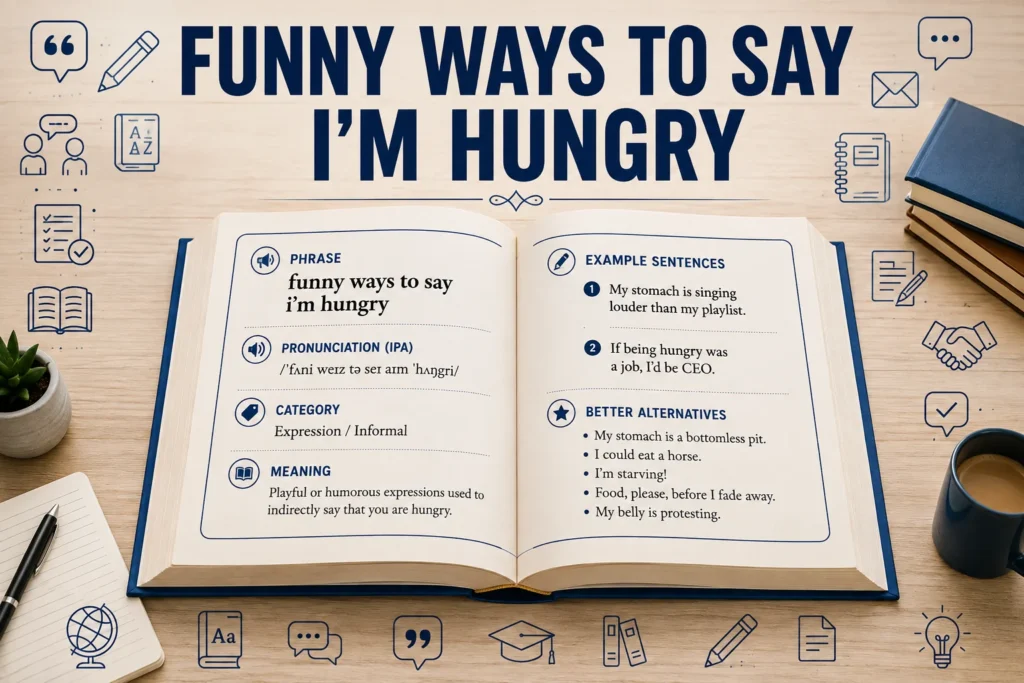
Funny ways to say I’m hungry can turn a simple statement into something playful, memorable, and conversational. Instead of repeatedly saying “I’m hungry,” you can use humor, exaggeration, idioms, or creative expressions to tell friends, coworkers, or family members that you need food.
The best expression depends on the situation. A funny phrase can work perfectly in a text to a friend, while a workplace conversation may need something lighter and more polite. In a client email or formal business message, humor about hunger may not fit at all, so a simple and professional sentence works better.
This guide provides 50 funny ways to say “I’m hungry,” along with meanings, tones, examples, and best-use situations. You will also find alternatives for casual conversations, workplace communication, emails, networking, customer service, and professional communication.
What Are Funny Ways to Say “I’m Hungry”?
Funny ways to say “I’m hungry” are playful expressions that communicate that you want or need food without using the standard phrase.
Some popular examples include:
- I’m starving.
- I could eat a horse.
- My stomach is growling.
- I’m running on empty.
- I need to feed the beast.
- My stomach has filed a formal complaint.
- I’m about to eat everything in sight.
- I’m dangerously close to becoming hangry.
- My stomach is asking for a refill.
- I need food before I start making questionable decisions.
Most of these expressions work best in casual conversation, texting, social media, and friendly workplace conversations. They are usually not appropriate for formal client emails unless you already have a relaxed relationship with the recipient.
Meaning of “I’m Hungry”
Literal Meaning
“I’m hungry” means you feel the physical need or desire to eat food.
For example:
“I’m hungry. Let’s get something to eat.”
It is direct, simple, and completely natural.
The phrase does not automatically sound funny, formal, casual, or emotional. Its tone depends mainly on the surrounding conversation.
Tone
“I’m hungry” is:
- Neutral
- Direct
- Everyday
- Informal to neutral
- Easy to understand
If you want humor, you can exaggerate the feeling:
“I’m so hungry I could eat the table.”
The speaker does not literally intend to eat the table. The exaggeration creates the joke.
Purpose
People use funny hunger expressions to:
- Make friends laugh.
- Add personality to a text.
- Break the ice.
- Express strong hunger.
- Make a casual conversation more entertaining.
- Tell someone it is time to eat.
- Lighten the mood.
- Avoid repeating “I’m hungry.”
Emotional Context
Hunger can also affect mood. Someone who has gone a long time without food may say:
“I’m getting hangry.”
“Hangry” combines hungry + angry. It describes the irritated or bad-tempered feeling that some people experience when they are very hungry.
Professional Usage of Funny Hunger Expressions
Funny hunger phrases do not belong in every professional situation. Good communication depends on knowing when humor helps and when it distracts.
Emails
A business email should usually avoid dramatic hunger jokes unless the message is informal and the relationship supports humor.
Casual:
“I’m getting hungry. Want to grab lunch?”
Professional:
“Would you like to join me for lunch?”
Very formal:
“Would you be available to join us for lunch?”
Workplace Communication
In a relaxed office, humorous expressions can create friendly interaction.
For example:
“My stomach is officially requesting lunch.”
This can work with a close colleague.
However, avoid phrases such as:
“I’m dying of hunger!”
during a formal meeting or serious discussion.
Clients
With clients, keep hunger-related humor light and appropriate.
Instead of:
“I’m starving. Let’s eat!”
use:
“Would you like to take a lunch break?”
If you have a very friendly relationship with the client, a light comment such as:
“I think we’ve earned a lunch break after that discussion.”
may sound natural.
Networking
Networking events often include food, so humor can help start conversations.
For example:
“I think the appetizers are calling my name.”
This sounds playful without being overly personal.
You could also say:
“I came for the networking, but I’m definitely staying for the food.”
That works especially well at casual professional events.
Customer Service
Customer service communication usually requires more restraint.
Avoid:
“I’m starving!”
when speaking to a customer.
Instead, if discussing a meal or restaurant:
“That sounds like a great choice.”
or:
“I think it’s almost time for a lunch break.”
Customer-facing communication should prioritize clarity, courtesy, and professionalism.
Funny Ways to Say “I’m Hungry”
Below are 50 expressions grouped by communication style. Some are humorous rather than exact synonyms, so use them according to the situation.
Professional and Lightly Humorous Alternatives
These options add personality without becoming too silly. They work well with friendly colleagues and casual professional communication.
1. I’m getting pretty hungry.
Meaning: You are beginning to feel hungry.
Tone: Mild, friendly, professional.
Best use: Workplace conversations.
Example:
“I’m getting pretty hungry. Should we grab lunch soon?”
2. I think it’s time for lunch.
Meaning: You are ready to eat.
Tone: Polite and practical.
Best use: Workplace or professional settings.
Example:
“I think it’s time for lunch. Would you like to join me?”
3. I could really use some food.
Meaning: You want something to eat.
Tone: Casual and understated.
Best use: Colleagues and friends.
Example:
“I could really use some food after that meeting.”
4. I’m ready for a meal.
Meaning: You are prepared to eat.
Tone: Neutral and polite.
Best use: Workplace or social situations.
Example:
“I’m ready for a meal whenever you are.”
5. I could definitely eat something.
Meaning: You would like some food.
Tone: Mild and conversational.
Best use: Casual workplace conversations.
Example:
“I could definitely eat something before we continue.”
6. I’m due for a food break.
Meaning: You have been working long enough and need food.
Tone: Light and slightly humorous.
Best use: Workplace.
Example:
“I’m definitely due for a food break.”
7. My lunch alarm is going off.
Meaning: You feel it is time to eat.
Tone: Playful.
Best use: Friendly coworkers.
Example:
“My lunch alarm is going off. Want to come along?”
8. I think my stomach has spoken.
Meaning: Your hunger is telling you to eat.
Tone: Lightly humorous.
Best use: Friends and coworkers.
Example:
“I think my stomach has spoken. It wants pizza.”
9. Food sounds like an excellent idea right now.
Meaning: You strongly want food.
Tone: Polite and playful.
Best use: Workplace or casual conversation.
Example:
“Food sounds like an excellent idea right now.”
10. I’m ready to refuel.
Meaning: You need food to restore your energy.
Tone: Modern and playful.
Best use: Work, fitness, travel.
Example:
“I’ve been working since morning. I’m ready to refuel.”
11. I need to recharge—with food.
Meaning: You need food to regain energy.
Tone: Playful and modern.
Best use: Friends and colleagues.
Example:
“My battery is at 10%. I need to recharge—with food.”
12. I’m running low on fuel.
Meaning: You are becoming hungry and losing energy.
Tone: Light humor.
Best use: Workplace, travel, casual conversation.
Example:
“I’m running low on fuel. Let’s grab something.”
13. My energy tank is almost empty.
Meaning: You need food and energy.
Tone: Playful.
Best use: Friends or coworkers.
Example:
“My energy tank is almost empty after that workout.”
14. I’m ready for some serious nourishment.
Meaning: You want a substantial meal.
Tone: Playfully formal.
Best use: Humor with friends.
Example:
“I’m ready for some serious nourishment.”
15. I could use a food-powered productivity boost.
Meaning: You believe eating will improve your energy and focus.
Tone: Professional humor.
Best use: Workplace.
Example:
“I could use a food-powered productivity boost before the next meeting.”
Formal and Playfully Formal Alternatives
These expressions create humor by making hunger sound like an official or serious matter.
16. I appear to require immediate nourishment.
Meaning: You need food soon.
Tone: Mock-formal and humorous.
Best use: Friends and humorous workplace conversations.
Example:
“I appear to require immediate nourishment.”
17. My nutritional needs have become rather urgent.
Meaning: You are very hungry.
Tone: Mock-formal.
Best use: Humor.
Example:
“My nutritional needs have become rather urgent.”
18. I believe refreshments are now necessary.
Meaning: You think it is time for food or drinks.
Tone: Formal-sounding and humorous.
Best use: Playful conversation.
Example:
“After three hours of meetings, I believe refreshments are now necessary.”
19. I would like to formally request lunch.
Meaning: You want to eat lunch.
Tone: Mock-formal.
Best use: Colleagues and friends.
Example:
“I would like to formally request lunch at your earliest convenience.”
20. My stomach has submitted a formal complaint.
Meaning: You are very hungry.
Tone: Funny and exaggerated.
Best use: Texting and workplace humor.
Example:
“My stomach has submitted a formal complaint. We need lunch.”
21. An immediate food intervention may be required.
Meaning: You need food soon.
Tone: Mock-serious.
Best use: Friends or humorous office conversations.
Example:
“An immediate food intervention may be required.”
22. I am experiencing a significant shortage of snacks.
Meaning: You want food or snacks.
Tone: Playfully formal.
Best use: Casual messages.
Example:
“I am experiencing a significant shortage of snacks.”
23. I have reached a critical hunger level.
Meaning: You are extremely hungry.
Tone: Dramatic and humorous.
Best use: Friends and social media.
Example:
“I have reached a critical hunger level. Pizza is now essential.”
24. My food reserves are dangerously low.
Meaning: You have not eaten enough recently.
Tone: Playfully dramatic.
Best use: Casual conversation.
Example:
“My food reserves are dangerously low.”
25. Further delay may result in hunger-related complications.
Meaning: You need food soon.
Tone: Mock-professional.
Best use: Friends and coworkers.
Example:
“Further delay may result in hunger-related complications, so let’s order lunch.”
Friendly and Funny Alternatives
These are more casual and work best with friends, family, and people who understand your humor.
26. I’m starving!
Meaning: You are extremely hungry.
Tone: Casual and dramatic.
Best use: Everyday conversation.
Example:
“I’m starving! Let’s get burgers.”
“Starving” is an exaggeration. It normally means you are very hungry, not that you are literally without food.
27. I could eat a horse.
Meaning: You are extremely hungry.
Tone: Funny, exaggerated, idiomatic.
Best use: Casual conversations.
Example:
“I skipped breakfast. I could eat a horse.”
28. My stomach is growling.
Meaning: Your stomach is making noises because you are hungry.
Tone: Casual and descriptive.
Best use: Everyday conversation.
Example:
“My stomach is growling. Can we eat?”
29. I’m getting hangry.
Meaning: You are hungry and becoming irritated.
Tone: Very casual and humorous.
Best use: Friends and family.
Example:
“Feed me soon. I’m getting hangry.”
30. Feed me!
Meaning: You urgently want food.
Tone: Playful and dramatic.
Best use: Close friends and family.
Example:
“I haven’t eaten all day. Feed me!”
31. My stomach is eating itself.
Meaning: You feel extremely hungry.
Tone: Dramatic and humorous.
Best use: Casual texting.
Example:
“My stomach is eating itself. Where are we going for dinner?”
32. I’m one snack away from happiness.
Meaning: Food would immediately improve your mood.
Tone: Playful and light.
Best use: Friends and social media.
Example:
“I’m one snack away from happiness.”
33. I need food before I become a different person.
Meaning: You are extremely hungry and may become irritable.
Tone: Funny and dramatic.
Best use: Friends.
Example:
“Someone find me food before I become a different person.”
34. My stomach is calling.
Meaning: Your body is telling you it is time to eat.
Tone: Friendly and simple.
Best use: Casual conversation.
Example:
“My stomach is calling. Let’s grab something.”
35. I’m ready to attack the menu.
Meaning: You are very hungry and ready to order food.
Tone: Funny and energetic.
Best use: Restaurants and friends.
Example:
“I’m ready to attack the menu.”
Email-Friendly and Casual Message Alternatives
These work particularly well in texts, casual emails, group chats, and informal invitations.
36. Should we solve this hunger problem?
Meaning: You want to find food.
Tone: Playful.
Best use: Friends and colleagues.
Example:
“Should we solve this hunger problem and grab lunch?”
37. I think lunch is calling my name.
Meaning: You feel ready for lunch.
Tone: Friendly and humorous.
Best use: Texts and workplace chats.
Example:
“I think lunch is calling my name. Want to join?”
38. I’m in desperate need of snacks.
Meaning: You strongly want something to eat.
Tone: Playfully dramatic.
Best use: Casual messages.
Example:
“I’m in desperate need of snacks. Any recommendations?
39. Food is currently my top priority.
Meaning: You really want food.
Tone: Funny and direct.
Best use: Casual messages.
Example:
“Food is currently my top priority.”
40. I’m thinking about food way too much.
Meaning: You are hungry because food is constantly on your mind.
Tone: Friendly and relatable.
Best use: Texting and social media.
Example:
“I’m thinking about food way too much. Let’s order something.”
41. My brain has officially switched to food mode.
Meaning: You are so hungry that you are focused on eating.
Tone: Modern and playful.
Best use: Messages and social media.
Example:
“My brain has officially switched to food mode.”
42. I’m ready to make a serious food decision.
Meaning: You are ready to choose and eat something.
Tone: Light and humorous.
Best use: Friends and colleagues.
Example:
“I’m ready to make a serious food decision. Pizza or tacos?”
43. Can we make food happen?
Meaning: You want to arrange a meal.
Tone: Casual and friendly.
Best use: Texting or informal workplace chat.
Example:
“Can we make food happen around 1?”
44. Let’s turn this hunger into lunch.
Meaning: You want to stop being hungry by eating lunch.
Tone: Playful.
Best use: Friends and colleagues.
Example:
“Let’s turn this hunger into lunch.”
45. I vote for food.
Meaning: You strongly support getting something to eat.
Tone: Short, funny, casual.
Best use: Group conversations.
Example:
“What should we do after work? I vote for food.”
Workplace-Safe Funny Alternatives
46. I think my productivity needs lunch.
Meaning: You need food to restore energy.
Tone: Professional humor.
Best use: Colleagues.
Example:
“I think my productivity needs lunch.”
47. My concentration could use a snack.
Meaning: You want food to regain focus.
Tone: Mild and professional.
Best use: Workplace.
Example:
“My concentration could use a snack before the next task.”
48. I’m approaching lunch-level hunger.
Meaning: You are becoming hungry around lunchtime.
Tone: Light humor.
Best use: Office conversations.
Example:
“I’m approaching lunch-level hunger. Anyone else?”
49. I’m operating on an empty stomach.
Meaning: You have not eaten and are working without food.
Tone: Neutral with a slight humorous edge.
Best use: Workplace or casual conversation.
Example:
“I’m operating on an empty stomach, so I may need a coffee and lunch soon.”
50.I think my stomach deserves a meeting.
Meaning: You need to stop working and eat.
Tone: Funny and playful.
Best use: Close colleagues.
Example:
“I think my stomach deserves a meeting with the lunch menu.”
Quick Comparison Table
| Alternative | Tone | Best Use |
| I’m starving | Casual | Friends |
| I’m getting hungry | Neutral | General conversation |
| I’m getting hangry | Funny | Friends |
| I could eat a horse | Exaggerated | Casual conversation |
| Feed me! | Playful | Close friends |
| My stomach is growling | Casual | Everyday conversation |
| My stomach is calling | Friendly | Friends and coworkers |
| I’m running low on fuel | Playful | Workplace |
| I’m ready to refuel | Professional | Work and travel |
| I need to recharge—with food | Funny | Colleagues |
| Food is my top priority | Humorous | Casual messages |
| Lunch is calling my name | Friendly | Texts |
| I vote for food | Funny | Group chats |
| Can we make food happen? | Casual | Friends |
| I could use some food | Neutral | Workplace |
| I’m ready for a meal | Polite | Professional |
| I think it’s time for lunch | Professional | Workplace |
| My stomach has spoken | Playful | Friends |
| My stomach filed a complaint | Funny | Colleagues |
| I need immediate nourishment | Mock-formal | Humor |
| My food reserves are low | Dramatic | Friends |
| I need a food intervention | Humorous | Casual |
| I’ve reached critical hunger | Dramatic | Friends |
| My brain is in food mode | Modern | Social media |
| I’m ready to attack the menu | Funny | Restaurants |
| I’m one snack from happiness | Playful | Friends |
| My concentration needs a snack | Workplace-safe | Colleagues |
| My productivity needs lunch | Workplace humor | Office |
| I’m operating on an empty stomach | Neutral | Work |
| I think my stomach deserves lunch | Funny | Colleagues |
Email Examples
Humor works differently depending on the recipient. Here are practical examples.
Client
Avoid overly casual hunger jokes with a new client.
Better:
Hi Sarah,
We’ve made great progress today. Would you like to take a short lunch break before we continue?
Best,
James
If your client relationship is very relaxed:
“I think we’ve earned a lunch break after that productive discussion!”
Manager
A casual internal message can use mild humor:
“I’m running low on fuel. Would it be okay if I took a short lunch break?”
This keeps the humor subtle while remaining professional.
Colleague
“My stomach has officially filed a complaint. Want to grab lunch?”
This works well with a coworker you know.
Customer
Customer-facing communication should remain professional:
“Would you like me to help you find a nearby lunch option?”
Avoid:
“I’m starving too!”
unless the conversation is clearly casual and appropriate.
Networking
At an informal networking event:
“I came here to meet new people, but I have to admit the food is helping.”
This can create a natural opening for conversation.
Meeting Follow-Up
For a casual internal meeting:
“Thanks everyone for the productive discussion. I think we’ve earned a lunch break!”
For a client:
“Thank you for the productive meeting today. We appreciate your time and look forward to continuing the conversation.”
Notice the difference. Professional communication should match the audience.
Common Mistakes
1. Overusing the Same Joke
If you always say:
“I’m starving!”
the expression quickly loses its humor.
Rotate between:
- “I’m running low on fuel.”
- “My stomach is calling.”
- “I’m ready to refuel.”
- “Food is currently my top priority.”
- “I’m getting hangry.”
2. Using Humor With the Wrong Audience
A joke that works with your best friend may not work with a senior manager or client.
Before using a funny expression, consider:
Do I know this person well enough for this tone?
If not, choose a neutral phrase.
3. Being Too Dramatic
“I’m literally dying of hunger” is common hyperbole, but it can sound excessive in professional settings.
Use:
“I’m getting pretty hungry.”
instead.
4. Using Too Much Casual Language at Work
Expressions like:
“Feed me!”
are usually inappropriate in formal workplace communication.
A better workplace alternative is:
“I think it’s time for a lunch break.”
5. Forgetting Email Etiquette
Humor can disappear when written because the reader cannot hear your voice or see your facial expression.
For example:
“Feed me 😂”
may be funny between friends but confusing in a business email.
When using humor in written professional communication, keep it obvious, mild, and relevant.
6. Using a Joke With a Client
Clients generally expect clarity and professionalism.
Instead of:
“I’m starving. Let’s eat!”
say:
“Would you like to take a lunch break?”
7. Confusing “Hungry” With “Hangry”
“Hunger” describes the need for food.
“Hangry” specifically suggests that hunger is affecting your mood.
For example:
“I’m hungry.”
is neutral.
“I’m getting hangry.”
suggests that you are becoming irritated.
Related Phrases
1. I’m starving.
Means you are extremely hungry.
“I skipped breakfast, and I’m starving.”
2. I’m getting hangry.
Means hunger is making you irritated.
“Let’s eat before I get hangry.”
3. I could eat a horse.
Means you are extremely hungry.
“I haven’t eaten since morning. I could eat a horse.”
4. My stomach is growling.
Means your stomach is making hunger noises.
“My stomach is growling during this meeting.”
5. I’m running on empty.
Means your energy is nearly gone.
“I’ve been working all morning and I’m running on empty.”
6. I need to refuel.
Means you need food to restore energy.
“Let’s stop somewhere so I can refuel.”
7. Food is calling my name.
Means you strongly want food.
“That pizza is calling my name.”
8. I need a snack.
Means you want a small amount of food.
“I need a snack before we leave.”
9. I need something to eat.
A simple alternative to “I’m hungry.”
“I need something to eat before the meeting.”
10. I’m ready for lunch.
Means you are prepared to eat lunch.
“I’m ready for lunch whenever you are.”
11. My stomach is empty.
Means you have not eaten enough.
“My stomach is empty after that long trip.”
12. I need some fuel.
A metaphor for needing food and energy.
“I need some fuel before the gym.”
13. I’m craving something.
Means you strongly want a particular food or type of food.
“I’m craving something spicy.”
14. I’m in the mood for food.
A playful way to say you want to eat.
“I’m definitely in the mood for food.”
15. I need a food break.
Means you want to stop working or doing an activity to eat.
“I think we need a food break.”
16. Let’s grab a bite.
Means let’s get something to eat.
“Do you want to grab a bite after work?”
17. Let’s get something to eat.
A direct and natural invitation.
“Let’s get something to eat before the movie.”
18. I’m ready to eat.
Means you are prepared for a meal.
“I’m ready to eat. Where should we go?”
Phrase Comparison
| Phrase | Tone | Formality | Best Use |
| I’m hungry | Neutral | Medium | Any general situation |
| I’m starving | Dramatic | Low | Friends and casual talk |
| I’m getting hangry | Funny | Low | Close friends |
| I could eat a horse | Exaggerated | Low | Casual conversation |
| I’m running low on fuel | Playful | Medium | Workplace and casual |
| I need to refuel | Professional | Medium-High | Work, travel, fitness |
| I could use some food | Neutral | Medium | Workplace |
| I think it’s time for lunch | Polite | High | Work and business |
| My stomach is calling | Friendly | Medium | Friends and coworkers |
| My stomach filed a complaint | Humorous | Low-Medium | Casual workplace |
| I need immediate nourishment | Mock-formal | Low | Jokes |
| Food is my top priority | Funny | Low-Medium | Friends and social media |
| I vote for food | Casual | Low | Groups and chats |
| My brain is in food mode | Modern | Low | Social media and texting |
| I need a food break | Practical | Medium | Workplace |
Cultural Usage
US English
American English commonly uses humorous exaggeration.
Examples include:
- “I’m starving.”
- “I could eat a horse.”
- “I’m getting hangry.”
- “I’m ready to eat.”
- “Let’s grab a bite.”
“Hangry” is especially common in casual American English.
UK English
British speakers also use phrases such as:
- “I’m starving.”
- “I’m getting peckish.”
- “I could eat a horse.”
- “Let’s grab some food.”
“Peckish” is a useful British English expression meaning slightly hungry.
Example:
“I’m feeling a bit peckish. Fancy getting something to eat?”
This sounds natural in informal British English.
Corporate Communication
Corporate communication usually favors subtle humor.
Good choices include:
“I think it’s time for lunch.”
“I’m running low on fuel.”
“I could use a quick food break.”
“I think we’ve earned a lunch break.”
Avoid overly dramatic expressions when communicating with executives, clients, or unfamiliar colleagues.
Customer Service
Customer service requires professionalism and empathy.
Instead of talking extensively about your own hunger, focus on the customer’s needs.
If you’re helping a customer choose food:
“That’s a popular choice.”
If you work in a restaurant:
“I’d be happy to help you choose something from the menu.”
The phrase “I’m starving” rarely adds value to a customer interaction.
Networking
Networking provides more room for light humor.
For example:
“I think the food table is becoming my new networking strategy.”
This can create a conversation without making the interaction too personal.
Another option:
“The appetizers definitely caught my attention.”
This sounds friendly while remaining suitable for a professional event.
FAQs
What are some funny ways to say “I’m hungry”?
You can say “I’m getting hangry,” “I could eat a horse,” “my stomach is calling,” “I’m running low on fuel,” “feed me,” or “my stomach has filed a formal complaint.”
What is a funny way to say you are very hungry?
“I could eat a horse” is a classic humorous expression. “I’ve reached a critical hunger level” is another playful option.
What is a slang word for hungry?
“Hangry” is a common slang term. It combines “hungry” and “angry” and describes hunger that affects your mood.
What is a funny way to say “I’m starving”?
Try “My food reserves are dangerously low,” “my stomach has filed a complaint,” or “I’m approaching critical hunger levels.”
What is a professional way to say “I’m hungry”?
A professional way to say it is “I could use some food,” “I’m ready for lunch,” “I think it’s time for a lunch break,” or “I’m ready for a meal.”
What is a formal alternative to “I’m hungry”?
There is no need for a highly formal synonym in most professional communication. “I’m ready for a meal” or “I would appreciate a lunch break” works better than an unnatural formal synonym.
What is a funny way to say “Let’s eat”?
You can say “Let’s solve this hunger problem,” “I vote for food,” “Let’s turn this hunger into lunch,” or “Can we make food happen?”
Can I use funny ways to say “I’m hungry” at work?
Yes, but use mild humor with people you know well. “I’m running low on fuel” or “I think we’ve earned a lunch break” is safer than “Feed me!”
Should I use funny hunger phrases in a business email?
Usually, keep business emails professional. Humor can work in an informal internal message, but avoid it with new clients or formal business contacts.
What is the best synonym for “I’m hungry”?
The closest simple alternatives are “I need something to eat,” “I’m ready for a meal,” “I’m feeling peckish,” and “I could use some food.” The best choice depends on your audience and level of formality.
Final Summary
Best Professional Options
For professional communication, choose:
- I could use some food.
- I’m ready for a meal.
- I think it’s time for lunch.
- I’m ready to refuel.
- I’m running low on fuel.
- I could definitely eat something.
These expressions work well in workplace communication without sounding overly casual.
Best Formal Options
For formal or mock-formal humor:
- I appear to require immediate nourishment.
- My nutritional needs have become rather urgent.
- I believe refreshments are now necessary.
- I would like to formally request lunch.
- An immediate food intervention may be required.
Use these mainly for humor, not as serious business email phrases.
Best Casual Options
For friends and family:
- I’m starving!
- I’m getting hangry.
- I could eat a horse.
- Feed me!
- My stomach is calling.
- I’m ready to attack the menu.
- Food is currently my top priority.
- I need food before I become a different person.
Best Email Options
For informal messages:
- I think lunch is calling my name.
- Should we solve this hunger problem?
- Can we make food happen?
- I vote for food.
- Let’s turn this hunger into lunch.
- I’m in desperate need of snacks.
For formal emails, use straightforward wording instead.
Best Workplace Options
- I’m running low on fuel.
- I’m ready to refuel.
- I could use a food break.
- I think it’s time for lunch.
- My concentration could use a snack.
- I think my productivity needs lunch.
- I’m approaching lunch-level hunger.
The most important rule is to match your humor to your audience. Funny hunger expressions are excellent for casual conversations, texts, and friendly colleagues, but professional communication and client messages usually require a more measured tone.
Conclusion
There are many funny ways to say “I’m hungry,” from classic expressions like “I could eat a horse” to modern phrases like “my brain has switched to food mode.” The right choice depends on your relationship with the listener and the setting. Friends usually welcome dramatic humor, while coworkers may prefer light expressions such as “I’m running low on fuel.” In client emails and formal professional communication, simple phrases like “I’m ready for lunch” work better. When you understand tone, context, and email etiquette, you can make your language more natural, funny, and appropriate without forcing the joke.