
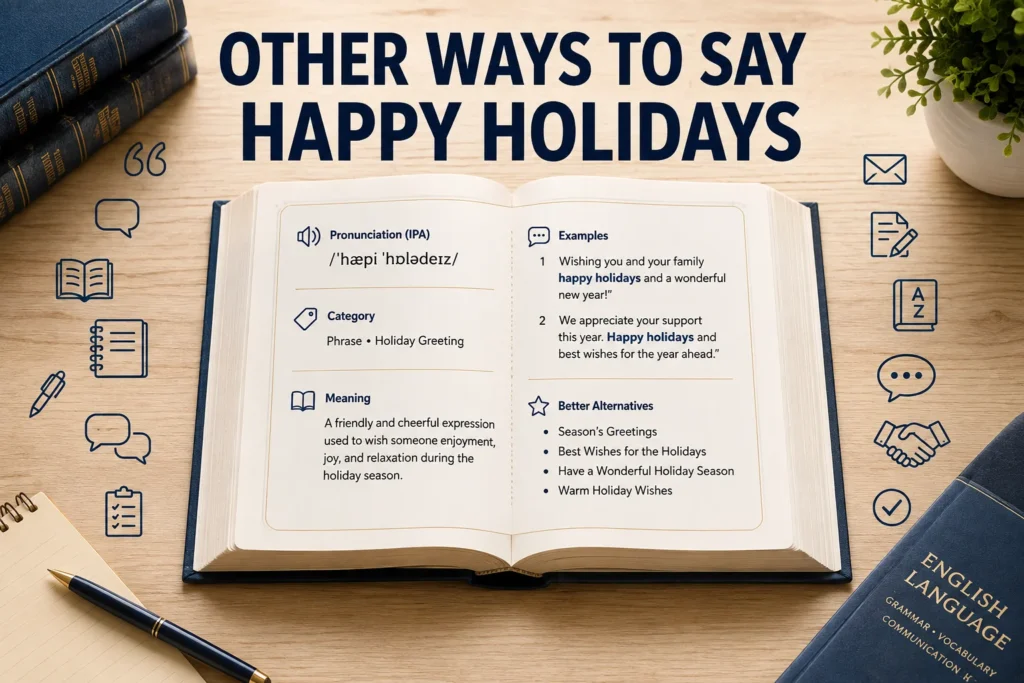
Finding the right words for a holiday message can be harder than it seems. “Happy Holidays” is warm, polite, and widely understood, but it may not fit every business email, workplace message, client conversation, or professional relationship.
If you are looking for other ways to say Happy Holidays, the best alternative depends on your audience and the tone you want to create. A message to a close colleague can be friendly and relaxed, while a message to a client or senior manager may need to sound polished and professional.
This guide provides professional, formal, friendly, and email-ready alternatives you can use in modern workplace communication. You will also find practical examples for clients, managers, colleagues, customers, networking contacts, and business emails.
Whether you need a professional way to say Happy Holidays, a formal alternative to Happy Holidays, or a warm phrase for a casual message, the examples below will help you choose the right expression.
What Does “Happy Holidays” Mean?
“Happy Holidays” is a general seasonal greeting used to wish someone happiness, peace, enjoyment, or good times during a holiday period.
The word “holidays” makes the phrase broad rather than referring to one specific holiday. This makes it useful when you do not know which holiday someone celebrates or when you are communicating with a diverse group.
Literal Meaning
The phrase essentially means:
“I hope you have a happy and enjoyable holiday season.”
It is a positive wish rather than a formal statement.
Tone
“Happy Holidays” usually sounds:
- Warm
- Polite
- Friendly
- Inclusive
- Positive
- Moderately professional
It can work in both personal and professional settings.
Purpose
People commonly use the phrase to:
- End an email before a holiday break
- Thank customers for their support
- Wish colleagues well
- Send seasonal greetings to clients
- Close a business message
- Start a holiday card
- Connect with professional contacts
Emotional Context
The phrase communicates goodwill. It can show appreciation without becoming overly personal.
For example:
Simple:
Happy Holidays! I hope you enjoy the season.
Professional:
Wishing you a wonderful holiday season and continued success in the new year.
Friendly:
Happy Holidays! Hope you have a relaxing and joyful break.
When Is “Happy Holidays” Appropriate in Professional Communication?
“Happy Holidays” is generally suitable when you want a warm seasonal greeting without naming a specific holiday.
However, the best wording depends on your relationship with the recipient.
1. In Business Emails
You can use “Happy Holidays” near the end of an email, especially during December or another holiday period.
Example:
Thank you for your continued partnership this year. Happy Holidays, and I look forward to working with you again in the new year.
For a more polished business email, consider:
Wishing you a wonderful holiday season and a successful year ahead.
2. In the Workplace
The phrase works well when addressing colleagues, teams, or employees.
Example:
Happy Holidays, everyone! Thank you for all your hard work this year.
If you want a more professional tone:
Wishing everyone a peaceful holiday season and a well-deserved break.
3. With Clients
Client communication usually benefits from appreciation and professionalism.
Instead of simply saying:
Happy Holidays!
You could write:
Thank you for your continued trust and partnership. Wishing you a wonderful holiday season.
This approach makes the message feel more personal without becoming too informal.
4. In Networking
A holiday greeting can be a natural way to reconnect with a professional contact.
Example:
It was great connecting with you this year. Wishing you a wonderful holiday season and continued success in the year ahead.
This is especially useful when you want to maintain a professional relationship.
5. In Customer Service
Customer-facing communication should remain warm but respectful.
Example:
Thank you for choosing us. We wish you a joyful holiday season and look forward to serving you again soon.
This sounds more customer-focused than simply writing “Happy Holidays.”
Other Ways to Say Happy Holidays
Below are practical alternatives grouped by tone and situation. Some expressions can fit more than one category, but each group highlights its strongest use.
Professional Alternatives
1. Wishing You a Wonderful Holiday Season
Meaning: A warm wish for an enjoyable holiday period.
Tone: Professional and friendly
Best use: Clients, colleagues, business emails
Example:
Wishing you a wonderful holiday season and a successful new year.
2. Best Wishes for the Holiday Season
Meaning: You are sending your good wishes for the holidays.
Tone: Polished and professional
Best use: Business correspondence
Example:
Best wishes for the holiday season to you and your team.
3. Wishing You a Joyful Holiday Season
Meaning: You hope the recipient experiences happiness during the holidays.
Tone: Warm and professional
Best use: Clients and colleagues
Example:
Wishing you a joyful holiday season filled with peace and happiness.
4. Warm Wishes for the Holidays
Meaning: A sincere and friendly seasonal greeting.
Tone: Warm and polished
Best use: Emails, cards, clients
Example:
Warm wishes for the holidays and the year ahead.
5. Season’s Greetings
Meaning: A traditional general holiday greeting.
Tone: Professional and neutral
Best use: Business cards, emails, corporate messages
Example:
Season’s Greetings from everyone at our team.
6. Wishing You a Happy Holiday Season
Meaning: A slightly fuller version of “Happy Holidays.”
Tone: Polite and professional
Best use: General business communication
Example:
Wishing you a happy holiday season and a wonderful start to the new year.
7. Have a Wonderful Holiday
Meaning: You hope the recipient enjoys their holiday.
Tone: Friendly and professional
Best use: Colleagues and clients
Example:
Thank you for your support this year. Have a wonderful holiday!
8. Enjoy the Holiday Season
Meaning: A simple wish for the recipient to enjoy the season.
Tone: Friendly and professional
Best use: Workplace communication
Example:
Enjoy the holiday season, and thank you for everything you have contributed this year.
9. Wishing You Peace and Joy This Holiday Season
Meaning: A sincere wish for happiness and peace.
Tone: Warm and professional
Best use: Clients, employees, partners
Example:
Wishing you peace and joy this holiday season and success in the coming year.
10. Best Wishes for a Joyful Holiday Season
Meaning: A formal but warm holiday greeting.
Tone: Professional
Best use: Business cards and formal emails
Example:
Best wishes for a joyful holiday season to you and your family.
11. Wishing You a Season of Joy
Meaning: You hope the holiday period brings happiness.
Tone: Warm and polished
Best use: Greeting cards and professional messages
Example:
Wishing you a season of joy and a bright year ahead.
12. Warmest Wishes This Holiday Season
Meaning: A more heartfelt version of a seasonal greeting.
Tone: Warm and professional
Best use: Clients and business partners
Example:
Our warmest wishes this holiday season, with sincere thanks for your partnership.
13. Wishing You a Wonderful Festive Season
Meaning: A wish for an enjoyable festive period.
Tone: Professional and warm
Best use: International business communication
Example:
Wishing you a wonderful festive season and continued success in the new year.
14. With Best Wishes for the Holidays
Meaning: A polished closing expression.
Tone: Professional
Best use: Email signatures and business correspondence
Example:
With best wishes for the holidays,
The Marketing Team
15. Wishing You All the Best This Holiday Season
Meaning: You are expressing general goodwill during the holidays.
Tone: Professional and friendly
Best use: Colleagues, clients, networking contacts
Example:
Wishing you all the best this holiday season and in the year ahead.
Formal Alternatives
When your message is going to a senior executive, important client, formal business contact, or large organization, a more polished expression may be appropriate.
16. Season’s Best Wishes
Tone: Formal and concise
Example:
Season’s best wishes to you and your colleagues.
17. Best Wishes for the Festive Season
Tone: Formal and elegant
Example:
Best wishes for the festive season and the coming year.
18. Our Best Wishes for the Holiday Season
Tone: Corporate and formal
Example:
Our best wishes for the holiday season and continued success in the new year.
19. With Warmest Regards for the Holiday Season
Tone: Formal and respectful
Example:
With warmest regards for the holiday season and our sincere appreciation for your partnership.
20. Wishing You a Peaceful Holiday Season
Tone: Formal and thoughtful
Example:
Wishing you a peaceful holiday season and a prosperous year ahead.
21. May Your Holiday Season Be Filled With Joy
Tone: Formal and heartfelt
Example:
May your holiday season be filled with joy, peace, and meaningful moments.
22. Best Wishes for the Coming Year
Tone: Formal
Best use: Business correspondence where you also want to mention the new year
Example:
Thank you for your partnership. Best wishes for the coming year.
23. Wishing You a Prosperous New Year
Tone: Formal and business-focused
Example:
Wishing you a peaceful holiday season and a prosperous new year.
24. With Sincere Holiday Wishes
Tone: Formal and respectful
Example:
With sincere holiday wishes and appreciation for your continued support.
25. Our Sincere Wishes for the Season
Tone: Formal and corporate
Example:
Please accept our sincere wishes for the season and the year ahead.
Friendly Alternatives
If you are writing to someone you know well, you can make the message more relaxed.
26. Have a Great Holiday!
Tone: Casual and cheerful
Example:
Thanks for all your help this year. Have a great holiday!
27. Enjoy Your Holiday Break!
Tone: Friendly and relaxed
Example:
You’ve earned it—enjoy your holiday break!
28. Have a Wonderful Break!
Tone: Casual and warm
Example:
Have a wonderful break, and I’ll see you in the new year!
29. Hope You Have a Fantastic Holiday!
Tone: Cheerful and personal
Example:
Hope you have a fantastic holiday with your loved ones!
30. Enjoy the Festivities!
Tone: Friendly and upbeat
Example:
Enjoy the festivities, and see you next year!
31. Have a Joyful Holiday!
Tone: Friendly
Example:
Have a joyful holiday and a fantastic start to the new year!
32. Have a Relaxing Holiday!
Tone: Friendly and caring
Example:
You’ve worked hard all year. Have a relaxing holiday!
33. Hope You Enjoy the Season!
Tone: Casual and positive
Example:
Thanks again for everything. Hope you enjoy the season!
34. Have a Wonderful Festive Season!
Tone: Friendly and polished
Example:
Have a wonderful festive season and an amazing new year!
35. Enjoy the Holidays and Take Care!
Tone: Warm and personal
Example:
Enjoy the holidays and take care. See you in January!
Email-Ready Alternatives
These phrases work especially well in professional emails because they can naturally close a message.
36. Wishing You a Wonderful Holiday Season and a Happy New Year
Best use: Clients and partners
Example:
Thank you for your continued support. Wishing you a wonderful holiday season and a happy new year.
37. Thank You for Your Partnership, and Best Wishes for the Holidays
Best use: Clients
Example:
Thank you for your partnership throughout the year, and best wishes for the holidays.
38. Wishing You and Your Team a Wonderful Holiday Season
Best use: Business contacts
Example:
It has been a pleasure working with you. Wishing you and your team a wonderful holiday season.
39. Thank You for a Great Year—Warm Holiday Wishes
Best use: Colleagues and partners
Example:
Thank you for a great year. Warm holiday wishes to you and your team.
40. Sending Our Best Wishes for the Holiday Season
Best use: Corporate emails
Example:
As the year comes to a close, we are sending our best wishes for the holiday season.
41. Wishing You a Restful Holiday Break
Best use: Workplace emails
Example:
Thank you for all your hard work this year. Wishing you a restful holiday break.
42. Thank You for Your Support This Year
Best use: Customers and clients
Example:
Thank you for your support this year. We wish you a wonderful holiday season.
43. We Appreciate Your Partnership—Happy Holidays
Best use: Client communication
Example:
We appreciate your partnership and look forward to working together next year. Happy Holidays!
44. Warm Holiday Wishes From Our Team
Best use: Company newsletters and customer emails
Example:
Warm holiday wishes from our entire team. Thank you for being part of our journey this year.
45. Wishing You a Joyful Season and a Successful New Year
Best use: Professional email closings
Example:
Wishing you a joyful season and a successful new year.
Workplace Alternatives
These expressions are useful for coworkers, managers, employees, and teams.
46. Wishing Everyone a Wonderful Holiday Season
Wishing everyone a wonderful holiday season and a well-deserved break.
47. Thank You for All Your Hard Work This Year
Thank you for all your hard work this year. Wishing you a relaxing holiday break.
48. Have a Well-Deserved Holiday Break
You have all worked incredibly hard. Have a well-deserved holiday break!
49. Enjoy Some Well-Deserved Time Off
Enjoy some well-deserved time off, and we’ll see you in the new year.
50. Wishing You and Your Families a Joyful Holiday Season
Wishing you and your families a joyful holiday season and a happy new year.
51. Thank You for an Incredible Year
Thank you for an incredible year. Wishing everyone a peaceful holiday season.
52. Enjoy the Festive Break
Enjoy the festive break, and thank you for everything you have done this year.
53. Wishing the Team a Happy and Restful Holiday
Wishing the entire team a happy and restful holiday.
54. Have a Safe and Enjoyable Holiday
Have a safe and enjoyable holiday, everyone. See you in the new year!
55. Best Wishes to You and Your Families
Best wishes to you and your families during the holiday season.
Quick Comparison Table
| Alternative | Tone | Best Use |
| Wishing You a Wonderful Holiday Season | Professional | Clients |
| Season’s Greetings | Neutral/Formal | Business emails |
| Warm Wishes for the Holidays | Warm | Clients and colleagues |
| Best Wishes for the Holiday Season | Professional | Business correspondence |
| Wishing You a Joyful Holiday Season | Warm | Teams and clients |
| Wishing You a Peaceful Holiday Season | Formal | Senior contacts |
| Have a Great Holiday! | Casual | Close colleagues |
| Enjoy Your Holiday Break! | Friendly | Workplace |
| Wishing You and Your Team a Wonderful Holiday Season | Professional | Clients |
| Best Wishes for the Festive Season | Formal | Corporate communication |
| Wishing You All the Best This Holiday Season | Professional | Networking |
| Enjoy Some Well-Deserved Time Off | Friendly | Coworkers |
| Thank You for Your Partnership | Professional | Clients |
| Warm Holiday Wishes From Our Team | Corporate | Customers |
| Wishing You a Restful Holiday Break | Professional | Employees |
Email Examples
Client Email
Subject: Holiday Wishes
Thank you for your continued trust and partnership throughout the year. We truly appreciate the opportunity to work with you.
Wishing you a wonderful holiday season and a successful year ahead.
This works because it combines appreciation with a seasonal greeting.
Email to a Manager
Thank you for your guidance and support throughout the year. I have greatly appreciated the opportunity to learn and grow with the team.
Wishing you a peaceful holiday season and a wonderful new year.
This sounds respectful without being excessively formal.
Email to a Colleague
Thanks for all your help this year! It has been great working with you.
Enjoy your holiday break, and I’ll see you in the new year!
This is more relaxed and suitable for a coworker you know well.
Customer Email
Thank you for choosing us and supporting our business this year. We appreciate your trust.
Wishing you and your family a wonderful holiday season. We look forward to serving you again in the new year.
This version puts the customer relationship first.
Networking Email
It was a pleasure connecting with you this year. I enjoyed our conversation and hope we have an opportunity to work together in the future.
Wishing you a wonderful holiday season and continued success in the new year.
This is a strong option for professional networking.
Meeting Follow-Up
Thank you for taking the time to meet with me today. I appreciate the conversation and look forward to staying in touch.
Wishing you a wonderful holiday season and a great start to the new year.
This keeps the greeting relevant without making the email feel like a generic holiday message.
Common Mistakes When Saying “Happy Holidays”
1. Using the Same Phrase With Everyone
A client, close colleague, manager, and customer may require different tones.
Instead of using:
Happy Holidays!
for every situation, consider adding context.
For a client:
Thank you for your partnership. Wishing you a wonderful holiday season.
For a colleague:
Enjoy your holiday break!
2. Being Too Casual
Phrases such as:
Have an awesome holiday!!!
may be fine with close friends but can sound too informal in a formal business email.
Choose:
Wishing you a wonderful holiday season.
instead.
3. Being Too Formal
On the other hand, extremely formal language can sound distant.
For a close coworker, this may feel unnatural:
Please accept our most sincere seasonal felicitations.
A simple:
Enjoy your holiday break!
sounds more human.
4. Forgetting the Relationship
Good professional communication considers the relationship first.
Ask yourself:
- Who am I writing to?
- How well do I know them?
- Is this a formal business relationship?
- Is the message part of an email?
- Do I want to express appreciation?
- Should I mention the new year?
Your answers will help you choose the right phrase.
5. Overusing Holiday Greetings
A holiday greeting usually needs only one clear expression.
Avoid writing:
Happy Holidays! Wishing you a wonderful holiday season! Season’s Greetings! Enjoy the holidays!
One or two well-chosen phrases are enough.
Related Holiday Phrases
Here are useful expressions related to “Happy Holidays.”
1. Season’s Greetings
A general seasonal greeting.
Example:
Season’s Greetings from our entire team.
2. Happy New Year
A direct wish for happiness in the coming year.
Example:
Happy New Year, and we look forward to working with you again.
3. Best Wishes for the New Year
A professional new-year greeting.
Example:
Best wishes for the new year and continued success.
4. Warm Holiday Wishes
A friendly seasonal expression.
Example:
Sending warm holiday wishes to you and your family.
5. Festive Greetings
A broad greeting connected to the festive season.
Example:
Festive greetings from everyone at our company.
6. Enjoy the Holiday Season
A simple wish for enjoyment.
Example:
Enjoy the holiday season and your well-deserved break.
7. Wishing You Peace and Joy
A warm and thoughtful expression.
Example:
Wishing you peace and joy throughout the holiday season.
8. Have a Wonderful Break
A casual workplace expression.
Example:
Have a wonderful break, and see you in January.
9. Best Wishes for the Festive Season
A polished alternative for professional settings.
Example:
Best wishes for the festive season and the year ahead.
10. Wishing You a Prosperous New Year
A business-focused expression.
Example:
Wishing you a prosperous new year and continued success.
11. Warmest Wishes
A heartfelt but flexible greeting.
Example:
Warmest wishes to you and your team this holiday season.
12. Have a Joyful Season
A positive seasonal expression.
Example:
Have a joyful season and a wonderful new year.
13. Enjoy the Festivities
A casual and cheerful phrase.
Example:
Enjoy the festivities and take some well-deserved time off.
14. Wishing You a Restful Break
A workplace-friendly phrase.
Example:
Wishing you a restful break after a busy year.
15. Thank You for Your Support This Year
A gratitude-focused alternative.
Example:
Thank you for your support this year. We wish you a wonderful holiday season.
“Happy Holidays” vs. Other Alternatives
| Phrase | Formality | Warmth | Best Use |
| Happy Holidays | Medium | High | General use |
| Season’s Greetings | High | Medium | Formal business |
| Wishing You a Wonderful Holiday Season | Medium-High | High | Clients |
| Warm Wishes for the Holidays | Medium | High | Colleagues |
| Best Wishes for the Holiday Season | High | Medium | Business emails |
| Enjoy Your Holiday Break | Low-Medium | High | Coworkers |
| Wishing You Peace and Joy | Medium | High | Thoughtful messages |
| Best Wishes for the New Year | High | Medium | Business contacts |
| Wishing You and Your Team a Wonderful Holiday Season | Medium-High | High | Clients and partners |
| Have a Great Holiday | Low-Medium | High | Close colleagues |
The key difference is not just vocabulary. It is tone and context.
“Happy Holidays” is broad and easy to use. “Season’s Greetings” sounds more traditional. “Wishing you a wonderful holiday season” feels warmer and more personal. “Enjoy your holiday break” is better for coworkers you know well.
Cultural Usage
US English
“Happy Holidays” is widely used in American English as a broad seasonal greeting. It is common in workplaces, stores, customer communication, greeting cards, and business emails.
For a professional American business email, phrases such as:
Wishing you a wonderful holiday season.
or:
Best wishes for the holiday season.
are natural choices.
UK English
British English commonly uses expressions such as:
- Happy Christmas
- Happy Holidays
- Season’s Greetings
- Happy New Year
- Festive greetings
- Enjoy the festive season
“Festive season” is particularly useful when you want a broad expression.
For example:
Wishing you a wonderful festive season and a happy new year.
Corporate Communication
Corporate holiday messages should be positive without becoming overly personal.
A strong example is:
We appreciate your continued partnership and wish you a wonderful holiday season and a successful year ahead.
This combines gratitude, goodwill, and professionalism.
Customer Service
Customer service messages should focus on appreciation.
Instead of simply:
Happy Holidays!
try:
Thank you for being a valued customer. Wishing you a wonderful holiday season.
The second version feels more intentional.
Networking
Networking messages should not sound like mass marketing.
A personalized message is stronger:
It was great connecting with you this year. Wishing you a wonderful holiday season and continued success in the year ahead.
This keeps the relationship at the center of the message.
How to Choose the Right Alternative
Use this simple rule:
For clients:
Wishing you a wonderful holiday season.
For formal business contacts:
Best wishes for the holiday season.
For managers:
Wishing you a peaceful holiday season and a wonderful new year.
For coworkers:
Enjoy your holiday break!
For customers:
Thank you for your support this year. Wishing you a wonderful holiday season.
For networking:
Wishing you a wonderful holiday season and continued success in the new year.
For a company-wide message:
Wishing everyone a joyful and restful holiday season.
For a short email closing:
Warm holiday wishes,
Frequently Asked Questions
What is a professional way to say “Happy Holidays”?
A professional way to say “Happy Holidays” is:
Wishing you a wonderful holiday season.
Other strong choices include “Best wishes for the holiday season” and “Season’s Greetings.”
What is a formal alternative to “Happy Holidays”?
“Season’s Greetings” is a traditional formal alternative. You can also use:
Best wishes for the holiday season.
For a more complete message:
Wishing you a peaceful holiday season and a prosperous new year.
How do you say “Happy Holidays” in a business email?
You can write:
Thank you for your continued partnership this year. Wishing you a wonderful holiday season and a successful new year.
This sounds more professional than using the greeting alone.
What is a friendly way to say “Happy Holidays”?
Try:
Have a great holiday!
Other friendly options include:
Enjoy your holiday break!
or:
Hope you have a fantastic holiday!
What can I say to a client instead of “Happy Holidays”?
A strong client-focused option is:
Thank you for your continued partnership. Wishing you a wonderful holiday season and a successful year ahead.
This combines appreciation with a seasonal greeting.
What is another word for “Happy Holidays”?
There is no single perfect synonym because “Happy Holidays” is a greeting rather than a simple vocabulary word. Useful alternatives include “Season’s Greetings,” “Warm Holiday Wishes,” and “Best Wishes for the Holiday Season.”
Can I say “Season’s Greetings” in a business email?
Yes. “Season’s Greetings” is appropriate for professional and corporate communication, especially when you want a neutral and traditional seasonal greeting.
How do you wish a coworker happy holidays professionally?
You can say:
Wishing you a wonderful holiday season and a well-deserved break.
For a closer colleague, you could use:
Enjoy your holiday break!
What should I write in a professional holiday email?
A strong professional holiday email usually includes three elements:
- Appreciation
- Holiday wishes
- A positive message for the new year
For example:
Thank you for your support and partnership this year. Wishing you a wonderful holiday season and continued success in the new year.
Is “Happy Holidays” appropriate for work?
Yes. “Happy Holidays” is appropriate for many workplace situations. The key is to match the wording to your relationship and the communication channel. A slightly longer version can sound more polished in formal business communication.
Best Alternatives at a Glance
If you need a quick answer, these are some of the strongest choices:
Most Professional
Wishing you a wonderful holiday season.
Most Formal
Best wishes for the holiday season.
Most Neutral
Season’s Greetings.
Best for Clients
Thank you for your continued partnership. Wishing you a wonderful holiday season.
Best for Coworkers
Enjoy your holiday break!
Best for Customers
Thank you for your support this year. Wishing you a wonderful holiday season.
Best for Networking
Wishing you a wonderful holiday season and continued success in the new year.
Best Email Closing
Warm holiday wishes,
Final Summary
There are many effective other ways to say Happy Holidays, but the best choice depends on your audience, relationship, and purpose. For professional communication, “Wishing you a wonderful holiday season” is one of the safest and most natural choices. “Season’s Greetings” works well when you want something traditional and neutral, while “Best wishes for the holiday season” offers a more formal tone. For colleagues, “Enjoy your holiday break!” feels warmer and more relaxed. In business emails, adding appreciation makes the greeting stronger. The right phrase should sound sincere, match the relationship, and fit the communication setting.