Introduction
If you want other ways to say happy thanksgiving, you already know the classic greeting works, but you also want words that sound more personal. You may write a card for your mother, send a quick text to a friend, or email a client before the holiday. The same short phrase can feel flat when you use it for every person in your life. A small change in wording can show that you thought about the person, not just the holiday.
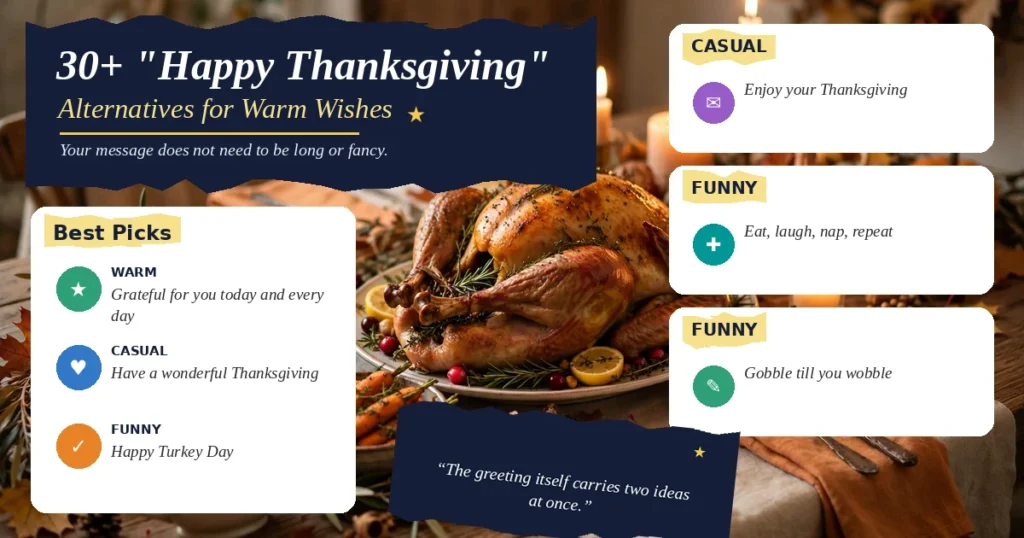
Thanksgiving gives people a clear reason to pause and thank the people around them. Families gather around a table, friends share a meal, and coworkers exchange kind notes before a long weekend. Your message does not need to be long or fancy. It needs to sound warm, honest, and right for the relationship. A short note that mentions a shared memory often means more than a long message full of general praise.
This guide gives you fresh options for every setting. You will find warm phrases for close family, short lines for quick texts, funny lines for friends, polite lines for work, and thoughtful lines for people who value gratitude and reflection. You will also find email examples, common mistakes to avoid, and answers to questions people ask every year. Use one phrase as it appears, or change a word or two so it sounds like you. The goal stays simple: send a wish that feels real.
Meaning
The phrase Happy Thanksgiving wishes someone joy on Thanksgiving Day, a holiday in the United States that centers on gratitude, food, family, and time together. People celebrate it on the fourth Thursday in November. Many families cook turkey, share side dishes, watch football or a parade, and talk about what they feel thankful for that year. The greeting itself carries two ideas at once. It names the holiday, and it hopes the other person enjoys it.
People also use the phrase as a short form of thanks. When you say it to a host, you thank them for the meal and the welcome. When you say it to a friend far away, you tell them you still think of them on a day that matters. When you say it to a coworker, you wish them rest and a good break. The meaning stays warm in each case, but the feeling behind it changes with the relationship.
That flexibility explains why the phrase lasts year after year. It works for a card, a text, a phone call, and a work email. It also works for people you know well and people you barely know. The challenge comes when you want to say more. A close friend deserves a line that sounds like you know them. A boss deserves a line that stays polite. A grandparent deserves a line that feels tender. The alternatives in this guide help you match the words to the person.
Professional usage
At work, a Thanksgiving message should stay polite, brief, and inclusive. Many workplaces include people who celebrate the holiday in different ways, and some people do not celebrate it at all. A good work message thanks people for their effort, wishes them a restful break, and avoids claims about how they spend the day. You can say you hope they enjoy time with loved ones, but you do not need to assume they cook turkey or travel home.
Keep work messages short. A client email needs only two or three sentences. A note to your team can run a little longer, but it should still focus on thanks and rest. Avoid jokes about food, weight, or drinking at work. Avoid long stories about your own holiday plans. The reader should feel appreciated, not lectured or left out.
Timing matters too. Send a work message a day or two before the holiday, not on the morning of Thanksgiving Day, when many people step away from email. If you lead a team, thank the group by name when you can, and name one real result from the year. Specific thanks always sound stronger than general thanks. For example, you can thank a team for finishing a hard project on time, or thank a client for clear feedback all year. That detail turns a routine greeting into a real message.
Alternatives
The phrases below fall into five tone groups. Each phrase includes a short note about tone and best use, plus an example sentence. Pick the group that fits your reader, then pick the line that sounds most like you.
Warm and heartfelt
- Wishing you a Thanksgiving full of warmth and good company — Warm and sincere; best for close family and dear friends. Example: Wishing you a Thanksgiving full of warmth and good company, and a table where everyone feels welcome.
- May your Thanksgiving be filled with love, laughter, and plenty to share — Tender and classic; best for cards and long messages. Example: May your Thanksgiving be filled with love, laughter, and plenty to share with the people you love most.
- Sending you all my love this Thanksgiving — Simple and direct; best for parents, grandparents, and partners. Example: Sending you all my love this Thanksgiving, and thinking of you from miles away.
- Grateful for you today and every day — Personal and emotional; best for someone who shaped your year. Example: Grateful for you today and every day, and I hope your holiday feels just as kind as you are.
- Hope your home is full and your heart is fuller — Poetic but still plain; best for a handwritten card. Example: Hope your home is full and your heart is fuller after a day with family.
- Thankful for your kindness, your humor, and your steady presence — Specific and heartfelt; best for a close friend or mentor. Example: Thankful for your kindness, your humor, and your steady presence through a busy year.
- Wishing you comfort, joy, and time with the people you love — Gentle and calm; best for someone who had a hard year. Example: Wishing you comfort, joy, and time with the people you love most this Thanksgiving.
- You make every gathering better, and I am so glad to know you — Warm and personal; best for a host or a dear friend. Example: You make every gathering better, and I am so glad to know you.
Short and casual
- Have a wonderful Thanksgiving — Friendly and easy; best for texts and quick notes. Example: Have a wonderful Thanksgiving, and save me a slice of pie.
- Enjoy your Thanksgiving — Simple and relaxed; best for neighbors and acquaintances. Example: Enjoy your Thanksgiving, and I hope the drive home stays easy.
- Happy Turkey Day — Playful and informal; best for friends and family who enjoy humor. Example: Happy Turkey Day, and may the turkey turn out golden.
- Have a great holiday weekend — Casual and broad; best for coworkers and casual contacts. Example: Have a great holiday weekend, and rest up before Monday.
- Eat well and rest well — Short and caring; best for a quick text to a busy friend. Example: Eat well and rest well, and enjoy every minute with your family.
- Sending Thanksgiving cheer your way — Bright and light; best for social media or a group chat. Example: Sending Thanksgiving cheer your way, with extra love for the cook.
- Hope you get seconds and good stories — Fun and warm; best for family group chats. Example: Hope you get seconds and good stories at the table this year.
- Have the happiest Thanksgiving — Cheerful and simple; best for a card or a short message. Example: Have the happiest Thanksgiving, and know that I miss you.
Funny and light
- May your turkey be moist and your family drama be mild — Funny and honest; best for close friends and siblings. Example: May your turkey be moist and your family drama be mild this year.
- Eat, laugh, nap, repeat — Short and funny; best for a text or a social media post. Example: Eat, laugh, nap, repeat, and do not feel guilty about any of it.
- Gobble till you wobble — Silly and classic; best for kids, cousins, and playful friends. Example: Gobble till you wobble, and save room for dessert.
- Thankful for elastic waistbands — Light and self-aware; best for friends who enjoy food jokes. Example: Thankful for elastic waistbands and a second helping of mashed potatoes.
- May your gravy stay smooth and your Wi-Fi stay strong — Modern and funny; best for friends and younger family. Example: May your gravy stay smooth and your Wi-Fi stay strong all weekend.
- Warning: pie calories do not count today — Playful and teasing; best for close friends at dessert time. Example: Warning: pie calories do not count today, so enjoy every slice.
- Thanks for putting up with me all year — Honest and funny; best for a partner, sibling, or best friend. Example: Thanks for putting up with me all year, and for still saving me a seat.
- Let the stretchy pants season begin — Casual and humorous; best for a lighthearted group message. Example: Let the stretchy pants season begin, and pass the cranberry sauce.
Professional and polite
- Wishing you a restful and enjoyable Thanksgiving break — Polite and safe; best for clients, managers, and teams. Example: Wishing you a restful and enjoyable Thanksgiving break, and thank you for a strong year of work together.
- Thank you for your hard work this year — Direct and respectful; best for employees and colleagues. Example: Thank you for your hard work this year, and I hope you enjoy a well-earned break.
- Grateful for your partnership this year — Formal and warm; best for clients and business partners. Example: Grateful for your partnership this year, and wishing you a peaceful holiday.
- Wishing you and your family a happy holiday — Inclusive and polite; best for a general work message. Example: Wishing you and your family a happy holiday, and a restful long weekend.
- Enjoy a well-deserved break — Short and professional; best for a team email or a card. Example: Enjoy a well-deserved break, and thank you for all you did this fall.
- Thank you for your support and collaboration — Formal and sincere; best for a client or a cross-team note. Example: Thank you for your support and collaboration, and I wish you a joyful Thanksgiving.
- Wishing you peace and plenty this season — Elegant and calm; best for a formal card. Example: Wishing you peace and plenty this season, and time to recharge.
- Happy Thanksgiving to you and yours — Classic and polite; best for almost any work contact. Example: Happy Thanksgiving to you and yours, and thank you for working with us this year.
Grateful and reflective
- Today I count you among my blessings — Thoughtful and sincere; best for family and close friends. Example: Today I count you among my blessings, and I hope you feel how much you matter.
- Grateful for another year of shared meals and shared memories — Reflective and warm; best for long-time friends and family. Example: Grateful for another year of shared meals and shared memories around your table.
- May gratitude fill your home this Thanksgiving — Calm and meaningful; best for a card or a faith-based message. Example: May gratitude fill your home this Thanksgiving, and carry into the year ahead.
- Thankful for the small moments that made this year good — Gentle and honest; best for a personal note. Example: Thankful for the small moments that made this year good, including our long talks and easy laughs.
- Wishing you a day of thanks, peace, and togetherness — Balanced and reflective; best for a general holiday card. Example: Wishing you a day of thanks, peace, and togetherness with the people you hold close.
- I carry your kindness with me, and I am grateful — Deep and personal; best for a mentor or a loved one. Example: I carry your kindness with me, and I am grateful for all you taught me.
- May this Thanksgiving remind us of all we already have — Thoughtful and broad; best for a group message or a social post. Example: May this Thanksgiving remind us of all we already have, and all the people who make life rich.
- With a full heart, I wish you a beautiful Thanksgiving — Tender and graceful; best for a handwritten note. Example: With a full heart, I wish you a beautiful Thanksgiving and a peaceful season ahead.
Quick comparison
Use this table when you need a fast choice. Match the person and the setting, then pick the tone that fits.
| Situation | Best tone | Try this |
|---|---|---|
| Card for a parent | Warm and heartfelt | Sending you all my love this Thanksgiving |
| Text to a friend | Short and casual | Have a wonderful Thanksgiving |
| Group chat with siblings | Funny and light | Gobble till you wobble |
| Email to a client | Professional and polite | Wishing you a restful and enjoyable Thanksgiving break |
| Note to a mentor | Grateful and reflective | Today I count you among my blessings |
| Social media post | Short and casual | Sending Thanksgiving cheer your way |
Short lines work best when the reader already knows you care. Longer lines work best when you want to explain why you care. A funny line works best when the friendship already includes humor. A formal line works best when the relationship stays professional. When you feel unsure, choose the warmer and simpler option. People rarely complain that a message felt too kind, but they often notice when a message feels forced or too familiar for the setting.
Email examples
The examples below show how to use these phrases in real messages. Change the names and details to fit your life.
Email to a client: Subject: Thank you and best wishes for Thanksgiving. Dear Ms. Rivera, thank you for your trust and clear direction this year. Wishing you a restful and enjoyable Thanksgiving break, and I look forward to our work together in December. Warm regards, Jordan.
Email to your team: Subject: Thankful for this team. Team, thank you for your hard work this year, especially during our busiest weeks in October. I hope you enjoy a well-deserved break, rest well, and return refreshed. I feel lucky to work with each of you. Best, Jordan.
Email to a manager: Subject: Happy Thanksgiving. Dear Mr. Chen, thank you for your guidance and steady support this year. Wishing you and your family a happy holiday, and I hope the long weekend brings rest and good time together. With thanks, Jordan.
Email to a friend you miss: Subject: Thinking of you this Thanksgiving. Hi Maya, I miss our long dinners and your loud laugh at the table. Grateful for you today and every day, and I hope your Thanksgiving feels full of love. Let us plan a call next week. Love, Jordan.
Email to a host: Subject: Thank you for Thanksgiving. Dear Aunt Rosa, thank you for opening your home and cooking such a wonderful meal. You make every gathering better, and I am so glad to know you. I hope you rest after all that work, and I will call on Sunday. Love, Jordan.
Notice how each email stays short and names one real detail. A client email names the working relationship. A team email names a busy season. A host email names the meal and the welcome. Those details do more work than extra adjectives. If you want to add a link to a related phrase guide in a longer newsletter, you can weave it in naturally, such as when you thank someone for the clarification they gave you before the holiday rush.
Common mistakes
Many Thanksgiving messages fail for small reasons. The most common mistake is copying the same long message to everyone. A boss, a best friend, and a distant cousin should not receive the same note. People can tell when a message was pasted, and the warmth fades fast. Write one short base message, then change one sentence for each person.
Another mistake is making the message only about yourself. A long list of your travel plans, your menu, or your busy year pushes the reader aside. The holiday centers on thanks, so keep the focus on the reader. Thank them, wish them well, and mention a shared moment if you can.
A third mistake is using humor in the wrong setting. A joke about family drama may delight a sibling but confuse a client. A joke about food may feel light to a friend but rude to someone who struggles with food or money. When you write to a work contact, keep humor out unless you know them very well. When you write to family, keep jokes kind and avoid teasing anyone who feels sensitive that day.
People also forget timing and tone in group messages. A group text at midnight on Thanksgiving can wake people up. A long voice note in a busy family chat can get lost. Send group wishes during the day, keep them short, and save long personal notes for a private message. Finally, check spelling and names before you send. A misspelled name or a wrong family detail can undo an otherwise kind message in seconds.
Related phrases
Thanksgiving messages often sit beside other greetings and thanks. People wish each other well at the table, thank the host after the meal, and follow up the next day. You may also need phrases for gratitude in general, not just for this holiday. If you want to express thanks in a fresh way all year, you can learn from guides that explain how to say I appreciate it with warmth and clarity. That skill helps after Thanksgiving too, when you thank a host, a helper, or a friend who drove you home.
Some people also use the holiday to reconnect with someone they miss. A simple line such as I miss you can carry real weight when you have not seen someone for months. If you need softer ways to say it, read the guide on I miss you and pick a line that fits your bond. A Thanksgiving note gives you a natural reason to reach out, and a kind follow-up keeps that connection alive after the holiday ends.
Other related phrases include greetings for the wider holiday season, thanks for a gift, and wishes for a safe trip home. You do not need to pack them all into one message. Choose one main wish, add one thank-you line if it fits, and stop there. A short message with one clear feeling beats a long message with five mixed feelings. When you plan a call after the holiday, a line about how you are looking forward to your call keeps the warmth going without adding pressure.
Phrase comparison
Some phrases sound alike but carry different weight. Happy Thanksgiving names the holiday directly and works in almost any setting. Have a wonderful Thanksgiving adds a wish for the quality of the day, so it feels a little warmer. Wishing you a restful break focuses on rest, which suits workers and busy parents. Grateful for you focuses on the person, not the day, so it feels more intimate.
Short phrases suit texts, cards with little space, and social media captions. Long phrases suit handwritten cards, emails, and messages to people you rarely see. Funny phrases suit people who share your humor and already expect a joke from you. Formal phrases suit clients, managers, and new contacts. Reflective phrases suit people who value quiet gratitude, faith, or deep conversation.
Think about what you want the reader to feel after they read your note. Do you want them to smile, feel thanked, feel included, or feel close to you again? Pick the phrase that creates that feeling. If two phrases both fit, pick the shorter one. Short messages feel confident and clear. Long messages feel warm only when every sentence adds something real. Cut any sentence that repeats the same idea in new words, and your message will sound stronger at once.
Cultural usage
Thanksgiving holds a special place in American culture, but people celebrate it in many ways. Some families follow old recipes and gather in the same house each year. Some friends host a Friendsgiving meal when they live far from family. Some people volunteer at a food bank, share a meal with neighbors, or spend a quiet day at home. Some newcomers to the United States join a friend’s celebration and learn the traditions for the first time. A good message respects all of these paths.
The holiday also carries a complex history. Many people now learn about the Native peoples whose land and stories shape the holiday’s past, and some families use the day to reflect as well as celebrate. You do not need to turn a greeting card into a history lesson, but you can keep your words honest and kind. Focus on gratitude, care, and togetherness, and avoid jokes that mock any group of people.
Outside the United States, people may not celebrate Thanksgiving at all. If you write to someone abroad, a simple wish for a good week often works better than a holiday greeting they do not observe. If they do celebrate with American friends, a warm note still fits. When you feel unsure, ask yourself what the reader celebrates and how they spend late November. A message that respects their life always lands better than a message that assumes one tradition for everyone.
Frequently asked questions
What is the best way to say Happy Thanksgiving to a boss?
Keep it short, polite, and focused on thanks. Wishing you and your family a happy holiday works well. You can add one line about their support this year, then stop. Avoid jokes, nicknames, or personal details. Send the note a day or two before the holiday so it feels planned, not rushed.
How do I say Happy Thanksgiving to someone who does not celebrate it?
Choose a warm wish that fits their life instead. A line such as wishing you a peaceful week or thinking of you this week feels kind without assuming a holiday. If they spend the day with American friends, a simple Happy Thanksgiving still fits. When in doubt, pick the broader wish and let them decide how to take it.
What should I write in a Thanksgiving card for my mother?
Name something specific she did this year. Thank her for a meal, a call, a lesson, or a steady presence in your life. A line such as grateful for you today and every day feels personal when you add one memory. End with love and a plan to call or visit soon. Specific details turn a generic card into a keepsake.
What is a good short text message for Thanksgiving?
Have a wonderful Thanksgiving works for almost anyone. Have the happiest Thanksgiving adds extra cheer for close friends and family. Eat well and rest well suits a busy friend. Keep the text to one or two lines, and add a name if the message could go to many people. A short message sent on time beats a long message sent late.
How can I wish a client a Happy Thanksgiving without sounding too familiar?
Use a professional tone and focus on the working relationship. Grateful for your partnership this year sounds warm but still businesslike. Wishing you a restful and enjoyable Thanksgiving break also works well. Sign with your full name and company if the client does not know you personally. Skip jokes, emojis, and personal questions.
What is a funny Thanksgiving message for friends?
Pick a joke that matches your shared humor. Gobble till you wobble suits a playful group chat. Thankful for elastic waistbands suits friends who laugh about big meals. May your turkey be moist and your family drama be mild suits friends who enjoy honest humor. Avoid jokes about anyone in the group, and keep the tone light.
Should I send a Thanksgiving message on the day itself or before?
Work messages work best a day or two before the holiday, when people still check email. Personal messages work well on the day itself, especially in the morning or early afternoon. A late-night message can wait until the next morning, when the reader can enjoy it. If you miss the day, a short note the next day still counts.
What should I say to a host after Thanksgiving dinner?
Thank the host for the meal, the welcome, and the time they spent preparing. A line such as you make every gathering better feels sincere when you mean it. Send the note the next day, while the evening still feels fresh. If you want a softer way to phrase your thanks, you can borrow ideas from guides on other ways to say I understand when you respond to their kind words.
Is Happy Turkey Day rude?
No, as long as you use it with people who enjoy playful language. It suits friends, family group chats, and light social media posts. Avoid it in formal work emails, cards for elders who prefer traditional greetings, and messages to people you do not know well. If you feel unsure, use Have a wonderful Thanksgiving instead. It stays friendly without any risk.
How can I make a Thanksgiving message more personal?
Add one detail only you would know. Mention a shared meal, a joke, a trip, or a kind act from this year. Thank the person for that moment by name. A personal detail shows that you wrote the note for them, not for everyone. Even one sentence changes the whole message from generic to memorable.
What should I write to a friend I have not seen in years?
Keep the note warm and open, without pressure. A line such as thinking of you this Thanksgiving and hoping life treats you well feels kind and easy to answer. Add one short memory if you share one, then invite a call without a fixed plan. People welcome a gentle reconnection more than a long apology for lost time.
Can I use a Thanksgiving message for social media?
Yes. Short lines work best online. Sending Thanksgiving cheer your way fits a caption or a story. Grateful for another year of shared meals suits a photo of friends or family. Add a photo if you have one, and keep hashtags light. Avoid long paragraphs, since most people scroll past them.
What should I write in a message for a large group or team chat?
Keep it short, inclusive, and warm. Wishing everyone a restful and enjoyable Thanksgiving break suits a work group. Hope your homes are full and your hearts are fuller suits a family group. Avoid inside jokes that leave some people out. Tag no one unless you need to, and let the group reply in their own time.
Conclusion
Thanksgiving gives you a rare chance to say thank you out loud. A short note can carry real warmth when you pick the right tone and add one honest detail. Warm phrases suit family. Short phrases suit texts. Funny phrases suit close friends. Professional phrases suit work. Reflective phrases suit people who value quiet gratitude. The best message is not the longest one. It is the one that sounds like you and fits the person who reads it.
Use this guide as a starting point, not a script. Change a word, add a memory, or shorten a line until it feels natural. Send work notes early, send personal notes on the day, and follow up with a host the next morning. When you want to check the meaning of a word you plan to use, you can look up Thanksgiving in the Cambridge Dictionary for a clear definition and examples.
Wishing you a Thanksgiving full of warmth, good food, and people who make you feel at home.