Introduction
If you need other ways to say the author states, you already know the problem. The phrase works, but it grows dull fast. You use it once, then again, and soon every paragraph sounds the same. Readers notice the repeat, and your writing loses energy even when your ideas stay strong.
Writers use the author states when they report what a writer says in a book, article, or report. The phrase points to a fact, a claim, or a clear position. It keeps the focus on the source, not on your own opinion. That job matters in essays, summaries, and business reports. You still need variety, though, because strong writing changes the verb to match the strength of the idea.
This guide gives you clear replacements you can use right away. You will find formal options for essays, polite options for work emails, and simple options for everyday writing. Each option comes with a note on tone and a short example. You can also learn other ways to say just to clarify when you restate an idea in your own words. By the end, you will pick the right verb fast, and you will stop repeating the same phrase in every paragraph.
Meaning
The author states means the author says something in a clear and direct way. The author presents an idea as a fact or as a firm point. The phrase does not suggest doubt. It does not suggest a guess. It tells the reader that the source gives this point in plain terms.
Writers often use this phrase in summaries and essays. A student may write that an author states a cause of a problem. A manager may write that a report author states a sales result. A reader may write that a guide author states a rule for safe use. In each case, the phrase links the idea to its source. It shows that you report the idea, not invent it.
The phrase also sets a neutral tone. It does not praise the author. It does not attack the author. It simply reports the point. That neutral tone helps in school work and in business writing. Readers trust a summary more when you report ideas in a calm and fair way. You can build that trust further when you learn other ways to say I understand and show that you follow the main point before you respond to it.
Professional usage
Professional writers use the author states in essays, research summaries, memos, and reports. They use it when they cite a source and need a clean verb. The phrase fits formal work because it sounds direct and serious. It also fits short summaries because it moves the reader to the main idea fast.
In an essay, you can use the phrase in a topic sentence. You can write that the author states the main cause, then you explain the evidence. In a business report, you can use it when you quote a study or a company guide. You can write that the author states a clear result, then you link that result to your own plan. In an email, you can use it when you refer to a shared document. You can write that the author states the new rule, then you ask your team to follow it.
You should match the verb to the source. Use a firm verb for a firm claim. Use a soft verb for a suggestion or an opinion. This habit keeps your summary honest. It also stops you from making a soft idea sound like a proven fact. When you reply to a source or a colleague, you can also add thank you for the clarification to keep the tone polite and professional.
Alternatives
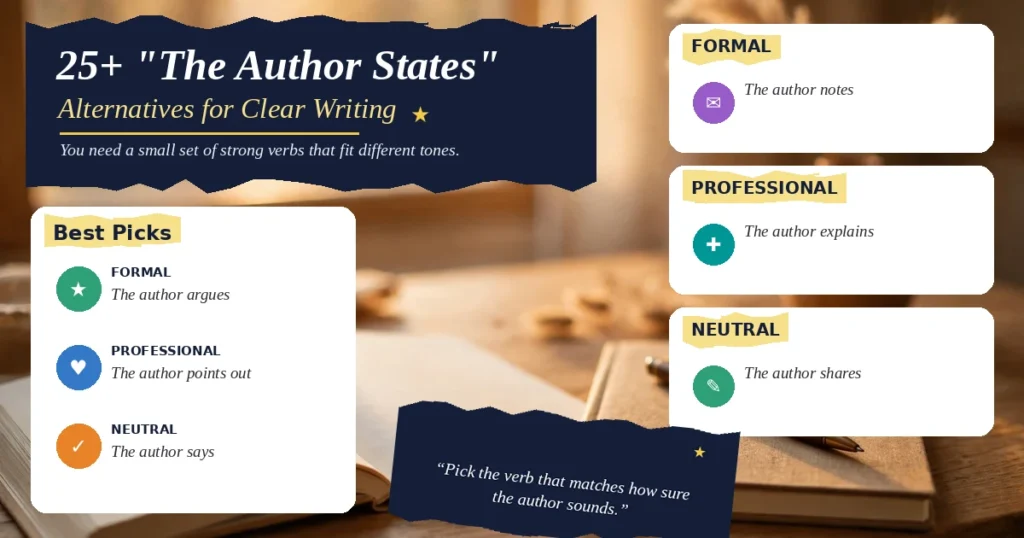
You do not need a new phrase for every sentence. You need a small set of strong verbs that fit different tones. The groups below give you 40 core alternatives. Each entry gives the phrase, a tone note, and a short example. Pick the verb that matches how sure the author sounds.
Formal academic alternatives
- The author argues — formal and strong, best for a clear position in an essay. Example: The author argues that small daily habits shape long term health.
- The author contends — formal and firm, best for a debated point. Example: The author contends that screen time harms sleep more than most parents expect.
- The author asserts — formal and direct, best for a firm claim. Example: The author asserts that clean water access improves school attendance.
- The author maintains — formal and steady, best for a repeated position. Example: The author maintains that practice matters more than talent.
- The author observes — formal and calm, best for a careful finding. Example: The author observes that shoppers choose simple labels first.
- The author notes — formal and light, best for a useful detail. Example: The author notes that morning light helps workers stay alert.
- The author emphasizes — formal and strong, best for a key point. Example: The author emphasizes that clear goals reduce team stress.
- The author concludes — formal and final, best for a closing judgment. Example: The author concludes that early reading builds strong language skills.
Professional business alternatives
- The author points out — clear and professional, best for a useful fact. Example: The author points out that late replies slow down projects.
- The author explains — clear and helpful, best for a process or reason. Example: The author explains how small teams track weekly progress.
- The author reports — neutral and factual, best for data or results. Example: The author reports that sales rose after the new pricing plan.
- The author highlights — positive and focused, best for a key result. Example: The author highlights that training cut errors by a clear margin.
- The author confirms — firm and reliable, best for a checked fact. Example: The author confirms that the policy starts next month.
- The author suggests — polite and open, best for advice. Example: The author suggests that managers hold short weekly check-ins.
- The author recommends — direct and practical, best for a clear action. Example: The author recommends that teams test each change before launch.
- The author outlines — structured and clear, best for steps or a plan. Example: The author outlines five steps for safer food storage.
Neutral everyday alternatives
- The author says — simple and neutral, best for most summaries. Example: The author says that rest helps students learn faster.
- The author writes — simple and direct, best for a book or article. Example: The author writes that honest feedback builds trust at work.
- The author shares — warm and light, best for a story or tip. Example: The author shares a simple method for daily planning.
- The author tells readers — clear and direct, best for advice to an audience. Example: The author tells readers to save a small amount each week.
- The author mentions — light and brief, best for a side point. Example: The author mentions that quiet rooms help focus.
- The author describes — clear and visual, best for a scene or process. Example: The author describes how a small shop grew into a busy store.
- The author adds — light and smooth, best for an extra point. Example: The author adds that short breaks improve afternoon focus.
- The author reminds readers — helpful and calm, best for a repeated warning. Example: The author reminds readers to back up files each week.
Soft and diplomatic alternatives
- The author implies — soft and careful, best for an indirect point. Example: The author implies that poor sleep hurts work quality.
- The author hints — soft and light, best for a subtle point. Example: The author hints that change will come slowly to the team.
- The author proposes — polite and open, best for a new idea. Example: The author proposes a simple rota for shared tasks.
- The author believes — personal and soft, best for an opinion. Example: The author believes that kind leadership lifts team morale.
- The author feels — personal and gentle, best for a view or sense. Example: The author feels that small towns need better bus links.
- The author hopes — warm and hopeful, best for a wish or goal. Example: The author hopes that schools keep art lessons in the week.
- The author prefers — polite and clear, best for a choice. Example: The author prefers short meetings with a clear agenda.
- The author acknowledges — honest and fair, best for a limit or problem. Example: The author acknowledges that the study used a small sample.
Strong and direct alternatives
- The author declares — very strong, best for a public or formal claim. Example: The author declares that safety rules must come first.
- The author insists — very firm, best for a repeated demand. Example: The author insists that workers need proper rest breaks.
- The author stresses — strong and urgent, best for a warning. Example: The author stresses that clean data drives good decisions.
- The author warns — strong and serious, best for a risk. Example: The author warns that rushed work leads to costly errors.
- The author proves — very strong, best only with clear evidence. Example: The author proves that practice improves test scores with trial results.
- The author demonstrates — strong and evidence based, best for a shown result. Example: The author demonstrates how a simple habit cuts waste.
- The author claims — direct but less certain, best for an unproven point. Example: The author claims that the new plan will double sign-ups.
- The author shows — clear and evidence based, best for a visible result. Example: The author shows that clear signs help visitors find help fast.
Quick comparison
A quick comparison helps you pick the right verb without overthinking. Strong verbs suit firm claims. Soft verbs suit opinions and suggestions. Neutral verbs suit simple reports. Use the table below as a fast guide when you draft.
| Phrase | Tone | Best use |
|---|---|---|
| The author argues | Formal and strong | A clear position in an essay |
| The author notes | Formal and light | A useful detail or finding |
| The author suggests | Polite and open | Advice or a soft idea |
| The author reports | Neutral and factual | Data, results, or news |
| The author claims | Direct but uncertain | A point that still needs proof |
| The author explains | Clear and helpful | A process, reason, or method |
| The author warns | Strong and serious | A risk or a clear danger |
| The author shares | Warm and light | A story, tip, or personal idea |
Use states when the author gives a point in plain and direct terms. Use argues when the author defends a view against other views. Use claims when you want to show doubt or distance from the point. Use notes when the point is small but useful. This small shift changes how readers judge the idea. It also shows that you read with care, not just with speed.
You should also watch the verb tense. Most summaries use the present tense. You write that the author argues, not argued, even for an old book. The present tense keeps the summary alive and clear. It also matches the style of most school and business writing. Keep the tense steady through a paragraph so readers do not stumble.
Email examples
Email writing needs short and polite verbs. You do not need academic verbs in most work emails. You need clear verbs that point to the source and move the action forward. The examples below show how to use the alternatives in real email lines.
- Subject line summary: The author explains the new refund steps in the guide, so please check section two before you reply to customers.
- Team update: The author points out that late reports delay the whole project, so please send your update by Friday noon.
- Client note: The author recommends a short trial first, and I agree that a trial will reduce risk for your team.
- Manager note: The author confirms that the policy starts next month, so we will update the handbook this week.
- Follow-up note: The author suggests weekly check-ins, and I will set up the first check-in for Monday morning.
Keep each email line short. Put the source point first, then the action. Readers act faster when they see the point and the next step in the same short paragraph. You can also keep the tone warm when you write I appreciate it after a colleague shares a useful source with you. A short thank-you line makes a work email feel human, and it still keeps the focus on the work.
Avoid long quotes in emails. A short summary works better than a full paragraph from the source. Your reader wants the main point, not the whole page. If the source point matters for a decision, add the page or section name so your reader can check it fast.
Common mistakes
Writers make a few common mistakes with this phrase. Each mistake is easy to fix once you spot it. Check your draft for these errors before you send or submit your work.
- Repeat: Writers repeat the author states in every paragraph. Fix this by rotating verbs from the groups above. Use notes, explains, and points out to break the pattern.
- Wrong strength: Writers use proves for a mere opinion. Fix this by using claims or suggests for ideas without solid proof. Save proves and demonstrates for results with clear evidence.
- Missing source: Writers write a claim without naming the author or source. Fix this by naming the author or book in the same sentence. Readers must know who holds the view.
- Passive drift: Writers slip into passive lines such as it is stated by the author. Fix this by keeping the author as the subject. Write that the author states the point in active voice.
- Vague follow-up: Writers end a summary without a next step. Fix this by adding a clear action. If you plan to follow up, use other ways to say I will let you know to promise an update in a clear and polite way.
- Mixed tense: Writers mix present and past verbs in one summary. Fix this by keeping the present tense for the author verbs through the whole piece.
Read your draft out loud. Your ear catches repeats faster than your eye. If you hear the same verb three times, change two of them. Your writing will sound smoother at once, and your reader will stay with your ideas to the end.
Related phrases
Related phrases help you vary your writing even more. You can use them when you move from one idea to the next, or when you compare two sources. They keep your summary fresh without changing the meaning.
The phrase the writer points out works like the author points out. It suits articles and short guides. The phrase the study shows suits research reports with data. The phrase the report finds suits business and news summaries. The phrase according to the author suits a short credit at the start or end of a sentence. Each phrase still links the idea to its source.
You can also pair a reporting verb with a connector. For example, you can write that the author notes a problem, then explains a fix. You can write that the author claims a gain, but shows no proof. These pairs move your summary forward and show how ideas link. They also help you avoid flat lists of single sentences.
When you offer help after a summary, you can use other ways to say if I can be of any help to close your note in a kind and professional way. A helpful close suits emails, reports, and group work. It tells the reader that you will support the next step, not just report the source.
Phrase comparison
States, argues, claims, notes, and suggests look similar, but they carry different weight. States reports a point in plain terms. Argues defends a view with reasons. Claims reports a point with doubt or distance. Notes reports a small but useful detail. Suggests offers advice or a soft idea. Pick the verb that matches the evidence.
Consider one idea about sleep. If the author states that sleep aids memory, you report a plain point. If the author argues that sleep aids memory, you show that the author defends the point. If the author claims that sleep aids memory, you signal that the point still needs proof. If the author notes that sleep aids memory, you treat the point as a side detail. If the author suggests more sleep, you treat the point as advice. One verb change shifts the whole tone.
Use this test before you pick a verb. Ask how sure the author sounds. Ask how much proof the author gives. Ask whether the author defends, reports, or advises. Your answers point to the right verb. This habit also protects you from overstating a source. Readers trust writers who match verbs to evidence. They distrust summaries that turn every opinion into a proven fact.
Cultural usage
Culture shapes how direct a reporting verb sounds. In United States academic writing, argues and asserts sound normal and strong. Teachers expect students to use these verbs to show analysis. In British academic writing, notes, observes, and suggests appear more often. The tone stays polite and careful, even for firm views.
In business writing across cultures, clear verbs win. Teams in many countries prefer points out, explains, and confirms. These verbs travel well because they stay neutral. Strong verbs such as insists and declares can sound rude in a polite work culture. Soft verbs such as hints and implies can sound vague in a direct work culture. Match your verb to your reader, not just to your habit.
In casual writing, simple verbs work best. Readers in blogs, emails, and social posts prefer says, writes, and shares. These verbs feel warm and easy. Formal verbs can sound stiff in a casual post. Save contends and maintains for essays and reports. Use simple verbs when you write for a wide audience. Clear and simple language reaches more readers, and it keeps your message kind.
Frequently asked questions
What does the author states mean in an essay?
The author states means the author says a point in a clear and direct way. The author presents the point as a fact or as a firm view. You use the phrase when you report the source, not when you give your own opinion.
Can I use the author states in a school essay?
Yes, you can use the phrase in a school essay. Teachers accept it as a clear reporting verb for summaries and analysis. You should still vary your verbs so your essay does not sound dull.
What is a simple replacement for the author states?
The author says is the simplest replacement, and it works in most summaries. The author notes also works well for a short detail. Both options keep your sentence clear and easy to read.
Is the author states too formal for an email?
The phrase can sound formal in a short work email, but it still works for a policy or a guide. For most emails, use the author explains or the author points out instead. These verbs sound clear and polite without sounding stiff.
Should I use the author states or the author argues?
Use the author states for a plain point that needs no debate. Use the author argues when the author defends a view with reasons. The right choice depends on how much the author tries to persuade the reader.
Can I start a sentence with the author states?
Yes, you can start a sentence with the phrase, and many summaries do so. You can also place the phrase after a short lead, such as in chapter two, the author states the main rule. Vary the sentence start so your paragraph does not repeat one pattern.
How often can I use the author states in one essay?
Use the phrase once or twice in a short essay, then switch to other verbs. Readers notice repeats fast, and repeats weaken strong ideas. A mix of notes, explains, argues, and suggests keeps your essay smooth.
What is the past tense form of the author states?
The past form is the author stated, and you use it for a past event or a past report. Most summaries still use the present form, the author states, even for old books. Keep one tense through a paragraph so readers do not feel confused.
Does the author states work for fiction books?
Yes, the phrase works for fiction when you report what a narrator or guide says. For a novel, the author shows or the author describes often fits better than states. Pick the verb that matches whether the author tells, shows, or explains the point.
Can I use the author states in a business report?
Yes, you can use the phrase in a business report for a clear finding or rule. The author reports and the author confirms also suit business writing well. Use a firm verb for a checked fact and a soft verb for advice.
What is the difference between states and claims?
States reports a point in plain and direct terms with no sign of doubt. Claims reports a point with distance, and it suggests that the point still needs proof. Use claims when you do not want to endorse the point as fact.
Is it correct to write the authors states without an apostrophe?
No, you should write the author states for one author, with no apostrophe. You write the author’s view with an apostrophe only when you show possession. Check the number of authors first, then pick the correct form.
Can I replace the author states with according to the author?
Yes, according to the author works as a short credit for a point. You can write that according to the author, short breaks improve focus. This form suits short notes and email lines well.
How do I avoid repeating the author states?
Build a short list of five verbs you like, such as notes, explains, argues, suggests, and shows. Rotate through that list as you draft each paragraph. Read your draft out loud and change any verb you hear three times.
Which alternative fits a summary best?
The author notes and the author explains fit most summaries well. They sound clear, neutral, and easy to read for school and work. For a strong final judgment, the author concludes fits the closing paragraph best.
Conclusion
You now have many clear options beyond one tired phrase. You can pick a formal verb for an essay, a polite verb for an email, and a simple verb for everyday writing. You can match the verb to the strength of the idea, and you can keep your summary honest and fair. Small verb choices make a large difference in how readers judge your work.
Start with a short list of favorites. Use notes for details, explains for methods, argues for defended views, and suggests for advice. Rotate your verbs, keep the present tense steady, and name the source in each key sentence. Your writing will sound fresh, and your reader will follow your ideas with ease. Practice these verbs in your next essay or email, and you will soon pick the right one without pausing to search.
For the core meaning behind the verb, you can check the full meaning of states and see how the word works in clear example sentences. Use that check to confirm your tone, then write with confidence. Strong summaries do not need fancy words. They need the right verb, clear evidence, and a steady voice from start to finish.