Introduction
When you want to praise a coworker, you need professional ways to say youre a true team player without sounding stiff or fake. The right words can lift a whole team. They can also help a quiet worker get the credit they deserve. Many people use the same tired phrase again and again. They write “great team player” in every email and every review. After a while, those words lose their power. Readers stop and skim past them. They do not feel the praise behind them.
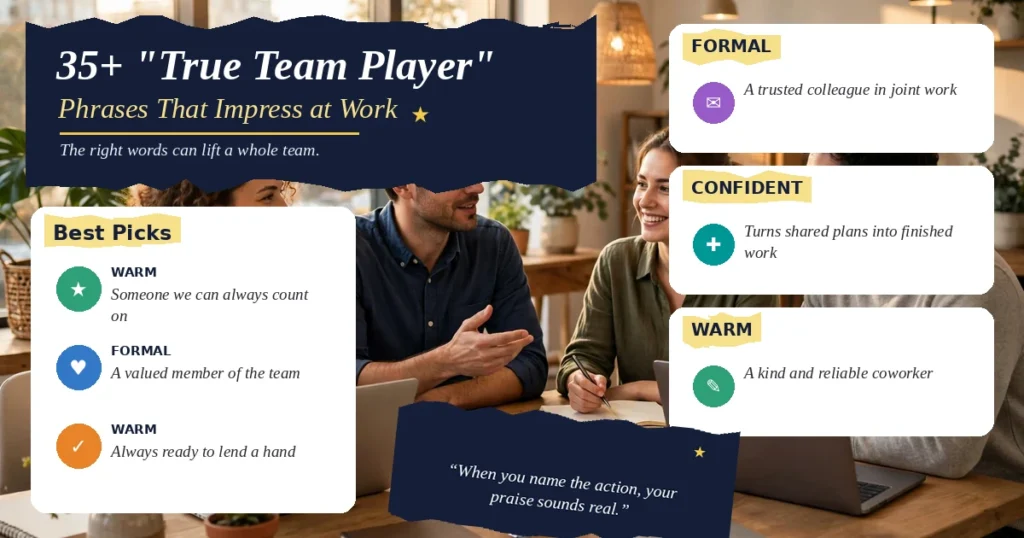
This guide gives you fresh, clear, and polite ways to say the same thing with more warmth and more detail. You will find short phrases for quick chats. You will also find longer phrases for reviews, reference letters, and thank-you notes. Each phrase tells the reader what the person actually did. Did they share credit? Did they help on a tight deadline? Did they listen well in a hard meeting? When you name the action, your praise sounds real.
You can use these phrases at work, in school projects, and in volunteer teams. They fit emails to a boss, notes to a coworker, and posts that thank a whole group. They also help when you praise yourself in a polite way. For example, you can describe your own teamwork in a job interview or a self-review without sounding proud or loud. The key is to stay specific, calm, and kind.
Good teamwork praise does more than make one person smile. It shows the team what good work looks like. It tells new staff how people treat each other here. It builds trust between people who must rely on each other each day. When leaders praise teamwork in clear words, more people want to help. They share ideas sooner. They ask for help sooner. They fix small problems before those problems grow big.
In the sections below, you will learn what a true team player means in plain terms. You will see how to use these phrases in formal and casual settings. You will get 35 ready phrases in five tone groups. You will also get email examples, a quick comparison table, common mistakes to avoid, and answers to 15 common questions. By the end, you will not need to repeat one old phrase. You will have the right words for each person and each moment.
Meaning
A true team player is a person who puts the team goal ahead of personal credit. This person shares work, shares praise, and shares blame when things go wrong. They do not hide facts to look good. They do not leave hard tasks for others. They step in when a coworker feels stuck. They also step back when another person should lead.
The phrase means more than being nice. A kind person can still miss deadlines and skip meetings. A true team player does the work and does it on time. They answer messages. They keep promises. They tell the team early when a task will take longer than planned. They also listen with care when others speak. They ask good questions. They respect different views, even when they disagree.
In a strong team, each person has a clear role. A true team player knows their role and respects the roles of others. They do not take over someone else’s task without asking. They do not wait for orders when they can see a clear need. They offer help in a way that respects the other person’s skill. For example, they might say, “I have free time this afternoon. Can I take the first draft off your plate?” That offer is kind, clear, and easy to accept or refuse.
Trust sits at the heart of this phrase. Teams move fast when people trust each other. They share early drafts. They admit mistakes fast. They give honest feedback without fear. A true team player builds that trust day by day through small, steady acts. They show up. They follow through. They give credit by name. Over time, those small acts add up to a strong work culture.
The phrase also fits many jobs. In an office, it can mean clear notes and on-time reports. In a shop or clinic, it can mean covering a shift or helping a new worker learn the ropes. In a remote team, it can mean clear updates, quick replies, and respect for time zones. The setting changes, but the core stays the same: reliable work, honest talk, and care for the shared goal.
Professional usage
Use team-player praise when you have a real example to back it up. A vague note like “She is a team player” tells the reader very little. A strong note names the act. Try this pattern: name the person, name the action, and name the result. For example, “Sara stayed late to check the final report, so our client got clean data on time.” That one sentence proves the praise. It also helps a boss or hiring manager trust your words.
In formal writing, keep the tone calm and plain. Avoid slang, jokes, and loud praise words like “amazing” or “unreal.” Use steady words such as reliable, steady, helpful, and thoughtful. In a review, pair the praise with a result: faster work, fewer errors, or a happier client. In a reference letter, add one short story that shows teamwork in action. One story beats five vague claims.
In emails, place the praise near the start or near the end. At the start, it sets a warm tone. At the end, it leaves a good last note. Keep it short in a busy work email. One or two lines are enough. Save the longer praise for a review, a nomination, or a thank-you note. If you praise a whole team, name the shared win first, then name one or two people who led key parts.
You can also use these phrases to thank someone with care. When you want to show thanks in a warm and simple way, you can read ideas for how to say I appreciate it in a work note. Pair that thanks with a clear team example. For instance, write, “I appreciate it. You shared your notes early, and that saved the whole team a full day.” That mix of thanks and detail sounds sincere.
When you describe your own teamwork, stay modest and factual. Do not write, “I am the best team player here.” Instead, write, “I worked with sales and support to cut reply time by one day.” Facts let the reader judge your work. They also sound more professional. If you need soft ways to show you follow a point in a meeting, you can also learn other ways to say I understand so your replies sound calm and clear.
Use team praise with care across ranks. Praise a junior worker for effort and growth. Praise a senior worker for guidance and steady support. Praise a peer for shared work and honest feedback. The same phrase can fit all three, but the example should match the role. That care shows respect. It also stops praise from sounding copied and pasted.
Alternatives
The phrases below fall into five tone groups. Pick the group that fits your reader and your moment. A warm phrase fits a thank-you note. A formal phrase fits a review. A results-focused phrase fits a nomination. A humble phrase fits a peer note. A short phrase fits a chat message. Read the note after each phrase. It tells you when to use it and why it works.
Warm and supportive phrases
- A steady support for the whole team — Warm and kind; best for thank-you notes. Example: “You are a steady support for the whole team, and we felt it during the busy launch week.”
- Someone we can always count on — Warm and simple; best for peer praise. Example: “Sara is someone we can always count on when a deadline moves up.”
- A kind and reliable coworker — Soft and polite; best for short notes. Example: “Thank you for being a kind and reliable coworker on this project.”
- The person who lifts the team mood — Warm and human; best for casual praise. Example: “Ali is the person who lifts the team mood and keeps us calm under pressure.”
- Always ready to lend a hand — Friendly and direct; best for daily work notes. Example: “Priya is always ready to lend a hand, even when her own list is full.”
- A caring partner in shared work — Gentle and respectful; best for cross-team notes. Example: “You have been a caring partner in shared work from day one.”
- A true friend to the team goal — Warm and loyal; best for long service notes. Example: “After three years, you remain a true friend to the team goal.”
Professional and formal phrases
- A dependable contributor to team success — Formal and safe; best for reviews. Example: “Ahmed is a dependable contributor to team success across four major projects.”
- A collaborative professional with strong work habits — Formal and precise; best for reference letters. Example: “She is a collaborative professional with strong work habits and clear notes.”
- Committed to shared goals and shared standards — Formal and steady; best for appraisals. Example: “He stays committed to shared goals and shared standards, even on hard days.”
- A valued member of the team — Formal and polite; best for award notes. Example: “We thank Maria as a valued member of the team for her steady work this year.”
- Consistent in support and follow-through — Formal and proof-based; best for manager notes. Example: “Lena is consistent in support and follow-through, and her files are always ready on time.”
- A trusted colleague in joint work — Formal and calm; best for client emails. Example: “You will work with Omar, a trusted colleague in joint work, on the next phase.”
- Dedicated to the success of the group — Formal and strong; best for nominations. Example: “Nina is dedicated to the success of the group, not just her own tasks.”
Results-focused and confident phrases
- Drives team results through clear teamwork — Confident and direct; best for nominations. Example: “Carlos drives team results through clear teamwork and fast, honest updates.”
- Turns shared plans into finished work — Strong and action-based; best for project reviews. Example: “Aisha turns shared plans into finished work without waiting for reminders.”
- Raises the standard for the whole team — Bold but factual; best when results prove it. Example: “His careful checks raise the standard for the whole team.”
- Makes joint work faster and smoother — Practical and clear; best for process praise. Example: “Her simple checklist makes joint work faster and smoother for new staff.”
- Delivers on time and helps others deliver too — Results-led; best for busy teams. Example: “Tom delivers on time and helps others deliver too when the load grows.”
- Brings focus and energy to group goals — Confident and upbeat; best for kickoff notes. Example: “Sara brings focus and energy to group goals from the first meeting.”
- A key driver of team wins — Strong and short; best for award citations. Example: “Lee is a key driver of team wins in sales and support this quarter.”
Collaborative and humble phrases
- Works well with others and shares credit — Humble and honest; best for peer reviews. Example: “Ana works well with others and shares credit by name in every update.”
- Listens first, then builds on shared ideas — Thoughtful and calm; best for meeting praise. Example: “He listens first, then builds on shared ideas instead of pushing his own plan.”
- Puts the team win ahead of personal praise — Modest and strong; best for leaders. Example: “She puts the team win ahead of personal praise, even when she led the work.”
- Welcomes new views and different skills — Open and kind; best for diverse teams. Example: “Omar welcomes new views and different skills in every planning session.”
- Shares knowledge without holding back — Generous and clear; best for mentor praise. Example: “Priya shares knowledge without holding back, and new staff learn fast with her.”
- Keeps the team aligned with calm updates — Steady and useful; best for remote teams. Example: “He keeps the team aligned with calm updates twice a week.”
- Builds trust through small, steady acts — Quiet and deep; best for long-term praise. Example: “She builds trust through small, steady acts, day after day.”
Short praise for messages and reviews
- A rock for this team — Short and warm; best for chat messages. Example: “Thanks, Sam. You are a rock for this team.”
- Team-first, every time — Short and punchy; best for quick notes. Example: “Team-first, every time. That is how I would sum up your work this month.”
- Reliable, kind, and team-minded — Short and neat; best for review bullets. Example: “Reliable, kind, and team-minded. That line fits your year in full.”
- Our go-to team partner — Short and friendly; best for peer chats. Example: “You are our go-to team partner for tough client calls.”
- Stronger together because of you — Short and heartfelt; best for group thanks. Example: “We are stronger together because of you, and this launch proves it.”
- A team player in the best sense — Short and clear; best for formal short notes. Example: “He is a team player in the best sense: steady, fair, and always prepared.”
- All in for the team goal — Short and bold; best for project close notes. Example: “You stayed all in for the team goal, right through the final week.”
Quick comparison
Use this table when you need a fast pick. Match your setting to the tone, then pick a phrase from that row. A short note needs a short phrase. A formal review needs a formal phrase. A nomination needs proof plus a confident phrase.
| Setting | Best tone | Good pick | Keep it short? |
|---|---|---|---|
| Formal review | Professional and formal | A dependable contributor to team success | No, add one example |
| Thank-you email | Warm and supportive | Someone we can always count on | Yes, one or two lines |
| Award nomination | Results-focused and confident | Drives team results through clear teamwork | No, add results |
| Peer chat message | Short praise | A rock for this team | Yes, one line |
| Cross-team note | Collaborative and humble | Works well with others and shares credit | Yes, keep it calm |
| Reference letter | Professional and formal | A collaborative professional with strong work habits | No, add one story |
The table shows a simple rule. Formal settings reward detail. Casual settings reward brevity. In both cases, one real example beats three vague claims. If you write a review, add dates, tasks, or results. If you write a chat note, keep the praise short and warm. The reader should feel the thanks in seconds.
Also note the tone shift across groups. Warm phrases stress care. Formal phrases stress trust. Results phrases stress outcomes. Humble phrases stress listening and sharing. Short phrases stress speed. When you mix tones in one note, the message can feel confused. Pick one tone for a short note. For a long review, you can start warm, move to results, and close with humble praise. That flow feels natural and balanced.
Email examples
The examples below show the phrases in real use. Change the names, tasks, and dates to fit your case. Keep the structure: warm opening, clear example, and kind close.
Example 1: Thank-you email to a coworker.
Subject: Thank you for your help this week
Hi Sara,
Thank you for your steady help this week. You are someone we can always count on, and you proved it again when the client moved the deadline up. You shared your notes early and checked the final file twice. That care saved us a full day of fixes.
I am glad to work with you.
Best,
Ali
Example 2: Praise email to a manager about a team member.
Subject: Quick note of praise for Priya
Hi Ms. Khan,
I want to note Priya’s work on the spring launch. She is a dependable contributor to team success. She led the test plan, answered new staff questions with care, and kept the shared file up to date. Our error rate fell, and the launch went out on time.
Please pass on my thanks to her.
Kind regards,
Omar
Example 3: Team-wide thanks after a project ends.
Subject: Thank you, team
Hi team,
We finished the project on time because we worked as one team. Each of you shared work, shared ideas, and shared credit. You stayed all in for the team goal through a tough final week. I am proud of how we helped each other and how we treated our client with care.
Thank you all.
Best,
Lena
Example 4: Short praise in a reply email.
Subject: Re: Final report
Hi Tom,
Thanks for the clean final report. You deliver on time and help others deliver too, and it shows in this file. I have shared it with the client with no changes.
Thanks again,
Nina
Example 5: Self-review line about teamwork.
In my self-review, I can write: “This quarter, I worked with sales and support to cut reply time by one day. I shared my call notes each week, and I helped two new staff learn the intake process.” That line is factual and modest. It shows teamwork through actions, not claims. If you also want to thank someone for clear notes in the same thread, you can add a line with thank you for the clarification and then name what became clear. That small step keeps the tone polite and the record clear.
Common mistakes
Many people praise teamwork in ways that weaken the praise. The first mistake is vagueness. They write “great team player” with no example. The reader cannot tell what the person did. Fix it by adding one action and one result. Name the task, the help, and the gain.
The second mistake is over-praise. They use five strong words in one sentence. They write “amazing, brilliant, unstoppable team star.” That sounds fake, even when the work was good. Fix it by using one calm phrase and one fact. Steady praise earns more trust than loud praise.
The third mistake is praise that hides a complaint. They write, “You are a team player, but you need to reply faster.” The praise feels like a trick. Fix it by keeping praise and feedback apart. Send the praise note on its own. Send the feedback note later, with clear and kind steps.
The fourth mistake is praising only loud workers. Quiet workers often do key tasks: clean files, careful checks, and calm help for new staff. If leaders praise only the loudest voices, trust drops. Fix it by watching for quiet acts. Note who checks the work, who helps new staff, and who stays late to finish shared tasks.
The fifth mistake is copying the same line for all staff. When ten people get the same sentence, no one feels seen. Fix it by changing the example for each person. Use their task, their skill, and their result. Even a small change makes the note feel personal.
The sixth mistake is using team praise to excuse poor planning. A leader might praise “team spirit” after a team works through the night due to late plans. That praise can feel unfair. Fix it by thanking the team and fixing the plan. Praise the effort, then change the process so the overload does not repeat.
The seventh mistake is praising teamwork but ignoring conflict. Teams disagree. That is normal. A true team player handles disagreement with respect. If you praise someone who dismissed others in meetings, the praise rings false. Instead, praise clear listening and fair debate. When tension runs high, it helps to show you hear the other side, and you can study how to say I understand your frustration in a calm and respectful way. That skill keeps praise honest and keeps teams safe.
Related phrases
Team praise connects to many other polite phrases. You may need them in the same email or review. Here are close phrases and when to use each one.
A reliable partner is a good fit when two people share a task over time. A strong collaborator fits joint projects with shared plans. A supportive colleague fits daily help and kind guidance. A team-first worker fits moments when someone gives up personal credit for a group win. A trusted helper fits short-term help with care and skill.
Use “great to work with” when you want a simple, warm close. Use “easy to work with” when you want to praise clear talk and low drama. Use “brings out the best in others” when a person helps peers grow. Use “keeps the team on track” when a person manages time, files, and next steps with care. Each phrase points to a slightly different strength, so pick the one that matches the real act.
When you thank someone for a chance to join a team, you can borrow words from guides on other ways to say thank you for the opportunity. That thanks pairs well with team praise. For example, write, “Thank you for the chance to join this team. I learned a lot from working with such steady and kind people.” That mix sounds grateful and grounded.
When you close a note and want to offer more help, you can use ideas from other ways to say if I can be of any help. A line like “Please let me know if I can help with the next phase” keeps the team spirit alive after the praise. It turns a thank-you note into an open door for future joint work.
Do not stack five related phrases in one sentence. Pick one main phrase and one support phrase at most. Too many praise words in one line sound rehearsed. One clear phrase plus one real example will always read better than a long list of compliments.
Phrase comparison
Not all team phrases mean the same thing. Some stress results. Some stress care. Some stress speed. Use this section to pick the phrase that matches your true point.
“A dependable contributor to team success” stresses trust over time. It fits reviews and reference letters. It tells the reader the person shows up again and again. “Drives team results through clear teamwork” stresses outcomes. It fits nominations and project wins. It tells the reader the team finished faster or better because of this person.
“Works well with others and shares credit” stresses fairness. It fits peer reviews and cross-team work. It tells the reader the person treats peers with respect. “Someone we can always count on” stresses warmth and reliability. It fits thank-you notes and quick praise. It tells the reader the person feels safe to rely on.
“A rock for this team” is short and emotional. It fits chat messages and close-knit teams. It may feel too casual for a formal review. “A collaborative professional with strong work habits” is formal and balanced. It fits hiring files and senior readers. It may feel too stiff for a friendly peer note.
“Team-first, every time” stresses values. It fits culture notes and team charters. It tells the reader the person chooses the group over ego. “Makes joint work faster and smoother” stresses process skill. It fits teams that value clear systems. It tells the reader the person removes friction for others.
The best choice depends on three questions. Who will read this? What did the person actually do? What tone fits the setting? Answer those three, then pick the phrase. If you still feel stuck, pick the simplest true phrase and add one example. Simple and true beats clever and vague.
Cultural usage
Team praise sounds different across cultures, so use care when you write to global teams. In some work cultures, direct praise in public feels warm and welcome. In others, public praise can feel awkward, even when the words are kind. When in doubt, praise in private first, then ask if public thanks would feel good.
In the United States and the United Kingdom, short and direct praise is common. People often praise in emails, meetings, and reviews with clear words. In many South Asian workplaces, praise often pairs with respect for seniors and gratitude for guidance. A line that thanks a senior for support can matter as much as praise for skill. In many East Asian workplaces, group praise may feel safer than singling out one person. A note that thanks the team first, then names one key role, can respect that norm.
Language also shapes tone. In English work emails, “team player” is a standard phrase. Readers know it well. In other languages, a direct translation may sound odd or too sporty. If you write to a global team, use plain words that translate well. “Works well with others” and “shares credit” travel better than sport terms or slang.
Remote teams add one more layer. Praise in a chat channel can lift a whole distributed team. But time zones mean some people read it hours later. Keep remote praise clear and self-contained. Name the person, the task, and the result so late readers still grasp the point. Avoid jokes that rely on local slang or office events that remote staff did not see.
Gender and rank also shape how praise lands. Praise women and junior staff for skill and results, not only for kindness. Praise senior staff for guidance and fair credit, not only for power. When praise names skill for all staff, it feels fair. When it only calls some people “nice” and others “strong,” it can feel biased. Aim for balanced words: reliable, skilled, thoughtful, and steady work for all.
Frequently asked questions
What does it mean to call someone a true team player?
It means the person puts the shared goal ahead of personal credit. They do reliable work, share praise, and help peers when tasks grow hard. They also speak honestly and keep promises, so the team can trust their word.
How can I praise a coworker without sounding fake?
Name one real action and one real result. For example, say they shared notes early and that step saved the team a day. Specific detail proves the praise and stops it from sounding copied.
Which phrase fits a formal performance review?
Use a formal phrase such as “a dependable contributor to team success.” Then add one example with a task, a date, or a result. Formal readers trust proof more than strong adjectives, so keep the tone calm.
Which phrase fits a quick chat message?
Use a short phrase such as “a rock for this team” or “team-first, every time.” Keep it to one line and add a brief thanks. Short praise works best when it arrives close to the good work.
Can I use these phrases in a job interview?
Yes, but describe your teamwork through actions, not labels. Say you worked with two teams to finish a task early, and name what you did. Facts let the hiring manager judge your teamwork with confidence.
How do I praise my own teamwork in a self-review?
Write in a modest and factual tone. State the joint task, your role, and the result for the team. Avoid claims such as “best team player” because they sound proud and hard to prove.
Should I praise the whole team or one person?
Praise the team first when the win was shared, then name one or two key roles. That order feels fair and still gives credit where it counts. If one person led the work, name their role with care.
Is “team player” too vague for a reference letter?
Yes, on its own it is too vague. Pair it with one short story that shows teamwork in action. A story about shared work, honest feedback, or help on a deadline makes the letter strong.
How often should I praise teamwork at work?
Praise soon after good work, and keep it brief and sincere. Small, regular praise builds trust better than one long speech once a year. Avoid praising the same act twice, since repeat praise loses force.
What if a team member helps but misses deadlines?
Praise the help, and handle the deadline issue apart from the praise. Thank them for the support in one note. Then discuss time plans in a separate note with clear steps and support.
Can I use these phrases for school or volunteer teams?
Yes, these phrases fit school projects, clubs, and volunteer groups. Change the examples to fit class tasks, events, or community work. The core ideas of trust, sharing, and follow-through stay the same.
How do I praise a quiet team member?
Watch for quiet acts such as clean files, careful checks, and calm help for new people. Name those acts in your praise so the person feels truly seen. Quiet work deserves the same clear credit as loud work.
Should I use team praise in a client email?
Yes, when it is brief and relevant to the client. For example, you can thank a colleague who prepared clean data for the client on time. Keep the focus on the client gain, not on internal praise alone.
What tone should I avoid in team praise?
Avoid loud slang, jokes about other staff, and praise that hides a complaint. Avoid stacking five strong adjectives in one sentence. Calm, specific, and kind words earn more trust than loud or funny lines.
How can I make team praise feel personal?
Use the person’s name, their task, and their result. Change the example for each person, even when you praise a whole team. A small personal detail shows you noticed their real work, not just their job title.
Conclusion
Good team praise is simple, specific, and kind. It names the person, names the act, and names the result. It fits the setting, whether that setting is a quick chat, a warm email, or a formal review. When you pick one clear phrase and add one real example, your words feel true. They also teach the team what good work looks like.
Start small this week. Pick one coworker who helped you and send a short note. Use a phrase from this guide that matches their real act. If they shared credit, say so. If they met a hard deadline, say so. If they helped a new worker learn the ropes, say so. That one note can lift their day and build trust for the next project.
Over time, steady praise changes a team. People share ideas sooner. They ask for help sooner. They give credit with ease. They fix small problems before those problems grow. Leaders who praise with care also learn more about their teams. They see who checks the work, who guides new staff, and who keeps calm plans on track.
Keep this guide close when you write reviews, thank-you notes, and nominations. Return to the tone groups when you feel stuck. Use the comparison table for a fast pick. Avoid vague lines and loud claims. Let facts carry the praise, and let warmth carry the tone.
If you want a clear definition to keep in mind, you can check the meaning of team player and use it as a simple check for your own words. A true team player works with others, shares the load, and cares for the shared goal. When your praise shows those traits in action, it will sound professional, warm, and true.