
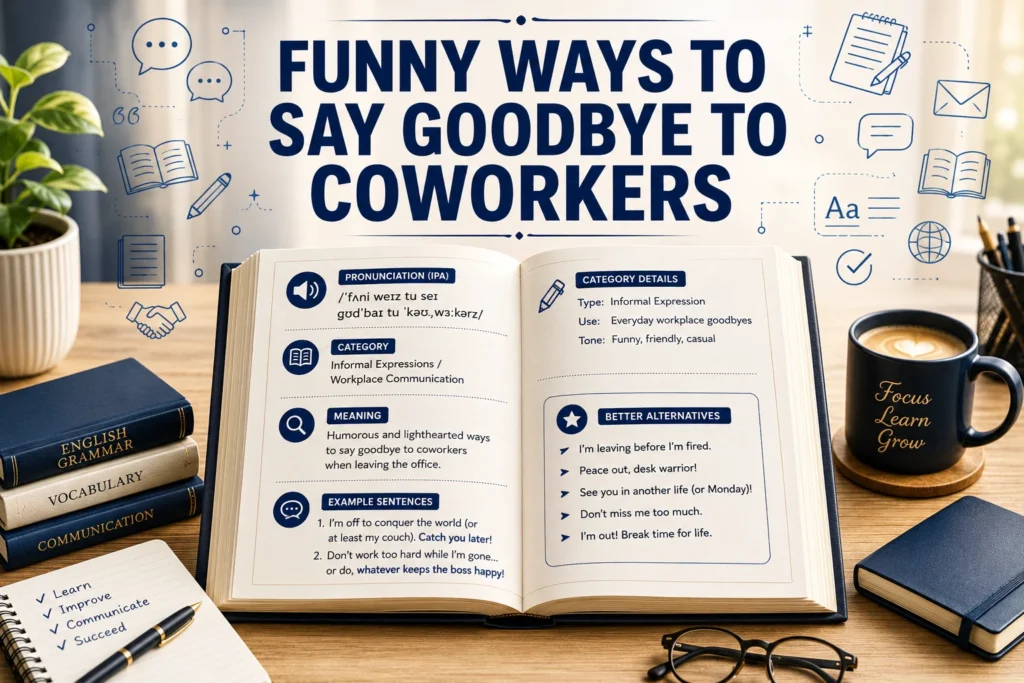
Finding funny ways to say goodbye to coworkers can make a final day, office farewell, team change, or casual goodbye feel warmer and more memorable. The right phrase can show personality without making the workplace awkward.
A funny goodbye works best when you know your audience. You can use playful language with close colleagues, keep the humor light with a manager, and choose a polished farewell when you speak with clients or professional contacts.
Many people search for a professional way to say goodbye to coworkers because a simple “bye” can feel too plain. Others want a funny synonym for goodbye that sounds natural in a team chat, farewell card, email, or office conversation.
The key lies in matching the phrase to the relationship.
For example:
- A close coworker: “Try not to enjoy the office without me.”
- A team member: “I’m off to pretend I’ll miss the meetings.”
- A manager: “Thanks for everything. I’ll miss the team—and maybe even the meetings.”
- A client: “It has been a pleasure working with you. I hope we stay in touch.”
- A networking contact: “Until our paths cross again!”
This guide gives you 55 practical alternatives, from professional and formal choices to friendly, funny, email-ready, and workplace-specific expressions.
What Does “Goodbye to Coworkers” Mean?
Literal meaning
“Goodbye to coworkers” means saying farewell to people you work with when you leave the office, change departments, finish a project, move to another company, retire, or simply end the workday.
The word goodbye carries a basic farewell meaning, but your choice of words can change the emotional effect.
Tone
A goodbye can sound:
- Professional
- Formal
- Friendly
- Warm
- Funny
- Casual
- Emotional
- Appreciative
- Playful
- Respectful
The situation should determine your tone.
Purpose
A workplace goodbye can help you:
- End a conversation politely.
- Leave a positive impression.
- Thank colleagues for their support.
- Celebrate a career change.
- Keep professional relationships strong.
- Add humor to a farewell.
- Show appreciation without sounding overly emotional.
Emotional context
A goodbye often carries more meaning than the words themselves.
“See you tomorrow” sounds routine.
“Take care, and thanks for making work so much fun” sounds warm.
“Good luck surviving without me!” sounds playful and works best among close coworkers.
Examples
Simple:
“Have a great evening. See you tomorrow!”
Friendly:
“Take care, everyone. I’ll see you around!”
Funny:
“I’m signing off before someone gives me another task!”
Farewell:
“Thanks for all the great memories. I’ll miss working with you.”
When Is It Appropriate to Use Funny Goodbyes at Work?
Humor can improve workplace communication, but context matters.
In Emails
A funny goodbye works well in a team email when coworkers already know your personality.
Example:
“Thanks for everything, team. I’m officially logging off before someone finds one last task for me!”
For clients, keep the humor subtle.
“It has been a pleasure working with you. I’m signing off for now, but I hope we stay in touch.”
In the Workplace
You can use playful goodbyes with coworkers during normal office interactions.
Examples:
- “I’m out. Try to keep the place running.”
- “See you tomorrow, assuming the coffee machine survives.”
- “Time to escape before another meeting appears.”
With Clients
Client communication requires more care. Avoid jokes that could sound disrespectful or careless.
Use warm professionalism instead:
“Thank you for your time today. I look forward to speaking with you again.”
In Networking
Networking calls for a positive and memorable tone.
Try:
“Until our paths cross again!”
Or:
“Great connecting with you. Let’s stay in touch.”
In Customer Service
Customer service teams should prioritize courtesy and clarity.
Instead of an overly casual goodbye, use:
“Thank you for reaching out. Have a wonderful day!”
You can add gentle warmth when the company culture allows it.
Professional Ways to Say Goodbye to Coworkers
1. “Take care, and see you soon.”
Meaning: A warm and simple farewell.
Tone: Professional and friendly.
Best use: Everyday workplace conversations.
Example:
“Thanks for your help today. Take care, and see you soon.”
2. “Have a great rest of your day.”
Meaning: You wish your coworker a pleasant day after leaving.
Tone: Polite and professional.
Best use: End-of-day conversations.
Example:
“I’ll send the report tomorrow. Have a great rest of your day.”
3. “Until next time.”
Meaning: You expect another interaction in the future.
Tone: Polished and warm.
Best use: Office, networking, and professional conversations.
Example:
“Thanks for the discussion. Until next time!”
4. “See you around.”
Meaning: You expect to meet again sometime.
Tone: Casual but professional.
Best use: Coworkers you know well.
Example:
“I’m heading out. See you around!”
5. “All the best.”
Meaning: You express good wishes.
Tone: Professional and warm.
Best use: Farewell emails and messages.
Example:
“Thanks for everything, Sarah. All the best in your new role.”
6. “Wishing you continued success.”
Meaning: You hope the person continues to do well.
Tone: Professional and polished.
Best use: Career changes and formal farewells.
Example:
“Wishing you continued success in your new position.”
7. “Keep in touch.”
Meaning: You want to maintain the relationship.
Tone: Friendly and professional.
Best use: Coworkers who leave the company.
Example:
“It was great working with you. Keep in touch!”
8. “It was great working with you.”
Meaning: You show appreciation for the professional relationship.
Tone: Respectful and warm.
Best use: Departing coworkers.
Example:
“It was great working with you. Good luck with your next chapter.”
9. “Until we meet again.”
Meaning: You expect another meeting someday.
Tone: Warm and slightly formal.
Best use: Farewell messages and professional contacts.
Example:
“Thanks for all your support. Until we meet again.”
10. “Wishing you all the best ahead.”
Meaning: You wish someone success in the future.
Tone: Positive and professional.
Best use: Career transitions.
Example:
“Congratulations on the new opportunity. Wishing you all the best ahead.”
11. “Have a wonderful evening.”
Meaning: You wish someone a pleasant evening.
Tone: Polite and professional.
Best use: End-of-day office conversations.
Example:
“That covers everything for today. Have a wonderful evening.”
12. “Enjoy the rest of your week.”
Meaning: You wish someone well for the remaining days.
Tone: Friendly and professional.
Best use: Thursday or Friday workplace conversations.
Example:
“I’ll catch up with you Monday. Enjoy the rest of your week!”
13. “Thanks for everything. Take care.”
Meaning: You combine appreciation with a farewell.
Tone: Warm and sincere.
Best use: Colleagues you worked with closely.
Example:
“Thanks for everything over the past year. Take care!”
14. “Good luck with what comes next.”
Meaning: You wish someone success in a new situation.
Tone: Supportive and professional.
Best use: Resignations, transfers, and career changes.
Example:
“Good luck with what comes next. You’ll do great!”
15. “I hope our paths cross again.”
Meaning: You hope to meet or work together again.
Tone: Professional and thoughtful.
Best use: Farewell messages and networking.
Example:
“It has been a pleasure working with you. I hope our paths cross again.”
Formal Alternatives
16. “Farewell, and best wishes.”
Meaning: A respectful formal goodbye.
Tone: Formal and courteous.
Best use: Official farewell messages.
Example:
“Farewell, and best wishes for your future endeavors.”
17. “I wish you every success.”
Meaning: You express strong good wishes for someone’s future.
Tone: Formal.
Best use: Professional departures.
Example:
“I wish you every success in your new role.”
18. “It has been a pleasure working with you.”
Meaning: You express appreciation for the professional relationship.
Tone: Formal and respectful.
Best use: Clients, managers, and senior coworkers.
Example:
“It has been a pleasure working with you over the past three years.”
19. “I wish you the very best.”
Meaning: You offer sincere good wishes.
Tone: Formal but warm.
Best use: Farewell cards and emails.
Example:
“I wish you the very best in your next position.”
20. “Thank you for your collaboration.”
Meaning: You recognize someone’s contribution.
Tone: Formal and businesslike.
Best use: Project endings and professional emails.
Example:
“Thank you for your collaboration. I wish you continued success.”
21. “Thank you for your support and guidance.”
Meaning: You appreciate someone’s help.
Tone: Respectful and formal.
Best use: Managers, mentors, and senior colleagues.
Example:
“Thank you for your support and guidance throughout my time here.”
22. “I appreciate the opportunity to work with you.”
Meaning: You value the professional experience.
Tone: Formal and appreciative.
Best use: Clients and business contacts.
Example:
“I appreciate the opportunity to work with you and wish you continued success.”
23. “I look forward to staying in touch.”
Meaning: You want to continue the relationship.
Tone: Professional.
Best use: Farewell emails and networking.
Example:
“Thank you again. I look forward to staying in touch.”
24. “Please accept my best wishes.”
Meaning: You formally express good wishes.
Tone: Very formal.
Best use: Official correspondence.
Example:
“Please accept my best wishes for your future endeavors.”
25. “I wish you continued success in your career.”
Meaning: You hope the person keeps progressing professionally.
Tone: Formal and polished.
Best use: Career transitions.
Example:
“I wish you continued success in your career and future projects.”
Friendly and Funny Goodbyes
26. “I’m out before someone gives me another task.”
Meaning: You joke about avoiding more work.
Tone: Funny and casual.
Best use: Close coworkers.
Example:
“Everything is done, so I’m out before someone gives me another task!”
27. “Try not to have too much fun without me.”
Meaning: You jokingly suggest coworkers will miss you.
Tone: Playful.
Best use: Friendly teams.
Example:
“I’m heading home. Try not to have too much fun without me!”
28. “I’m officially escaping.”
Meaning: You humorously describe leaving work.
Tone: Casual and funny.
Best use: End of the workday.
Example:
“Five o’clock has arrived. I’m officially escaping!”
29. “Time to disappear before the next meeting.”
Meaning: You joke about avoiding another meeting.
Tone: Playful.
Best use: Meeting-heavy workplaces.
Example:
“That’s all from me. Time to disappear before the next meeting!”
30. “See you tomorrow, survivors.”
Meaning: You jokingly call coworkers survivors after a busy day.
Tone: Very casual and humorous.
Best use: Close-knit teams.
Example:
“Another Monday conquered. See you tomorrow, survivors!”
31. “I’m logging off before the emails find me.”
Meaning: You joke about escaping work messages.
Tone: Funny and relatable.
Best use: Office chat.
Example:
“I’m logging off before the emails find me. Have a good evening!”
32. “May your inbox stay quiet.”
Meaning: You jokingly wish someone fewer emails.
Tone: Friendly and humorous.
Best use: Digital workplaces.
Example:
“Have a good evening. May your inbox stay quiet!”
33. “Goodbye for now, office warriors.”
Meaning: A playful farewell for hardworking coworkers.
Tone: Warm and funny.
Best use: Team chats.
Example:
“Goodbye for now, office warriors. See you tomorrow!”
34. “I’m off to reclaim my evening.”
Meaning: You jokingly say you are leaving work for personal time.
Tone: Casual.
Best use: End of the workday.
Example:
“The clock has spoken. I’m off to reclaim my evening!”
35. “Catch you on the other side of the weekend.”
Meaning: You will see coworkers after the weekend.
Tone: Playful.
Best use: Friday afternoons.
Example:
“Happy Friday, everyone! Catch you on the other side of the weekend.”
Email-Ready Goodbyes
36. “Signing off for now.”
Meaning: You are ending your message or workday.
Tone: Professional and friendly.
Best use: Emails and team chats.
Example:
“Thanks for your help today. Signing off for now!”
37. “I’ll leave you to it.”
Meaning: You are ending the interaction so others can continue.
Tone: Polite and natural.
Best use: Workplace emails and conversations.
Example:
“Thanks for your time. I’ll leave you to it and catch up with you tomorrow.”
38. “Thanks again, and have a great day.”
Meaning: You close an email with appreciation and goodwill.
Tone: Professional.
Best use: Business emails.
Example:
“Thanks again for your support, and have a great day.”
39. “Until our next conversation.”
Meaning: You expect future communication.
Tone: Polished.
Best use: Professional emails.
Example:
“Thank you for the update. Until our next conversation.”
40. “I’ll catch up with you soon.”
Meaning: You plan to communicate again.
Tone: Friendly and professional.
Best use: Coworkers and regular contacts.
Example:
“I’ll send the notes later today. I’ll catch up with you soon.”
41. “Thanks for a productive day.”
Meaning: You appreciate the day’s work.
Tone: Professional and positive.
Best use: Project teams.
Example:
“Thanks for a productive day, everyone. Enjoy your evening.”
42. “Have a relaxing evening.”
Meaning: You wish someone a peaceful evening.
Tone: Warm and polite.
Best use: Work emails and team messages.
Example:
“That’s everything from my side. Have a relaxing evening.
43. “Enjoy your weekend.”
Meaning: A simple Friday farewell.
Tone: Friendly and professional.
Best use: Friday emails and messages.
Example:
“Thanks for your help this week. Enjoy your weekend!”
44. “Talk soon.”
Meaning: You expect to speak again soon.
Tone: Friendly and concise.
Best use: Informal professional emails.
Example:
“Thanks, Mark. Talk soon.”
45. “Until next time, and thanks again.”
Meaning: You combine a farewell with appreciation.
Tone: Warm and professional.
Best use: Farewell emails.
Example:
“Until next time, and thanks again for all your help.”
Workplace-Specific Alternatives
46. “Time to clock out!”
Meaning: You announce that you are finished working.
Tone: Casual and cheerful.
Best use: End-of-day office conversations.
Example:
“Five o’clock! Time to clock out!”
47. “Another day in the books.”
Meaning: You mark the end of another workday.
Tone: Casual and slightly humorous.
Best use: Team chats.
Example:
“Another day in the books. See you all tomorrow!”
48. “We survived another one.”
Meaning: You jokingly celebrate finishing a difficult day.
Tone: Funny and informal.
Best use: Close coworkers.
Example:
“That was a long one. We survived another one!
49. “See you at the office battlefield tomorrow.”
Meaning: You jokingly compare work to a battlefield.
Tone: Very playful.
Best use: Close-knit teams with a strong sense of humor.
Example:
“Good work today. See you at the office battlefield tomorrow!”
50. “I’m calling it a day.”
Meaning: You have finished working.
Tone: Natural and professional.
Best use: Everyday workplace communication.
Example:
“I’ve finished the report, so I’m calling it a day.”
51. “That’s me done!”
Meaning: You have completed your work for the day.
Tone: Casual.
Best use: Friendly office conversations.
Example:
“That’s me done! Have a good evening, everyone.”
52. “See you bright and early.”
Meaning: You expect to see coworkers the next morning.
Tone: Friendly and slightly playful.
Best use: End-of-day farewells.
Example:
“Have a good evening. See you bright and early!”
53. “Until tomorrow, team.”
Meaning: You expect to see your team the next day.
Tone: Warm and professional.
Best use: Team environments.
Example:
“Great work today. Until tomorrow, team!”
54. “Same time, same office tomorrow.”
Meaning: You jokingly point out that everyone will return the next day.
Tone: Playful.
Best use: Close coworkers.
Example:
“Another productive day done. Same time, same office tomorrow!”
55. “Go home before the office misses you.”
Meaning: You humorously encourage coworkers to leave work.
Tone: Funny and casual.
Best use: Friendly teams.
Example:
“You’ve done enough today. Go home before the office misses you!”
Quick Comparison Table
| Alternative | Tone | Best Use |
| Take care, and see you soon | Professional | Everyday work |
| All the best | Professional | Farewell emails |
| Keep in touch | Warm | Departing coworkers |
| It was a pleasure working with you | Formal | Clients and managers |
| I wish you every success | Formal | Career transitions |
| Until we meet again | Polished | Professional farewells |
| Signing off for now | Friendly professional | Emails |
| Talk soon | Casual professional | Coworkers |
| I’m officially escaping | Funny | Close colleagues |
| May your inbox stay quiet | Funny | Team chat |
| We survived another one | Humorous | Close coworkers |
| Time to clock out | Casual | End of day |
| Enjoy your weekend | Friendly | Friday |
| I’m calling it a day | Natural | Workplace |
| I hope our paths cross again | Warm | Networking |
Email Examples for Different Situations
1. Client Email
Subject: Thank You
Thank you for the opportunity to work together. It has been a pleasure working with you. I wish you continued success, and I hope our paths cross again in the future.
This version works because it keeps the tone professional while still sounding warm.
2. Manager Email
Subject: Thank You
Thank you for your support and guidance. I truly appreciate everything I learned while working with you and the team. I wish you and everyone here continued success. I hope we stay in touch.
A manager deserves a respectful tone. Avoid overly casual jokes unless you have a very relaxed relationship.
3. Colleague Email
Subject: See You Around
Thanks for all the laughs, help, and teamwork. I’m officially escaping, but I’ll definitely miss working with you. Try not to have too much fun without me!
This version works well for a close coworker.
4. Customer Email
Subject: Thank You
Thank you for reaching out. It was a pleasure assisting you. I appreciate your time and hope you have a wonderful day!
Customer communication should focus on courtesy rather than humor.
5. Networking Email
Subject: Great Connecting With You
It was great connecting with you. Thank you for the conversation and insights. I hope our paths cross again soon. Until then, all the best!
This approach keeps the relationship open without sounding overly familiar.
6. Meeting Follow-Up
Subject: Meeting Follow-Up
Thanks, everyone, for a productive discussion today. I’ll send the remaining notes shortly. Until next time—and hopefully before the next meeting invite appears!
The final joke works when the team has an informal culture.
Common Mistakes When Saying Goodbye at Work
1. Using Humor With Everyone
Not every coworker shares the same sense of humor.
A joke that works with your closest teammate might sound inappropriate to a senior manager or client.
Better approach: Adjust the humor to the relationship.
2. Making the Goodbye Too Casual
Phrases like “I’m outta here” or “Later!” may work with friends, but they can sound careless in formal business communication.
Use:
“Thanks for everything. Take care.”
3. Making a Joke About the Company
Avoid jokes that attack your employer, manager, customers, or workplace.
For example:
“Finally escaping this terrible place!”
Even if you mean it as a joke, someone may read it literally.
A safer alternative:
“I’m officially signing off. Thanks for all the memories!”
4. Overusing Funny Phrases
A funny goodbye works because it adds personality. If every message contains a joke, the humor loses its effect.
Use humor selectively.
5. Choosing the Wrong Level of Formality
Consider who will read your message.
Client:
“It has been a pleasure working with you.”
Manager:
“Thank you for your guidance and support.”
Coworker:
“Try not to enjoy the office without me!”
Close friend at work:
“We survived another one!”
Each phrase fits a different relationship.
6. Forgetting Email Etiquette
A professional goodbye email should still include:
- Appreciation
- A clear closing
- Appropriate humor
- Contact information when needed
- A positive final impression
Never let a joke replace important information.
Related Goodbye Expressions
1. “Take care”
A warm and common farewell.
Example: “Thanks for everything. Take care!”
2. “See you soon”
Shows that you expect another meeting.
Example: “Have a good evening. See you soon.”
3. “See you around”
A casual farewell for people you may meet again.
Example: “I’m heading out. See you around!”
4. “Until next time”
A polished alternative to goodbye.
Example: “Great working with you. Until next time!”
5. “Keep in touch”
Encourages continued communication.
Example: “Good luck with the new job, and keep in touch.”
6. “All the best”
Expresses positive wishes.
Example: “All the best in your new role.”
7. “Have a good one”
A casual American English farewell.
Example: “Thanks for your help. Have a good one!”
8. “Talk soon”
Suggests another conversation soon.
Example: “I’ll send the details later. Talk soon.”
9. “Catch you later”
A casual goodbye.
Example: “I’m heading out. Catch you later!”
10. “Have a great evening”
A polite end-of-day phrase.
Example: “Thanks for your time. Have a great evening.”
11. “Wishing you well”
A warm farewell.
Example: “Wishing you well in your next chapter.”
12. “Good luck”
Shows support for a new opportunity.
Example: “Good luck with the new position!”
13. “Until we meet again”
A more thoughtful farewell.
Example: “It has been a pleasure. Until we meet again.”
14. “I hope our paths cross again”
Shows that you value the relationship.
Example: “I hope our paths cross again sometime.”
15. “Stay in touch”
A direct invitation to maintain contact.
Example: “Thanks for everything. Stay in touch!”
16. “Have a safe trip”
Use this when someone travels.
Example: “Have a safe trip, and see you next week!”
17. “Enjoy your weekend”
A natural Friday farewell.
Example: “Great work this week. Enjoy your weekend!”
Phrase Comparison
The phrase you choose should reflect the situation.
| Phrase | Tone | Formality | Best Use |
| Goodbye | Neutral | Medium | General situations |
| Take care | Warm | Medium | Coworkers |
| All the best | Professional | High | Emails |
| Keep in touch | Friendly | Medium | Departing colleagues |
| Until next time | Polished | High | Business communication |
| Talk soon | Friendly | Medium | Regular contacts |
| I’m officially escaping | Funny | Low | Close coworkers |
| May your inbox stay quiet | Funny | Low | Team chat |
| It has been a pleasure working with you | Formal | High | Clients |
| I wish you every success | Formal | Very high | Career farewell |
| We survived another one | Humorous | Low | Close teams |
| I’m calling it a day | Casual professional | Medium | End of workday |
| Signing off for now | Professional | Medium-high | |
| I hope our paths cross again | Warm | High | Networking |
| Enjoy your weekend | Friendly | Medium | Friday |
Cultural Usage
US English
American workplace communication often favors friendly and direct language.
Common choices include:
- “Have a good one!”
- “Take care!”
- “Talk soon!”
- “See you around!”
- “Enjoy your weekend!”
Humor can work well in casual American workplaces, especially among coworkers who already know each other.
UK English
British workplace communication often uses expressions such as:
- “See you later.”
- “Take care.”
- “All the best.”
- “Cheers.”
- “See you tomorrow.”
“Cheers” can function as a casual closing in British English, although context matters.
Corporate Communication
Large companies usually require a more controlled tone.
Use:
“Thank you for your collaboration. I wish you continued success.”
Save jokes for internal conversations where the team culture supports them.
Customer Service
Customer service communication should remain courteous and clear.
Good options include:
“Thank you for contacting us. Have a wonderful day.”
Or:
“Thank you for your time. Please take care.”
Avoid sarcastic or highly personal jokes.
Networking
Networking requires a balance between warmth and professionalism.
Strong options include:
- “It was great connecting with you.”
- “I hope we stay in touch.”
- “I hope our paths cross again.”
- “Until next time.”
- “Wishing you continued success.”
These phrases keep the door open for future opportunities.
How to Choose the Best Funny Goodbye
Use this simple rule:
For a close coworker
Choose something playful.
“Try not to have too much fun without me!”
For your team
Use light workplace humor.
“May your inbox stay quiet!”
For your manager
Keep the humor subtle.
“Thanks for everything. I’ll miss the team—and maybe even the meetings!”
For a client
Stay professional.
“It has been a pleasure working with you.”
For a networking contact
Use a relationship-focused farewell.
“I hope our paths cross again.”
For an email
Use a polished closing.
“Thanks again, and have a great day.”
faqs
What are some funny ways to say goodbye to coworkers?
Try phrases such as “I’m officially escaping,” “May your inbox stay quiet,” “Try not to have too much fun without me,” or “We survived another one.”
Choose humor that matches your relationship with the coworker.
What is a professional way to say goodbye to coworkers?
Good professional choices include:
- “Take care, and see you soon.”
- “All the best.”
- “It was great working with you.”
- “Keep in touch.”
- “I hope our paths cross again.”
What is a formal alternative to goodbye?
Use “Farewell,” “Until we meet again,” “I wish you every success,” or “It has been a pleasure working with you.”
How do I say goodbye to coworkers in an email?
Keep the message short, appreciative, and appropriate for your workplace.
Example:
“Thank you for all your support. It has been a pleasure working with you. I wish you all the best and hope we stay in touch.”
What is a funny way to say goodbye on Friday?
Try:
“Catch you on the other side of the weekend!”
Or:
“I’m off to reclaim my evening. Happy Friday!”
How do I say goodbye to a coworker who is leaving?
Show appreciation and wish them well.
“It was great working with you. Good luck with your next chapter, and keep in touch!”
Can I use funny goodbyes with my manager?
Yes, if your relationship and workplace culture support humor. Keep the joke respectful and avoid jokes about the manager’s abilities or the company.
What is a good goodbye for a work group chat?
Try:
“Good work today, everyone. May your inbox stay quiet!”
This works especially well in informal team chats.
What is the best goodbye for a client?
Use a professional phrase such as:
“It has been a pleasure working with you. I wish you continued success.”
What is a good goodbye for a coworker I will never see again?
Try:
“It has been a pleasure working with you. I wish you all the best, and I hope our paths cross again.”
What is a funny farewell message for a coworker?
You could write:
“Thanks for all the laughs and teamwork. I’m officially escaping. Try not to have too much fun without me!”
What is a short professional goodbye?
“Take care,” “All the best,” “Until next time,” and “Talk soon” all work well.
What is a funny way to leave work?
Try:
“I’m calling it a day before another meeting appears!”
Or:
“I’m logging off before the emails find me!”
What should I avoid in a workplace goodbye?
Avoid offensive jokes, sarcasm that people could misunderstand, personal comments, insults, and complaints about the company.
What is the best email etiquette for saying goodbye?
Start with appreciation, state the farewell clearly, keep the tone appropriate, and end with a positive closing. Use humor only when you know the audience will appreciate it.
Best Choices by Situation
If you need a professional way to say goodbye to coworkers, choose:
“It was great working with you. All the best!”
If you need a formal alternative to goodbye, choose:
“I wish you every success.”
If you need a funny goodbye for a close coworker, choose:
“Try not to have too much fun without me!”
If you need a funny workplace goodbye, choose:
“May your inbox stay quiet!”
If you need a business email phrase, choose:
“Thank you for your collaboration. I wish you continued success.”
If you need a networking farewell, choose:
“I hope our paths cross again.”
If you need a short casual goodbye, choose:
“Talk soon!”
If you need a Friday farewell, choose:
“Catch you on the other side of the weekend!”
Final Summary
The best funny ways to say goodbye to coworkers combine humor with good judgment. For close teammates, playful lines such as “I’m officially escaping” or “May your inbox stay quiet” can make a farewell memorable. For professional settings, choose “All the best,” “Keep in touch,” or “It was a pleasure working with you.” Formal situations call for respectful phrases such as “I wish you every success.” In emails, clients, and networking, prioritize clarity, appreciation, and professional communication. The strongest goodbye always matches the relationship, workplace culture, and purpose of the conversation.