
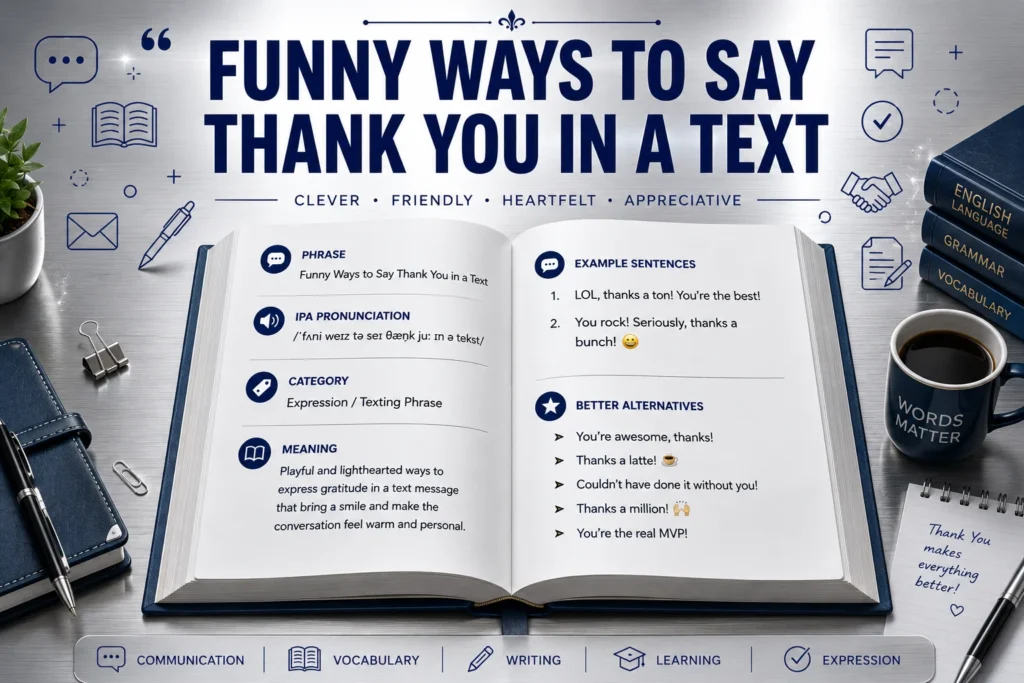
Saying thank you over text does not always need to sound serious or repetitive. The right message can show genuine appreciation while still matching your relationship with the other person. Whether you are thanking a friend, coworker, manager, client, customer, or professional contact, a small change in wording can make your message warmer and more memorable.
This guide covers funny ways to say thank you in a text, along with professional, formal, friendly, and email-ready alternatives. You will also find examples for workplace communication, customer service, networking, and business emails.
The key is simple: match your level of humor to the relationship and situation.
What Does “Thank You” Mean?
Literal Meaning
“Thank you” is a polite expression used to show appreciation for something someone has done, given, or said.
For example:
“Thank you for helping me with the report.”
The message tells the other person that you noticed their effort and appreciate it.
Tone
The tone of “thank you” can range from formal to casual.
- Formal: “I sincerely appreciate your assistance.”
- Professional: “Thank you for your support.”
- Friendly: “Thanks so much!”
- Casual: “Thanks a ton!”
- Funny: “You’re officially my favorite human today.”
Purpose
People use thank-you messages to:
- Show appreciation
- Build relationships
- Recognize someone’s effort
- Maintain professional goodwill
- Strengthen customer relationships
- Make conversations warmer
- End an interaction positively
Emotional Context
A simple thank-you can communicate more than politeness. It can show respect, gratitude, warmth, relief, excitement, or even humor.
Compare:
Simple:
“Thanks for helping.”
Warm:
“Thanks so much for helping me. I really appreciate it!”
Funny:
“Thanks! You have officially saved the day.”
The meaning stays similar, but the emotional effect changes.
Professional Usage of Thank-You Alternatives
Knowing a professional way to say thank you in a text helps you avoid sounding either too cold or too casual.
1. Emails
Professional emails usually benefit from direct and sincere language.
Good examples include:
- “Thank you for your assistance.”
- “I appreciate your help.”
- “Thank you for your time.”
- “I’m grateful for your support.”
- “Thank you for the quick response.”
Avoid jokes when communicating about serious complaints, sensitive matters, or high-stakes business issues.
2. Workplace Communication
With coworkers, you can usually use warmer language.
For example:
“Thanks for jumping in and helping with this. You saved me a lot of time!”
A little humor can work well when you already have a friendly relationship.
3. Clients
Client communication should remain respectful and polished.
Try:
“Thank you for your continued support. We truly appreciate working with you.”
A funny response may work with a long-term client who already communicates casually, but keep the humor appropriate.
4. Networking
Networking messages should sound genuine rather than overly formal.
For example:
“Thanks again for taking the time to chat. I really enjoyed our conversation.”
This sounds more natural than repeatedly saying “Thank you for your valuable time.”
5. Customer Service
Customer service requires appreciation without sounding scripted.
Instead of:
“Thank you.”
Try:
“Thanks for your patience—we really appreciate it!”
This feels personal while remaining professional.
Funny Ways to Say Thank You in a Text
Here are playful options for friends, family members, coworkers, and casual conversations.
1. “You’re a lifesaver!”
Meaning: You helped me when I really needed it.
Tone: Friendly and appreciative.
Best use: Friends, coworkers, close contacts.
Example:
“You’re a lifesaver! Thanks for covering for me.”
2. “I owe you one!”
Meaning: I appreciate your help and will return the favor.
Tone: Casual and friendly.
Best use: Friends or coworkers.
Example:
“Thanks for picking me up. I owe you one!”
3. “You’re officially my favorite person today.”
Meaning: I appreciate what you just did.
Tone: Playful.
Best use: Friends and close colleagues.
Example:
“You brought coffee? You’re officially my favorite person today.”
4. “You just earned yourself a lifetime supply of gratitude.”
Meaning: I am extremely thankful.
Tone: Funny and exaggerated.
Best use: Casual texting.
Example:
“Thanks for helping me move. You just earned yourself a lifetime supply of gratitude.”
5. “Thanks a million—and I promise I’m only slightly dramatic.”
Meaning: Thank you very much.
Tone: Humorous.
Best use: Friends.
Example:
“Thanks a million for fixing that!”
6. “You’re the real MVP.”
Meaning: You did something especially helpful.
Tone: Casual and modern.
Best use: Friends, teammates, informal coworkers.
Example:
“You sent me the notes? You’re the real MVP.”
7. “May your Wi-Fi always be strong.”
Meaning: A humorous blessing showing appreciation.
Tone: Playful.
Best use: Casual texting.
Example:
“Thanks for helping me with the presentation. May your Wi-Fi always be strong.”
8. “I would send you a trophy, but this text will have to do.”
Meaning: You deserve recognition.
Tone: Funny and appreciative.
Best use: Friends or colleagues.
Example:
“Thanks for sorting that out. I would send you a trophy, but this text will have to do.”
9. “Thanks! You have my eternal gratitude.”
Meaning: I am very grateful.
Tone: Playfully dramatic.
Best use: Casual conversations.
Example:
“Thanks for saving me a seat. You have my eternal gratitude.”
10. “You’re a legend. Thanks!”
Meaning: You did something impressive or helpful.
Tone: Friendly and enthusiastic.
Best use: Friends and informal workplace chats.
Example:
“You fixed the printer? You’re a legend. Thanks!”
11. “Thanks! I’ll repay you in snacks.”
Meaning: I appreciate your help and will return the favor.
Tone: Funny and casual.
Best use: Friends and coworkers.
Example:
“Thanks for helping me finish this. I’ll repay you in snacks.”
12. “You deserve a medal for this.”
Meaning: Your help was especially valuable.
Tone: Playful.
Best use: Informal situations.
Example:
“You found my missing file? You deserve a medal.”
13. “Thank you, kind human!”
Meaning: A cheerful way to express appreciation.
Tone: Light and friendly.
Best use: Casual texts.
Example:
“Thank you, kind human, for sending that over!”
14. “You’re dangerously helpful. Thank you!”
Meaning: You were extremely helpful.
Tone: Playfully exaggerated.
Best use: Friends or close coworkers.
Example:
“You finished the spreadsheet already? You’re dangerously helpful. Thank you!”
15. “Thanks! My gratitude has entered the chat.”
Meaning: A humorous version of expressing thanks.
Tone: Internet-style humor.
Best use: Casual texting.
Example:
“You remembered my birthday? My gratitude has entered the chat.”
Professional Ways to Say Thank You
If you need a professional way to say thank you in a text, choose language that sounds sincere without becoming overly formal.
16. “I really appreciate your help.”
Meaning: You value the person’s assistance.
Tone: Professional and warm.
Best use: Workplace and business messages.
Example:
“I really appreciate your help with the project.”
17. “Thank you for your support.”
Meaning: You recognize someone’s assistance.
Tone: Professional.
Best use: Clients, managers, coworkers.
Example:
“Thank you for your support throughout the project.”
18. “I appreciate you taking the time.”
Meaning: You value the person’s time and effort.
Tone: Polite and professional.
Best use: Meetings and networking.
Example:
“I appreciate you taking the time to speak with me today.”
19. “Thanks for your quick response.”
Meaning: You appreciate their prompt reply.
Tone: Professional and straightforward.
Best use: Business emails and texts.
Example:
“Thanks for your quick response. I’ll review the document today.”
20. “I’m grateful for your assistance.”
Meaning: You sincerely appreciate their help.
Tone: Polished.
Best use: Formal professional communication.
Example:
“I’m grateful for your assistance with this matter.”
21. “Thank you for going the extra mile.”
Meaning: You recognize extra effort.
Tone: Warm and professional.
Best use: Workplace and customer service.
Example:
“Thank you for going the extra mile to resolve the issue.
22. “I truly appreciate your effort.”
Meaning: You recognize someone’s work.
Tone: Sincere and professional.
Best use: Workplace communication.
Example:
“I truly appreciate your effort on this project.”
23. “Thanks for making this easier.”
Meaning: Their help reduced your workload.
Tone: Friendly-professional.
Best use: Coworkers and clients.
Example:
“Thanks for making this process so much easier.”
24. “Your help means a lot.”
Meaning: Their assistance has real value.
Tone: Warm.
Best use: Personal and professional relationships.
Example:
“Your help means a lot. Thank you for being so supportive.”
25. “I appreciate your time and effort.”
Meaning: You recognize both their time and work.
Tone: Professional.
Best use: Business communication.
Example:
“I appreciate your time and effort in reviewing the proposal.”
Formal Alternatives to Thank You
A formal alternative to thank you works best when you communicate with senior leaders, clients, institutions, or people you do not know well.
26. “I sincerely appreciate your assistance.”
Professional and formal.
“I sincerely appreciate your assistance with this matter.”
27. “Please accept my sincere thanks.”
Highly formal and courteous.
“Please accept my sincere thanks for your support.”
28. “I am deeply grateful for your support.”
Expresses strong appreciation.
“I am deeply grateful for your continued support.”
29. “Your assistance is greatly appreciated.”
Formal and concise.
“Your assistance is greatly appreciated.”
30. “I would like to express my appreciation.”
Useful in formal written communication.
“I would like to express my appreciation for your guidance.”
31. “I am sincerely grateful.”
Short but formal.
“I am sincerely grateful for your assistance.”
32. “Thank you for your continued cooperation.”
Ideal for business relationships.
“Thank you for your continued cooperation throughout this process.”
33. “I greatly value your support.”
Professional and respectful.
“I greatly value your support and guidance.”
34. “Your support is sincerely appreciated.”
Polished and formal.
“Your continued support is sincerely appreciated.”
35. “I extend my sincere appreciation.”
Very formal.
“I extend my sincere appreciation for your assistance.”
Friendly Ways to Say Thank You
For friends, relatives, classmates, and close coworkers, you can sound more relaxed.
36. “Thanks so much!”
Simple and warm.
“Thanks so much for helping me!”
37. “Thanks a ton!”
Casual and enthusiastic.
“Thanks a ton for picking me up!”
38. “You’re the best!”
Warm and personal.
“Thanks for helping me. You’re the best!”
39. “I can’t thank you enough!”
Shows strong appreciation.
“I can’t thank you enough for helping me through this.”
40. “You’re amazing!”
Short and enthusiastic.
“Thanks for sorting that out. You’re amazing!”
41. “Big thanks!”
Brief and casual.
“Big thanks for sending that over!”
42. “Much appreciated!”
Short and useful.
“Much appreciated! That really helped.”
43. “Thanks a bunch!”
Friendly and informal.
“Thanks a bunch for the help!”
44. “You rock!”
Very casual.
“Thanks for helping me—you rock!”
45. “You just made my day!”
Shows that someone’s action made you happy.
“You remembered! You just made my day.”
Email-Friendly Ways to Say Thank You
These business email phrases sound natural without being unnecessarily stiff.
46. “Thank you for your time.”
“Thank you for your time today. I enjoyed discussing the project with you.”
47. “Thank you for getting back to me.”
“Thank you for getting back to me so quickly.”
48. “I appreciate your prompt response.”
“I appreciate your prompt response and clarification.”
49. “Thank you for the update.”
“Thank you for the update. I’ll review the information and get back to you.”
50. “Thank you for your feedback.”
“Thank you for your feedback. I’ll incorporate your suggestions.”
51. “I appreciate your guidance.”
“I appreciate your guidance throughout this process.”
52. “Thank you for your consideration.”
“Thank you for your consideration. I look forward to hearing from you.”
53. “Thank you for clarifying.”
“Thank you for clarifying the next steps.”
54. “I appreciate your attention to this matter.”
“I appreciate your attention to this matter and your quick response.”
55. “Thank you for your continued support.”
“Thank you for your continued support. We value our partnership.”
Quick Comparison Table
| Alternative | Tone | Best Use |
| You’re a lifesaver! | Funny | Friends/coworkers |
| I owe you one! | Casual | Friends |
| You’re the real MVP! | Funny | Informal chats |
| Thanks a ton! | Friendly | Friends |
| You’re the best! | Warm | Personal messages |
| Much appreciated! | Professional | Workplace |
| I really appreciate your help. | Professional | Business |
| Thank you for your support. | Professional | Clients |
| I appreciate your time. | Professional | Networking |
| I sincerely appreciate your assistance. | Formal | Formal email |
| Please accept my sincere thanks. | Formal | Official communication |
| Thank you for your consideration. | Formal | Business email |
| Thank you for your feedback. | Professional | Workplace |
| Thank you for the update. | Neutral | |
| I can’t thank you enough! | Warm | Friends/personal |
Email Examples
Client
Thank you for your continued support. We truly appreciate your business and look forward to working with you on the next stage of the project.
Manager
Thank you for your guidance and support. I really appreciate the time you took to help me work through this.
Colleague
Thanks for jumping in and helping with the report. You’re a lifesaver!
Customer
Thank you for your patience while we resolved the issue. We really appreciate your understanding.
Networking Contact
Thank you for taking the time to speak with me today. I enjoyed our conversation and appreciated your insights.
Meeting Follow-Up
Thank you for your time today. I appreciated the discussion and found your suggestions very helpful.
Common Mistakes When Saying Thank You
1. Using Too Much Humor
Funny messages work best when the relationship supports them.
Instead of:
“Thanks, you magnificent genius!”
Use:
“Thanks so much for your help!”
with a client or senior manager unless you already have a relaxed relationship.
2. Choosing the Wrong Tone
A joke may sound inappropriate after someone handles a serious problem.
For example, avoid:
“You’re a legend 😂”
when responding to a customer complaint.
Use:
“Thank you for your patience and understanding.”
3. Being Too Formal
Not every message needs:
“Please accept my deepest expression of gratitude.”
That can sound unnatural in a quick workplace text.
A better option:
“I really appreciate your help.”
4. Repeating “Thank You” Too Often
If every email contains “thank you” several times, the expression can lose impact.
Use alternatives such as:
- “I appreciate your help.”
- “Your support means a lot.”
- “I’m grateful for your assistance.”
- “Much appreciated.”
5. Forgetting the Specific Reason
A specific thank-you often sounds more sincere.
Weak:
“Thanks.”
Better:
“Thanks for staying late to help finish the presentation.”
This small detail makes the message feel genuine.
Related Phrases for Showing Appreciation
Here are useful expressions that work as a synonym for thank you or as related gratitude phrases.
- Much appreciated — I value what you did.
“Much appreciated for the quick response.” - I’m grateful — I sincerely appreciate your help.
“I’m grateful for your support.” - I appreciate it — I recognize your effort.
“I appreciate it. That helped a lot.” - You’re the best — You did something especially helpful.
“You’re the best for helping me out.” - I owe you one — I intend to return the favor.
“Thanks! I owe you one.” - You have my thanks — A slightly formal expression.
“You have my thanks for your assistance.” - I’m truly grateful — Strong appreciation.
“I’m truly grateful for your support.” - I appreciate your kindness — Thanks for being thoughtful.
“I appreciate your kindness during a difficult week.” - Thanks for stepping in — Appreciation for intervention or help.
“Thanks for stepping in when we needed help.” - Thanks for having my back — Appreciation for support.
“Thanks for having my back today.” - I can’t thank you enough — Very strong gratitude.
“I can’t thank you enough for your help.” - You made my day — Their action made you happy.
“That message really made my day.” - I’m thankful for you — Personal and warm.
“I’m thankful for you and everything you do.” - You’re a star — Friendly praise.
“Thanks for helping me—you’re a star.” - You saved the day — Humorous appreciation for important help.
“Thanks for fixing that. You saved the day!” - I appreciate your effort — Recognizes someone’s work.
“I appreciate your effort on this.” - Thanks for going above and beyond — Recognizes exceptional effort.
“Thanks for going above and beyond to help.” - Your help means a lot — Shows emotional value.
“Your help means a lot to me.”
Phrase Comparison: Which Thank-You Expression Should You Use?
| Phrase | Formality | Humor | Best Situation |
| Thank you | Medium | None | Almost anywhere |
| Thanks | Casual | None | Everyday texting |
| Thanks a ton | Casual | Low | Friends |
| You’re a lifesaver | Casual | Medium | Friends/coworkers |
| You’re the real MVP | Casual | High | Informal conversations |
| I owe you one | Casual | Low | Personal favors |
| Much appreciated | Professional | None | Workplace |
| I appreciate your help | Professional | None | Business |
| Thank you for your support | Professional | None | Clients |
| I appreciate your time | Professional | None | Networking |
| I sincerely appreciate your assistance | Formal | None | Official communication |
| Please accept my sincere thanks | Very formal | None | Formal correspondence |
| I can’t thank you enough | Warm | Low | Personal gratitude |
The best expression depends less on the words themselves and more on relationship, context, purpose, and communication channel.
Cultural Usage
US English
American workplace communication often favors friendly, direct appreciation.
Common expressions include:
- “Thanks so much!”
- “I really appreciate it.”
- “Thanks for your help.”
- “You’re a lifesaver!”
- “Much appreciated.”
Humor can work well in informal workplace conversations, especially through text or chat.
UK English
British English often uses polite but understated appreciation.
Examples include:
- “Many thanks.”
- “Much appreciated.”
- “Thanks very much.”
- “I really appreciate it.”
“Cheers” can also express thanks in informal British communication, depending on context.
Corporate Communication
Corporate messages should focus on clarity and professionalism.
Good choices include:
“Thank you for your assistance.”
“I appreciate your support.”
“Thank you for your time.”
Avoid excessive emojis, sl*ng, or exaggerated humor when writing to senior leaders or unfamiliar business contacts.
Customer Service
Customer service messages should sound appreciative and respectful.
Good:
“Thank you for your patience while we resolved this.”
Better for a friendly brand:
“Thanks for hanging in there with us—we really appreciate your patience!”
Networking
Networking messages should sound personal rather than automated.
Instead of:
“Thank you for your valuable time.”
Try:
“Thanks again for taking the time to chat. I really enjoyed our conversation.”
This sounds more natural and memorable.
Frequently Asked Questions
What are funny ways to say thank you in a text?
Some funny options include “You’re a lifesaver!”, “You’re the real MVP!”, “I owe you one!”, “You’re officially my favorite person today,” and “May your Wi-Fi always be strong.”
What is a professional way to say thank you in a text?
Use phrases such as “I really apprec(
*ate your help,” “Thank you for your support,” “I appreciate your time,” or “Thank you for your assistance.”
What is a formal alternative to thank you?
Good formal alternatives include “I sincerely appreciate your assistance,” “Please accept my sincere thanks,” and “Your assistance is greatly appreciated.”
How do you say thank you in a funny way to a friend?
Try:
“You’re a legend!”
or:
“I owe you one!”
You can also use ex*ggerated humor such as:
“You have my eternal gratitude.”
How do you say thank you professionally without sounding repetitive?
Alternate between phrases such as “I appreciate your help,” “Thank you for your support,” “Much appreciated,” and “I’m grateful for your assistance.”
Can I use funny thank-you messages at work?
Yes, if the workplace relationship and situation allow it. Humor works best with coworkers you know well. Keep messages professional when speaking with clients, senior leaders, or during sensitive situations.
What is another word for thank you?
There is no single perfect synonym, but expressions such as “much appreciated,” “I’m grateful,” “I appreciate it,” and “I’m thankful” can communicate similar ideas.
How do I thank a client professionally?
Use a sincere, specific message:
“Thank you for your continued support. We truly appreciate your business.”
How do I thank someone for helping me at work?
Try:
“I really appreciate your help with this. Your support made the process much easier.”
For a close colleague:
“Thanks for jumping in—you saved the day!”
Is “thanks a lot” professional?
It can be professional in casual workplace communication, but context matters. In some situations, “I really appreciate your help” sounds warmer and more polished.
Final Summary
The best funny ways to say thank you in a text depend on who you are talking to and why you are thanking them. For friends, try “You’re a legend,” “You’re the real MVP,” or “I owe you one.” For coworkers, “I really appreciate your help” and “Much appreci*ted” work well. For clients and formal communication, choose “Thank you for your support,” “I appreciate your time,” or “I sincerely appreciate your assist*nce.” The strongest professional communication does not simply say thanks—it explains what you appreciate. A specific, sincere message will alm*st always sound better than a generic expressi*n.