
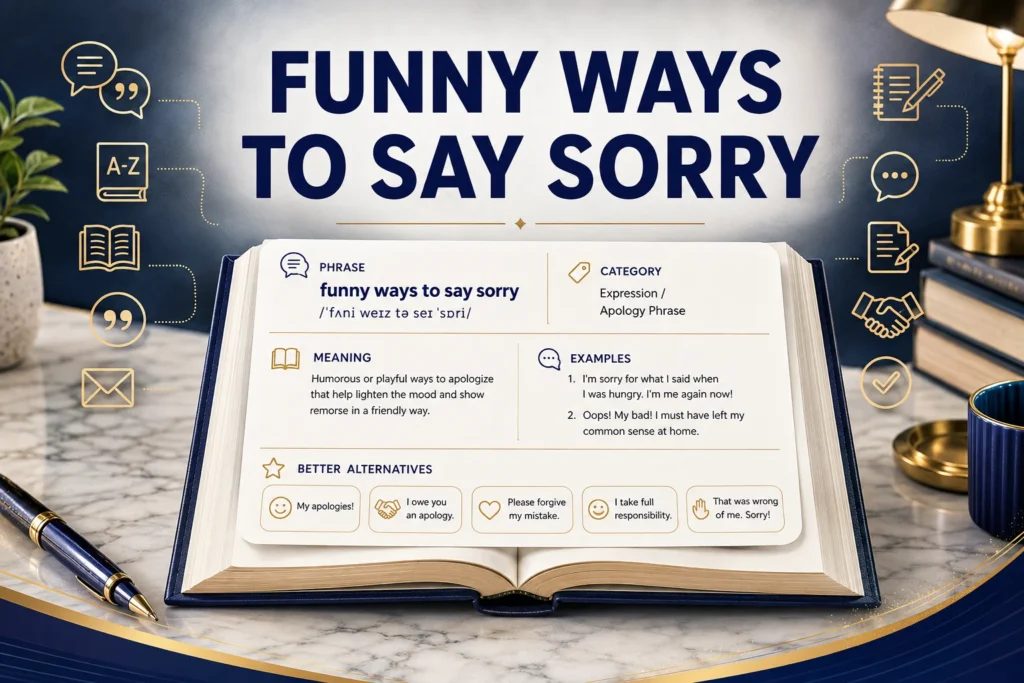
Saying “sorry” does not always need to sound serious, stiff, or repetitive. Sometimes you want to apologize while adding a little humor. That is where funny ways to say sorry can help. A playful apology can make a conversation warmer, reduce tension, or turn a small mistake into a lighthearted moment.
However, funny apologies do not work in every situation. A joke may be perfect when texting a close friend but inappropriate when responding to an unhappy customer or apologizing to a manager. The key is knowing your audience, relationship, and situation.
If you are searching for a professional way to say sorry, a formal alternative to sorry, or simply a funny synonym for “sorry,” this guide gives you practical choices for texts, emails, workplace communication, networking, customer service, and everyday conversations.
You will find more than 50 alternatives, examples, tone guidance, and tips for choosing the right apology without sounding fake or overly dramatic.
What Does “Sorry” Mean?
The word “sorry” usually expresses regret for something you did, said, forgot, misunderstood, or caused.
Literal meaning
“Sorry” communicates that you recognize a mistake or situation that caused inconvenience, disappointment, hurt, or trouble.
Example:
“I’m sorry I missed your call.”
The speaker acknowledges the mistake and expresses regret.
Tone
The tone of “sorry” can change dramatically depending on the words around it.
- Casual: “Sorry about that!”
- Friendly: “Oops, my bad!”
- Funny: “Please accept my official apology from the Department of Bad Decisions.”
- Professional: “I apologize for the inconvenience.”
- Formal: “Please accept my sincere apologies.”
- Serious: “I sincerely regret what happened.”
Purpose
People use apologies to:
- Accept responsibility.
- Repair a relationship.
- Reduce tension.
- Acknowledge inconvenience.
- Show empathy.
- Correct a misunderstanding.
- Rebuild trust.
Emotional context
A good apology matches the seriousness of the situation.
For a tiny mistake, humor can help:
“Oops. My brain clearly took the day off. Sorry!”
For a serious mistake, keep the message sincere:
“I sincerely apologize for the mistake and the inconvenience it caused.”
The most important rule is simple: use humor to soften a small mistake, not to dismiss someone’s feelings.
Why Use Funny Ways to Say Sorry?
People often search for alternatives to “sorry” because the basic word can feel repetitive.
You might want a funny apology when:
- You accidentally arrive late.
- You forget to reply to a friend.
- You make a silly mistake.
- You send the wrong message.
- You interrupt someone.
- You misunderstand something.
- You eat the last slice of pizza.
- You forget someone’s birthday.
- You make a harmless mistake at work.
- You want to break awkward tension.
A humorous apology can make your message feel more natural.
For example:
“My apologies. My brain appears to be operating on airplane mode.”
This sounds more playful than:
“Sorry.”
Still, humor requires judgment. Never use a joke to avoid responsibility for a serious problem.
When Is “Sorry” Appropriate?
In Text Messages
Texting gives you more freedom to be playful, especially with friends and family.
Example:
“Sorry! My phone and I had a disagreement about replying on time.”
At Work
Workplace communication requires more care. A light joke may work with a close colleague, but a client or senior manager usually needs a straightforward apology.
Better:
“I apologize for the delay. I’ve attached the updated file.”
Light workplace version for a colleague:
“My apologies—I apparently decided to make this task more complicated than necessary.”
In Emails
Email etiquette depends on the recipient.
A funny apology may suit an informal internal email:
“Sorry for the confusion. My calendar apparently had its own agenda.”
For a client:
“I apologize for the confusion and appreciate your patience.”
With Customers
Customer service should prioritize empathy over humor.
Instead of:
“Oops, our system decided to have a bad day!”
Use:
“I’m sorry for the inconvenience. We’re working to resolve the issue as quickly as possible.”
In Networking
A professional apology should remain polite and concise.
“I apologize for the delayed response, and I appreciate you following up.”
A little warmth is fine, but avoid jokes that could make the interaction seem careless.
Professional Alternatives
These options work well when you want to apologize without sounding overly casual.
1. “I apologize for the inconvenience.”
Meaning: You regret causing trouble or difficulty.
Tone: Professional
Best use: Clients, customers, business emails
Example:
“I apologize for the inconvenience and appreciate your patience.”
2. “I apologize for the confusion.”
Meaning: You acknowledge that your message or action caused misunderstanding.
Tone: Professional
Best use: Workplace communication
Example:
“I apologize for the confusion. Please use the updated schedule attached.”
3. “I’m sorry for the delay.”
Meaning: You regret taking longer than expected.
Tone: Professional and neutral
Best use: Email, projects, customer communication
Example:
“I’m sorry for the delay in getting back to you.”
4. “Please accept my apologies.”
Meaning: You formally acknowledge your mistake.
Tone: Polite
Best use: Business communication
Example:
“Please accept my apologies for the oversight.”
5. “I regret the mistake.”
Meaning: You clearly express regret.
Tone: Serious and professional
Best use: Formal workplace situations
Example:
“I regret the mistake and have corrected the report.”
6. “I take responsibility for the error.”
Meaning: You accept responsibility instead of making excuses.
Tone: Professional
Best use: Workplace or management situations
Example:
“I take responsibility for the error and have taken steps to prevent it from happening again.”
7. “Thank you for your patience.”
Meaning: You acknowledge inconvenience without repeatedly saying sorry.
Tone: Professional
Best use: Delays and customer service
Example:
“Thank you for your patience while we resolved the issue.”
8. “I appreciate your understanding.”
Meaning: You recognize the other person’s patience or flexibility.
Tone: Professional
Best use: Business emails
Example:
“I appreciate your understanding regarding the revised timeline.”
9. “I acknowledge the oversight.”
Meaning: You admit that you missed something.
Tone: Professional
Best use: Reports, projects, workplace communication
Example:
“I acknowledge the oversight and have corrected the figures.”
10. “That was my mistake.”
Meaning: You directly accept fault.
Tone: Clear and sincere
Best use: Colleagues and everyday work situations
Example:
“That was my mistake. I’ll correct it now.”
11. “I should have caught that.”
Meaning: You admit you should have noticed an error.
Tone: Professional but conversational
Best use: Workplace
Example:
“I should have caught that before sending the report.”
12. “I appreciate you pointing that out.”
Meaning: You respond positively after someone identifies your mistake.
Tone: Mature and professional
Best use: Workplace communication
Example:
“I appreciate you pointing that out. I’ll update the document.”
13. “I’ll make sure it doesn’t happen again.”
Meaning: You focus on preventing repetition.
Tone: Responsible
Best use: Workplace and customer communication
Example:
“I apologize for the error. I’ll make sure it doesn’t happen again.”
14. “I apologize for the oversight on my part.”
Meaning: You accept responsibility for missing something.
Tone: Professional
Best use: Business emails
Example:
“I apologize for the oversight on my part and have attached the missing document.”
15. “I’m sorry I missed that.”
Meaning: You admit that you failed to notice something.
Tone: Natural and professional
Best use: Email and workplace conversations
Example:
“I’m sorry I missed that detail in the original report.”
Formal Alternatives
When the situation requires serious or respectful language, use one of these formal alternatives.
16. “Please accept my sincere apologies.”
Meaning: A serious and respectful apology.
Tone: Formal
Best use: Official correspondence
Example:
“Please accept my sincere apologies for the inconvenience caused.”
17. “I sincerely apologize.”
Meaning: You express genuine regret.
Tone: Formal and sincere
Best use: Serious professional situations
Example:
“I sincerely apologize for the misunderstanding.”
18. “I deeply regret the error.”
Meaning: You strongly express regret.
Tone: Very formal
Best use: Significant mistakes
Example:
“I deeply regret the error and the inconvenience it caused.”
19. “I regret any inconvenience caused.”
Meaning: You acknowledge the difficulty your actions created.
Tone: Formal
Best use: Official emails
Example:
“I regret any inconvenience caused by the schedule change.”
20. “Please accept my apologies for the oversight.”
Meaning: You formally admit that you missed something.
Tone: Formal
Best use: Business correspondence
Example:
“Please accept my apologies for the oversight in the original submission.”
21. “I take full responsibility.”
Meaning: You accept complete responsibility.
Tone: Serious
Best use: Important professional mistakes
Example:
“I take full responsibility for the incorrect information.”
22. “I acknowledge my error.”
Meaning: You clearly admit your mistake.
Tone: Formal
Best use: Official workplace communication
Example:
“I acknowledge my error and have corrected the document.”
23. “I regret the misunderstanding.”
Meaning: You express regret about confusion between people.
Tone: Formal
Best use: Business communication
Example:
“I regret the misunderstanding and hope this clarification resolves the matter.”
24. “I offer my sincere apologies.”
Meaning: A formal expression of regret.
Tone: Formal
Best use: Letters and serious emails
Example:
“I offer my sincere apologies for the delay.”
25. “I wish to apologize for…”
Meaning: A formal introduction to an apology.
Tone: Formal
Best use: Professional letters
Example:
“I wish to apologize for the confusion surrounding the appointment.”
Friendly and Funny Alternatives
These are better for friends, family, casual chats, and harmless mistakes.
26. “Oops, my bad!”
Meaning: I made a mistake.
Tone: Casual and funny
Best use: Friends and casual conversations
Example:
“Oops, my bad! I thought the meeting was tomorrow.”
27. “My bad!”
Meaning: I accept responsibility.
Tone: Very casual
Best use: Friends and close colleagues
Example:
“My bad! I sent you the wrong file.”
28. “Whoops! That one’s on me.”
Meaning: I made that mistake.
Tone: Friendly
Best use: Texting
Example:
“Whoops! That one’s on me. I completely forgot.”
29. “I messed up!”
Meaning: I made a mistake.
Tone: Honest and casual
Best use: Friends and informal situations
Example:
“I messed up! I thought you said Friday.”
30. “My brain has left the chat.”
Meaning: I made a silly mistake.
Tone: Funny and modern
Best use: Texts and social conversations
Example:
“My brain has left the chat. Sorry, I forgot the attachment.”
31. “Please forgive my temporary lack of intelligence.”
Meaning: A humorous way to admit a silly mistake.
Tone: Playful
Best use: Close friends
Example:
“Please forgive my temporary lack of intelligence. I completely missed the obvious.”
32. “I owe you one!”
Meaning: I regret the inconvenience and want to make it up to you.
Tone: Friendly
Best use: Friends and colleagues
Example:
“Sorry I made you wait. I owe you one!”
33. “Consider that my official apology.”
Meaning: A playful way to apologize.
Tone: Funny
Best use: Casual conversations
Example:
“I forgot your coffee. Consider that my official apology.”
34. “I plead guilty.”
Meaning: You jokingly admit responsibility.
Tone: Humorous
Best use: Friends
Example:
“I ate the last cookie. I plead guilty.”
35. “Guilty as charged!”
Meaning: You admit you did it.
Tone: Funny and casual
Best use: Harmless mistakes
Example:
“Did you forget to reply again?”
“Guilty as charged!”
36. “Please accept this apology before I embarrass myself further.”
Meaning: A humorous request for forgiveness.
Tone: Playful
Best use: Friends and casual chats
Example:
“I called you by the wrong name. Please accept this apology before I embarrass myself further.”
37. “I have made a tiny human error.”
Meaning: You made a small mistake.
Tone: Lighthearted
Best use: Casual workplace or friend conversations
Example:
“I have made a tiny human error—the meeting is actually at 3.”
38. “My mistake has entered the building.”
Meaning: A playful admission of error.
Tone: Silly
Best use: Friends
Example:
“I brought the wrong charger. My mistake has entered the building.”
39. “Oops. Can we pretend that never happened?”
Meaning: You want to move past a harmless mistake.
Tone: Funny
Best use: Casual situations
Example:
“I sent that message to the wrong group. Oops. Can we pretend that never happened?”
40. “I blame my brain.”
Meaning: You jokingly blame yourself for a mistake.
Tone: Casual
Best use: Friends and informal chats
Example:
“I forgot your birthday. I blame my brain.”
Funny Apologies for Text Messages
41. “Oops, my fingers betrayed me.”
Meaning: You made a texting mistake.
Tone: Funny
Best use: Texting
Example:
“Oops, my fingers betrayed me. That message was meant for someone else.”
42. “Sorry, my brain was buffering.”
Meaning: You were slow to understand or respond.
Tone: Playful
Best use: Texting
Example:
“Sorry, my brain was buffering. Now I understand.”
43. “My bad. Please don’t cancel our friendship.”
Meaning: You jokingly ask for forgiveness.
Tone: Funny and affectionate
Best use: Close friends
Example:
“My bad. Please don’t cancel our friendship because I forgot.”
44. “I owe you a coffee for that one.”
Meaning: You offer a small gesture to make up for the mistake.
Tone: Friendly
Best use: Friends or colleagues
Example:
“Sorry I kept you waiting. I owe you a coffee.”
45. “Oops. That sounded much better in my head.”
Meaning: You regret what you said.
Tone: Humorous
Best use: Casual chats
Example:
“Oops. That sounded much better in my head. Sorry!”
46. “Please accept my apology and one imaginary cookie.”
Meaning: A playful apology with a humorous reward.
Tone: Silly and friendly
Best use: Texting friends
Example:
“Please accept my apology and one imaginary cookie.”
47. “I made a mistake. Shocking, I know.”
Meaning: You jokingly admit an error.
Tone: Sarcastic
Best use: Close friends
Example:
“I forgot the date. I made a mistake. Shocking, I know.”
48. “My apologies. My common sense took a lunch break.”
Meaning: You admit a silly decision.
Tone: Funny
Best use: Friends and casual colleagues
Example:
“My apologies. My common sense took a lunch break.”
49. “I officially apologize for my nonsense.”
Meaning: You admit that your behavior was silly.
Tone: Playful
Best use: Casual relationships
Example:
“I officially apologize for my nonsense yesterday.”
50. “Can I trade you one apology for forgiveness?”
Meaning: You humorously ask to be forgiven.
Tone: Playful
Best use: Friends
Example:
“Can I trade you one apology for forgiveness?”
Workplace-Friendly Alternatives
Humor at work should remain respectful. These phrases work best with colleagues who understand your communication style.
51. “That one slipped past me.”
Meaning: You missed something.
Tone: Conversational
Best use: Colleagues
Example:
“That one slipped past me. I’ll correct it now.”
52. “I should have double-checked that.”
Meaning: You admit you failed to verify something.
Tone: Responsible
Best use: Workplace
Example:
“I should have double-checked that before sending the report.”
53. “That was an avoidable mistake on my part.”
Meaning: You admit responsibility.
Tone: Professional
Best use: Workplace communication
Example:
“That was an avoidable mistake on my part. I’ve fixed the issue.”
54. “My mistake—thanks for catching it.”
Meaning: You accept the error and appreciate the correction.
Tone: Friendly-professional
Best use: Colleagues
Example:
“My mistake—thanks for catching it before the meeting.”
55. “I made a small detour from common sense.”
Meaning: You jokingly acknowledge a silly mistake.
Tone: Light humor
Best use: Close colleagues
Example:
“I made a small detour from common sense with that spreadsheet.”
Quick Comparison Table
| Alternative | Tone | Best Use |
| I apologize for the inconvenience | Professional | Clients |
| Please accept my sincere apologies | Formal | Serious emails |
| I sincerely apologize | Formal | Important mistakes |
| That was my mistake | Professional | Workplace |
| I take responsibility | Serious | Workplace |
| I’m sorry for the delay | Neutral | |
| Thank you for your patience | Professional | Customer service |
| My bad | Casual | Friends |
| Oops, my bad | Funny | Texting |
| Whoops! That one’s on me | Friendly | Friends |
| My brain was buffering | Funny | Texting |
| Guilty as charged | Humorous | Friends |
| I plead guilty | Funny | Casual chats |
| I owe you one | Friendly | Friends/colleagues |
| My brain has left the chat | Playful | Texting |
| I should have double-checked that | Professional | Workplace |
| I acknowledge the oversight | Formal | Business |
| I regret the misunderstanding | Formal | Business |
| I’ll make sure it doesn’t happen again | Responsible | Workplace |
| Thanks for catching that | Friendly-professional | Colleagues |
Email Examples
1. Apology to a Client
Subject: Apologies for the Delay
Hi [Name],
I apologize for the delay in sending the updated proposal. I’ve attached the revised version for your review.
Thank you for your patience and understanding.
Best,
[Name]
For a client, avoid jokes unless you already have a relaxed relationship. A clear apology builds more trust than forced humor.
2. Apology to a Manager
Subject: Correction to the Report
Hi [Name],
I apologize for the error in the report. I’ve reviewed the figures and attached the corrected version.
I’ll make sure to double-check the data before submitting future reports.
Best,
[Name]
This approach shows responsibility instead of making excuses.
3. Apology to a Colleague
Sorry about that—I completely missed the attachment. My brain apparently decided to take an unscheduled break. I’ve attached it now. Thanks for catching it!
This example uses humor because the relationship is more casual.
4. Apology to a Customer
We’re sorry for the inconvenience. We understand how frustrating the delay can be, and we’re working to resolve the issue as quickly as possible. Thank you for your patience.
Customer service apologies should focus on empathy, accountability, and a solution.
5. Networking Apology
Hi [Name],
I apologize for the delayed response. I appreciate you reaching out and would be happy to continue our conversation.
Please let me know a convenient time to connect.
Best regards,
[Name]
Keep networking apologies concise and professional.
6. Meeting Follow-Up
Hi everyone,
Apologies for the confusion during today’s meeting. I’ve summarized the agreed action items below so we can move forward with the same understanding.
Thank you for your patience.
This works better than trying to make a joke about confusion during an important meeting.
Common Mistakes When Saying Sorry
1. Overusing Humor
If every apology contains a joke, people may stop taking your apologies seriously.
Instead of:
“Oops, my brain exploded again!”
use a direct apology when the mistake matters.
2. Using Humor for Serious Problems
Never joke about situations involving major financial loss, customer complaints, personal harm, sensitive information, or serious professional errors.
A serious situation needs a serious apology.
3. Choosing the Wrong Tone
“Oops, my bad!” may work with your friend.
It usually does not work with an angry customer.
For a customer:
“I apologize for the inconvenience.”
For a friend:
“Oops, my bad!”
4. Sounding Insincere
A funny apology should still accept responsibility.
Weak:
“Sorry if you somehow got upset.”
Better:
“I’m sorry. I shouldn’t have said that.”
5. Making Excuses
Avoid turning an apology into a list of reasons.
Weak:
“Sorry, but I was busy, my phone died, and then traffic was terrible…”
Better:
“I’m sorry I was late. I should have left earlier.”
6. Apologizing Without Fixing the Problem
A good professional apology often includes an action.
“I apologize for the incorrect invoice. I’ve corrected it and attached the new version.”
That is str*nger than:
“Sorry about that.”
7. Overly Formal Language in Casual Conversations
You do not need:
“Please accept my most sincere apologies for this unfortunate circumstance.”
when texting your best friend.
Try:
“Oops, my bad!”
Related Phrases for Saying Sorry
Here are useful expressions that communicate apology, regret, responsibility, or empathy.
1. “My mistake.”
A direct admission of responsibility.
“My mistake. I sent the wrong file.”
2. “My bad.”
A casual apology.
“My bad! I misunderstood you.”
3. “I apologize.”
A professional apology.
“I apologize for the delay.”
4. “I sincerely apologize.”
A stronger formal apology.
“I sincerely apologize for the misunderstanding.”
5. “I regret that.”
A formal expression of regret.
“I regret that the issue caused confusion.”
6. “Please forgive me.”
A personal request for forgiveness.
“Please forgive me for forgetting.”
7. “I didn’t mean to.”
Useful when harm was accidental.
“I didn’t mean to interrupt you.”
8. “I didn’t realize.”
Useful when you lacked awareness.
“I didn’t realize that the deadline had changed.”
9. “I take responsibility.”
Shows accountability.
“I take responsibility for the mistake.”
10. “That’s on me.”
A casual way to accept fault.
“I forgot to call. That’s on me.”
11. “I owe you one.”
Suggests that you want to make up for the mistake.
“Sorry I kept you waiting. I owe you one.”
12. “Thanks for understanding.”
Shows appreciation.
“Thanks for underst*nding while I fixed the issue.”
13. “Thanks for your patience.”
Useful for delays.
“Thanks for your patience while we investigated.”
14. “I appreciate you letting me know.”
Shows gratitude when someone points out a mistake.
“I appreciate you letting me know about the error.”
15. “I’ll correct it.”
Focuses on action.
“I’ll correct it and resend the document.”
16. “I’ll make it right.”
Shows willingness to repair the situation.
“I’m sorry. I’ll make it right.”
17. “I hope you can forgive me.”
A personal and emotional apology.
“I hope you can forgive me for forgetting.”
18. “Let me make it up to you.”
Offers a solution or gesture.
“Let me make it up to you with dinner.”
Phrase Comparison: “Sorry” vs. Alternatives
| Phrase | Tone | Formality | Best Use |
| Sorry | Neutral | Low | Everyday situations |
| My bad | Casual | Very low | Friends |
| Oops, my bad | Funny | Very low | Texts |
| That’s on me | Casual | Low | Friends/colleagues |
| I apologize | Professional | Medium | Work |
| I sincerely apologize | Formal | High | Serious business situations |
| Please accept my apologies | Formal | High | Business emails |
| I regret the error | Formal | High | Official communication |
| I take responsibility | Serious | Medium-high | Workplace |
| I acknowledge the oversight | Formal | High | Professional writing |
| Thank you for your patience | Professional | Medium | Delays/customer service |
| I’m sorry for the inconvenience | Professional | Medium | Customers/clients |
| Guilty as charged | Funny | Very low | Friends |
| My brain was buffering | Funny | Very low | Texting |
| I owe you one | Friendly | Low | Friends/colleagues |
The best synonym for “sorry” depends on what you want to communicate. “My bad” expresses casual responsibility, while “I sincerely apol*gize” expresses serious regret. “Thank you for your patience” shifts attention toward appreciation, while “I take responsibility” emphasizes accountability.
How to Choose the Right Funny Apology
Ask yourself five questions bef*re sending your message:
1. Who am I talking to?
A close friend gives you much more freedom than a client.
2. How serious is the mistake?
Small mistake = humor may work.
Serious mistake = keep it sincere.
3. What is our relationship?
The closer the relationship, the more informal your language can be.
4. Does the other person enjoy humor?
Do not assume everyone appreciates sarcasm.
5. Does the apology solve anything?
If the mistake caused a real problem, explain what you will do to fix it.
A strong apology often follows this structure:
Acknowledge → Apologize → Take responsibility → Fix the problem
Example:
“I’m sorry for missing the deadline. That was my mistake. I’ve completed the work now and will plan ahead to avoid another delay.”
Cultural Usage
US English
American English often uses direct and conversational apologies.
Common expressions include:
- “My bad.”
- “Oops, sorry!”
- “That’s on me.”
- “I apologize.”
- “Sorry about that.”
In informal American communication, humor can make an apology feel relaxed and natural.
UK English
British English frequently uses “sorry” in everyday interactions, sometimes even for minor inconveniences or interruptions.
Examples include:
“Sorry, could you repeat that?”
and:
“Sorry about the mix-up.”
Polite understatement can sound more natural than exaggerated humor in some British professional settings.
Corporate Communication
Corporate communication usually favors clarity over comedy.
Good choices include:
“I apologize for the oversight.”
“I take responsibility for the error.”
“Thank you for your patience.”
Avoid jokes when communicating about serious delays, financial issues, complaints, or major mistakes.
Customer Service
Customer service apologies should recognize the customer’s experience.
Strong example:
“I’m sorry for the inconvenience. I understand how frustrating this delay must be, and we’re working to resolve it.”
Humor can backfire if the customer feels frustrated.
Networking
Networking requires a balance between warmth and professionalism.
Instead of:
“Oops, my brain disappeared and I forgot to reply!”
use:
“Apologies for the delayed response. I appreciate you following up.”
You can become more playful after you establish a relationship.
Professional Communication: When to Use “Sorry” vs. “I Apologize”
Both expressions are correct, but they create slightly different impressions.
“Sorry” sounds natural, direct, and conversational.
“Sorry for the delay.”
“I apologize” sounds more professional and deliberate.
“I apologize for the delay.”
For routine workplace communication, either can work. For a formal business email, “I apologize” may sound more polished.
However, professional communication is not about using the longest or most formal phrase. Clear language usually works best.
Business Email Phrases for Apologies
If you need business email phrases, these are useful:
- “I apologize for the delay.”
- “I apologize for the confusion.”
- “Please accept my apologies.”
- “Thank you for your patience.”
- “I appreciate your understanding.”
- “I regret the oversight.”
- “I take responsibility for the error.”
- “I’ve corrected the issue.”
- “I’ll make sure this does not happen again.”
- “Thank you for bringing this to my attention.”
These phrases work especially well because they combine apology with accountability and action.
FAQs
What are some funny ways to say sorry?
You can say:
- “Oops, my bad!”
- “My brain was buffering.”
- “Guilty as charged!”
- “I plead guilty.”
- “That one’s on me.”
- “My common sense took a lunch break.”
- “I officially apologize for my nonsense.”
- “Please don’t cancel our friendship.”
Use these mainly with friends or people who appreciate humor.
What is a funny way to say sorry over text?
Try:
“Oops, my brain was buffering. Sorry!”
Or:
“My bad! Please accept one imaginary cookie as compensation.”
These work best for harmless mistakes.
What is a professional way to say sorry?
Use:
“I apologize for the inconvenience.”
Other options include:
“I apologize for the delay.”
“Please accept my apologies for the oversight.”
“I take responsibility for the error.”
What is a formal alternative to “sorry”?
Good formal alternatives include:
- “I sincerely apologize.”
- “Please accept my sincere apologies.”
- “I deeply regret the error.”
- “I regret any inconvenience caused.”
- “I acknowledge my error.”
What is a funny way to apologize to a friend?
You can say:
“Guilty as charged!”
“My bad. Please don’t cancel our friendship.”
“My brain has officially left the chat.”
“I owe you one!”
How do I apologize professionally in an email?
Keep the message short and direct. Acknowledge the problem, apologize, and explain how you will fix it.
Example:
“I apologize for the delay. I’ve attached the completed document and appreciate your patience.”
Can I use humor in a workplace apology?
Yes, but only when the mistake is minor and your relationship with the colleague supports humor.
For example:
“My mistake—my spreadsheet skills briefly went on vacation.”
For managers, clients, or serious issues, choose a straightforward apology.
What is another word for sorry?
Depending on context, alternatives include:
- Apologize
- Regret
- My mistake
- My bad
- Excuse me
- I take responsibility
- Please forgive me
These are not perfect substitutes in every sentence, so choose according to tone and purpose.
Is “my bad” professional?
Usually, no. “My bad” is casual and works best with friends or close colleagues.
For professional communication, use:
“That was my mistake.”
or:
“I apologize for the error.”
How can I apologize without saying “sorry”?
Focus on responsibility and action.
Instead of:
“Sorry for the delay.”
try:
“Thank you for your patience. I’ve completed the request and attached the updated document.”
Or:
“I apologize for the oversight. I’ve corrected the issue.”
This approach can sound more purposeful than repeating “sorry.”
Final Summary
Best Pr*fessional Options
- “I apologize for the inconvenience.”
- “I apologize for the confusion.”
- “That was my mistake.”
- “I take responsibility for the error.”
- “I appreciate your understanding.”
Best Formal Opti*ns
- “Please accept my sincere apologies.”
- “I sincerely apologize.”
- “I deeply regret the error.”
- “I acknowledge my error.”
- “I regret any inconvenience caused.”
Best C*sual Options
- “My bad!”
- “Oops, my bad!”
- “That’s on me.”
- “Whoops! That one’s on me.”
- “I owe you one!”
Best Funny Options
- “My brain was buffering.”
- “My brain has left the chat.”
- “Guilty as charged!”
- “I plead guilty.”
- “My common sense took a lunch break.”
- “Please don’t cancel our friendship.”
- “I officially apologize for my nonsense.”
Best Email Options
- “I apologize for the delay.”
- “Please accept my apologies.”
- “Thank you for your patience.”
- “I appreciate your understanding.”
- “I apologize for the oversight.”
Conclusion
The best funny ways to say sorry depend on the person, situation, and seriousness of the mistake. Use playful phrases such as “Oops, my bad!” or “My brain was buffering” with friends and trusted colleagues. For clients, managers, customers, and formal emails, choose clear expressions such as “I apologize for the inconvenience,” “I take responsibility,” or “Please accept my sincere apologies.” A good apology does more than say sorry: it acknowledges the mistake, respects the other person, and shows how you will make things right. When you match your tone to the situation, your apology sounds natural, sincere, and effective.