The phrase “ask me a question” is clear and friendly, but it may not always be the best choice for professional communication. Depending on the situation, you may want a more polished, formal, inviting, or natural expression.
If you are looking for other ways to say “ask me a question,” you have many options. You can say “Please feel free to ask,” “I’d be happy to answer any questions,” “Please let me know if you have any questions,” or “I welcome your questions.”
The best phrase depends on your audience and setting. An email to a client may require a more professional tone than a conversation with a colleague. Likewise, a teacher, manager, speaker, customer service representative, or business professional may choose different wording.
This guide explains the best alternatives for emails, workplace communication, clients, networking, customer service, presentations, meetings, and casual conversations.
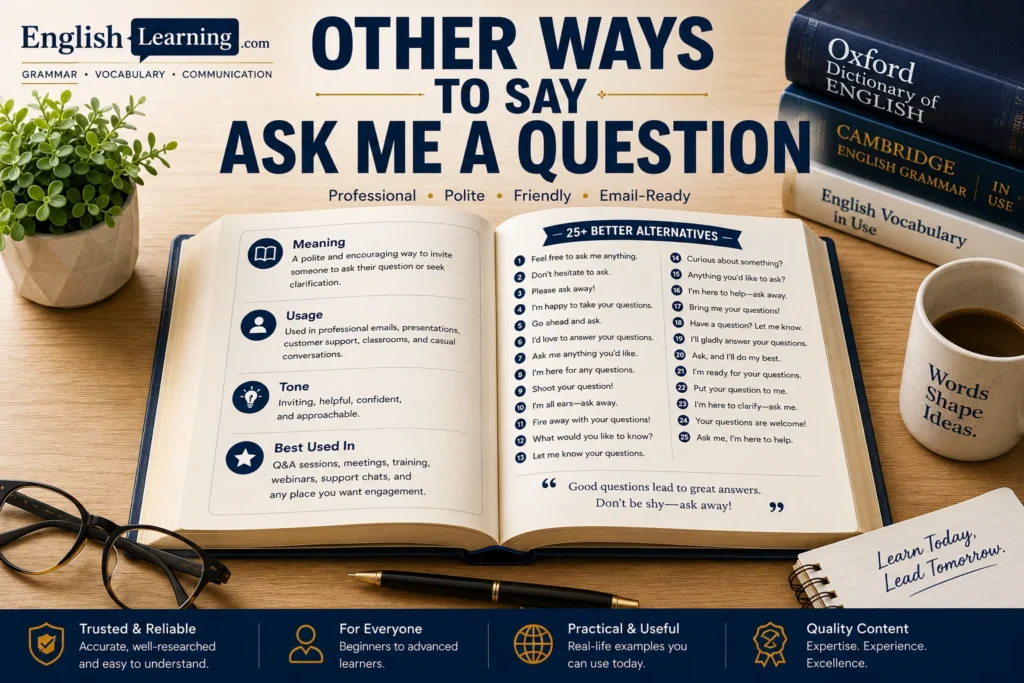
What Does “Ask Me a Question” Mean?
“Ask me a question” is an invitation for another person to request information, clarification, advice, or an explanation.
Literal meaning
The phrase directly tells someone that they can ask you something.
For example:
“If you have any questions, ask me.”
Or:
“Ask me a question about the project.”
The meaning is simple, but the tone can change depending on how you phrase the invitation.
Tone
“Ask me a question” can sound:
- Direct
- Friendly
- Informal
- Open
- Inviting
- Sometimes slightly commanding
The phrase itself is not incorrect. However, professional communication often benefits from softer wording.
Purpose
You might invite questions when you want to:
- Encourage discussion
- Offer clarification
- Help a customer
- Invite feedback
- Start a presentation
- Support a colleague
- Encourage students
- Continue a conversation
- Make yourself available
Emotional context
The way you invite questions can affect how comfortable people feel asking them.
Compare:
“Ask me a question.”
with:
“Please feel free to ask if anything is unclear.”
The second version sounds more welcoming because it removes pressure.
Another example:
“Do you have any questions?”
This sounds neutral and professional.
A warmer version is:
“I’d be happy to answer any questions you may have.”
When Should You Use Alternatives to “Ask Me a Question”?
Different situations call for different expressions. Choosing the right wording shows awareness of professional communication, workplace etiquette, and audience expectations.
In Emails
In professional emails, avoid unnecessarily direct language.
Instead of:
“Ask me a question if you need help.”
Try:
“Please feel free to reach out if you have any questions.”
Or:
“I’d be happy to answer any questions you may have.”
These versions sound more courteous and natural.
In the Workplace
With colleagues, you can use relaxed but professional expressions.
“Let me know if you have any questions.”
or:
“Feel free to ask if you need any clarification.”
These phrases encourage communication without sounding too formal.
With Clients
Client communication usually requires a helpful and respectful tone.
Good options include:
“Please let me know if you have any questions.”
“I’d be happy to provide further clarification.”
“Please feel free to reach out if you need any additional information.”
In Networking
Networking conversations benefit from open and friendly language.
You might say:
“I’d be happy to answer any questions about my experience.”
Or:
“Feel free to ask if you’d like to know more.”
These expressions make the conversation feel collaborative.
In Customer Service
Customer service representatives should make customers feel comfortable asking for assistance.
Instead of:
“Ask me a question.”
Try:
“Please let me know how I can assist you.”
or:
“If you have any questions, I’d be happy to help.”
Professional Alternatives
1. Please Feel Free to Ask
Meaning: You are welcome to ask anything you need to know.
Tone: Professional, warm, inviting
Best use: Emails, meetings, workplace communication
Example:
“If anything remains unclear, please feel free to ask.”
This is one of the safest alternatives for professional communication.
2. Please Let Me Know If You Have Any Questions
Meaning: Tell me if you need clarification or additional information.
Tone: Professional and polite
Best use: Business emails and client communication
Example:
“Please let me know if you have any questions about the proposal.”
3. I’d Be Happy to Answer Any Questions
Meaning: I am willing to provide answers or clarification.
Tone: Warm and professional
Best use: Emails, presentations, client communication
Example:
“I’d be happy to answer any questions regarding the new policy.”
4. Feel Free to Ask
Meaning: You can ask without hesitation.
Tone: Friendly and professional
Best use: Workplace and casual professional conversations
Example:
“If you need more information, feel free to ask.”
5. I’m Happy to Answer Your Questions
Meaning: I am willing to provide information.
Tone: Helpful and professional
Best use: Clients, colleagues, presentations
Example:
“I’m happy to answer your questions before we move forward.”
6. Let Me Know If You Have Any Questions
Meaning: Contact me if you need further information.
Tone: Natural and professional
Best use: Emails and workplace communication
Example:
“Let me know if you have any questions about the timeline.”
7. I’m Available to Answer Any Questions
Meaning: I am available if you need clarification.
Tone: Professional
Best use: Business emails and formal workplace communication
Example:
“I’m available to answer any questions before the meeting.”
8. I’d Be Glad to Clarify
Meaning: I am willing to explain anything that is unclear.
Tone: Polite and professional
Best use: Client emails and business discussions
Example:
“If any part of the agreement is unclear, I’d be glad to clarify.”
9. I’m Happy to Provide Further Information
Meaning: I can give you more details if needed.
Tone: Professional
Best use: Clients, sales emails, business correspondence
Example:
“I’m happy to provide further information if required.”
10. Please Don’t Hesitate to Ask
Meaning: You should feel comfortable asking questions.
Tone: Polite and reassuring
Best use: Customer service, clients, professional emails
Example:
“Please don’t hesitate to ask if you need additional assistance.”
11. I Welcome Your Questions
Meaning: I encourage you to ask questions.
Tone: Confident and professional
Best use: Presentations, meetings, workshops
Example:
“I welcome your questions at any point during the presentation.”
12. I’m Here to Answer Your Questions
Meaning: I am available to provide answers.
Tone: Supportive and approachable
Best use: Presentations, customer service, training
Example:
“I’m here to answer your questions and help you understand the process.”
13. I Can Provide Further Clarification
Meaning: I can explain something in more detail.
Tone: Professional and formal
Best use: Business emails and technical discussions
Example:
“I can provide further clarification if any part of the proposal needs explanation.”
14. Let Me Know What You’d Like to Know
Meaning: Tell me which information you need.
Tone: Friendly and professional
Best use: Networking and workplace conversations
Example:
“Let me know what you’d like to know about the position.”
15. I’d Be Glad to Discuss Any Questions You Have
Meaning: I am willing to discuss your concerns or questions.
Tone: Polished and professional
Best use: Clients, managers, business meetings
Example:
“I’d be glad to discuss any questions you have before we finalize the agreement.”
Formal Alternatives
These expressions work well when you need a more formal alternative to “ask me a question.”
16. Please Feel Free to Raise Any Questions
Meaning: You may bring up anything that requires clarification.
Tone: Formal
Best use: Meetings, presentations, corporate communication
Example:
“Please feel free to raise any questions during the discussion.”
17. Should You Have Any Questions, Please Let Me Know
Meaning: If you have questions, contact me.
Tone: Very formal
Best use: Formal business emails
Example:
“Should you have any questions, please let me know.”
18. I Would Be Pleased to Answer Any Questions
Meaning: I would be happy to provide answers.
Tone: Formal and courteous
Best use: Formal correspondence
Example:
“I would be pleased to answer any questions regarding this matter.”
19. I Would Be Happy to Provide Clarification
Meaning: I can explain anything that needs clarification.
Tone: Formal and professional
Best use: Business communication
Example:
“I would be happy to provide clarification regarding the proposed changes.”
20. Please Direct Any Questions to Me
Meaning: Send or address questions to me.
Tone: Formal
Best use: Corporate communication and official notices
Example:
“Please direct any questions regarding the project to me.”
21. I Remain Available to Answer Any Questions
Meaning: I am still available if you need further information.
Tone: Formal
Best use: Formal emails and business correspondence
Example:
“I remain available to answer any questions you may have.”
22. I Would Welcome Any Questions
Meaning: I encourage people to ask questions.
Tone: Formal and inviting
Best use: Presentations and meetings
Example:
“I would welcome any questions before we conclude.”
23. Please Raise Any Points That Require Clarification
Meaning: Mention anything you do not understand.
Tone: Formal
Best use: Meetings, reports, corporate communication
Example:
“Please raise any points that require clarification.”
24. I Am Available Should You Require Further Information
Meaning: Contact me if you need more details.
Tone: Highly formal
Best use: Formal business emails
Example:
“I am available should you require further information.”
25. Please Advise If You Require Further Clarification
Meaning: Tell me if you need additional explanation.
Tone: Formal and businesslike
Best use: Corporate emails and professional correspondence
Example:
“Please advise if you require further clarification.”
Friendly Alternatives
Use these when you want to sound approachable and relaxed.
26. Feel Free to Ask Anything
Meaning: You can ask whatever you want to know.
Tone: Friendly
Best use: Conversations, networking, informal workplace settings
Example:
“Feel free to ask anything about my experience.”
27. Go Ahead and Ask
Meaning: You can ask your question now.
Tone: Casual and encouraging
Best use: Conversations
Example:
“Sure, go ahead and ask.”
28. What Would You Like to Know?
Meaning: Invite the person to tell you what information they need.
Tone: Friendly and direct
Best use: Conversations, networking, customer service
Example:
“What would you like to know about the project?”
29. What Can I Help You With?
Meaning: Ask what assistance the person needs.
Tone: Friendly and helpful
Best use: Customer service and workplace conversations
Example:
“Hi! What can I help you with today?”
30. Ask Away
Meaning: You are completely welcome to ask questions.
Tone: Very friendly and casual
Best use: Friends, informal conversations
Example:
“You said you had a few questions. Ask away!”
31. Fire Away
Meaning: Go ahead and ask your questions.
Tone: Very casual
Best use: Friends and relaxed conversations
Example:
“I’m ready whenever you are. Fire away!”
32. I’m All Ears
Meaning: I am ready and willing to listen.
Tone: Friendly and conversational
Best use: Informal conversations
Example:
“If you have something you want to discuss, I’m all ears.”
33. Shoot
Meaning: Go ahead and ask.
Tone: Very casual
Best use: Informal conversations
Example:
“You have a question? Shoot.”
Avoid this expression in formal business emails.
34. Go for It
Meaning: You have permission or encouragement to ask.
Tone: Casual and encouraging
Best use: Friendly conversations
Example:
“If you want to ask something, go for it.”
35. I’m Happy to Chat About It
Meaning: I am willing to discuss the subject.
Tone: Friendly
Best use: Networking and informal workplace communication
Example:
“If you want to know more about the project, I’m happy to chat about it.”
Email-Friendly Alternatives
Email requires special attention because the reader cannot hear your voice or see your facial expression.
36. Please Let Me Know If You Have Any Questions
This is one of the most useful business email phrases.
Example:
“Please let me know if you have any questions about the attached document.”
37. Please Feel Free to Reach Out With Any Questions
This sounds warm and professional.
Example:
“Please feel free to reach out with any questions.”
38. I’d Be Happy to Answer Any Questions You May Have
This is especially useful when writing to clients.
Example:
“I’d be happy to answer any questions you may have regarding the proposal.”
39. If You Have Any Questions, I’m Happy to Help
This combines an invitation with an offer of assistance.
Example:
“If you have any questions about the process, I’m happy to help.”
40. Please Contact Me if You Need Any Further Information
A strong choice for formal business emails.
Example:
“Please contact me if you need any further information.”
41. I’m Available If You’d Like to Discuss This Further
This encourages a follow-up conversation without sounding pushy.
Example:
“I’m available if you’d like to discuss this further.”
42. Please Let Me Know if Anything Needs Clarification
Useful when sending documents, reports, or proposals.
Example:
“Please let me know if anything in the report needs clarification.”
43. I’d Be Glad to Discuss Any Questions
This sounds polished and collaborative.
Example:
“I’d be glad to discuss any questions you may have.”
44. Feel Free to Contact Me With Any Questions
A classic professional email expression.
Example:
“Feel free to contact me with any questions.”
45. I’m Available to Discuss Any Questions or Concerns
This is useful when the subject may involve concerns or objections.
Example:
“I’m available to discuss any questions or concerns before you make a decision.”
Workplace Alternatives
46. Let Me Know If You Need Anything
A broad, friendly workplace expression.
Example:
“Let me know if you need anything before the presentation.”
47. Feel Free to Ask If You Need Clarification
This is useful when explaining a task.
Example:
“Feel free to ask if you need clarification on any of these steps.”
48. Let Me Know What You Need Clarified
A direct but professional option.
Example:
“Let me know what you need clarified, and I’ll walk you through it.”
49. I’m Happy to Walk You Through It
This offers more than simply answering a question.
Example:
“If anything is unclear, I’m happy to walk you through it.”
50. We Can Go Over Any Questions Together
This creates a collaborative tone.
Example:
“We can go over any questions together before the meeting.”
Quick Comparison Table
| Alternative | Tone | Best Use |
| Please feel free to ask | Professional | Workplace, emails |
| Let me know if you have any questions | Professional | Business emails |
| I’d be happy to answer any questions | Warm professional | Clients |
| Feel free to ask | Friendly | Workplace |
| I welcome your questions | Formal | Presentations |
| Please don’t hesitate to ask | Polite | Clients |
| Certainly, feel free to ask | Professional | Customer service |
| I’d be glad to clarify | Professional | Business emails |
| Should you have any questions | Formal | Corporate emails |
| I would be pleased to answer | Formal | Official communication |
| Please direct any questions to me | Formal | Corporate settings |
| I remain available to answer questions | Formal | Business correspondence |
| What would you like to know? | Friendly | Conversations |
| What can I help you with? | Friendly | Customer service |
| Ask away | Casual | Informal conversations |
| Fire away | Very casual | Friends |
| I’m all ears | Casual | Informal conversations |
| Go ahead and ask | Casual | Conversations |
| Please contact me with questions | Professional | Emails |
| I’m happy to walk you through it | Helpful | Workplace |
Email Examples
1. Client Email
Instead of writing “Ask me a question,” use a phrase that sounds helpful and professional.
Example:
Dear [Client Name],
Thank you for reviewing the proposal. Please feel free to reach out if you have any questions or need additional information.
I’d be happy to clarify any part of the proposal.
Kind regards,
[Your Name]
2. Email to a Manager
When communicating with a manager, keep the wording confident and professional.
Example:
Hi [Manager Name],
I’ve attached the revised report for your review. Please let me know if you have any questions or would like me to make any further changes.
Best regards,
[Your Name]
3. Email to a Colleague
With a colleague, you can use a natural and friendly tone.
Example:
Hi [Name],
I’ve shared the updated presentation with you. Feel free to ask if anything needs clarification.
Thanks,
[Your Name]
4. Customer Service Email
Customer communication should sound welcoming and reassuring.
Example:
Dear [Customer Name],
I hope this information helps resolve your concern. Please don’t hesitate to contact us if you have any questions or need further assistance.
Kind regards,
[Your Name]
5. Networking Follow-Up
Networking emails should invite conversation without sounding overly formal.
Example:
Hi [Name],
It was great speaking with you today. If you’d like to know more about my experience or discuss the project further, please feel free to reach out.
I’d be happy to answer any questions.
Best regards,
[Your Name]
6. Meeting Follow-Up
A meeting follow-up should make it easy for people to request clarification.
Example:
Hi everyone,
Thank you for joining today’s meeting. I’ve attached the materials we discussed.
Please let me know if you have any questions or if anything from the discussion needs further clarification.
Best,
[Your Name]
Common Mistakes
1. Repeating “Ask Me a Question”
Using the same phrase repeatedly can make your communication sound unnatural.
Instead of:
“Ask me a question if you need help.”
Try:
“Please feel free to ask if you need clarification.”
2. Using Casual Language With Clients
Expressions such as “shoot,” “fire away,” and “ask away” can sound too informal in professional correspondence.
Instead, use:
“Please feel free to ask.”
or:
“I’d be happy to answer any questions.”
3. Making the Invitation Sound Like an Order
Compare:
“Ask me if you have questions.”
with:
“Please let me know if you have any questions.”
The second version sounds more courteous because it invites communication rather than giving a command.
4. Being Too Formal
Not every situation requires formal corporate language.
For example, saying:
“I remain available should you require further clarification.”
to a close colleague may sound unnecessarily stiff.
A simpler:
“Let me know if you have any questions.”
is usually better.
5. Using “Any Questions?” Without Context
“Any questions?” is common, especially in meetings. However, it can sometimes sound abrupt.
Instead, try:
“What questions do you have?”
or:
“I’d be happy to answer any questions before we wrap up.”
6. Using “Ask Me Anything” in Formal Settings
“Ask me anything” is friendly and popular online, but it may sound too casual for some business situations.
Use:
“I welcome any questions you may have.”
for a formal setting.
Related Phrases
Here are useful expressions related to inviting questions.
1. Let Me Know
Meaning: Tell me if you need something.
“Let me know if you need more information.”
2. Feel Free to Reach Out
Meaning: Contact me whenever necessary.
“Feel free to reach out if you have questions.”
3. Please Don’t Hesitate to Contact Me
Meaning: Contact me without worrying about disturbing me.
“Please don’t hesitate to contact me with any concerns.”
4. I’m Happy to Help
Meaning: I am willing to provide assistance.
“I’m happy to help if you need clarification.”
5. I’m Here to Help
Meaning: I am available to assist.
“I’m here to help if you have any questions.”
6. I Can Clarify
Meaning: I can explain something more clearly.
“I can clarify any points that remain unclear.”
7. Let’s Discuss It
Meaning: We can talk about the issue together.
“If you have concerns, let’s discuss them.”
8. I’d Be Glad to Explain
Meaning: I am willing to provide an explanation.
“I’d be glad to explain how the process works.”
9. Please Reach Out
Meaning: Contact me.
“Please reach out if you need further assistance.”
10. I Welcome Your Feedback
Meaning: I encourage you to share your thoughts.
“I welcome your feedback on the proposal.”
11. I’m Available for Further Discussion
Meaning: I am willing to continue the conversation.
“I’m available for further discussion if needed.”
12. We Can Discuss This Further
Meaning: The conversation can continue later.
“We can discuss this further during our next meeting.”
13. I’d Be Happy to Discuss This
Meaning: I am willing to talk about the subject.
“I’d be happy to discuss this with you.”
14. Please Raise Any Concerns
Meaning: Tell me about anything that worries you.
“Please raise any concerns before we finalize the plan.”
15. Do You Have Any Questions?
Meaning: An invitation to ask questions.
“Before we finish, do you have any questions?”
16. What Would You Like Me to Clarify?
Meaning: Ask which part needs more explanation.
“What would you like me to clarify?”
17. Is There Anything You’d Like to Discuss?
Meaning: Invite someone to raise a topic.
“Is there anything you’d like to discuss before we proceed?”
18. How Can I Assist?
Meaning: Ask how you can help.
“How can I assist you today?”
Phrase Comparison: “Ask Me a Question” vs. Alternatives
| Phrase | Formality | Tone | Best Use |
| Ask me a question | Low–medium | Direct | General conversations |
| Feel free to ask | Medium | Friendly | Workplace |
| Please feel free to ask | Medium–high | Polite | Professional settings |
| Let me know if you have questions | Medium | Natural | Emails |
| I’d be happy to answer | Medium–high | Warm | Clients |
| Please don’t hesitate to ask | High | Reassuring | Business emails |
| I welcome your questions | High | Inviting | Presentations |
| I would be pleased to answer | High | Formal | Official communication |
| Should you have any questions | Very high | Formal | Corporate emails |
| What would you like to know? | Low–medium | Friendly | Conversations |
| Ask away | Low | Casual | Friends |
| Fire away | Very low | Casual | Informal conversations |
| I’m all ears | Low | Friendly | Casual conversations |
| How can I assist? | High | Helpful | Customer service |
| I’m happy to clarify | Medium–high | Helpful | Professional communication |
The comparison shows why there is no single synonym for “ask me a question” that works everywhere. Each expression carries a slightly different level of formality and warmth.
Cultural Usage
US English
American English commonly uses relaxed expressions such as:
- Feel free to ask.
- Let me know if you have questions.
- What would you like to know?
- Ask away.
- I’d be happy to help.
In American workplaces, direct communication is common, so “Ask me a question” is understandable. However, polite alternatives often sound more welcoming.
UK English
British professional communication often favors expressions such as:
- Please feel free to ask.
- Please do not hesitate to ask.
- Please let me know if you have any questions.
- I’d be happy to clarify.
- Not at all, please ask.
The exact choice depends on the organization and relationship.
Corporate Communication
Corporate communication usually benefits from clarity and courtesy.
For example:
“Please let me know if you have any questions.”
is simple and professional.
A more formal version is:
“Should you have any questions, please do not hesitate to contact me.”
However, the second version may sound overly formal for everyday workplace emails.
Customer Service
Customer service communication should make people feel comfortable asking for help.
Strong options include:
“How can I assist you?”
“Please let me know if you have any questions.”
“I’d be happy to help.”
“Please don’t hesitate to contact us.”
Avoid overly casual phrases such as:
“Shoot.”
or:
“Fire away.”
Networking
Networking calls for a friendly but professional approach.
Instead of:
“Ask me a question.”
try:
“I’d be happy to answer any questions about my experience.”
Or:
“Feel free to ask if you’d like to know more.”
These expressions keep the conversation open without putting pressure on the other person.
Choosing the Right Alternative
A useful way to choose your wording is to think about who you are talking to, why you are inviting questions, and how formal the situation is.
For a client
Use:
“Please feel free to reach out if you have any questions.”
For a manager
Use:
“Please let me know if you have any questions.”
For a colleague
Use:
“Feel free to ask if anything is unclear.”
For a customer
Use:
“I’d be happy to answer any questions.”
For a presentation
Use:
“I welcome your questions.”
For a formal letter
Use:
“Should you have any questions, please do not hesitate to contact me.”
For a friend
Use:
“Ask away!”
FAQs
What is another way to say “ask me a question”?
You can say “Feel free to ask,” “Please let me know if you have any questions,” “I’d be happy to answer any questions,” or “What would you like to know?”
What is a professional way to say “ask me a question”?
A strong professional option is:
“Please feel free to ask if you need any clarification.”
For emails, “Please let me know if you have any questions” is especially useful.
What is a formal alternative to “ask me a question”?
Try:
“Should you have any questions, please let me know.”
Another formal choice is:
“I would be pleased to answer any questions you may have.”
What is a polite way to invite someone to ask questions?
Use:
“Please feel free to ask.”
or:
“Please don’t hesitate to ask if you need clarification.”
How do you say “ask me a question” in an email?
A natural business email phrase is:
“Please let me know if you have any questions.”
You can also write:
“I’d be happy to answer any questions you may have.”
Is “ask me a question” professional?
Yes, but it sounds direct and relatively informal. In professional communication, “Please feel free to ask” or “Please let me know if you have any questions” often sounds more polished.
What can I say instead of “Do you have any questions?”
Try:
“What questions do you have?”
“Is there anything you’d like me to clarify?”
“I’d be happy to answer any questions.”
What is a friendly way to say “ask me a question”?
You can say “Feel free to ask,” “Ask away,” “What would you like to know?” or “Go ahead and ask.”
What is a formal way to invite questions in a presentation?
Use:
“I welcome your questions.”
or:
“Please feel free to raise any questions during the discussion.”
What is the best phrase for a client email?
“Please let me know if you have any questions” is one of the safest choices. For a warmer tone, use “I’d be happy to answer any questions you may have.”
What should I say when offering help to a customer?
Try:
“How can I assist you?”
or:
“Please let me know if you have any questions.”
Both sound professional and customer-focused.
Is “ask away” professional?
“Ask away” is friendly and conversational, but it is usually too casual for formal business emails. It works better with colleagues, friends, or informal discussions.
Is “feel free to ask” polite?
Yes. “Feel free to ask” gives the other person permission to ask without making them feel pressured.
What is the most professional way to say “I’m here for questions”?
Try:
“I’m available to answer any questions you may have.”
For a presentation, you could say:
“I welcome any questions you may have.”
What is the best alternative to “ask me anything”?
For professional communication, use:
“Please feel free to ask any questions you may have.”
For a casual setting, “Ask away” or “What would you like to know?” sounds more natural.
Final Summary
There are many effective alternatives to “ask me a question,” and the best choice depends on your audience, purpose, and level of formality. For professional emails, “Please let me know if you have any questions” is a reliable choice. For clients, “I’d be happy to answer any questions you may have” sounds warm and helpful. For formal situations, use “I would be pleased to answer any questions” or “Should you have any questions, please let me know.” For casual conversations, “Ask away” and “What would you like to know?” work well. Choosing the right phrase makes your communication clearer, more welcoming, and more professional.
Conclusion
Knowing other ways to say “ask me a question” can help you sound more confident, polite, and professional in different situations. In business emails, “Please let me know if you have any questions” is a safe and natural choice. For clients and customers, “I’d be happy to answer any questions you may have” sounds warm and helpful. In formal communication, “I would be pleased to answer any questions” works well. For colleagues and casual conversations, “Feel free to ask” or “What would you like to know?” sounds more natural. The best phrase depends on your audience, relationship, and communication style.