Introduction
We all need other ways to say just to clarify, because repeating the same phrase gets old fast. Maybe you use it three times in one meeting. Maybe it slips into every email you send. After a while, it starts to sound like a habit instead of a choice, and your message loses some of its power.
The phrase itself is fine. It is polite, clear, and direct. But when you lean on it too much, it can sound unsure or even a little pushy. The good news is that English gives you dozens of fresh ways to do the same job. Some sound more formal, some feel friendlier, and some fit better in writing.
In this guide, you will learn 35 polished alternatives grouped by tone, plus real email examples, quick tables, and answers to the questions people ask most. Whether you are talking to a client, writing to your boss, or chatting with a coworker, you will find the right phrase for the moment. By the end, you will never feel stuck saying the same line twice in a row again.
Meaning
To say “just to clarify” means to pause and restate a point in simpler or more exact words so that everyone shares the same understanding. People use it before repeating key details, correcting a possible mistake, or checking that the other person heard them right. It is a small signal that says: what comes next matters, so listen closely.
The phrase works in almost any setting. You hear it in business meetings, customer calls, classrooms, and family chats. It can introduce your own restatement (“Just to clarify, the deadline is Friday, not Thursday”) or invite someone else to explain (“Just to clarify, which account do you mean?”). Both uses share one goal: remove doubt before it grows into a bigger problem.
Why does this little phrase matter so much? Because most mistakes at work do not come from hard tasks. They come from quiet misunderstandings. Someone nods along when they are actually confused. Someone reads an email too fast and misses the key point. A quick clarification catches these slips early, and it saves hours of rework later. That is why strong communicators use this phrase on purpose, not by accident.
Professional usage
At work, clarity is a form of respect. When you take ten seconds to restate a point, you show the other person that their understanding matters to you. This is why knowing when and how to use “just to clarify” is such a useful professional skill.
Use it before deadlines, numbers, prices, and dates. These details are the ones people get wrong most often, and getting them wrong costs money or time. A simple “just to clarify, the client wants the draft by Tuesday at noon” removes all doubt. It also protects you. If the other person agrees in writing, you have a clear record of what was decided.
Use it when a conversation gets complicated. Long meetings and long email threads can drift. After twenty minutes of talk, nobody remembers exactly what was agreed. Pausing to restate the main point brings everyone back to the same page. Team leaders do this all the time, and it is one of the easiest ways to run a tighter meeting.
Use it gently when you think the other person is confused. Never say “you are wrong.” Instead, say “just to clarify” and restate the point calmly. This keeps the tone friendly and lets the other person correct themselves without embarrassment. Pairing this phrase with a patient attitude makes a big difference, especially when tensions run high — the same gentle approach helps when you need to ask someone to wait a little longer during a delay.
One warning: do not use this phrase to correct your boss in public or to sound smarter than others. Tone matters more than words. If your voice sounds sharp or impatient, any clarifying phrase can feel like an attack. Keep your tone warm, keep your sentences short, and people will thank you for the clarity instead of resenting it.
Alternatives
Here are 35 fresh ways to replace “just to clarify,” grouped by tone. Each entry shows the best setting for the phrase and a short example so you can see it in action. Pick the group that matches your situation, then choose the line that feels most natural to you.
Professional and polished
These fit emails, meetings, and client calls. They sound confident without sounding stiff.
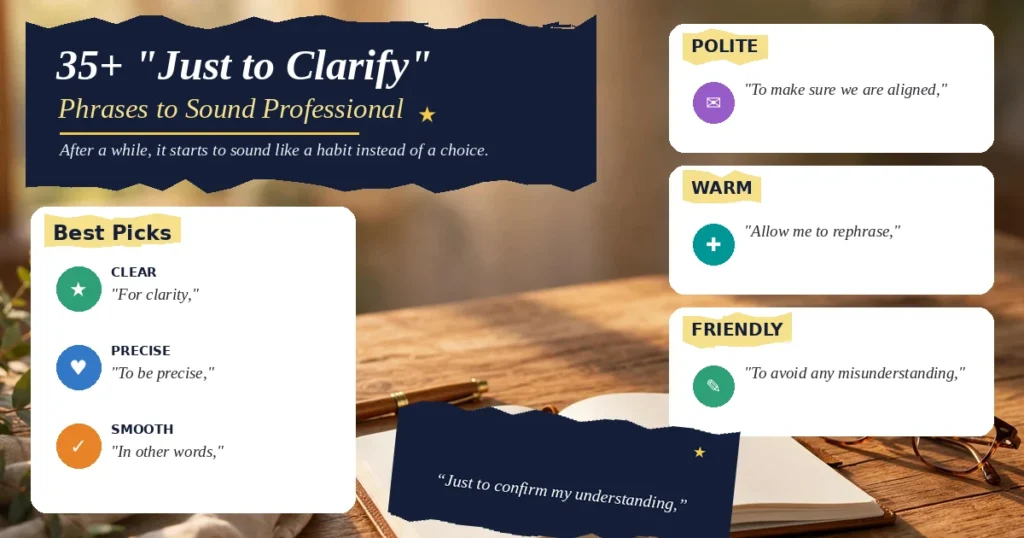
For clarity, — A clean opener for written messages when you want to restate a key point. Example: “For clarity, the invoice covers October only.”
To make sure we are aligned, — Perfect for team settings where shared understanding matters. Example: “To make sure we are aligned, we are launching on the 12th.”
Just to confirm my understanding, — Slightly softer than the original, and great when you are checking your own reading of a situation. Example: “Just to confirm my understanding, you need two versions of the report.”
To be precise, — Works well when numbers, dates, or technical details need sharpening. Example: “To be precise, the discount applies to annual plans only.”
In other words, — A natural bridge when you are about to restate something in simpler terms. Example: “In other words, we need more time before we commit.”
What I mean is, — Direct and honest, best in one-on-one talks where warmth matters. Example: “What I mean is, we can start in March, not February.”
To put it another way, — A smooth restatement tool for conversations and presentations. Example: “To put it another way, quality matters more than speed here.”
Formal and diplomatic
Reach for these in sensitive talks, legal matters, or messages to senior leaders.
To avoid any misunderstanding, — Shows care and foresight, ideal before tricky details. Example: “To avoid any misunderstanding, the contract ends in December.”
For the sake of clarity, — A formal classic that adds weight to written documents. Example: “For the sake of clarity, all payments are due within 30 days.”
Allow me to rephrase, — Polite and respectful, great when you want to restate your own point. Example: “Allow me to rephrase: the budget needs approval first.”
If I may clarify, — Very courteous, perfect for speaking with clients or executives. Example: “If I may clarify, the fee does not include travel costs.”
For the record, — Firm and official, use when you want your words noted or remembered. Example: “For the record, I approved the draft on Monday.”
To ensure mutual understanding, — Strong for negotiations and agreements between two sides. Example: “To ensure mutual understanding, let us list the terms in writing.”
Let me restate this clearly, — Firm but fair, good when a point has been missed more than once. Example: “Let me restate this clearly: no changes after Friday.”
Friendly and conversational
These keep the mood light while still making your point clear.
So basically, — Casual and quick, best with coworkers you know well. Example: “So basically, we just need the logo by Friday.”
In short, — A tiny phrase that wraps up long talk neatly. Example: “In short, the plan stays the same.”
What I am trying to say is, — Honest and warm, works when you are thinking out loud. Example: “What I am trying to say is, I need a little more help.”
Long story short, — Fun and relaxed, great after a long explanation. Example: “Long story short, we got the deal.”
To put it simply, — Kind and clear, helps when the topic feels heavy. Example: “To put it simply, start with step one and call me if you get stuck.”
Here is what I mean, — Direct and friendly, good for face-to-face chats. Example: “Here is what I mean: take Tuesday off and rest.”
To sum it up, — A friendly closer that gathers loose ends. Example: “To sum it up, we meet at nine, we leave at five.”
Email ready
These are built for inboxes. They are short, clear, and easy to scan.
To confirm, — One of the strongest email openers, all business and no fluff. Example: “To confirm, the meeting is at 2 PM tomorrow.”
Just confirming, — Light and polite, perfect for quick check-ins. Example: “Just confirming: should I send this to the whole team?”
For reference, — Useful when pointing back to earlier details or files. Example: “For reference, the quote from March is attached.”
To be clear, — Firm but polite, good when a previous email caused confusion. Example: “To be clear, I did not approve the extra charge.”
Clarifying my last point, — Smooth follow-up phrase for a second email on the same thread. Example: “Clarifying my last point, the start date is the 5th, not the 15th.”
Following up for clarity, — Professional nudge that keeps threads moving. Example: “Following up for clarity, who owns this task now?”
A quick note to clarify, — Soft opener that lowers the reader’s guard before a correction. Example: “A quick note to clarify: the link in my last email was wrong.”
Meeting and conversation
These sound natural out loud and keep talks flowing.
So you are saying, — Great for checking someone else’s point in real time. Example: “So you are saying the client changed their mind?”
Correct me if I am wrong, — Humble and inviting, lets others fix mistakes kindly. Example: “Correct me if I am wrong, but we agreed on $500.”
Let me make sure I follow, — Warm and careful, shows you are really listening. Example: “Let me make sure I follow: the order ships on Monday?”
Hold on, let me get this straight, — A bit stronger, use when surprise or urgency is real. Example: “Hold on, let me get this straight: we lost the file?”
Before we move on, — Perfect meeting phrase that pauses the group for a quick check. Example: “Before we move on, are we all agreed on the price?”
Real quick, — Very casual, works with close teams and friends. Example: “Real quick, which room are we meeting in?”
So the takeaway is, — Strong closer that locks in the main point of a talk. Example: “So the takeaway is, we launch next week no matter what.”
Quick comparison
In a hurry? Here are the top picks at a glance. Choose one based on your tone and setting.
| Alternative | Tone | Best use |
|---|---|---|
| To confirm | Professional | Emails about meetings, dates, and tasks |
| For clarity | Professional | Restating key points in writing |
| If I may clarify | Formal | Speaking with clients or executives |
| To avoid any misunderstanding | Formal | Sensitive or legal details |
| To make sure we are aligned | Professional | Team meetings and shared goals |
| What I mean is | Friendly | One-on-one talks |
| To put it simply | Friendly | Explaining something complex kindly |
| Just confirming | Email ready | Quick check-ins on a thread |
| Before we move on | Conversational | Pausing a meeting for a quick check |
| Correct me if I am wrong | Conversational | Checking facts without sounding pushy |
Email examples
See how these phrases work in real emails. Copy the style, change the details, and make each one your own.
To a client
Subject: Project timeline update
Hi Sarah,
Thanks for the call today. To make sure we are aligned, the final designs will reach you by Friday, March 14. The price we discussed is $2,400, and it covers three rounds of changes.
Please let me know if anything here looks different from your notes.
Best,
Daniel
To a manager
Subject: Leave request
Hi Mr. Thompson,
I am writing to request two days off next month. Just to confirm my understanding, I have 12 vacation days left this year, so this request fits within my balance. I plan to be away on April 8 and 9, and I will finish the client report before I leave.
Thank you for your time.
Kind regards,
Priya
To a colleague
Subject: Quick check
Hi Jake,
For clarity, the client meeting moved to 3 PM in Room B, not Room A. I know the calendar invite still shows the old room. Could you please update it so nobody goes to the wrong place?
Thanks a lot.
Best,
Maria
Meeting follow up
Subject: Notes from today’s meeting
Hi team,
Thanks for a great discussion. Before we move on, here is what we agreed: Lisa owns the budget sheet, Tom contacts the vendor by Wednesday, and I will send the updated timeline by Friday. If anything here is off, please reply by end of day.
Appreciate you all.
Best,
Rachel
To a customer
Subject: Your order status
Hi James,
Thanks for reaching out about your order. To be clear, your package shipped yesterday and should arrive by Thursday. The tracking number is 8472910. If it has not arrived by Friday morning, please reply to this email and I will look into it right away.
Warm regards,
Support team
Notice how each email stays short and puts the clearest sentence near the top. That is the real secret of reaching out well — lead with the point, then add the details.
Common mistakes
1. Using it five times in one email
Repeating any phrase makes it lose meaning. If you catch yourself writing it twice, replace one with “to confirm” or “for clarity.”
2. Clarifying something nobody asked about
Do not restate points that are already clear. This can sound like you do not trust the reader.
3. Sounding annoyed when you say it
A sharp tone turns a helpful phrase into a weapon. Keep your voice or wording calm, or the other person will feel attacked.
4. Using it instead of giving a direct answer
Some people hide behind clarifying phrases to avoid hard answers. Say what you mean first, then clarify if needed.
5. Writing long clarifications
A clarification should be short. If your restatement takes three paragraphs, your first message was the real problem.
6. Clarifying in front of a crowd to embarrass someone
Never use this phrase to point out someone’s mistake in a group. Talk to them privately instead.
7. Using casual versions with senior leaders
“So basically” works with friends, not with a CEO. Match your phrase to your audience.
8. Forgetting to check understanding
Saying “just to clarify” means little if you do not pause. Ask a simple question after, like “does that make sense?”
9. Over-explaining simple points
Not every sentence needs a follow-up. Trust your reader on the easy stuff and save clarifications for what matters.
10. Ignoring cultural differences
In some cultures, public correction feels rude even when gentle. Soften your wording and choose a private channel when in doubt.
Related phrases
These expressions live in the same family as “just to clarify.” Learn them and your English will sound richer and more natural.
To put it mildly — Softens a strong opinion. Example: “To put it mildly, the meeting did not go well.”
Let me put it this way — Introduces a new angle on the same point. Example: “Let me put it this way: we cannot afford another delay.”
In other words, — A natural bridge when you are about to restate something in simpler terms. Example: “In other words, we need more time before we commit.”
What I mean is, — Direct and honest, best in one-on-one talks where warmth matters. Example: “What I mean is, we can start in March, not February.”
To be honest — Adds honesty before a frank point. Example: “To be honest, I did not understand the first email.”
If you will — A polite filler that softens a restatement. Example: “It was a wake-up call, if you will.”
To spell it out — Breaks a point into very clear steps. Example: “To spell it out: sign, scan, and send it back.”
As in — Quickly pins down which meaning you intend. Example: “As in, your data stays private.”
That is to say — A formal way to restate with precision. Example: “That is to say, the fee rises in June.”
Put differently — A neat, professional restatement cue. Example: “Put differently, we are starting over.”
In plain English — Promises simple words for a complex idea. Example: “In plain English, your data stays private.”
For what it is worth — Adds a humble opinion before clarifying. Example: “For what it is worth, I think the old plan was fine.”
Be that as it may — Accepts a point, then moves past it. Example: “Be that as it may, we still need an answer today.”
With that said — Shifts direction while keeping the link to before. Example: “With that said, the budget is still tight.”
Make no mistake — Adds firm emphasis before a clear statement. Example: “Make no mistake, this deadline will not move.”
Phrase comparison
“Just to clarify” sits in the middle of the formality scale, which is why it works almost everywhere. But the middle is not always the best seat. When you talk to a senior executive or a valued client, a slightly more formal line like “if I may clarify” or “to avoid any misunderstanding” shows extra care. These phrases slow the reader down just enough to signal that precision matters, and they carry a polish that the plain original lacks.
In friendly settings, the original can actually sound too stiff. With a close coworker or a friend, “what I mean is” or “to put it simply” feels warmer and more human. These phrases invite the listener in instead of announcing a correction. The difference is small, but people feel it. One sounds like a teacher with a red pen, the other like a friend leaning closer to help.
Email rewards the shortest options. “To confirm” and “just confirming” win because busy readers scan instead of reading. They take up almost no space and still do the full job. Meeting talk, on the other hand, rewards interactive phrases like “correct me if I am wrong” and “before we move on.” These turn a one-way statement into a two-way check, and that small shift keeps everyone engaged. If you only remember one rule, make it this: match the phrase to the person, not just to the point.
Cultural usage
US English
Americans like direct, upbeat clarifying phrases. “So basically,” “real quick,” and “to be clear” are common in offices across the country. US business culture values speed, so short phrases win. People also expect a friendly tone, and a smile in person or an exclamation-free but warm email goes a long way. When a US colleague says “just to clarify,” they usually want a fast yes or no, not a long debate.
UK English
British speakers often soften the phrase with extra politeness. “If I may clarify” and “for the sake of clarity” fit well in UK workplaces. Brits also use gentle humor to ease corrections, so you might hear “just to make sure I have got this right” with a light laugh. In writing, UK English favors “to confirm” and “for reference.” The key difference is understatement: British clarifications tend to sound smaller than they are, so listen for the quiet emphasis.
Corporate communication
Big companies run on written records, so clarifying phrases carry extra weight here. In corporate emails, “to ensure mutual understanding” and “to avoid any misunderstanding” are popular because they create a clear paper trail. Many firms train managers to restate decisions at the end of meetings using “before we move on.” This habit cuts down on the classic problem of two people leaving the same meeting with two different plans. In reports and memos, “that is to say” and “to be precise” add the formal touch that official documents need.
Customer service
In customer service, clarity must come with kindness. Support agents often say “just to make sure I understand” before repeating a customer’s problem back to them. This builds trust fast, because the customer feels heard. When a customer is upset, combining clarification with empathy works best — agents are trained to show they understand the frustration first, then restate the issue calmly. Phrases like “what I am hearing is” and “let me make sure I follow” keep the tone soft while still moving toward a fix.
Frequently asked questions
What does “just to clarify” mean?
It means you are about to restate something so there is no confusion. You might repeat a detail, correct a small mistake, or check your own understanding. It is a polite signal that clear communication matters to you.
Is “just to clarify” rude?
Not by itself. The phrase is neutral and widely accepted. It only sounds rude if your tone is sharp or if you use it to talk down to someone. Keep your voice calm and your intent helpful, and it will land well.
What is a formal way to say “just to clarify”?
“If I may clarify” and “to avoid any misunderstanding” are excellent formal choices. They add courtesy and weight to your words. Use them with senior leaders, clients, and in official documents.
How do you say “just to clarify” in an email?
“To confirm” is the strongest email option because it is short and scannable. “Just confirming” works for quick threads, and “for clarity” fits longer messages. Put the phrase near the top so busy readers catch it fast.
Can I say “just to clarify” to my boss?
Yes, and it is often smart to do so. Restating a task or deadline shows care, not weakness. Just keep the tone respectful and the message short. Your boss will likely appreciate the care you take.
What is the difference between “clarify” and “confirm”?
Clarify means to make something clearer or easier to understand. Confirm means to check that something is true or agreed. You clarify a confusing point, and you confirm a fact. In practice, the two often work as a pair.
Is “just for clarification” correct?
It is grammatically okay, but it sounds stiff and old-fashioned. Modern speakers and writers prefer “just to clarify” or “for clarity.” If you want to sound natural, stick with the shorter forms.
How do you politely correct someone in a meeting?
Start with “correct me if I am wrong” or “before we move on,” then restate the fact gently. Avoid words like “actually” that can sound superior. If the mistake is big or personal, wait and speak privately after the meeting.
What can I say instead of “just to clarify” on a call?
“So you are saying” and “let me make sure I follow” sound natural on calls. They invite the other person to respond, which keeps the conversation alive. For a quick pause, “real quick” works with friends at work.
Is it okay to say “just to clarify” twice in one email?
Try not to. Repeating it weakens your message and can annoy the reader. Swap the second one for “to confirm” or “for reference.” Variety keeps your writing fresh and professional.
What is the shortest way to say “just to clarify”?
“To confirm” is the shortest strong option at just two words. “To confirm” is the shortest strong option at just two words. Both fit emails, chats, and quick notes where space and time are tight.
How do you ask someone else to clarify politely?
Try “could you walk me through that?” or “just so I am clear, do you mean…?” These put the focus on your understanding, not their failure to explain. People open up when they do not feel blamed.
What does “for clarity” mean in an email?
It means the writer is restating a point so it cannot be misread. It usually appears before dates, prices, or decisions. When you see it, pay extra attention — the next sentence is the important one.
Is “to be clear” the same as “just to clarify”?
They are close, but “to be clear” sounds a bit firmer. Use it when a past message caused real confusion. “Just to clarify” is softer and better for routine double-checks. Choose based on how much weight you want.
How can I sound more professional when clarifying?
Match your phrase to your audience and keep it short. Use formal lines with leaders, friendly ones with peers, and always pause to check understanding. Small habits like these build a reputation for clear, calm communication.
Conclusion
Here are the best picks to remember, two per tone so you never run out of options. For professional settings, reach for “to confirm” and “to make sure we are aligned.” In formal moments, use “if I may clarify” and “to avoid any misunderstanding.” With friends and close coworkers, “what I mean is” and “to put it simply” keep things warm. For emails, “just confirming” and “a quick note to clarify” scan beautifully. In live meetings, “before we move on” and “correct me if I am wrong” invite everyone into the conversation.
Clear words build strong work. Every time you pause to restate a point, you save someone from a costly mistake and show that you value their time. Start with one or two new phrases from this guide, use them this week, and watch your messages get sharper. People notice clear communicators, and they remember them — so make sure they also feel genuinely appreciated when you close the loop. If you want to thank someone for helping you reach that shared understanding, a note of thanks for the clarification goes a long way. And when the roles reverse, knowing other ways to say you understand keeps the exchange smooth on both sides. For the exact dictionary sense of the word behind all of this, see clarify on Cambridge Dictionary.