
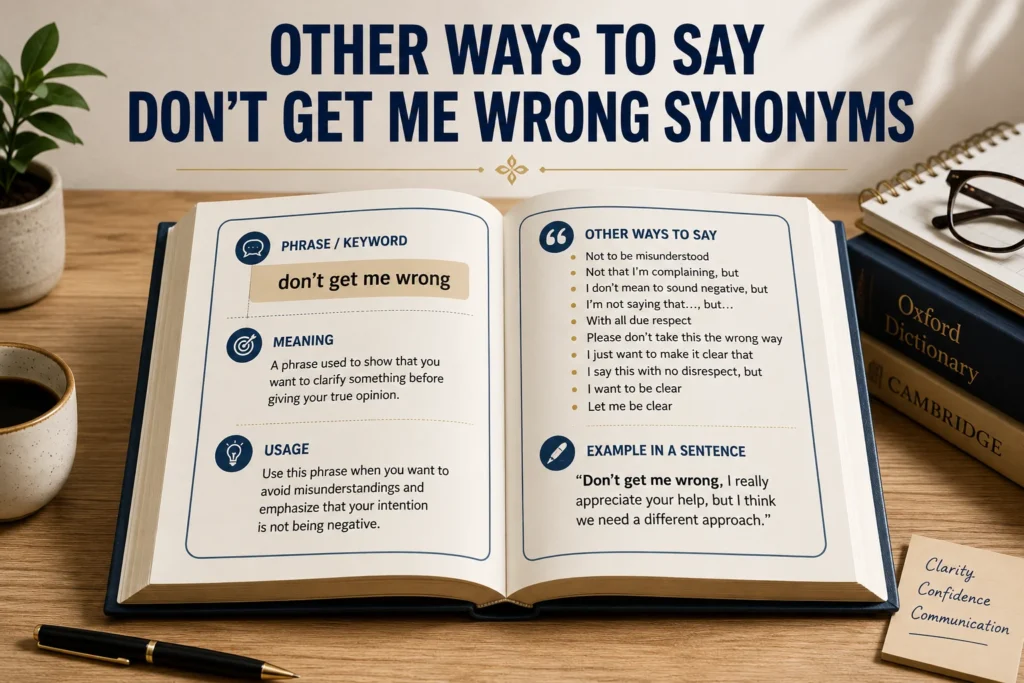
“Don’t get me wrong” is a useful English phrase, but it can sometimes sound defensive, conversational, or slightly blunt in professional communication. If you are writing an email to a client, speaking with a manager, or explaining a different opinion to a colleague, you may want a more polished expression.
This guide covers other ways to say don’t get me wrong synonyms, including professional, formal, friendly, workplace, and email-ready alternatives. You will learn what each phrase means, what tone it creates, and when to use it.
Whether you need a professional way to say “don’t get me wrong,” a formal alternative, or a friendly expression for everyday conversation, the examples below will help you choose the right phrase.
What Does “Don’t Get Me Wrong” Mean?
“Don’t get me wrong” means “please do not misunderstand what I am saying.” People commonly use it before making a clarification, qualification, disagreement, or criticism.
Literal meaning
The phrase asks another person not to interpret your words incorrectly.
For example:
“Don’t get me wrong, I appreciate your work, but I think we need to improve the report.”
The speaker is saying that they appreciate the work while also pointing out a problem.
Tone
“Don’t get me wrong” usually sounds:
- Conversational
- Informal to neutral
- Direct
- Slightly defensive in some situations
- Friendly when used carefully
It works well in casual conversation, but professional communication often benefits from a softer alternative.
Purpose
People use the phrase to:
- Clarify their real intention.
- Prevent misunderstanding.
- Balance praise with criticism.
- Introduce a different opinion.
- Show that disagreement does not mean hostility.
- Explain a qualification or limitation.
Example
“Don’t get me wrong, the presentation was strong, but the financial section needs more detail.”
A more professional version could be:
“I want to emphasize that the presentation was strong; however, the financial section could use more detail.”
Professional Alternatives
These phrases work well in business communication, workplace discussions, meetings, and professional emails.
1. “Please don’t misunderstand me.”
Meaning: I want to make sure you understand my intention correctly.
Tone: Professional, clear, direct.
Best use: Workplace conversations and sensitive discussions.
Example:
“Please don’t misunderstand me; I value your contribution to the project.”
2. “I want to be clear that…”
Meaning: I want to make my position or intention clear.
Tone: Professional and confident.
Best use: Business emails and meetings.
Example:
“I want to be clear that we appreciate your continued support.”
This is one of the strongest professional alternatives because it focuses on clarity rather than misunderstanding.
3. “To be clear…”
Meaning: I want to clarify an important point.
Tone: Concise and professional.
Best use: Emails, reports, meetings, and presentations.
Example:
“To be clear, we are not rejecting the proposal. We are requesting a few revisions.”
4. “I’d like to clarify…”
Meaning: I want to explain something so there is no confusion.
Tone: Polite and professional.
Best use: Client emails and workplace communication.
Example:
“I’d like to clarify that the revised deadline applies only to Phase Two.”
5. “I want to clarify that…”
Meaning: I want to prevent an incorrect interpretation.
Tone: Professional and neutral.
Best use: Business communication.
Example:
“I want to clarify that the delay was related to the supplier, not the internal review process.”
6. “Please understand that…”
Meaning: Please consider my actual intention or position.
Tone: Polite but firm.
Best use: Important explanations.
Example:
“Please understand that we must follow the company’s approval process.”
7. “I hope I’m not giving the wrong impression…”
Meaning: I want to make sure my message is not misunderstood.
Tone: Polite and diplomatic.
Best use: Sensitive workplace discussions.
Example:
“I hope I’m not giving the wrong impression. I fully support the project, but I have concerns about the timeline.”
8. “That’s not to say…”
Meaning: What I just said does not mean something else.
Tone: Professional and nuanced.
Best use: Written communication and presentations.
Example:
“The first proposal has several strengths. That’s not to say the second proposal lacks value.”
9. “I don’t mean to suggest that…”
Meaning: I am not trying to imply the interpretation you may have assumed.
Tone: Diplomatic and professional.
Best use: Disagreements and sensitive topics.
Example:
“I don’t mean to suggest that the team performed poorly. I believe we simply need a stronger process.”
10. “What I mean is…”
Meaning: Here is the meaning I intend.
Tone: Natural and conversational.
Best use: Meetings and workplace conversations.
Example:
“What I mean is that we should review the process before expanding the project.”
11. “To avoid any misunderstanding…”
Meaning: I want to prevent confusion.
Tone: Formal and professional.
Best use: Business emails and official communication.
Example:
“To avoid any misunderstanding, the quoted price does not include delivery.”
12. “For clarity…”
Meaning: I am providing additional information to make something clear.
Tone: Professional and concise.
Best use: Emails, contracts, reports, and instructions.
Example:
“For clarity, the meeting will begin at 10 a.m. rather than 10:30 a.m.”
13. “I want to make sure my point is clear.”
Meaning: I want you to understand my exact point.
Tone: Professional and straightforward.
Best use: Meetings and discussions.
Example:
“I want to make sure my point is clear: we need approval before moving forward.”
14. “I hope that clarifies my position.”
Meaning: I hope my explanation makes my opinion clear.
Tone: Professional and diplomatic.
Best use: Emails and disagreements.
Example:
“I hope that clarifies my position regarding the proposed changes.
15. “I’d like to emphasize that…”
Meaning: I want to highlight an important point.
Tone: Professional and confident.
Best use: Business emails, presentations, and reports.
Example:
“I’d like to emphasize that customer satisfaction remains our top priority.”
Formal Alternatives
Use these expressions when you need a more formal alternative to “don’t get me wrong.”
16. “I would like to clarify…”
Example:
“I would like to clarify that the decision was based on the latest financial data.”
17. “I wish to clarify…”
Example:
“I wish to clarify that this recommendation does not reflect a lack of confidence in the team.”
18. “It is important to clarify that…”
Example:
“It is important to clarify that the policy applies to all departments.”
19. “I would not want this to be misunderstood.”
Example:
“I would not want this to be misunderstood as criticism of your work.”
20. “This should not be interpreted as…”
Example:
“This should not be interpreted as a rejection of your proposal.”
21. “I do not intend to imply that…”
Example:
“I do not intend to imply that the current process is ineffective.”
22. “For the avoidance of doubt…”
Meaning: I am making something completely clear to prevent confusion.
Tone: Very formal.
Example:
“For the avoidance of doubt, the agreement will remain valid until December.”
This expression appears more often in formal British English, legal writing, contracts, and official documents.
23. “To prevent any misinterpretation…”
Example:
“To prevent any misinterpretation, I would like to explain the reasoning behind this decision.”
24. “I would like to make my position clear.”
Example:
“I would like to make my position clear before we proceed with the discussion.”
25. “I trust this clarifies my intention.”
Example:
“I trust this clarifies my intention and addresses the concerns raised.”
Friendly Alternatives
You do not always need formal language. These expressions sound natural with friends, colleagues, or people you know well.
26. “Just to be clear…”
Example:
“Just to be clear, I’m not saying the idea is bad.”
27. “I hope that makes sense.”
Example:
“I think we should wait another week. I hope that makes sense.”
28. “That’s not what I mean.”
Example:
“That’s not what I mean. I’m saying we should try another approach.”
29. “I’m not saying that…”
Example:
“I’m not saying that you did anything wrong.”
30. “What I’m trying to say is…”
Example:
“What I’m trying to say is that we need more time.”
31. “I hope you know what I mean.”
Example:
“I hope you know what I mean. I’m only trying to help.”
32. “I don’t mean it that way.”
Example:
“I don’t mean it that way. I was only making a suggestion.”
33. “Let me explain what I mean.”
Example:
“Let me explain what I mean before you make a decision.”
34. “That’s not to say I disagree.”
Example:
“That’s not to say I disagree. I just see it differently.”
35. “I’m not trying to say…”
Example:
“I’m not trying to say your idea won’t work.”
Email-Ready Alternatives
When writing professional emails, avoid unnecessary defensiveness. Instead of “Don’t get me wrong,” use language that clearly explains your intention.
36. “I’d like to clarify my previous point.”
“I’d like to clarify my previous point regarding the proposed timeline.”
37. “I want to clarify that…”
“I want to clarify that we remain fully committed to the project.”
38. “To avoid any confusion…”
“To avoid any confusion, the revised quotation replaces the previous version.”
39. “For clarity, please note that…”
“For clarity, please note that the final price includes installation.”
40. “I hope to clarify…”
“I hope to clarify the reason for the change below.”
41. “I’d like to emphasize…”
“I’d like to emphasize that your feedback is important to us.”
42. “Please note that…”
“Please note that the deadline has been moved to Friday.”
43. “I want to make sure there is no misunderstanding…”
“I want to make sure there is no misunderstanding regarding the agreed scope of work.”
44. “To put this into context…”
“To put this into context, the additional cost resulted from the supplier’s price increase.”
45. “I hope this provides some clarification.”
“I hope this provides some clarification regarding our decision.”
These are particularly useful business email phrases because they sound neutral instead of defensive.
Workplace Alternatives
In workplace communication, your goal should be clarity without making the other person feel criticized.
46. “I see your point, but…”
“I see your point, but I think we should consider the long-term cost.”
47. “I understand your perspective; however…”
“I understand your perspective; however, the current data suggests a different approach.”
48. “I agree with part of that, but…”
“I agree with part of that, but I think we need additional information.”
49. “I appreciate your point. My concern is…”
“I appreciate your point. My concern is the impact on the deadline.”
50. “I have a slightly different view.”
“I have a slightly different view on how we should handle the issue.”
These expressions often work better than “Don’t get me wrong” because they acknowledge the other person’s perspective first.
Quick Comparison Table
| Alternative | Tone | Best Use |
| Please don’t misunderstand me | Professional | Workplace |
| I want to be clear that | Professional | Emails |
| To be clear | Direct | Meetings |
| I’d like to clarify | Polite | Clients |
| For clarity | Concise | Business writing |
| To avoid any misunderstanding | Formal | Emails |
| I don’t mean to suggest that | Diplomatic | Sensitive discussions |
| That’s not to say | Neutral | Discussions |
| I’d like to emphasize | Professional | Reports |
| Just to be clear | Friendly | Colleagues |
| What I mean is | Conversational | Meetings |
| Let me clarify | Neutral | Workplace |
| Please understand that | Firm | Important issues |
| I see your point, but | Diplomatic | Disagreement |
| I have a slightly different view | Polite | Networking/workplace |
| For the avoidance of doubt | Very formal | Legal/official |
| This should not be interpreted as | Formal | Official communication |
| I hope this clarifies | Professional | Emails |
| I appreciate your point; however | Diplomatic | Business discussions |
| I want to make sure my point is clear | Professional | Meetings |
How to Use These Alternatives in Emails
The best professional communication strategy is to replace defensive language with clear, respectful language.
Instead of:
“Don’t get me wrong, your proposal is good, but it is too expensive.”
Try:
“Your proposal has several strengths. However, the current cost is above our budget.”
This version sounds more objective and less confrontational.
Another option is:
“I appreciate the strengths of your proposal. My main concern is the overall cost.”
This approach separates appreciation from concern, which creates a more constructive tone.
Email Examples
1. Client Email
Less polished:
“Don’t get me wrong, we like your proposal, but we need some changes.”
Professional:
“We appreciate the strengths of your proposal. However, we would like to discuss a few adjustments before moving forward.”
This works because it recognizes the client’s effort before introducing a concern.
2. Email to a Manager
“I’d like to clarify my previous comment. I fully support the project, but I believe we should review the proposed timeline before proceeding.”
This is a strong professional way to clarify your position without sounding defensive.
3. Email to a Colleague
“Just to be clear, I’m not questioning your approach. I’m suggesting that we review one additional option before making a final decision.”
This sounds friendly while still being professional.
4. Customer Service Email
“We understand your concern. To clarify, the additional charge applies only to expedited delivery.”
This is better than:
“Don’t get me wrong, but that charge is clearly mentioned in our policy.”
The first version avoids blame and focuses on information.
5. Networking Email
“I appreciate your perspective. I have a slightly different view based on my experience with similar projects.”
This keeps disagreement respectful and encourages further conversation.
6. Meeting Follow-Up
“I’d like to clarify one point from today’s discussion. My concern was not with the proposal itself, but with the proposed implementation timeline.”
This is an excellent example of professional workplace communication.
When Should You Avoid “Don’t Get Me Wrong”?
The phrase is not grammatically wrong. The issue is tone and context.
Avoid it when:
1. You are writing to an important client
“Don’t get me wrong” may sound too casual.
Instead, use:
“I’d like to clarify…”
2. You are giving criticism
The phrase can make the reader expect negative information.
Instead:
“I appreciate the work that has gone into this. One area we could strengthen is…”
3. You are discussing a sensitive issue
Use neutral language.
Instead of:
“Don’t get me wrong, but this was a poor decision.”
Try:
“I understand the reasoning behind the decision; however, I have some concerns about its potential impact.”
4. You are writing formal documents
Choose precise language such as:
“For clarity…”
or
“This should not be interpreted as…”
Common Mistakes
Overusing the phrase
If you repeatedly write “Don’t get me wrong,” your communication may sound defensive.
Instead, state the positive point and concern directly.
Weak:
“Don’t get me wrong, the report is good, but…”
Better:
“The report provides a strong overview. I recommend adding more supporting data.”
Using an overly formal expression
“For the avoidance of doubt” may sound unnatural in a casual email.
If you are messaging a colleague, “Just to be clear” may work better.
Sounding defensive
Expressions such as “Please understand that” can sound firm if used too often.
Consider:
“I’d like to clarify…”
instead.
Using “however” incorrectly
Do not create unnecessary complexity:
“Don’t get me wrong, however…”
Choose one clear structure.
For example:
“I appreciate the proposal. However, I recommend revising the budget.”
Criticizing after praise
If your praise sounds insincere, the phrase can create suspicion.
Instead of:
“Don’t get me wrong, you did a great job, but everything needs to be changed.”
Say:
“You made a strong start. I recommend making a few changes to improve the final result.”
Related Phrases
Here are related expressions that can replace or complement “Don’t get me wrong.”
1. “To be clear”
Means you want to remove confusion.
“To be clear, we have not canceled the project.”
2. “For clarity”
Introduces clarification.
“For clarity, the quoted price excludes tax.”
3. “I’d like to clarify”
Introduces an explanation.
“I’d like to clarify my previous email.”
4. “That’s not to say”
Prevents a statement from being interpreted too broadly.
“The process is improving. That’s not to say it is perfect.”
5. “I don’t mean to imply”
Rejects an unintended interpretation.
“I don’t mean to imply that the team was responsible.”
6. “What I mean is”
Explains the intended meaning.
“What I mean is that we need more time.”
7. “I understand your point”
Acknowledges another person’s opinion.
“I understand your point, but I see another option.”
8. “I appreciate your perspective”
Shows respect before disagreement.
“I appreciate your perspective, although I have a different view.”
9. “With that said”
Introduces a contrasting point.
“The proposal has several benefits. With that said, we should consider the cost.”
10. “That being said”
Introduces a qualification.
“The results are encouraging. That being said, we need more data.”
11. “Having said that”
Adds a contrasting thought.
“The first option is affordable. Having said that, the second offers better long-term value.”
12. “On the other hand”
Introduces another perspective.
“The plan is affordable. On the other hand, it may take longer.”
13. “I see it differently”
Politely signals disagreement.
“I see it differently based on the available data.”
14. “My concern is…”
Focuses on the specific issue.
“My concern is the effect on customer satisfaction.”
15. “One point I’d like to make is…”
Introduces an important clarification.
“One point I’d like to make is that the deadline has not changed.”
16. “I hope this clarifies”
Closes a clarification.
“I hope this clarifies our position.”
17. “To put this into context”
Provides background.
“To put this into context, the change was requested by the client.”
18. “I want to emphasize”
Highlights an important point.
“I want to emphasize that your feedback is valuable.”
“Don’t Get Me Wrong” vs. Professional Alternatives
| Phrase | Formality | Tone | Best Situation |
| Don’t get me wrong | Low–Medium | Conversational | Casual discussion |
| Just to be clear | Medium | Friendly | Colleagues |
| To be clear | Medium–High | Direct | Business |
| I’d like to clarify | High | Polite | Emails |
| For clarity | High | Neutral | Documents |
| I want to be clear that | High | Confident | Business emails |
| I don’t mean to suggest | High | Diplomatic | Sensitive topics |
| To avoid misunderstanding | High | Professional | Clients |
| I appreciate your perspective | High | Respectful | Disagreement |
| I have a different view | Medium–High | Neutral | Meetings |
| For the avoidance of doubt | Very High | Formal | Legal/official |
| This should not be interpreted as | Very High | Formal | Policies/documents |
Cultural Usage
US English
In American English, “Don’t get me wrong” is very common in everyday speech. It can introduce a contrast without necessarily sounding rude.
For example:
“Don’t get me wrong, I like the new system, but it takes some time to learn.”
In American corporate communication, however, direct alternatives such as “To be clear” or “I’d like to clarify” often sound more polished.
UK English
British speakers also use “Don’t get me wrong” frequently in informal conversation.
Formal British communication may favor expressions such as:
- “For clarity”
- “To clarify”
- “I would like to emphasize”
- “For the avoidance of doubt”
“For the avoidance of doubt” is particularly formal and can appear in legal, contractual, or official contexts.
Corporate Communication
Corporate writing usually benefits from objective language.
Instead of:
“Don’t get me wrong, this plan isn’t bad.”
Use:
“The plan has several strengths, although there are areas that require further consideration.”
This sounds more analytical and less personal.
Customer Service
Customer service requires empathy and clarity.
Avoid:
“Don’t get me wrong, but you misunderstood our policy.”
Use:
“We understand the confusion. To clarify, our policy states that…”
The second version protects the customer’s dignity and keeps the conversation constructive.
Networking
Networking depends heavily on maintaining positive relationships.
Instead of:
“Don’t get me wrong, but I disagree.”
Try:
“I appreciate your perspective. My experience has led me to a slightly different conclusion.”
This creates room for discussion rather than confrontation.
Choosing the Right Alternative
There is no single perfect synonym for “Don’t get me wrong.” Choose the expression according to your purpose.
If you want to clarify:
Use:
“I’d like to clarify…”
If you want to prevent confusion:
Use:
“To avoid any misunderstanding…”
If you want to sound professional:
Use:
“I want to be clear that…”
If you want to sound diplomatic:
Use:
“I appreciate your perspective; however…”
If you want to sound friendly:
Use:
“Just to be clear…”
If you want to disagree politely:
Use:
“I see your point, but…”
If you need highly formal language:
Use:
“This should not be interpreted as…”
If you are writing a legal or official document:
Use:
“For the avoidance of doubt…”
Best Professional Way to Say “Don’t Get Me Wrong”
If you need one dependable expression for professional communication, “I’d like to clarify…” is one of the safest choices.
For example:
“I’d like to clarify that our recommendation is based on the current project requirements.”
It sounds professional without being overly formal.
Another strong choice is:
“I want to be clear that…”
For example:
“I want to be clear that we value your feedback and remain committed to resolving the issue.”
Best Formal Alternative to “Don’t Get Me Wrong”
For formal writing, consider:
“I would like to clarify that…”
or:
“This should not be interpreted as…”
For highly formal or legal contexts:
“For the avoidance of doubt…”
Use the last option carefully. It can sound unnecessarily legal in an ordinary business email.
Best Friendly Alternative
For friends or close colleagues:
“Just to be clear…”
Example:
“Just to be clear, I’m not upset. I just think we should discuss it again.”
It sounds natural and avoids the defensive feeling that “Don’t get me wrong” can sometimes create.
Best Alternative for Business Emails
For email etiquette, these are especially useful:
- “I’d like to clarify…”
- “To be clear…”
- “For clarity…”
- “I want to clarify that…”
- “To avoid any misunderstanding…”
- “I’d like to emphasize…”
- “I hope this clarifies…”
- “I want to make sure there is no misunderstanding…”
These expressions make your message easier to understand while keeping the tone professional.
Faqs
What is a synonym for “Don’t get me wrong”?
Common alternatives include “Please don’t misunderstand me,” “I’d like to clarify,” “To be clear,” “Just to be clear,” and “I don’t mean to suggest that.”
The best choice depends on the formality and context.
What is a professional way to say “Don’t get me wrong”?
“I’d like to clarify…” is a strong professional alternative.
Example:
“I’d like to clarify that we support the proposal, but we recommend revising the timeline.”
What is a formal alternative to “Don’t get me wrong”?
You can say:
“I would like to clarify that…”
For highly formal communication, you can use:
“This should not be interpreted as…”
Is “Don’t get me wrong” professional?
It can be professional in some conversations, but it is generally conversational rather than formal. In client emails, official documents, and sensitive business communication, a clearer alternative often works better.
Is “Don’t get me wrong” rude?
Not usually. However, depending on the context, it can sound defensive or imply that the listener might misunderstand you.
A softer phrase such as “I appreciate your perspective; however…” can sound more diplomatic.
What can I say instead of “Don’t get me wrong” in an email?
Try:
“I’d like to clarify…”
“To avoid any misunderstanding…”
“For clarity…”
“I want to be clear that…”
These phrases fit professional email etiquette.
What is a polite way to disagree without saying “Don’t get me wrong”?
Try:
“I understand your perspective, but I have a slightly different view.”
This acknowledges the other person’s position before introducing disagreement.
What is the best alternative for a client?
“I’d like to clarify…” is usually a safe choice.
Example:
“I’d like to clarify that the additional fee applies only to expedited delivery.”
What can I say to my manager instead of “Don’t get me wrong”?
Use:
“I appreciate the direction. I’d like to raise one concern regarding the timeline.”
This sounds respectful and constructive.
What is a casual synonym for “Don’t get me wrong”?
“Just to be clear” and “What I mean is…” are natural casual alternatives.
What is a diplomatic alternative to “Don’t get me wrong”?
Try:
“I appreciate your perspective; however, I have a slightly different view.”
This works especially well when you disagree.
Can I use “That’s not to say” instead of “Don’t get me wrong”?
Yes. “That’s not to say” works when you want to prevent one statement from implying another.
Example:
“The current process works well. That’s not to say we cannot improve it.”
What does “Don’t get me wrong” imply?
It usually implies that the speaker expects their next statement to be misunderstood or interpreted more negatively than intended.
Is “For the avoidance of doubt” a synonym for “Don’t get me wrong”?
It can perform a similar clarification function, but the tone differs significantly. “For the avoidance of doubt” is much more formal and often suits legal, contractual, or official writing.
How can I sound less defensive than “Don’t get me wrong”?
Focus on the actual message rather than warning the reader about misunderstanding.
Instead of:
“Don’t get me wrong, your idea is good, but…”
Say:
“Your idea has several strengths. I recommend considering one additional option.”
This sounds more confident, objective, and constructive.
Final Summary
The best other ways to say “Don’t get me wrong” depend on your audience, purpose, and level of formality. For professional communication, “I’d like to clarify,” “I want to be clear that,” and “To avoid any misunderstanding” are reliable choices. For polite disagreement, “I appreciate your perspective; however” works particularly well. For casual conversations, “Just to be clear” and “What I mean is” sound natural. In formal or legal writing, “This should not be interpreted as” or “For the avoidance of doubt” may be appropriate. Choosing the right phrase makes your workplace communication, business emails, and professional communication clearer, more respectful, and more effective.
Conclusion
Choosing the right alternative to “Don’t get me wrong” can make your communication clearer, more polite, and more professional. In business emails and workplace communication, phrases such as “I’d like to clarify,” “To be clear,” and “I want to be clear that” are excellent choices. For polite disagreement, “I appreciate your perspective; however” sounds respectful and diplomatic. In casual conversations, “Just to be clear” and “What I mean is” feel more natural. For highly formal communication, “This should not be interpreted as” can work well. Ultimately, the best phrase depends on your audience, relationship, purpose, and level of formality.