
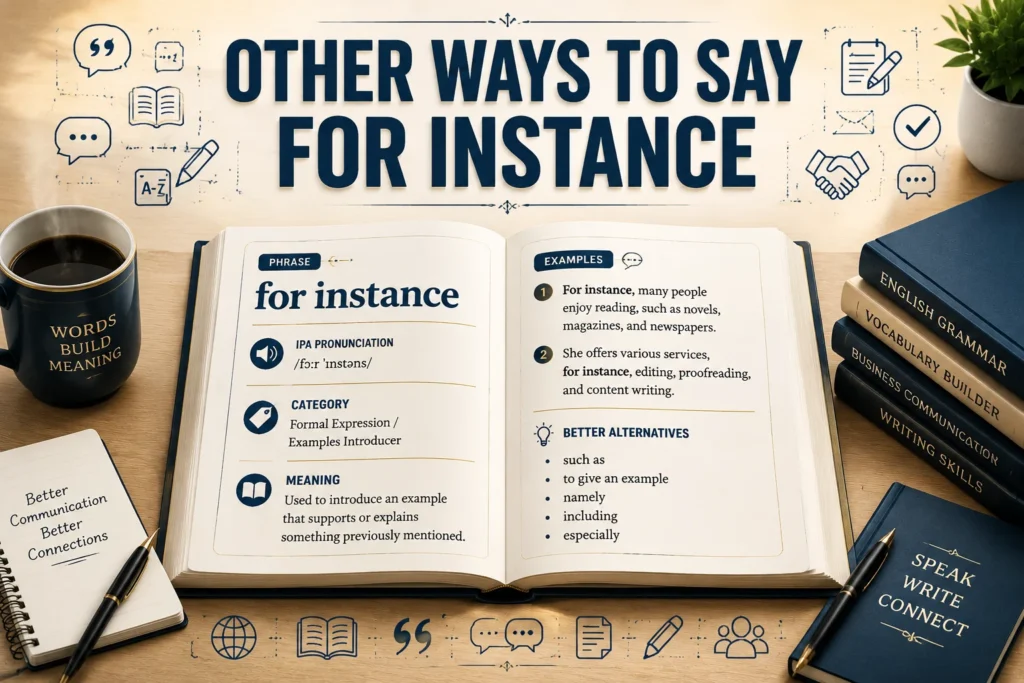
“For instance” is a common phrase used to introduce an example that explains or supports an idea. While it’s clear and widely accepted, using it repeatedly in emails, reports, presentations, or everyday writing can make your content feel repetitive. Learning other ways to say “for instance” helps you write more naturally, improve professional communication, and match the tone of different situations. Whether you’re writing to a client, speaking with colleagues, or creating business documents, choosing the right alternative makes your message more engaging and polished.
What Does “For Instance” Mean?
“For instance” means “here is an example” or “to give one example.” It introduces a specific example that helps explain a statement or idea.
Tone: Neutral, professional, and informative.
Purpose: To clarify information by providing an example without listing every possibility.
Examples
- Several apps can improve productivity. For instance, Trello helps teams manage projects.
- Small changes can make a difference. For instance, replying to emails promptly builds trust.
- Many countries encourage renewable energy. For instance, Norway invests heavily in electric vehicles.
When to Use “For Instance” or Its Alternatives
Emails: Explain ideas with clear examples.
Example: Several documents are required. For instance, your ID and proof of address.
Workplace: Clarify instructions or recommendations.
Example: Focus on high-impact tasks. For instance, customer support and quality assurance.
Clients: Make proposals easier to understand.
Example: Our services include digital marketing. For instance, SEO and content writing.
Networking: Share experiences with relevant examples.
Example: I’ve worked with different industries. For instance, healthcare and education.
Customer Service: Explain products or policies clearly.
Example: Some features are included. For instance, free updates and live chat support.
Professional Alternatives to “For Instance”
1. For Example
Tone: Professional
Best Use: Business writing, emails, presentations
Example: We offer several services, for example, website design and SEO.
2. Such As
Tone: Neutral
Best Use: Everyday and professional writing
Example: The package includes benefits such as free training and priority support.
3. Including
Tone: Professional
Best Use: Business emails and reports
Example: The proposal includes several recommendations, including cost-saving strategies.
4. To Illustrate
Tone: Formal
Best Use: Reports and presentations
Example: To illustrate, customer satisfaction increased by 20% after the update.
5. As an Example
Tone: Professional
Best Use: Meetings and presentations
Example: As an example, our latest campaign generated twice as many leads.
6. Namely
Tone: Formal
Best Use: Official documents
Example: Three departments were recognized, namely Sales, HR, and Marketing.
7. Specifically
Tone: Professional
Best Use: Emails and reports
Example: We need feedback, specifically on the onboarding process.
8. In Particular
Tone: Professional
Best Use: Workplace communication
Example: The training benefited everyone, in particular new employees.
9. Particularly
Tone: Professional
Best Use: Business communication
Example: Customers appreciated the faster response times, particularly during peak hours.
10. One Example Is
Tone: Neutral
Best Use: Everyday and workplace communication
Example: One example is our automated reporting system.
11. By Way of Example
Tone: Formal
Best Use: Reports and proposals
Example: By way of example, our new workflow reduced project delays.
12. To Give an Example
Tone: Friendly Professional
Best Use: Presentations and conversations
Example: To give an example, our support team now resolves most issues within one hour.
Quick Comparison Table
| Alternative | Tone | Best Use |
| For Example | Professional | Emails and reports |
| Such As | Neutral | General writing |
| Including | Professional | Business communication |
| To Illustrate | Formal | Presentations |
| As an Example | Professional | Meetings |
| Namely | Formal | Official documents |
| Specifically | Professional | Emails |
| In Particular | Professional | Workplace |
| Particularly | Professional | Reports |
| One Example Is | Neutral | Everyday writing |
| By Way of Example | Formal | Proposals |
| To Give an Example | Friendly Professional | Conversations and presentations |
More Alternatives to Say “For Instance”
13. For One
Tone: Friendly
Best Use: Conversations and blog writing
Example: There are several reasons to upgrade. For one, it improves security.
14. As Evidence
Tone: Formal
Best Use: Reports and proposals
Example: As evidence, customer satisfaction increased after the update.
15. To Demonstrate
Tone: Professional
Best Use: Business presentations
Example: To demonstrate, our response time dropped from six hours to two.
16. As Shown By
Tone: Professional
Best Use: Reports and analytics
Example: As shown by the latest survey, customer loyalty has improved.
17. Consider
Tone: Friendly Professional
Best Use: Presentations and discussions
Example: Consider our premium plan, which includes unlimited support.
18. Take
Tone: Conversational
Best Use: Everyday writing
Example: Take email marketing—it remains one of the highest-converting channels.
19. A Good Example Is
Tone: Neutral
Best Use: Workplace communication
Example: A good example is our customer onboarding process.
20. One Case Is
Tone: Professional
Best Use: Reports and case studies
Example: One case is our successful product launch last quarter.
21. As Seen In
Tone: Professional
Best Use: Business reports
Example: As seen in the quarterly report, sales continue to grow.
22. This Includes
Tone: Professional
Best Use: Emails and business writing
Example: The package offers several benefits. This includes free installation and ongoing support.
23. To Cite One Example
Tone: Formal
Best Use: Academic and professional writing
Example: To cite one example, our customer retention rate increased by 18%.
24. Among Them
Tone: Professional
Best Use: Reports and summaries
Example: Several companies attended the event, among them leading technology firms.
25. One Illustration Is
Tone: Formal
Best Use: Reports and presentations
Example: One illustration is our new training program, which reduced onboarding time.
Quick Comparison Table
| Alternative | Tone | Best Use |
| For One | Friendly | Blogs and conversations |
| As Evidence | Formal | Reports |
| To Demonstrate | Professional | Presentations |
| As Shown By | Professional | Business reports |
| Consider | Friendly Professional | Discussions |
| Take | Conversational | Everyday writing |
| A Good Example Is | Neutral | Workplace |
| One Case Is | Professional | Case studies |
| As Seen In | Professional | Reports |
| This Includes | Professional | Business emails |
| To Cite One Example | Formal | Academic writing |
| Among Them | Professional | Summaries |
| One Illustration Is | Formal | Presentations |
Email Examples
Client
Our solution offers several advantages, for example, faster implementation and lower maintenance costs.
Manager
To illustrate, the revised workflow reduced processing time by 30%.
Colleague
One example is the new reporting template, which saves time each week.
Customer
Your subscription includes premium features, including priority support and free updates.
Networking
I’ve worked with several industries, such as healthcare, finance, and education.
Meeting Follow-up
As discussed today, we’ll prioritize customer experience improvements, specifically response times and onboarding.
Common Mistakes
Although “for instance” is a useful phrase, using it incorrectly can make your writing less effective.
1. Overusing the Phrase
Repeating “for instance” throughout the same email or article makes your writing sound repetitive.
Instead of:
- For instance, we improved sales.
- For instance, we reduced costs.
- For instance, we hired more staff.
Better:
- For example, we improved sales.
- We also reduced costs.
- One example is our expanded support team.
2. Using a Formal Alternative in Casual Conversations
Some alternatives, such as “namely” or “by way of example,” may sound too formal in everyday speech.
Casual:
For example…
Formal:
Namely…
3. Giving Weak or Irrelevant Examples
Choose examples that clearly support your main point.
Weak:
Our service is reliable. For instance, we have a logo.
Better:
Our service is reliable. For instance, we respond to most customer inquiries within one hour.
4. Mixing Similar Phrases
Avoid using multiple example phrases in the same sentence.
Incorrect:
For instance, such as email and phone support.
Correct:
For instance, email and phone support.
or
Such as email and phone support.
Related Phrases
| Phrase | Meaning | Example |
| For example | Introduces an example | For example, online meetings save time. |
| Such as | Gives examples | Services such as SEO and web design. |
| Including | Adds examples | Including free updates and support. |
| Namely | Lists exact items | Namely HR, Sales, and Finance. |
| Specifically | Gives precise details | Specifically for new customers. |
| In particular | Highlights one example | In particular, remote workers benefited. |
| Particularly | Gives emphasis | Particularly during busy seasons. |
| To illustrate | Explains with an example | To illustrate, sales increased by 15%. |
| As an example | Gives one example | As an example, our latest campaign succeeded. |
| One example is | Introduces an example | One example is our training program. |
| By way of example | Formal example | By way of example, customer retention improved. |
| To demonstrate | Shows proof | To demonstrate, response times improved. |
| This includes | Introduces included items | This includes free installation. |
| Among them | Refers to examples in a group | Among them were several startups. |
| To cite one example | Gives supporting evidence | To cite one example, revenue doubled. |
Phrase Comparison
| Phrase | Tone | Formality | Best Use |
| For instance | Neutral | Medium | General writing |
| For example | Professional | Medium | Emails and reports |
| Such as | Neutral | Medium | Everyday writing |
| Including | Professional | High | Business communication |
| Namely | Formal | High | Official documents |
| Specifically | Professional | High | Detailed explanations |
| To illustrate | Formal | High | Presentations |
| One example is | Neutral | Medium | Workplace communication |
| Particularly | Professional | Medium | Reports |
| By way of example | Formal | High | Proposals |
Cultural Usage
US English
American English commonly uses for example, for instance, and such as in both spoken and written communication.
UK English
British English also uses for instance, but formal writing often favors namely, in particular, and to illustrate.
Corporate Communication
Businesses typically prefer:
- For example
- Including
- Specifically
- To illustrate
These alternatives make reports and emails clear and professional.
Customer Service
Support teams often use:
- For example
- Such as
- Including
These phrases help explain products, services, and policies in a simple way.
Networking
When speaking with professionals, these alternatives sound natural:
- For example
- One example is
- Such as
- To give an example
FAQs
What is another way to say “for instance”?
Common alternatives include for example, such as, including, to illustrate, and one example is.
Is “for example” the same as “for instance”?
Yes. Both introduce examples, although for example is slightly more common in everyday writing.
What is the most professional alternative to “for instance”?
Including, specifically, to illustrate, and namely are excellent choices for professional communication.
Can I use “such as” instead of “for instance”?
Yes, but such as usually introduces a list of examples, while for instance often introduces one specific example.
Is “for instance” formal?
It has a neutral tone and works well in both formal and informal writing.
Which alternative is best for business emails?
For example, including, and specifically are among the best options.
How can I avoid repeating “for instance”?
Use alternatives like to illustrate, one example is, such as, or including.
Is “namely” more formal than “for instance”?
Yes. Namely is generally used in official, academic, or legal writing.
Can I use “for instance” in presentations?
Absolutely. It helps explain ideas with clear, relevant examples.
Why should I use different alternatives?
Using a variety of expressions makes your writing more engaging, professional, and easier to read.
Conclusion
“For instance” is a clear and effective way to introduce examples, but using different alternatives can make your writing more natural and professional. Expressions like for example, such as, including, to illustrate, and specifically help you explain ideas more clearly while matching the tone of emails, workplace communication, reports, and presentations. By choosing the right phrase for the situation, you’ll improve readability, avoid repetition, and communicate with greater confidence in both professional and everyday writing.