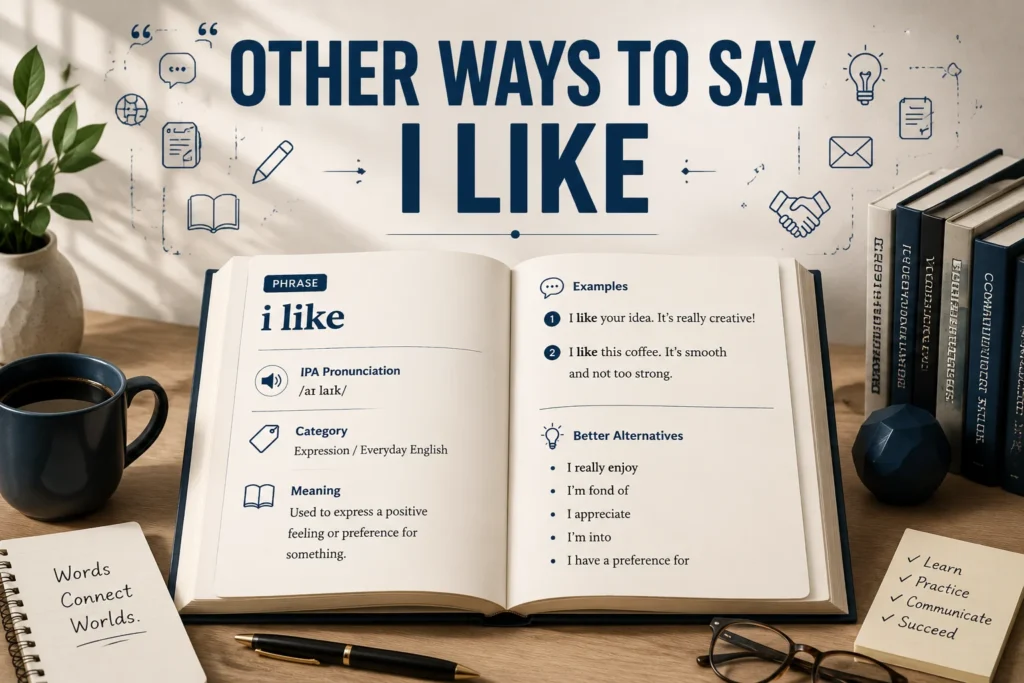
The phrase “I like” is one of the most common ways to express appreciation, preference, or approval. While it’s simple and natural, repeating it in emails, workplace conversations, presentations, or everyday writing can sound repetitive. Learning other ways to say “I like” helps you communicate more professionally, express your thoughts with greater precision, and match the tone of different situations. Whether you’re writing to a client, talking to a colleague, or giving feedback, using the right alternative can make your message sound more confident and polished.
What Does “I Like” Mean?
“I like” means you have a positive feeling about someone, something, or an idea. It expresses enjoyment, approval, or preference without being overly strong.
Tone: Neutral, friendly, and positive.
Purpose: To show appreciation, agreement, or interest in a polite and natural way.
Examples
- I like your presentation.
- I like this design.
- I like working with your team.
In professional communication, replacing “I like” with more specific expressions often makes your message clearer and more impactful.
When to Use Alternatives to “I Like”
Emails: Show appreciation professionally.
Example: I appreciate your thoughtful suggestions.
Workplace: Give constructive feedback.
Example: I value your approach to solving this problem.
Clients: Express approval while maintaining professionalism.
Example: We appreciate your creative proposal.
Networking: Build positive relationships.
Example: I enjoyed learning about your experience.
Customer Service: Create a warm and respectful tone.
Example: We appreciate your feedback.
Professional Alternatives to “I Like”
1. I Appreciate
Tone: Professional
Best Use: Business emails, client communication
Example: I appreciate your quick response.
2. I Value
Tone: Professional and respectful
Best Use: Workplace discussions
Example: I value your opinion on this project.
3. I Enjoy
Tone: Friendly professional
Best Use: Conversations and emails
Example: I enjoy working with your team.
4. I’m Fond Of
Tone: Warm and friendly
Best Use: Personal or semi-formal conversations
Example: I’m fond of your writing style.
5. I’m Interested In
Tone: Professional
Best Use: Networking and business
Example: I’m interested in learning more about your services.
6. I Admire
Tone: Respectful
Best Use: Compliments and recognition
Example: I admire your leadership skills.
7. I Prefer
Tone: Neutral and professional
Best Use: Expressing choices
Example: I prefer virtual meetings on Fridays.
8. I’m Impressed By
Tone: Professional and positive
Best Use: Client feedback and workplace communication
Example: I’m impressed by the quality of your work.
9. I Love (Use Carefully)
Tone: Friendly and enthusiastic
Best Use: Casual conversations or creative industries
Example: I love the new branding concept.
Tip: In formal business emails, “I appreciate” or “I’m impressed by” often sounds more professional than “I love.”
10. I Think Highly Of
Tone: Formal and respectful
Best Use: Recommendations and professional recognition
Example: I think highly of your attention to detail.
11. I Respect
Tone: Professional
Best Use: Workplace and leadership communication
Example: I respect your decision and understand your reasoning.
12. I’m Pleased With
Tone: Formal
Best Use: Performance reviews and client feedback
Example: I’m pleased with the progress your team has made.
Quick Comparison Table
| Alternative | Tone | Best Use |
| I Appreciate | Professional | Business emails |
| I Value | Professional | Workplace communication |
| I Enjoy | Friendly Professional | General conversations |
| I’m Fond Of | Friendly | Personal communication |
| I’m Interested In | Professional | Networking |
| I Admire | Respectful | Compliments |
| I Prefer | Neutral | Expressing preferences |
| I’m Impressed By | Professional | Feedback |
| I Love | Casual | Informal conversations |
| I Think Highly Of | Formal | Recommendations |
| I Respect | Professional | Workplace discussions |
| I’m Pleased With | Formal | Client communication |
More Alternatives to Say “I Like”
13. I Am Grateful For
Tone: Professional
Best Use: Client appreciation, workplace emails
Example: I am grateful for your continued support.
14. I Approve Of
Tone: Formal
Best Use: Management and official communication
Example: I approve of your proposed strategy.
15. I Am Delighted With
Tone: Warm and professional
Best Use: Client feedback
Example: I am delighted with the final design.
16. I Find It Appealing
Tone: Professional
Best Use: Reviews and presentations
Example: I find this proposal appealing because it is practical.
17. I Am Happy With
Tone: Friendly professional
Best Use: Everyday workplace communication
Example: I am happy with the team’s progress.
18. It Appeals to Me
Tone: Professional
Best Use: Business discussions
Example: The flexible schedule appeals to me.
19. I Am Drawn To
Tone: Thoughtful
Best Use: Networking and creative work
Example: I am drawn to innovative ideas.
20. I Have a Preference For
Tone: Formal
Best Use: Business meetings
Example: I have a preference for face-to-face meetings.
21. I Am Enthusiastic About
Tone: Positive
Best Use: Projects and teamwork
Example: I am enthusiastic about this new initiative.
22. I Am a Fan Of
Tone: Friendly
Best Use: Casual conversations
Example: I am a fan of your podcast.
23. I Appreciate the Value Of
Tone: Professional
Best Use: Workplace discussions
Example: I appreciate the value of clear communication.
24. I Welcome
Tone: Formal
Best Use: Business communication
Example: I welcome your suggestions and feedback.
25. I Endorse
Tone: Formal
Best Use: Recommendations and approvals
Example: I fully endorse this proposal.
Quick Comparison Table
| Alternative | Tone | Best Use |
| I Am Grateful For | Professional | Appreciation |
| I Approve Of | Formal | Official communication |
| I Am Delighted With | Warm | Client feedback |
| I Find It Appealing | Professional | Reviews |
| I Am Happy With | Friendly Professional | Workplace |
| It Appeals to Me | Professional | Discussions |
| I Am Drawn To | Thoughtful | Creative work |
| I Have a Preference For | Formal | Meetings |
| I Am Enthusiastic About | Positive | Team projects |
| I Am a Fan Of | Friendly | Casual conversations |
| I Appreciate the Value Of | Professional | Business |
| I Welcome | Formal | Emails |
| I Endorse | Formal | Recommendations |
Email Examples
Client
I appreciate your detailed proposal and look forward to working together.
Manager
I value your guidance throughout this project.
Colleague
I’m impressed by the effort you put into today’s presentation.
Customer
We appreciate your feedback and thank you for choosing our services.
Networking
I enjoyed meeting you at the conference and hope we stay in touch.
Meeting Follow-up
I appreciate everyone’s valuable contributions during today’s meeting.
Common Mistakes
Using “I like” is perfectly acceptable, but relying on it too often can make your communication sound repetitive. Here are some common mistakes to avoid.
1. Repeating “I Like” Too Often
Using the same phrase multiple times in one conversation or email reduces variety.
Instead of:
- I like your idea.
- I like your presentation.
- I like your report.
Better:
- I appreciate your idea.
- I’m impressed by your presentation.
- I value the effort you put into the report.
2. Using Casual Language in Formal Emails
“I like” may sound too casual in professional communication.
Instead of: I like your proposal.
Better: I appreciate your proposal. or I’m impressed by your proposal.
3. Choosing an Overly Strong Expression
Words like “I love” may sound too emotional in formal business settings.
Better Choice:
- I appreciate…
- I value…
- I’m pleased with…
4. Matching the Wrong Tone
Choose an expression that fits the audience.
- Client: I appreciate your feedback.
- Manager: I value your guidance.
- Friend: I love your new idea.
Related Phrases
| Phrase | Meaning | Example |
| I appreciate | Show gratitude | I appreciate your support. |
| I value | Show respect | I value your opinion. |
| I enjoy | Express enjoyment | I enjoy reading your articles. |
| I admire | Show respect | I admire your leadership. |
| I respect | Show regard | I respect your decision. |
| I prefer | Express preference | I prefer online meetings. |
| I’m impressed by | Express admiration | I’m impressed by your work. |
| I’m pleased with | Show satisfaction | I’m pleased with the results. |
| I’m interested in | Show curiosity | I’m interested in your services. |
| I’m fond of | Show affection | I’m fond of this writing style. |
| It appeals to me | Express attraction | The design appeals to me. |
| I’m enthusiastic about | Show excitement | I’m enthusiastic about this project. |
| I approve of | Express approval | I approve of your suggestion. |
| I welcome | Accept positively | I welcome your feedback. |
| I endorse | Give support | I endorse this proposal. |
Phrase Comparison
| Phrase | Tone | Formality | Best Use |
| I like | Neutral | Medium | Everyday communication |
| I appreciate | Professional | High | Business emails |
| I value | Professional | High | Workplace |
| I enjoy | Friendly | Medium | General conversations |
| I admire | Respectful | High | Compliments |
| I prefer | Neutral | Medium | Expressing choices |
| I’m impressed by | Professional | High | Feedback |
| I respect | Professional | High | Workplace |
| I’m pleased with | Formal | High | Client communication |
| I love | Casual | Low | Friends and informal settings |
Cultural Usage
US English
American English frequently uses I like, I enjoy, I appreciate, and I’m impressed by in both personal and professional communication.
UK English
British English often prefers slightly more formal expressions such as I appreciate, I value, and I’m pleased with, especially in workplace settings.
Corporate Communication
In business, professionals commonly use:
- I appreciate
- I value
- I’m pleased with
- I’m impressed by
These phrases sound more polished than simply saying I like.
Customer Service
Customer service teams often use:
- We appreciate your feedback.
- We value your business.
- We’re pleased to assist you.
These expressions build trust and maintain a professional tone.
Networking
When building professional relationships, these alternatives work well:
- I enjoyed meeting you.
- I appreciate your insights.
- I’m interested in learning more.
- I admire your work.
FAQs
What is another way to say “I like”?
Some of the best alternatives include I appreciate, I enjoy, I value, I’m impressed by, and I admire.
What is a professional way to say “I like”?
Use I appreciate, I value, I’m pleased with, or I’m impressed by in business communication.
Is “I like” appropriate in business emails?
Yes, but more professional alternatives often create a stronger impression.
What is the best formal alternative to “I like”?
I appreciate, I value, and I approve of are excellent formal choices.
Can I say “I love” instead of “I like”?
Yes, but “I love” is more emotional and is usually better suited to informal conversations.
Which phrase should I use when giving positive feedback?
I’m impressed by and I’m pleased with are excellent options.
What is the best phrase for client emails?
I appreciate your feedback or I value your partnership sound professional and respectful.
How can I avoid repeating “I like”?
Use alternatives such as I enjoy, I admire, I appreciate, and I value depending on the context.
Which alternative is best for workplace communication?
I value, I appreciate, and I’m impressed by are widely used in professional workplaces.
Is “I appreciate” more formal than “I like”?
Yes. I appreciate expresses gratitude and respect, making it more suitable for professional communication.
Conclusion
While “I like” is a simple and natural phrase, using a variety of alternatives can make your communication more engaging and professional. Expressions like I appreciate, I value, I’m impressed by, I admire, and I’m pleased with help you express approval with greater clarity and confidence. Whether you’re writing an email, speaking with a client, collaborating with colleagues, or networking with professionals, choosing the right phrase strengthens your message and leaves a positive impression. Expanding your vocabulary also improves your writing, making it more polished, natural, and effective in every situation.