
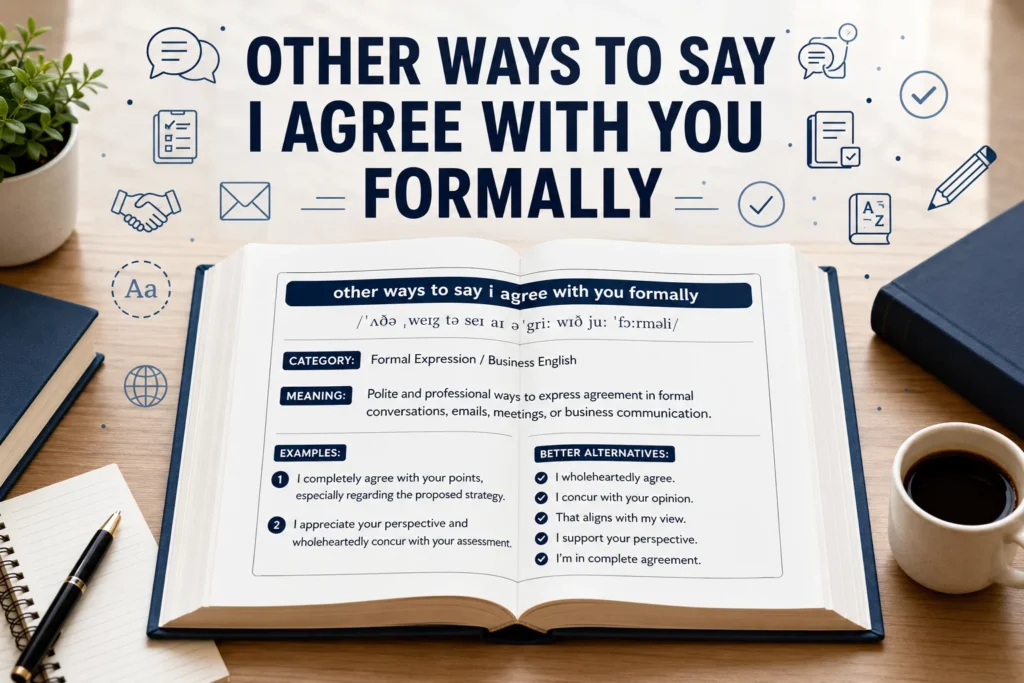
In professional communication, the way you express agreement can shape how others perceive your confidence, respect, and professionalism. While saying “I agree with you” is perfectly correct, repeating it in every email, meeting, or workplace conversation can sound repetitive and less polished.
Many professionals look for other ways to say “I agree with you” formally to make their communication more engaging, respectful, and appropriate for different situations. Whether you’re replying to a client, supporting your manager’s proposal, participating in a team meeting, or responding to a business email, choosing the right expression helps you communicate with clarity and confidence.
This guide explores the best professional, formal, and polite alternatives to “I agree with you.” You’ll learn when to use each phrase, understand its tone, and see practical examples that fit modern workplace communication. By the end, you’ll know the professional way to say “I agree with you formally,” discover a formal alternative to “I agree with you,” improve your business email phrases, and strengthen your overall professional communication skills.
What Does “I Agree with You” Mean?
“I agree with you” is a common expression used to show that you share the same opinion, support another person’s idea, or accept their viewpoint.
It is one of the most frequently used phrases in conversations, meetings, emails, presentations, and workplace discussions because it communicates cooperation and mutual understanding.
Literal Meaning
Literally, “I agree with you” means:
“I share your opinion.”
or
“I think your idea is correct.”
It tells the other person that your views align with theirs.
Tone
The phrase usually sounds:
- Professional
- Respectful
- Neutral
- Positive
- Cooperative
Although it is suitable in most situations, using it repeatedly may make your communication sound repetitive. Choosing alternative expressions helps you sound more confident and articulate.
Purpose
People use this phrase to:
- Express support
- Confirm shared opinions
- Build trust
- Encourage collaboration
- Show active listening
- Reach consensus
- Maintain positive workplace relationships
Emotional Context
Unlike emotional phrases such as “I’m delighted” or “I’m disappointed,” “I agree with you” communicates agreement without strong emotion.
Its purpose is to acknowledge another person’s perspective respectfully.
Compare these examples:
Basic:
I agree with you.
Professional:
I completely agree with your assessment.
Formal:
I share your perspective on this matter.
Friendly:
I think you’re absolutely right.
Each version communicates agreement while creating a different tone.
Examples
Business Email
I agree with your recommendation to postpone the launch until next week.
Workplace Meeting
I completely agree with your proposal.
Client Communication
I share your concerns regarding the project timeline.
Manager
I believe your suggestion is the best approach.
Team Discussion
That’s an excellent point, and I agree with your conclusion.
When Should You Use “I Agree with You” Formally?
Expressing agreement professionally is an essential part of effective workplace communication. It helps build trust, encourages collaboration, and demonstrates respect for others’ ideas.
Here are some common situations where formal alternatives are especially useful.
1. Business Emails
Business emails often require a professional tone, especially when responding to proposals, recommendations, or project updates.
Example:
I completely agree with your recommendations and support moving forward with the proposed timeline.
2. Workplace Communication
Whether you’re speaking during meetings or collaborating on projects, expressing agreement professionally helps strengthen teamwork.
Example:
I share your perspective on improving our customer service process.
3. Client Communication
Clients appreciate clear, respectful responses that acknowledge their ideas.
Example:
I agree with your suggested revisions and will implement them in the next draft.
4. Customer Service
Support representatives often need to acknowledge customers’ concerns before offering solutions.
Example:
I understand your concerns and agree that this issue should be addressed promptly.
5. Networking
Professional networking conversations benefit from respectful agreement that encourages further discussion.
Example:
I completely agree with your insights on industry trends.
Why Use an Alternative?
Modern business communication values variety, clarity, and professionalism. Instead of relying on the same phrase repeatedly, using different expressions helps you communicate more naturally and effectively.
Benefits include:
- Sounding more professional
- Improving workplace communication
- Building stronger client relationships
- Demonstrating active listening
- Avoiding repetitive language
- Making emails more engaging
- Showing confidence and respect
- Following modern email etiquette
15 Professional Alternatives to “I Agree with You” Formally
1. I Completely Agree
Tone: Professional
Best Use:
- Meetings
- Business emails
- Presentations
Example:
I completely agree with your recommendation to update the policy.
Why it works:
It expresses strong agreement while maintaining a professional tone.
2. I Share Your View
Tone: Formal
Best Use:
- Client communication
- Reports
- Discussions
Example:
I share your view that customer satisfaction should remain our top priority.
Why it works:
This phrase sounds thoughtful and respectful.
3. I Share Your Perspective
Tone: Professional
Best Use:
- Workplace discussions
- Strategy meetings
Example:
I share your perspective on improving internal communication.
Why it works:
It emphasizes mutual understanding rather than simple agreement.
4. I Couldn’t Agree More
Tone: Friendly Professional
Best Use:
- Team meetings
- Networking
- Informal business conversations
Example:
I couldn’t agree more with your suggestion to simplify the process.
Why it works:
It conveys enthusiastic agreement while remaining appropriate for most professional settings.
5. I Believe You’re Right
Tone: Polite
Best Use:
- One-on-one discussions
- Emails
Example:
I believe you’re right about adjusting the project timeline.
Why it works:
It acknowledges the other person’s judgment respectfully.
6. I Support Your Recommendation
Tone: Formal Professional
Best Use:
- Business proposals
- Management discussions
Example:
I support your recommendation to expand our marketing efforts.
Why it works:
It demonstrates both agreement and commitment.
7. I Concur
Tone: Very Formal
Best Use:
- Executive communication
- Legal correspondence
- Official reports
Example:
I concur with your assessment of the current situation.
Why it works:
“Concur” is concise, formal, and widely used in professional settings.
8. I Concur with Your Assessment
Tone: Formal
Best Use:
- Performance reviews
- Reports
- Executive meetings
Example:
I concur with your assessment regarding the proposed budget changes.
Why it works:
It sounds authoritative and suitable for high-level discussions.
9. That’s a Fair Point
Tone: Professional Friendly
Best Use:
- Meetings
- Brainstorming sessions
Example:
That’s a fair point. We should consider that before making a decision.
Why it works:
It acknowledges the other person’s contribution while keeping the conversation collaborative.
10. I Think That’s the Right Approach
Tone: Professional
Best Use:
- Project planning
- Team discussions
Example:
I think that’s the right approach for improving efficiency.
Why it works:
It expresses agreement while focusing on the proposed solution.
11. You Make an Excellent Point
Tone: Friendly Professional
Best Use:
- Meetings
- Presentations
- Networking
Example:
You make an excellent point about prioritizing customer feedback.
Why it works:
It recognizes the value of the other person’s idea before expressing agreement.
12. I Support That Idea
Tone: Professional
Best Use:
- Workplace collaboration
- Team meetings
Example:
I support that idea because it aligns with our long-term goals.
Why it works:
It clearly communicates approval and collaboration.
13. I See It the Same Way
Tone: Friendly Professional
Best Use:
- Internal communication
- Colleague discussions
Example:
I see it the same way, especially regarding the proposed deadline.
Why it works:
It sounds natural while reinforcing shared thinking.
14. I Appreciate Your Perspective, and I Agree
Tone: Polite Formal
Best Use:
- Client communication
- Leadership discussions
Example:
I appreciate your perspective, and I agree that additional testing is necessary.
Why it works:
It acknowledges the speaker before expressing agreement, making it especially respectful.
15. I Fully Support Your Position
Tone: Formal
Best Use:
- Executive meetings
- Official correspondence
- Policy discussions
Example:
I fully support your position on strengthening our quality standards.
Why it works:
This phrase communicates strong endorsement and professionalism.
Tips for Choosing the Right Alternative
The best alternative depends on your audience and the context:
- For clients: I share your perspective on this matter.
- For managers: I support your recommendation.
- For colleagues: That’s a fair point.
- For formal reports: I concur with your assessment.
- For networking: You make an excellent point.
Selecting the right expression helps you sound confident, respectful, and professional while strengthening your business communication and workplace relationships.
Other Ways to Say “I Agree with You” Formally: Professional & Polite Alternatives in 2026
In professional communication, the way you express agreement can shape how others perceive your confidence, respect, and professionalism. While saying “I agree with you” is perfectly correct, repeating it in every email, meeting, or workplace conversation can sound repetitive and less polished.
Many professionals look for other ways to say “I agree with you” formally to make their communication more engaging, respectful, and appropriate for different situations. Whether you’re replying to a client, supporting your manager’s proposal, participating in a team meeting, or responding to a business email, choosing the right expression helps you communicate with clarity and confidence.
This guide explores the best professional, formal, and polite alternatives to “I agree with you.” You’ll learn when to use each phrase, understand its tone, and see practical examples that fit modern workplace communication. By the end, you’ll know the professional way to say “I agree with you formally,” discover a formal alternative to “I agree with you,” improve your business email phrases, and strengthen your overall professional communication skills.
What Does “I Agree with You” Mean?
“I agree with you” is a common expression used to show that you share the same opinion, support another person’s idea, or accept their viewpoint.
It is one of the most frequently used phrases in conversations, meetings, emails, presentations, and workplace discussions because it communicates cooperation and mutual understanding.
Literal Meaning
Literally, “I agree with you” means:
“I share your opinion.”
or
“I think your idea is correct.”
It tells the other person that your views align with theirs.
Tone
The phrase usually sounds:
- Professional
- Respectful
- Neutral
- Positive
- Cooperative
Although it is suitable in most situations, using it repeatedly may make your communication sound repetitive. Choosing alternative expressions helps you sound more confident and articulate.
Purpose
People use this phrase to:
- Express support
- Confirm shared opinions
- Build trust
- Encourage collaboration
- Show active listening
- Reach consensus
- Maintain positive workplace relationships
Emotional Context
Unlike emotional phrases such as “I’m delighted” or “I’m disappointed,” “I agree with you” communicates agreement without strong emotion.
Its purpose is to acknowledge another person’s perspective respectfully.
Compare these examples:
Basic:
I agree with you.
Professional:
I completely agree with your assessment.
Formal:
I share your perspective on this matter.
Friendly:
I think you’re absolutely right.
Each version communicates agreement while creating a different tone.
Examples
Business Email
I agree with your recommendation to postpone the launch until next week.
Workplace Meeting
I completely agree with your proposal.
Client Communication
I share your concerns regarding the project timeline.
Manager
I believe your suggestion is the best approach.
Team Discussion
That’s an excellent point, and I agree with your conclusion.
When Should You Use “I Agree with You” Formally?
Expressing agreement professionally is an essential part of effective workplace communication. It helps build trust, encourages collaboration, and demonstrates respect for others’ ideas.
Here are some common situations where formal alternatives are especially useful.
1. Business Emails
Business emails often require a professional tone, especially when responding to proposals, recommendations, or project updates.
Example:
I completely agree with your recommendations and support moving forward with the proposed timeline.
2. Workplace Communication
Whether you’re speaking during meetings or collaborating on projects, expressing agreement professionally helps strengthen teamwork.
Example:
I share your perspective on improving our customer service process.
3. Client Communication
Clients appreciate clear, respectful responses that acknowledge their ideas.
Example:
I agree with your suggested revisions and will implement them in the next draft.
4. Customer Service
Support representatives often need to acknowledge customers’ concerns before offering solutions.
Example:
I understand your concerns and agree that this issue should be addressed promptly.
5. Networking
Professional networking conversations benefit from respectful agreement that encourages further discussion.
Example:
I completely agree with your insights on industry trends.
Why Use an Alternative?
Modern business communication values variety, clarity, and professionalism. Instead of relying on the same phrase repeatedly, using different expressions helps you communicate more naturally and effectively.
Benefits include:
- Sounding more professional
- Improving workplace communication
- Building stronger client relationships
- Demonstrating active listening
- Avoiding repetitive language
- Making emails more engaging
- Showing confidence and respect
- Following modern email etiquette
15 Professional Alternatives to “I Agree with You” Formally
1. I Completely Agree
Tone: Professional
Best Use:
- Meetings
- Business emails
- Presentations
Example:
I completely agree with your recommendation to update the policy.
Why it works:
It expresses strong agreement while maintaining a professional tone.
2. I Share Your View
Tone: Formal
Best Use:
- Client communication
- Reports
- Discussions
Example:
I share your view that customer satisfaction should remain our top priority.
Why it works:
This phrase sounds thoughtful and respectful.
3. I Share Your Perspective
Tone: Professional
Best Use:
- Workplace discussions
- Strategy meetings
Example:
I share your perspective on improving internal communication.
Why it works:
It emphasizes mutual understanding rather than simple agreement.
4. I Couldn’t Agree More
Tone: Friendly Professional
Best Use:
- Team meetings
- Networking
- Informal business conversations
Example:
I couldn’t agree more with your suggestion to simplify the process.
Why it works:
It conveys enthusiastic agreement while remaining appropriate for most professional settings.
5. I Believe You’re Right
Tone: Polite
Best Use:
- One-on-one discussions
- Emails
Example:
I believe you’re right about adjusting the project timeline.
Why it works:
It acknowledges the other person’s judgment respectfully.
6. I Support Your Recommendation
Tone: Formal Professional
Best Use:
- Business proposals
- Management discussions
Example:
I support your recommendation to expand our marketing efforts.
Why it works:
It demonstrates both agreement and commitment.
7. I Concur
Tone: Very Formal
Best Use:
- Executive communication
- Legal correspondence
- Official reports
Example:
I concur with your assessment of the current situation.
Why it works:
“Concur” is concise, formal, and widely used in professional settings.
8. I Concur with Your Assessment
Tone: Formal
Best Use:
- Performance reviews
- Reports
- Executive meetings
Example:
I concur with your assessment regarding the proposed budget changes.
Why it works:
It sounds authoritative and suitable for high-level discussions.
9. That’s a Fair Point
Tone: Professional Friendly
Best Use:
- Meetings
- Brainstorming sessions
Example:
That’s a fair point. We should consider that before making a decision.
Why it works:
It acknowledges the other person’s contribution while keeping the conversation collaborative.
10. I Think That’s the Right Approach
Tone: Professional
Best Use:
- Project planning
- Team discussions
Example:
I think that’s the right approach for improving efficiency.
Why it works:
It expresses agreement while focusing on the proposed solution.
11. You Make an Excellent Point
Tone: Friendly Professional
Best Use:
- Meetings
- Presentations
- Networking
Example:
You make an excellent point about prioritizing customer feedback.
Why it works:
It recognizes the value of the other person’s idea before expressing agreement.
12. I Support That Idea
Tone: Professional
Best Use:
- Workplace collaboration
- Team meetings
Example:
I support that idea because it aligns with our long-term goals.
Why it works:
It clearly communicates approval and collaboration.
13. I See It the Same Way
Tone: Friendly Professional
Best Use:
- Internal communication
- Colleague discussions
Example:
I see it the same way, especially regarding the proposed deadline.
Why it works:
It sounds natural while reinforcing shared thinking.
14. I Appreciate Your Perspective, and I Agree
Tone: Polite Formal
Best Use:
- Client communication
- Leadership discussions
Example:
I appreciate your perspective, and I agree that additional testing is necessary.
Why it works:
It acknowledges the speaker before expressing agreement, making it especially respectful.
15. I Fully Support Your Position
Tone: Formal
Best Use:
- Executive meetings
- Official correspondence
- Policy discussions
Example:
I fully support your position on strengthening our quality standards.
Why it works:
This phrase communicates strong endorsement and professionalism.
Tips for Choosing the Right Alternative
The best alternative depends on your audience and the context:
- For clients: I share your perspective on this matter.
- For managers: I support your recommendation.
- For colleagues: That’s a fair point.
- For formal reports: I concur with your assessment.
- For networking: You make an excellent point.
Selecting the right expression helps you sound confident, respectful, and professional while strengthening your business communication and workplace relationships.
(FAQs)
1. What is the best professional way to say “I agree with you” formally?
Some of the best professional alternatives include:
- I completely agree.
- I share your perspective.
- I support your recommendation.
- I concur with your assessment.
- I fully agree with your proposal.
These expressions are appropriate for business emails, meetings, presentations, and workplace discussions because they sound confident, respectful, and professional.
2. Is “I agree with you” professional?
Yes. “I agree with you” is grammatically correct and professional. However, using it repeatedly can make your communication sound repetitive. Switching between different expressions helps your emails and conversations sound more polished and engaging.
3. What is a formal alternative to “I agree with you”?
Formal alternatives include:
- I concur.
- I concur with your assessment.
- I share your view.
- I am in complete agreement.
- I fully support your position.
- I endorse this approach.
These phrases are especially useful in executive communication, reports, legal correspondence, and official business writing.
4. What can I say instead of “I agree” in an email?
You can write:
- I completely agree with your recommendation.
- I support your proposal.
- I share your perspective.
- I believe this is the right approach.
- I appreciate your insight and agree.
These alternatives sound more professional and provide greater variety in business emails.
5. Is “I concur” too formal?
“I concur” is a very formal expression. It works well in executive meetings, legal documents, academic writing, and official correspondence.
For everyday workplace communication, phrases like “I completely agree” or “I share your perspective” usually sound more natural.
6. How do I express agreement professionally in a meeting?
In meetings, you can use phrases such as:
- That’s an excellent point.
- I completely agree.
- I support that idea.
- I think that’s the right approach.
- We’re on the same page.
- I share your perspective.
These expressions show active listening and encourage collaboration.
7. How do I agree with a client politely?
When communicating with clients, choose respectful and professional wording, such as:
- I completely agree with your recommendation.
- I appreciate your feedback and agree.
- I share your concerns.
- I support your suggestion.
- I believe your approach is the right one.
These responses acknowledge the client’s viewpoint while maintaining professionalism.
8. How can I avoid repeating “I agree”?
Instead of using the same phrase repeatedly, vary your language with alternatives like:
- I concur.
- I support this decision.
- That makes sense.
- I share your opinion.
- You make an excellent point.
- I see your point.
- I couldn’t agree more.
- I reached the same conclusion.
Using a variety of expressions keeps your communication fresh and engaging.
9. Which expression is best for workplace communication?
For most workplace situations, these options work well:
- I completely agree.
- I support your recommendation.
- I think that’s the right approach.
- I see it the same way.
- We’re on the same page.
They balance professionalism with a collaborative tone.
10. Why should I use different ways to say “I agree with you”?
Using different expressions helps you:
- Sound more professional.
- Improve workplace communication.
- Avoid repetitive language.
- Build stronger relationships.
- Show active listening.
- Match your tone to different audiences.
- Strengthen your business writing.
- Communicate more confidently.
Small changes in wording can make your emails, meetings, and conversations more effective and memorable.
Final Summayr
Expressing agreement professionally is an important part of effective business communication. While “I agree with you” is always correct, using a wider range of expressions allows you to communicate with greater confidence, clarity, and professionalism.
For everyday workplace conversations, “I completely agree,” “I support your recommendation,” and “I think that’s the right approach” are excellent choices because they sound natural while remaining professional.
When communicating with clients, phrases such as “I share your perspective,” “I appreciate your insight,” and “I fully agree with your proposal” create a respectful and collaborative tone.
In formal settings like executive meetings, reports, or legal correspondence, expressions such as “I concur,” “I concur with your assessment,” and “I am in complete agreement” demonstrate professionalism and authority.
For internal teamwork and informal collaboration, friendlier alternatives like “That’s a fair point,” “You make an excellent point,” and “We’re on the same page” help encourage open discussion and positive relationships.
Choosing the right phrase for the right audience strengthens your professional communication, improves your business email writing, and helps you build trust with colleagues, managers, clients, and business partners.
Conclusion
Professional communication is about more than sharing ideas—it is also about expressing them with clarity, confidence, and respect. Although “I agree with you” remains a reliable expression, using alternatives such as “I completely agree,” “I share your perspective,” “I support your recommendation,” or “I concur with your assessment” makes your communication more polished and engaging. Matching your language to the situation, audience, and level of formality demonstrates professionalism while encouraging productive conversations. By expanding your vocabulary and using these alternatives thoughtfully, you’ll write stronger emails, contribute more effectively in meetings, and build lasting professional relationships in every workplace setting.