
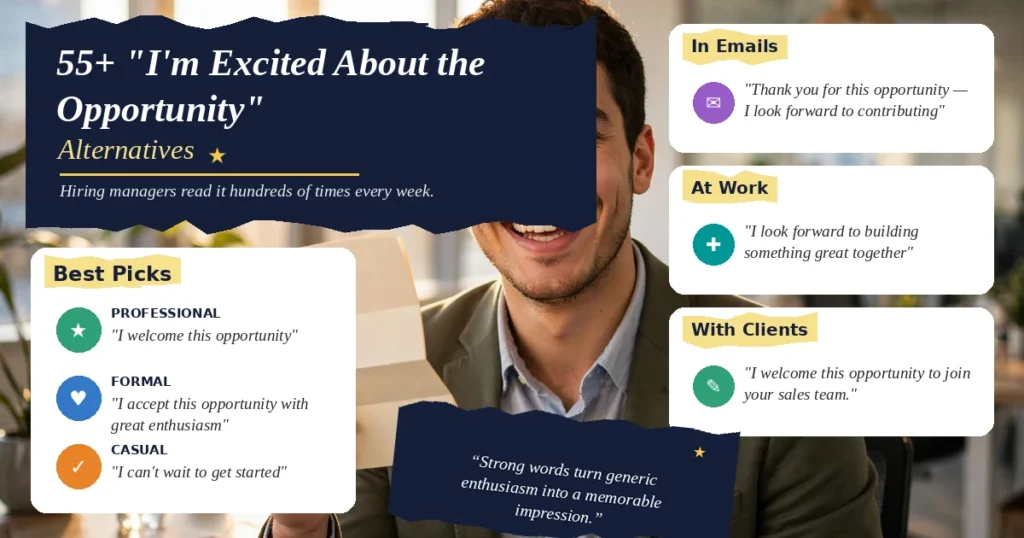
Searching for other ways to say “I’m excited about the opportunity”? Good instinct. The phrase is warm and positive, but hiring managers read it hundreds of times every week. It starts to sound generic, and generic never stands out in a crowded inbox.
This guide gives you 55 professional and polite alternatives for job applications, interviews, offer letters, and networking emails. Each option includes a one-line usage note and a short real-world example you can adapt in seconds. You will find formal choices for cover letters, confident lines for interviews, and friendly versions for follow-up messages.
Whether you need a formal alternative to “I’m excited about the opportunity” for a cover letter or a natural line for a thank-you email, you will find it below. The goal is simple: show genuine enthusiasm in words that sound like you — not like a template everyone else copied.
What “I’m excited about the opportunity” means
“I’m excited about the opportunity” means you feel enthusiastic and grateful about a possible job, project, or partnership. Candidates say it in cover letters and interviews to show interest. It signals motivation, but overuse has made it feel routine to many hiring managers.
The tone is warm, positive, and eager. It suits most professional settings, from application emails to acceptance calls. The risk is not rudeness but blandness — when every applicant writes the same line, yours disappears into the pile.
The emotional context is hope mixed with ambition. You want the role, and you want them to know it. Stronger alternatives keep that emotion while adding specifics about why the role fits you, which makes your professional communication far more persuasive.
Example in a cover letter: “I’m excited about the opportunity to join your marketing team.” A sharper version: “Your team’s growth-stage challenges match exactly where I do my best work.” The second line shows the same enthusiasm with proof behind it.
When to use it professionally
In emails
Use enthusiastic alternatives in application and follow-up emails. “I welcome the chance to contribute to your team” sounds confident in a cover letter. Keep the energy high but the language specific, and follow solid email etiquette throughout.
In the workplace
When a promotion or new project lands, express excitement with commitment. “I’m invested in making this role a success” tells your manager you bring drive, not just delight. That framing strengthens everyday workplace communication.
With clients
New client partnerships deserve warm professionalism. “I look forward to building something great together” shows enthusiasm while keeping the focus on results the client will see.
In networking
After meeting a potential employer or partner, follow up fast. “Our conversation confirmed this is exactly the challenge I’ve been seeking” feels personal and memorable. These business email phrases keep you top of mind.
In customer service
Service roles value genuine warmth. “I’m thrilled to help you get started” reassures customers and sets a positive tone. Keep it sincere — forced excitement reads as fake.
55 professional and polite alternatives
Professional alternatives
I welcome this opportunity. Confident and clean; works in cover letters. Example: “I welcome this opportunity to join your sales team.”
I am enthusiastic about this role. Direct and polished; suits applications. Example: “I am enthusiastic about this role and its growth potential.”
I look forward to contributing to your team. Warm and team-minded; ideal for interviews. Example: “I look forward to contributing to your team from day one.”
This opportunity aligns perfectly with my goals. Strategic; shows thoughtful intent. Example: “This opportunity aligns perfectly with my goals in product design.”
I am eager to bring my skills to your organization. Proactive; strong in cover letters. Example: “I am eager to bring my data skills to your organization.”
I appreciate the chance to be considered. Grateful and humble; good for follow-ups. Example: “I appreciate the chance to be considered for this position.”
I am genuinely interested in this position. Sincere; fits screening calls. Example: “I am genuinely interested in this position and your mission.”
This role excites me professionally. Focused; keeps emotion work-appropriate. Example: “This role excites me professionally because of its scope.”
I am motivated by what this position offers. Driven; suits performance cultures. Example: “I am motivated by what this position offers in leadership growth.”
I would be thrilled to join your team. Warm and upbeat; good for final rounds. Example: “I would be thrilled to join your team next quarter.”
I am honored to be considered for this role. Respectful; ideal for senior positions. Example: “I am honored to be considered for this role.”
This opportunity energizes me. Vivid and modern; stands out in emails. Example: “This opportunity energizes me more than any role I’ve seen.”
I am keen to take on this challenge. Bold; shows readiness. Example: “I am keen to take on this challenge and deliver results.”
I value the chance to contribute here. Grounded; good for mission-driven orgs. Example: “I value the chance to contribute here and grow with you.”
I am passionate about this opportunity. Strong but professional; use sparingly. Example: “I am passionate about this opportunity in renewable energy.”
Formal alternatives
I am deeply grateful for this opportunity. Dignified; suits formal offer replies. Example: “I am deeply grateful for this opportunity to serve.”
I accept this opportunity with great enthusiasm. Ceremonial; perfect for offer acceptance. Example: “I accept this opportunity with great enthusiasm.”
It would be a privilege to serve in this capacity. Elevated; fits executive roles. Example: “It would be a privilege to serve in this capacity.”
I regard this opportunity with the highest interest. Stately; good for formal letters. Example: “I regard this opportunity with the highest interest.”
I am sincerely appreciative of your consideration. Gracious; ideal for thank-you notes. Example: “I am sincerely appreciative of your consideration.”
This prospect holds great professional significance for me. Weighty; suits senior applications. Example: “This prospect holds great professional significance for me.”
I embrace this opportunity wholeheartedly. Committed; strong for acceptances. Example: “I embrace this opportunity wholeheartedly.”
It is an honor to be entrusted with this role. Solemn; fits leadership appointments. Example: “It is an honor to be entrusted with this role.”
I approach this opportunity with earnest dedication. Serious; good for formal statements. Example: “I approach this opportunity with earnest dedication.”
I am profoundly thankful for this chance. Heartfelt; suits personal thank-you letters. Example: “I am profoundly thankful for this chance to grow.”
Friendly alternatives
I can’t wait to get started. Upbeat; great for offer acceptances. Example: “I can’t wait to get started on Monday!”
This is exactly the kind of role I’ve been looking for. Personal; shows real fit. Example: “This is exactly the kind of role I’ve been looking for.”
I’m really looking forward to this. Natural; suits casual follow-ups. Example: “I’m really looking forward to this next chapter.”
Count me in — I’m all in. Bold and warm; good with friendly hiring managers. Example: “Count me in — I’m all in on this project.”
This opportunity has me fired up. High-energy; use with peers. Example: “This opportunity has me fired up for Q1.”
I’m pumped about what’s ahead. Casual; fits startup culture. Example: “I’m pumped about what’s ahead for the team.”
This feels like the perfect fit. Confident; good for final interviews. Example: “This feels like the perfect fit for my skills.”
I’m thrilled to be part of this. Joyful; suits team welcomes. Example: “I’m thrilled to be part of this amazing team.”
What an amazing chance — thank you. Grateful; ideal for quick replies. Example: “What an amazing chance — thank you for thinking of me.”
I couldn’t be more excited. Maximum warmth; use once, not often. Example: “I couldn’t be more excited to join you.”
Email alternatives
“Thank you for this opportunity — I look forward to contributing.” Balanced; perfect for acceptance emails. Example: “Thank you for this opportunity — I look forward to contributing to the Q3 launch.”
“I am writing to express my strong interest in this role.” Classic; ideal for cover emails. Example: “I am writing to express my strong interest in the analyst role.”
“Please know how much I value this chance.” Sincere; good for thank-you emails. Example: “Please know how much I value this chance to interview.”
“I accept your offer with enthusiasm.” Crisp; suits formal acceptances. Example: “I accept your offer with enthusiasm and will sign today.”
“I’m grateful for the opportunity to interview.” Humble; perfect for post-interview notes. Example: “I’m grateful for the opportunity to interview with your team.”
“This role is a great match, and I’m eager to begin.” Confident; strong in follow-ups. Example: “This role is a great match, and I’m eager to begin in June.”
“Thank you for considering me — I’m excited to move forward.” Warm; fits process updates. Example: “Thank you for considering me — I’m excited to move forward to the next round.”
“I welcome the chance to join your team.” Open; good for referral emails. Example: “I welcome the chance to join your team after Sara’s kind referral.”
“I’m honored by your offer and ready to start.” Respectful; ideal for senior offers. Example: “I’m honored by your offer and ready to start on the 15th.”
“Looking ahead, I’m excited about what we can build together.” Visionary; suits partnership emails. Example: “Looking ahead, I’m excited about what we can build together this year.”
Workplace alternatives
I’m ready to hit the ground running. Driven; great for new hires. Example: “I’m ready to hit the ground running on the migration.”
I’m invested in making this role a success. Committed; suits promotions. Example: “I’m invested in making this role a success for the whole team.”
This challenge is exactly what I wanted. Focused; good for stretch assignments. Example: “This challenge is exactly what I wanted at this stage.”
I’m committed to delivering results here. Accountable; strong with managers. Example: “I’m committed to delivering results here in my first 90 days.”
I’m energized by this new chapter. Positive; fits internal moves. Example: “I’m energized by this new chapter in product.”
I’m all in on this team. Loyal; good for team announcements. Example: “I’m all in on this team and our roadmap.”
I’m looking forward to adding real value. Humble and confident; suits onboarding. Example: “I’m looking forward to adding real value this quarter.”
This role plays to my strengths. Self-aware; good for interviews. Example: “This role plays to my strengths in client work.”
I’m motivated to exceed expectations. Ambitious; strong in reviews. Example: “I’m motivated to exceed expectations in this position.”
I’m proud to be joining this organization. Honorable; fits public announcements. Example: “I’m proud to be joining this organization and its mission.”
Quick comparison table
| Alternative | Tone | Best use |
|---|---|---|
| I welcome this opportunity | Professional | Cover letters |
| I am enthusiastic about this role | Polished | Job applications |
| I accept this opportunity with great enthusiasm | Formal | Offer acceptance |
| I can’t wait to get started | Friendly | Casual acceptances |
| Thank you for this opportunity — I look forward to contributing | Grateful | Acceptance emails |
| This opportunity aligns perfectly with my goals | Strategic | Interviews |
| It would be a privilege to serve in this capacity | Elevated | Executive roles |
| I’m ready to hit the ground running | Driven | New hires |
| I am honored to be considered for this role | Respectful | Senior positions |
| This feels like the perfect fit | Confident | Final interviews |
Email examples
Email to a client
“Hi Rachel, I’m delighted about our new partnership and the chance to support your expansion. I look forward to building something great together this year. I’ll send the kickoff agenda by Friday.”
Email to a manager
“Hi David, thank you for trusting me with the team lead role. I’m invested in making it a success and ready to hit the ground running. Can we meet Thursday to align on priorities?”
Email to a colleague
“Hey Sam, great news — I got the rotation on the analytics project! This challenge is exactly what I wanted. I’d love your advice on the reporting tools when you have a minute.”
Email to a customer
“Hello Tom, welcome aboard! I’m thrilled to help you get started with your new plan. Your onboarding specialist will reach out today, and I’m here if you need anything.”
Networking email
“Hi Elena, it was wonderful meeting you at the summit. Our conversation confirmed this is exactly the kind of challenge I’ve been seeking. I’d love to stay in touch as your hiring plans take shape.”
Meeting follow-up email
“Hi Marcus, thank you for today’s interview. I’m even more convinced this role aligns perfectly with my goals after hearing about the roadmap. I appreciate your consideration and look forward to next steps.”
Common mistakes to avoid
1. Sounding generic
“I’m excited about the opportunity” appears in thousands of applications. Add one specific detail about the role so your line stands out.
2. Overusing exclamation marks
One exclamation mark shows warmth; five look desperate. Let strong words carry the energy instead.
3. Showing excitement without substance
Enthusiasm alone doesn’t hire you. Pair it with a skill or result that proves you deserve the role.
4. Being too casual for formal offers
“I’m pumped!” thrills startups but alarms law firms. Match your energy to the company’s culture.
5. Repeating it in every paragraph
Say it once, with impact. Repeating the same excitement line makes your letter feel padded.
6. Confusing excitement with desperation
“I’d do anything for this job” scares hiring managers. Show confidence: you want the role, and you bring value.
Related phrases
Thrilled to bits — extremely happy (British informal). Example: “She was thrilled to bits about the promotion.”
Looking forward to — anticipating with pleasure. Example: “I’m looking forward to the interview.”
Eager to — wanting strongly to do something. Example: “He’s eager to start the project.”
Can’t wait — very excited for something soon. Example: “I can’t wait for my first day.”
Honored — feeling privileged and respected. Example: “I’m honored by the nomination.”
Grateful for the chance — thankful for an opportunity. Example: “I’m grateful for the chance to learn.”
Jump at the chance — accept eagerly and quickly. Example: “She jumped at the chance to lead.”
Seize the opportunity — take it firmly and fast. Example: “He seized the opportunity to relocate.”
All in — fully committed. Example: “The whole team is all in.”
On board — joined and ready. Example: “We’re glad to have you on board.”
Welcome the challenge — accept difficulty gladly. Example: “I welcome the challenge of a new market.”
Embrace the opportunity — accept it wholeheartedly. Example: “She embraced the opportunity to mentor.”
Dream role — the perfect job you always wanted. Example: “This analyst post is my dream role.”
Perfect fit — exactly right for the situation. Example: “He’s a perfect fit for the culture.”
Fired up — full of energy and motivation. Example: “The team is fired up for launch.”
Over the moon — extremely delighted (British). Example: “She was over the moon about the offer.”
Phrase comparison: the original vs. its alternatives
The original phrase is warm but worn out. Hiring managers see “I’m excited about the opportunity” so often that it barely registers. Its tone is positive and safe, which makes it a fine default — but “fine” rarely wins a competitive process.
Professional alternatives like “this opportunity aligns perfectly with my goals” add strategy to the warmth. They show you chose this role deliberately, not just desperately. That signals maturity, which employers value more than raw enthusiasm.
Formal options such as “I accept this opportunity with great enthusiasm” carry ceremony and weight. They suit offer letters and executive appointments, but they feel heavy in a quick thank-you email. Reserve them for moments that deserve gravity.
Friendly picks like “I can’t wait to get started” keep the human spark alive. They work beautifully in startups and with warm hiring managers, but they can feel too casual for banks, law firms, or government roles.
The winning approach: replace the generic line with one specific sentence. Name the team, the mission, or the challenge that excites you. Specific enthusiasm beats template enthusiasm every time.
Cultural usage
United States
American hiring culture rewards visible enthusiasm. “I’m thrilled to join your team” lands well in most US workplaces. Just keep it professional — hype without substance reads as naive.
United Kingdom
British professionals favor understatement. “I’m very pleased about this opportunity” often works better than “I’m so excited!” Save the big energy for after you’ve built rapport.
Corporate communication
Large firms expect polished, measured language in writing. “I welcome this opportunity” fits corporate norms. Express bigger excitement verbally, where tone of voice does the work.
Customer service
Warmth is the product in service roles. “I’m delighted to help you get started” reassures customers instantly. Genuine enthusiasm here builds loyalty fast.
Networking
At events, specific beats generic. “Your expansion into Asia is exactly the challenge I’ve been seeking” opens doors that “I’m excited” never will. Name what excites you.
Frequently asked questions
What is a professional way to say “I’m excited about the opportunity”?
“I welcome this opportunity” is clean, confident, and professional. It works in cover letters, emails, and interviews. For extra warmth, use “I look forward to contributing to your team.”
How do you say you’re excited about a job professionally?
Name the specific reason for your excitement. “Your team’s growth-stage challenges match exactly where I do my best work” sounds professional and memorable. Specifics always beat generic enthusiasm.
Is it OK to say “excited” in a cover letter?
Yes, but use it once and pair it with substance. “I’m excited about this role because my analytics background fits your data-driven culture” works well. Bare excitement without a reason feels empty.
What can I say instead of “excited” in an interview?
Try “enthusiastic,” “motivated,” or “energized.” For example: “I’m energized by the scale of this challenge.” These words sound professional while keeping your energy visible.
How do you express enthusiasm in a job application email?
Open with strong interest and close with confidence. “I am writing to express my strong interest in this role” sets the tone. End with “I look forward to discussing how I can contribute.”
What is a formal way to accept a job offer?
“I accept this opportunity with great enthusiasm” is formal and gracious. Add your start date and thanks: “Thank you for your confidence in me. I look forward to starting on June 1.”
How do you say “I’m excited” without sounding desperate?
Show that you choose the role, not just need it. “This opportunity aligns perfectly with my goals” signals confidence. Desperation begs; confidence selects.
What is a synonym for “excited about the opportunity”?
“Enthusiastic about the role” is the closest professional synonym. “Eager to contribute” and “thrilled by the prospect” are strong options too. Pick the one that matches your industry’s tone.
Should I say “thrilled” or “excited” in a professional email?
Both work, but “thrilled” carries slightly more warmth and “excited” more energy. In formal emails, “pleased” or “delighted” often fit better. Match the word to the relationship.
How do you show enthusiasm in a thank-you email after an interview?
Reference something specific from the conversation. “Hearing about your expansion plans confirmed this is exactly the challenge I’ve been seeking” shows real engagement. Generic thanks fade; specifics stick.
What is a polite way to say you’re interested in a role?
“I am genuinely interested in this position” is polite and direct. Add why: “because your mission around financial inclusion resonates deeply with me.” Interest plus reason equals persuasion.
Can I say “I’m pumped” in a professional setting?
It depends on the culture. In startups and creative teams, “I’m pumped about what’s ahead” fits fine. In finance, law, or government, choose “I’m enthusiastic” instead.
How do British professionals express excitement about a job?
With understatement. “I’m very pleased about this opportunity” or “I’m delighted to be considered” are typical. Save overt excitement for casual conversation, not formal letters.
What should you not say when accepting a job offer?
Avoid negotiating after accepting, badmouthing your old employer, or sounding entitled. Don’t say “finally” or “about time.” Keep it gracious: thank them, confirm details, and show readiness.
How do you express excitement about a promotion?
Combine gratitude with commitment. “Thank you for this trust — I’m invested in making this role a success” works perfectly. It shows you value the opportunity and plan to earn it.
Conclusion
Quick picks — Professional: “I welcome this opportunity” and “I am enthusiastic about this role.” Formal: “I accept this opportunity with great enthusiasm” and “It would be a privilege to serve in this capacity.” Friendly-casual: “I can’t wait to get started” and “This feels like the perfect fit.” Email: “Thank you for this opportunity — I look forward to contributing” and “I am writing to express my strong interest in this role.”
Enthusiasm opens doors, but specifics get you hired. Name the team, the mission, or the challenge that draws you — then let one strong line carry the feeling. Use the big words once, and mean them. The right sentence makes your excitement impossible to ignore.
Related Articles
- Other Ways to Say Please Advise: Professional & Polite Alternatives in 2026
- Other Ways to Say As Soon As Possible Professional & Polite Alternatives
- 50+ “I Need Your Help” Alternatives That Sound Confident
- Other Ways to Say “Let Me Know What You Think”: Professional & Polite Alternatives in 2026
- Other Ways to Say Good Job: Professional & Polite Alternatives in 2026
- 55+ “I Am Honored” Alternatives for Big Moments
- 55+ “Kill Two Birds with One Stone” Pro Alternatives




