“My pleasure” is one of the most common responses people use after helping someone. It is polite, friendly, and professional, making it suitable for conversations at work, in customer service, during networking events, and in everyday life. However, repeating the same phrase can make your communication sound predictable.
Many professionals search for other ways to say my pleasure because they want to sound more natural, confident, or appropriate for different situations. The best response often depends on who you are speaking to. A client may expect a formal reply, while a coworker might appreciate something warmer and more conversational.
Whether you are writing business emails, replying to customers, speaking with colleagues, or building professional relationships, knowing a variety of alternatives helps you communicate more effectively. In this guide, you’ll learn the meaning of my pleasure, when to use it, and the best professional and formal alternatives with practical examples.
What Does “My Pleasure” Mean?
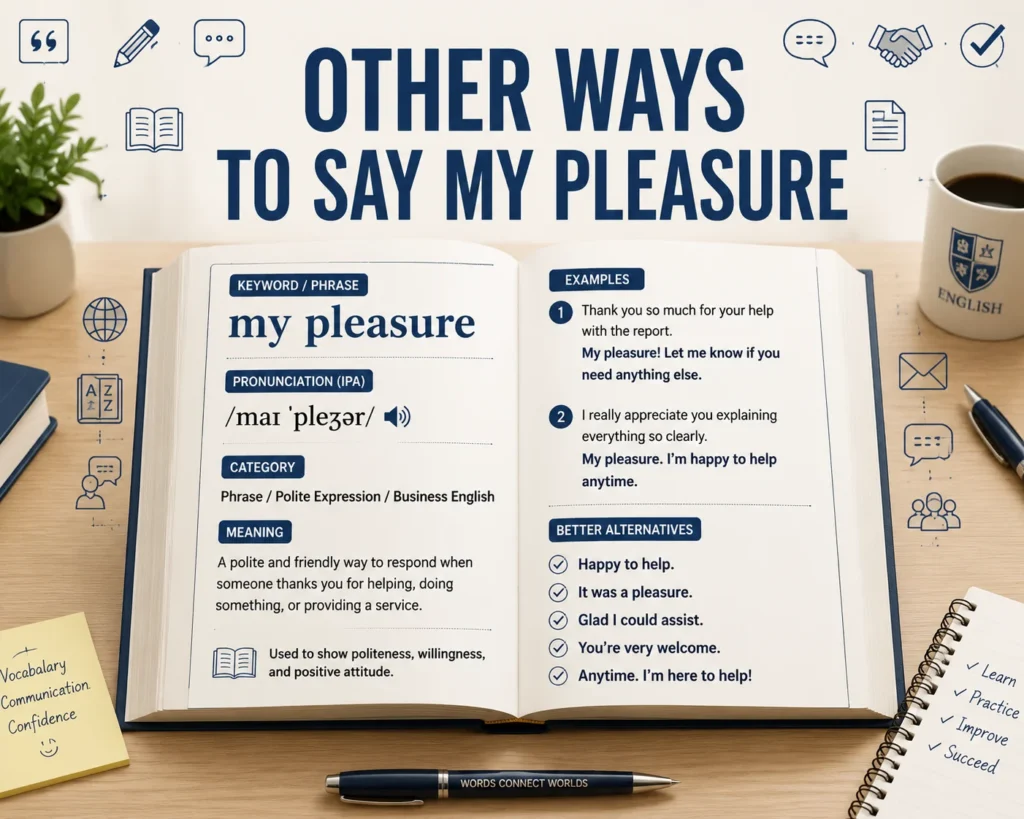
“My pleasure” is a polite expression that tells someone you were happy to help them. Instead of simply accepting thanks, it shows that providing assistance was enjoyable rather than inconvenient.
Literal Meaning
The phrase literally means:
Helping you gave me pleasure or satisfaction.
It emphasizes willingness rather than obligation.
Example
Person A: Thank you for explaining the report.
Person B: My pleasure.
This response suggests that helping was enjoyable and not a burden.
Tone of “My Pleasure”
“My pleasure” usually sounds:
- Warm
- Respectful
- Professional
- Friendly
- Positive
- Appreciative
Because of its positive tone, it works in both personal and professional communication.
Purpose of the Phrase
People use my pleasure to:
- Acknowledge gratitude politely
- Show willingness to help
- Build positive relationships
- Leave a good impression
- Encourage future communication
Instead of ending the conversation with “You’re welcome,” it creates a more thoughtful response.
Emotional Context
“My pleasure” communicates positive emotions.
It tells the other person:
- I enjoyed helping.
- You’re welcome anytime.
- Your appreciation is valued.
- I don’t see your request as a burden.
This makes the phrase especially effective in customer service and workplace communication.
Common Examples
Workplace
Employee: Thank you for helping me finish the presentation.
Manager: My pleasure.
Customer Service
Customer: Thanks for resolving my issue.
Support Agent: My pleasure. Let us know if you need anything else.
Business Email
Thank you for your prompt response.
My pleasure. Please don’t hesitate to reach out if you have additional questions.
Networking
“It was my pleasure meeting you at the conference.”
Everyday Conversation
Friend: Thanks for picking me up.
You: My pleasure.
When Is It Appropriate to Say “My Pleasure”?
Although the phrase works in many situations, some contexts make it especially effective.
1. Business Emails
“My pleasure” creates a courteous and professional impression when replying to appreciation.
Example:
Thank you for your feedback.
My pleasure. I’m always happy to assist.
2. Workplace Communication
Managers and coworkers frequently use it after helping with projects or answering questions.
Example:
My pleasure. Let me know if you need anything else.
3. Client Communication
Clients appreciate responses that feel sincere rather than automatic.
Example:
It was my pleasure assisting your team with this project.
4. Networking
During professional networking, this phrase demonstrates kindness and professionalism.
Example:
It was my pleasure speaking with you today.
5. Customer Service
Excellent customer service depends on positive language.
“My pleasure” often sounds warmer than “You’re welcome.”
Example:
My pleasure. We’re always here to help.
Professional Ways to Say “My Pleasure”
The following alternatives are ideal for business communication, workplace conversations, and client interactions.
1. Happy to Help
Meaning: I was glad to assist.
Tone: Friendly, professional
Best Use: Workplace, clients, emails
Example
Happy to help. Let me know if you have any further questions.
2. Glad I Could Help
Meaning: I’m pleased my assistance was useful.
Tone: Warm, professional
Best Use: Coworkers, customers
Example
I’m glad I could help with your project.
3. It Was a Pleasure
Meaning: Helping was enjoyable.
Tone: Professional
Best Use: Clients and meetings
Example
It was a pleasure working with your team.
4. I’m Happy to Assist
Meaning: I enjoy providing support.
Tone: Professional
Best Use: Business emails
Example
I’m happy to assist whenever you need support.
5. Anytime
Meaning: Feel free to ask again.
Tone: Friendly
Best Use: Colleagues
Example
Anytime. Just send me a message.
6. Always Happy to Help
Meaning: I consistently enjoy helping.
Tone: Warm
Best Use: Customer service
Example
We’re always happy to help.
7. Don’t Mention It
Meaning: Your thanks aren’t necessary.
Tone: Casual-professional
Best Use: Internal workplace communication
Example
Don’t mention it. It only took a minute.
8. It Was No Trouble at All
Meaning: Helping wasn’t difficult.
Tone: Professional
Best Use: Customer support
Example
It was no trouble at all.
9. I’m Delighted to Help
Meaning: I truly enjoyed assisting.
Tone: Polished
Best Use: Premium customer service
Example
I’m delighted to help with your request.
10. Certainly
Meaning: Of course.
Tone: Professional
Best Use: Service industries
Example
Certainly. Please let me know if you need further assistance.
11. You’re Very Welcome
Meaning: You’re welcome in a warmer way.
Tone: Friendly-professional
Best Use: Clients
Example
You’re very welcome. I appreciate your kind words.
12. I’m Pleased I Could Assist
Meaning: I’m satisfied my help was useful.
Tone: Formal-professional
Best Use: Business correspondence
Example
I’m pleased I could assist with your request.
13. It Was the Least I Could Do
Meaning: Helping felt natural.
Tone: Humble
Best Use: Colleagues
Example
It was the least I could do.
14. I Was Glad to Be of Assistance
Meaning: I appreciated the opportunity to help.
Tone: Formal
Best Use: Corporate communication
Example
I was glad to be of assistance during the transition.
15. It Was Wonderful Working With You
Meaning: I enjoyed collaborating.
Tone: Professional
Best Use: Projects
Example
It was wonderful working with you on this initiative.
Formal Alternatives to “My Pleasure”
Formal alternatives work well in executive communication, legal correspondence, client relationships, and official business emails.
1. The Pleasure Was Mine
Meaning: I benefited from the interaction as well.
Tone: Formal, gracious
Best Use: Meetings and networking
Example
The pleasure was mine. I look forward to working together again.
2. It Was an Honor
Meaning: Helping was a privilege.
Tone: Highly respectful
Best Use: Awards, ceremonies, VIP clients
Example
It was an honor assisting your organization.
3. I Appreciate the Opportunity
Meaning: Thank you for allowing me to help.
Tone: Professional
Best Use: Consulting, interviews
Example
I appreciate the opportunity to contribute.
4. I Was Happy to Be of Service
Meaning: I gladly provided assistance.
Tone: Formal
Best Use: Customer service and hospitality
Example
I was happy to be of service.
5. Assisting You Was a Pleasure
Meaning: Helping was enjoyable.
Tone: Elegant
Best Use: Professional emails
Example
Assisting you was a pleasure. Please contact me anytime.
6. Thank You for the Opportunity to Help
Meaning: I value being able to assist.
Tone: Professional
Best Use: Business partnerships
Example
Thank you for the opportunity to help your team.
7. I Am Grateful I Could Assist
Meaning: I’m thankful I could contribute.
Tone: Formal
Best Use: Nonprofits, education, healthcare
Example
I am grateful I could assist during the event.
8. I Was Pleased to Support You
Meaning: Supporting you was rewarding.
Tone: Corporate
Best Use: Workplace communication
Example
I was pleased to support your project.
9. Serving You Was Our Pleasure
Meaning: We enjoyed helping you.
Tone: Customer-focused
Best Use: Hospitality and customer service
Example
Serving you was our pleasure. We hope to see you again.
10. We Appreciate Your Kind Words
Meaning: Thank you for your appreciation.
Tone: Formal and appreciative
Best Use: Business replies and customer feedback
Example
We appreciate your kind words and were happy to help.
Featured Snippet: What Is a Professional Way to Say “My Pleasure”?
Some of the best professional alternatives to my pleasure include happy to help, I’m happy to assist, it was a pleasure, I’m pleased I could assist, the pleasure was mine, and I appreciate the opportunity to help. These phrases sound polished, respectful, and suitable for business emails, workplace communication, client interactions, and customer service.
Friendly Alternatives to “My Pleasure”
These alternatives work well with friends, colleagues, teammates, and people you know well. They sound warm, approachable, and conversational while remaining polite.
1. You’re Welcome
Meaning: A standard response to thanks.
Tone: Neutral, polite
Best Use: Everyday conversations
Example:
A: Thanks for your help.
B: You’re welcome.
2. No Problem
Meaning: Helping wasn’t an inconvenience.
Tone: Casual
Best Use: Friends and coworkers
Example:
No problem. Happy to help anytime.
3. No Worries
Meaning: There’s nothing to worry about.
Tone: Relaxed
Best Use: Informal conversations
Example:
No worries. I’m glad everything worked out.
4. Of Course
Meaning: Helping was expected.
Tone: Friendly
Best Use: Family, colleagues
Example:
Of course. Let me know if you need anything else.
5. Absolutely
Meaning: Certainly.
Tone: Positive
Best Use: Friendly workplace conversations
Example:
Absolutely. I’m always happy to help.
6. Anytime at All
Meaning: You can ask again whenever you need.
Tone: Warm
Best Use: Friends and coworkers
Example:
Anytime at all. Just give me a call.
7. It Was Nothing
Meaning: The help required very little effort.
Tone: Humble
Best Use: Informal situations
Example:
It was nothing. I’m glad everything worked out.
8. Glad to Be Helpful
Meaning: I’m pleased my help made a difference.
Tone: Friendly-professional
Best Use: Workplace
Example:
Glad to be helpful whenever you need me.
9. Happy I Could Help
Meaning: I enjoyed helping.
Tone: Warm
Best Use: Everyday communication
Example:
Happy I could help. Good luck!
10. You Got It
Meaning: Consider it done.
Tone: Casual
Best Use: Team communication
Example:
You got it. I’m here anytime.
Email Alternatives to “My Pleasure”
Business emails often require a polished response that feels genuine. These alternatives sound more natural than repeating my pleasure in every message.
1. Happy to Assist
Meaning: I’m pleased to provide support.
Tone: Professional
Best Use: Client emails
Example:
Happy to assist. Please let me know if you need further clarification.
2. I’m Glad I Could Be of Help
Meaning: I’m pleased my assistance was useful.
Tone: Professional
Best Use: Internal emails
Example:
I’m glad I could be of help.
3. It Was Great Working With You
Meaning: I enjoyed collaborating.
Tone: Warm professional
Best Use: Project completion
Example:
It was great working with you on this project.
4. Feel Free to Reach Out Anytime
Meaning: Contact me whenever needed.
Tone: Friendly professional
Best Use: Client communication
Example:
Feel free to reach out anytime if new questions come up.
5. I’m Always Here to Help
Meaning: I remain available.
Tone: Supportive
Best Use: Customer support
Example:
I’m always here to help with future requests.
6. Thank You for Reaching Out
Meaning: I appreciate your message.
Tone: Professional
Best Use: Email openings and closings
Example:
Thank you for reaching out. I’m happy to assist.
7. Please Don’t Hesitate to Contact Me
Meaning: You’re welcome to ask again.
Tone: Formal
Best Use: Business correspondence
Example:
Please don’t hesitate to contact me if you need additional information.
8. It Was Great Assisting You
Meaning: Helping was enjoyable.
Tone: Positive
Best Use: Customer service
Example:
It was great assisting you today.
9. I’m Here Whenever You Need Assistance
Meaning: Ongoing support is available.
Tone: Professional
Best Use: Client relationships
Example:
I’m here whenever you need assistance.
10. Wishing You Continued Success
Meaning: A positive closing after helping.
Tone: Professional
Best Use: Business emails
Example:
Wishing you continued success with your project.
Workplace Alternatives to “My Pleasure”
These expressions fit office conversations, meetings, collaboration, and leadership communication.
1. Happy to Support
Meaning: I’m pleased to contribute.
Tone: Professional
Best Use: Team projects
Example:
Happy to support the team.
2. Glad We Could Get It Done
Meaning: I’m pleased we solved it together.
Tone: Collaborative
Best Use: Teamwork
Example:
Glad we could get it done together.
3. It Was Great Collaborating
Meaning: Working together was enjoyable.
Tone: Professional
Best Use: Cross-functional teams
Example:
It was great collaborating on this initiative.
4. Thanks for the Opportunity
Meaning: I appreciate being involved.
Tone: Professional
Best Use: Managers and clients
Example:
Thanks for the opportunity to contribute.
5. I’m Glad We Reached a Solution
Meaning: I’m pleased we solved the issue.
Tone: Positive
Best Use: Problem-solving
Example:
I’m glad we reached a solution together.
6. Happy to Contribute
Meaning: I’m pleased my work helped.
Tone: Professional
Best Use: Team discussions
Example:
Happy to contribute whenever needed.
7. It Was Worthwhile
Meaning: Helping created value.
Tone: Professional
Best Use: Project work
Example:
It was worthwhile working on this project.
8. I Appreciate Working Together
Meaning: I value our collaboration.
Tone: Warm
Best Use: Long-term partnerships
Example:
I appreciate working together with your team.
9. Thank You for Your Kind Feedback
Meaning: I appreciate your appreciation.
Tone: Professional
Best Use: Performance recognition
Example:
Thank you for your kind feedback. It was a pleasure helping.
10. Looking Forward to Helping Again
Meaning: I welcome future opportunities.
Tone: Professional
Best Use: Client retention
Example:
Looking forward to helping again on your next project.
Quick Comparison Table
| Alternative | Tone | Best Use |
| You’re Welcome | Neutral | Everyday conversations |
| No Problem | Casual | Friends, coworkers |
| No Worries | Casual | Informal conversations |
| Of Course | Friendly | Team communication |
| Absolutely | Positive | Workplace |
| Anytime at All | Warm | Friends |
| It Was Nothing | Humble | Informal situations |
| Glad to Be Helpful | Friendly Professional | Workplace |
| Happy I Could Help | Warm | Daily communication |
| You Got It | Casual | Team chats |
| Happy to Assist | Professional | Client emails |
| I’m Glad I Could Be of Help | Professional | Internal emails |
| It Was Great Working With You | Warm | Projects |
| Feel Free to Reach Out Anytime | Professional | Client support |
| I’m Always Here to Help | Supportive | Customer service |
| Thank You for Reaching Out | Professional | Email replies |
| Please Don’t Hesitate to Contact Me | Formal | Business emails |
| It Was Great Assisting You | Professional | Customer service |
| I’m Here Whenever You Need Assistance | Professional | Clients |
| Wishing You Continued Success | Professional | Email closing |
| Happy to Support | Professional | Workplace |
| Glad We Could Get It Done | Collaborative | Teamwork |
| It Was Great Collaborating | Professional | Projects |
| Thanks for the Opportunity | Professional | Managers |
| Happy to Contribute | Professional | Workplace |
| Looking Forward to Helping Again | Professional | Clients |
Email Examples
1. Client
Subject: Re: Project Documents
Hi Sarah,
You’re very welcome. Happy to assist, and I’m glad everything has been resolved. Please let me know if you need anything else.
Best regards,
Michael
2. Manager
Hi David,
I’m glad I could help with the quarterly report. Happy to support whenever needed.
Best,
Emma
3. Colleague
Hi James,
No problem! I’m happy we finished everything before the deadline.
Thanks,
Alex
4. Customer
Dear Ms. Wilson,
Thank you for your kind words. It was great assisting you today. If you have any additional questions, please don’t hesitate to contact us.
Kind regards,
Customer Success Team
5. Networking Contact
Hello Daniel,
The pleasure was mine. I enjoyed meeting you at yesterday’s conference and hope we have the chance to collaborate again soon.
Best wishes,
Sophia
6. Meeting Follow-up
Hi Team,
Thank you for today’s productive discussion. Happy to contribute, and I look forward to supporting the next phase of the project.
Best,
Chris
Common Mistakes When Using “My Pleasure”
Even though my pleasure is polite, it isn’t always the best choice. Here are common mistakes to avoid.
1. Overusing the Phrase
Using my pleasure in every email or conversation can make your communication sound repetitive.
Better Approach: Rotate between alternatives such as happy to help, glad I could assist, or you’re very welcome.
2. Choosing the Wrong Tone
A casual phrase like no worries may sound too informal in communication with executives or important clients.
Better Approach: Use I’m pleased I could assist or the pleasure was mine in formal settings.
3. Being Too Formal
Expressions such as it was an honor may sound excessive for routine workplace interactions.
Better Approach: Reserve highly formal phrases for special occasions, VIP clients, or ceremonies.
4. Ignoring Email Etiquette
Replying with only my pleasure can feel abrupt in professional emails.
Better Approach: Add a helpful closing.
Example:
Happy to assist. Please let me know if you need any additional support.
Related Phrases
Here are common expressions related to my pleasure, along with their meanings and examples.
| Phrase | Meaning | Example |
| You’re welcome | Standard response to thanks | You’re welcome. |
| Happy to help | Glad to assist | Happy to help anytime. |
| Glad I could help | My help was useful | Glad I could help today. |
| Anytime | Ask again whenever needed | Anytime! |
| Of course | It was expected | Of course. |
| Certainly | Absolutely | Certainly, I’d be happy to help. |
| No problem | It wasn’t difficult | No problem at all. |
| No worries | Don’t worry about it | No worries! |
| Don’t mention it | Thanks aren’t necessary | Don’t mention it. |
| It was nothing | It required little effort | It was nothing. |
| The pleasure was mine | I enjoyed it too | The pleasure was mine. |
| Happy to assist | Professional support | Happy to assist with your request. |
| Always happy to help | Ongoing willingness | Always happy to help. |
| Glad to be of service | Formal assistance | Glad to be of service. |
| Feel free to reach out | Contact me again | Feel free to reach out anytime. |
Key Takeaways
- Choose your response based on your audience and the level of formality.
- Rotate different alternatives to keep your communication natural.
- Professional emails benefit from complete responses rather than a simple “My pleasure.”
- Friendly alternatives create warmer conversations, while formal alternatives strengthen business communication.
- Customer service professionals should focus on phrases that reassure and invite future communication.
Phrase Comparison: “My Pleasure” vs Alternatives
Choosing the right alternative depends on the situation, relationship, and level of formality. While my pleasure is always polite, some expressions sound better in specific professional environments.
| Phrase | Tone | Formality | Best Use |
| My Pleasure | Warm, polite | Professional | General business and customer service |
| Happy to Help | Friendly, supportive | Medium | Workplace and emails |
| Glad I Could Help | Appreciative | Medium | Colleagues and clients |
| It Was a Pleasure | Polished, respectful | High | Clients and networking |
| The Pleasure Was Mine | Elegant, formal | High | Meetings and professional events |
| I’m Happy to Assist | Helpful, professional | High | Business emails |
| Always Happy to Help | Supportive | Medium | Customer relationships |
| No Problem | Casual | Low | Friends and coworkers |
| No Worries | Relaxed | Low | Informal communication |
| Certainly | Professional | High | Customer service |
| I’m Pleased I Could Assist | Formal | High | Corporate communication |
| Feel Free to Reach Out | Supportive | Medium | Client emails |
“My Pleasure” in Different Situations
US English Usage
In American English, my pleasure is commonly used in restaurants, hotels, customer service, and professional conversations.
Americans often prefer friendly expressions that sound approachable.
Common choices:
- My pleasure
- Happy to help
- Absolutely
- Anytime
- Glad I could help
Example:
Customer: Thank you for your assistance.
Employee: My pleasure. Have a great day!
In workplace communication, Americans often prefer a balance between professionalism and friendliness.
UK English Usage
British English often uses more traditional and polite expressions.
Common alternatives include:
- You’re very welcome
- It was a pleasure
- Glad to be of assistance
- Not at all
- The pleasure was mine
Example:
Thank you for your support.
Not at all. I’m happy I could assist.
British communication often values humility, so phrases that sound less self-focused are popular.
Corporate Communication Usage
In corporate environments, the best alternatives should sound professional without feeling robotic.
Recommended phrases:
- I’m happy to assist
- It was a pleasure working with you
- Glad I could help
- I appreciate the opportunity to support
- Happy to contribute
Example:
Thank you for your quick response.
I’m happy to assist. Please let me know if you need any additional information.
These phrases improve professional communication and create stronger workplace relationships.
Customer Service Usage
Customer service teams often use alternatives that show care and availability.
Best options:
- My pleasure
- Happy to help
- Always happy to assist
- We’re here to help
- Glad we could resolve this
Example:
Thank you for solving my issue.
My pleasure. We’re always here if you need further assistance.
Good customer service language builds trust and improves customer experience.
Networking Usage
Networking requires warmth and professionalism.
Better alternatives include:
- It was a pleasure meeting you
- The pleasure was mine
- I enjoyed our conversation
- I’m glad we connected
- Looking forward to staying in touch
Example:
It was a pleasure meeting you at the conference. I enjoyed discussing future opportunities.
FAQs
What is the best professional way to say “my pleasure”?
The best professional alternatives include happy to help, I’m happy to assist, it was a pleasure, and I’m pleased I could assist. These phrases work well in emails, workplace communication, and client conversations.
Is “my pleasure” formal or casual?
“My pleasure” is considered polite and professional. It is less casual than “no problem” but less formal than phrases like “it was an honor.”
What is another word for “my pleasure”?
Common synonyms and alternatives include:
- Happy to help
- Glad I could assist
- You’re welcome
- It was a pleasure
- The pleasure was mine
- Anytime
Can I use “my pleasure” in a business email?
Yes. “My pleasure” works well in business emails, especially when replying to appreciation from clients, coworkers, or partners.
Example:
Thank you for your kind support.
My pleasure. I’m happy to assist with future requests.
What is a formal alternative to “my pleasure”?
Formal alternatives include:
- The pleasure was mine
- It was a pleasure assisting you
- I was pleased to be of assistance
- I appreciate the opportunity to help
Is “my pleasure” better than “you’re welcome”?
Both are correct. “My pleasure” sounds warmer and more professional, while “you’re welcome” is a standard response.
What can I say instead of “my pleasure” to a client?
For clients, use:
- It was a pleasure assisting you
- Happy to help
- I’m glad I could support your project
- Please feel free to reach out anytime
What is the best reply after someone says thank you at work?
Good workplace replies include:
- Happy to help
- Glad I could assist
- Anytime
- I was happy to contribute
- No problem
Can “my pleasure” sound sarcastic?
Usually no. However, tone and context matter. Saying it with an unfriendly tone or in a situation where help was inconvenient may make it sound less sincere.
What is the difference between “my pleasure” and “happy to help”?
“My pleasure” focuses on enjoyment, while “happy to help” focuses on willingness and support.
Example:
- My pleasure = I enjoyed helping.
- Happy to help = I was willing and glad to assist.
What should I say instead of “my pleasure” in an email?
Good email alternatives include:
- Happy to assist
- Glad I could help
- Please let me know if you need anything else
- It was a pleasure working with you
Is “no problem” professional?
“No problem” is acceptable in casual workplace communication but may sound less polished with executives or clients.
Use “happy to help” for more professional situations.
How do customer service employees say “my pleasure”?
Customer service professionals often use:
- My pleasure
- Happy to assist
- We’re always happy to help
- Glad we could resolve this for you
These phrases show care and reliability.
What is a better phrase than “you’re welcome”?
Depending on the situation:
Professional:
- Happy to help
- My pleasure
- Glad I could assist
Formal:
- The pleasure was mine
- It was a pleasure assisting you
Friendly:
- Anytime
- No worries
What is the best alternative to “my pleasure” in workplace communication?
The best workplace options are:
- Happy to help
- Glad I could assist
- Happy to support
- Appreciate the opportunity to contribute
- Always happy to help
Final Summary
The phrase “my pleasure” remains a professional and polite way to respond to thanks, but choosing the right alternative can make your communication stronger. For business emails and clients, use phrases like “I’m happy to assist,” “it was a pleasure,” and “glad I could help.” For workplace communication, “happy to support” and “always happy to help” sound natural and collaborative. For casual conversations, “anytime” and “no worries” work well. Matching your phrase to the situation improves email etiquette, workplace communication, and professional relationships.