
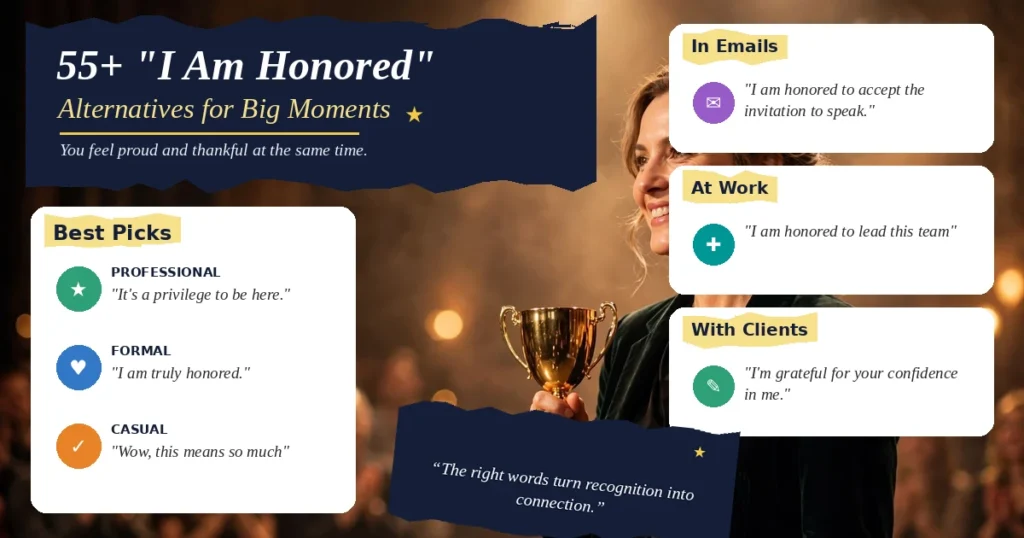
“I am honored” is a dignified way to say you feel proud and thankful at the same time. People use it when they receive an award, win a promotion, get invited to speak, or join an important team. It tells the listener that you take the moment seriously.
But the line can feel stiff or overused, especially in speeches and formal emails. That is why professionals look for other ways to say I am honored — they want a professional way to say I am honored in acceptance speeches, a formal alternative to I am honored for award letters, and warmer options for everyday workplace communication. The right words make gratitude sound personal instead of rehearsed.
This guide gives you 55 alternatives grouped by tone: professional, formal, friendly, email-ready, and workplace. Each entry includes the tone, the best use, and a real example. You will also find email samples, common mistakes, cultural notes, and answers to the questions people ask most.
What does “I am honored” mean?
“I am honored” means “I feel proud and deeply thankful to be chosen for this.” It expresses gratitude mixed with humility when someone gives you recognition, an opportunity, or a position of trust. The tone is respectful and serious, which makes it a natural fit for awards, ceremonies, and formal announcements.
The literal meaning is simple: you consider something a privilege. A speaker says it before an audience. A new board member says it in an acceptance email. An employee says it after a surprise promotion. In each case, the words signal that the speaker does not take the moment lightly.
The emotional context blends pride with modesty. “I am honored” says “this matters to me” without bragging. That balance is exactly why people reach for a good synonym for I am honored — they want the same dignity with fresher wording, especially when they speak in public more than once.
Tone-wise, the phrase leans formal. It can sound too heavy for casual chats — telling a coworker “I am honored” for a coffee invitation feels dramatic. The sections below show where it fits best and which alternatives raise or soften the tone for each moment.
When to use “I am honored” professionally
The phrase suits moments of recognition. Here is how to judge it across the five situations you will meet most.
Emails
Use it in acceptance and thank-you emails: “I am honored to accept the invitation to speak.” It sets a respectful tone from the first line. For routine messages, it is too heavy — save it for nominations, awards, and leadership roles.
Workplace
Say it when you receive a promotion, join a key project, or earn a company award. “I am honored to lead this team” shows the right mix of pride and humility. Avoid it for small wins, where it can sound sarcastic or overblown.
Clients
Clients respond well to “It is a privilege to work with you.” It flatters without groveling and frames the relationship as a partnership. Use it in kickoff meetings and renewal conversations to strengthen trust.
Networking
After someone introduces you to an important contact, try “I’m grateful for your confidence in me.” It thanks them for the trust behind the introduction. Generic “I am honored” can feel vague here — name what they did for you.
Customer service
Service teams rarely use “I am honored,” but leaders can use it in public messages: “We are honored by your loyalty.” It elevates brand language in anniversary posts and award announcements. Keep everyday support replies warm and simple instead.
55 other ways to say “I am honored”
Browse by tone and pick the line that fits your moment. Every entry shows the tone, the best use, and a short example.
Professional alternatives
These lines suit speeches, announcements, and professional workplace communication. They sound confident and gracious.
- I’m grateful for this opportunity. The most versatile swap; fits interviews, roles, and invitations. Example: “I’m grateful for this opportunity to lead the design team.”
- Thank you for this privilege. Formal but warm; suits ceremonies. Example: “Thank you for this privilege — I won’t take it lightly.”
- It’s a privilege to be here. Perfect opening line for speeches. Example: “It’s a privilege to be here among so many talented people.”
- I’m humbled by this opportunity. Adds modesty; great for big stages. Example: “I’m humbled by this opportunity to address the conference.”
- Thank you for trusting me with this. Thanks the giver for their confidence. Example: “Thank you for trusting me with this client account.”
- I’m honored to be part of this team. Specific and team-focused. Example: “I’m honored to be part of this team — let’s build something great.”
- It means a lot to receive this recognition. Heartfelt; fits award nights. Example: “It means a lot to receive this recognition from my peers.”
- I’m grateful for your confidence in me. Best after promotions and nominations. Example: “I’m grateful for your confidence in me and this new role.”
- Thank you for this distinction. Elegant; suits formal awards. Example: “Thank you for this distinction — it means the world to me.”
- I’m privileged to work alongside you. Praises the team while accepting praise. Example: “I’m privileged to work alongside you all.”
- This recognition means the world to me. Emotional but still professional. Example: “This recognition means the world to me — thank you.”
- I’m thankful for this nomination. The right line when you are shortlisted. Example: “I’m thankful for this nomination and the trust it shows.”
- It’s an honor to serve on this board. Tailored for governance and committees. Example: “It’s an honor to serve on this board of directors.”
- I’m deeply moved by this award. Shows genuine emotion on stage. Example: “I’m deeply moved by this award — thank you all.”
- Thank you for believing in my work. Personal and sincere; fits mentors and judges. Example: “Thank you for believing in my work from the start.”
Formal alternatives
These lines carry the most dignity. Use them in award letters, official statements, and ceremonies.
- I am truly honored. The classic formal alternative to I am honored; “truly” adds weight. Example: “I am truly honored to receive this award.”
- It is a great honor. Stately and simple; fits written announcements. Example: “It is a great honor to be named Employee of the Year.”
- I accept this honor with deep gratitude. Perfect for acceptance speeches. Example: “I accept this honor with deep gratitude to the committee.”
- I am profoundly humbled. Maximum modesty; suits major lifetime awards. Example: “I am profoundly humbled by this lifetime achievement award.”
- This honor is beyond words. Expresses overwhelming feeling. Example: “This honor is beyond words — thank you.”
- I am sincerely grateful for this honor. Formal gratitude in full dress. Example: “I am sincerely grateful for this honor and the trust behind it.”
- I receive this with the deepest appreciation. Ceremonial; fits official letters. Example: “I receive this with the deepest appreciation for your support.”
- It is my distinct privilege. Elevated phrasing for formal programs. Example: “It is my distinct privilege to open this conference.”
- I am honored beyond measure. Poetic and powerful; save for big moments. Example: “I am honored beyond measure to join this hall of fame.”
- I extend my heartfelt thanks for this recognition. Warm formality for thank-you letters. Example: “I extend my heartfelt thanks for this recognition.”
Friendly alternatives
Warm, natural, and a little excited. Use these with people you know when formality would feel stiff.
- Wow, this means so much. Genuine excitement; great on stage. Example: “Wow, this means so much — thank you, everyone.”
- I’m blown away — thank you. Casual and heartfelt. Example: “I’m blown away — thank you for the surprise party.”
- This is such a big deal to me. Honest and relatable. Example: “This is such a big deal to me — I can’t stop smiling.”
- I’m over the moon. Playful British-leaning joy. Example: “I’m over the moon about the promotion.”
- You’ve made my day. Thanks the giver directly. Example: “You’ve made my day with this nomination.”
- I’m speechless — thank you. Shows the moment overwhelmed you. Example: “I’m speechless — thank you for this award.”
- This is incredible. Simple, high-energy reaction. Example: “This is incredible — thank you for choosing me.”
- I can’t tell you how much this means. Emotional and sincere. Example: “I can’t tell you how much this means to my family.”
- I’m thrilled to be recognized. Upbeat professional-casual. Example: “I’m thrilled to be recognized by this team.”
- What an amazing surprise. Perfect for unexpected honors. Example: “What an amazing surprise — thank you all so much.”
Email alternatives
Polished lines for business email phrases — acceptances, thank-yous, and announcements.
- Thank you for this incredible opportunity. Strong opener for acceptance emails. Example: “Thank you for this incredible opportunity to join the panel.”
- I’m honored to be considered for this role. Perfect for interview thank-yous. Example: “I’m honored to be considered for this role at your firm.”
- Thank you for nominating me. Direct thanks to the nominator. Example: “Thank you for nominating me for the leadership award.”
- It’s a privilege to be selected. Gracious and confident. Example: “It’s a privilege to be selected among so many candidates.”
- I’m grateful to be part of this initiative. Fits programs and committees. Example: “I’m grateful to be part of this initiative.”
- Thank you for this meaningful recognition. Adds depth to a standard thanks. Example: “Thank you for this meaningful recognition of our team’s work.”
- I’m humbled to accept this invitation. Ideal for speaking invitations. Example: “I’m humbled to accept this invitation to keynote.”
- Thank you for including me. Simple and warm for group honors. Example: “Thank you for including me in this year’s cohort.”
- I’m delighted to be part of this. Cheerful professional tone. Example: “I’m delighted to be part of this year’s mentorship program.”
- It’s an honor to contribute to this project. Shows eagerness to add value. Example: “It’s an honor to contribute to this project.”
Workplace alternatives
Lines built for promotions, new roles, and team moments. They fit announcements, standups, and Slack.
- I’m honored to lead this project. Confident kickoff line. Example: “I’m honored to lead this project — let’s aim high.”
- Thank you for this promotion. Direct and professional. Example: “Thank you for this promotion — I’m excited for the challenge.”
- I’m proud to be on this team. Shares credit with colleagues. Example: “I’m proud to be on this team every single day.”
- It’s an honor to represent our department. Fits conferences and cross-team work. Example: “It’s an honor to represent our department at the summit.”
- Thank you for this vote of confidence. Thanks leadership for their trust. Example: “Thank you for this vote of confidence.”
- I’m honored by this endorsement. Best after recommendations. Example: “I’m honored by this endorsement from the board.”
- I’m grateful for this leadership opportunity. Shows readiness and thanks. Example: “I’m grateful for this leadership opportunity.”
- It’s a privilege to mentor this team. Humble leadership tone. Example: “It’s a privilege to mentor this team of rising stars.”
- Thank you for recognizing my work. Simple and sincere. Example: “Thank you for recognizing my work on the migration.”
- I’m honored to accept this role. Clean acceptance line. Example: “I’m honored to accept this role as team lead.”
Quick comparison table
Short on time? These ten picks cover almost every moment of recognition. Match the tone to the occasion.
| Alternative | Tone | Best use |
|---|---|---|
| I’m grateful for this opportunity | Professional | Roles, invitations, interviews |
| I am truly honored | Formal | Award letters and ceremonies |
| It’s a privilege to be here | Professional | Speech openings |
| Thank you for trusting me with this | Professional | Promotions and new duties |
| I’m humbled by this opportunity | Formal | Big stages and keynotes |
| Wow, this means so much | Friendly | Casual celebrations |
| I’m honored to be considered for this role | Professional | Interview thank-you emails |
| I accept this honor with deep gratitude | Very formal | Acceptance speeches |
| I’m proud to be on this team | Professional | Team announcements |
| Thank you for nominating me | Neutral | Short thank-you notes |
Email examples
Good email etiquette means matching your gratitude to the moment. These short samples show each alternative in a real message.
Award acceptance email
Subject: Thank you — Innovator of the Year
Dear Committee,
I am truly honored to receive the Innovator of the Year award. This recognition means the world to me and to everyone on my team. Thank you for believing in our work.
Warm regards,
Rachel
Promotion thank-you
Subject: Thank you for the promotion
Hi Mr. Thompson,
Thank you for this promotion. I’m grateful for your confidence in me, and I’m excited to take on the new responsibilities. I’m honored to accept this role.
Best regards,
David
Speaking invitation reply
Subject: Re: Keynote invitation
Hi Angela,
I’m humbled to accept this invitation to keynote your conference. It’s a privilege to be selected, and I look forward to sharing our team’s story with your audience.
Best,
Marcus
Nomination thank-you
Subject: Thank you for the nomination
Hi Karen,
Thank you for nominating me for the community leadership award. I’m thankful for this nomination, whatever the outcome. It means a lot to receive this recognition from you.
Warmly,
Sofia
New role announcement reply
Subject: Re: Welcome to the board
Dear Board Members,
It’s an honor to serve on this board. I’m grateful for this opportunity to contribute, and I look forward to working alongside each of you.
Sincerely,
James
Networking follow-up
Subject: Great meeting you
Hi Daniel,
Thank you for the introduction to your partners yesterday. I’m grateful for your confidence in me. It’s a privilege to be connected with such an impressive group.
Best,
Elena
Common mistakes to avoid
Even gracious words fail in the wrong setting. Watch out for these errors.
1. Using it for small favors
“I am honored” for a forwarded email sounds sarcastic. Save honored language for real recognition.
2. Sounding robotic on stage
Reading “I am honored” off a card feels rehearsed. Add one personal detail so the audience believes you.
3. Forgetting to thank specific people
A generic “I’m honored” thanks nobody in particular. Name the committee, the mentor, or the team behind the moment.
4. Overusing “humbled”
“Humbled” in every speech loses its power. Rotate with “grateful,” “privileged,” and “moved” to keep it fresh.
5. Bragging right after
“I’m honored — I worked so hard for this” cancels the humility. Let the thanks stand alone before you share your story.
6. Writing a cold acceptance email
A two-line “I accept. I am honored.” feels curt. Add warmth: mention what the opportunity means to you.
7. Mixing casual slang into formal thanks
“I’m honored, you guys rock” clashes badly. Keep one consistent tone from greeting to sign-off.
Related phrases
These expressions carry a similar meaning with a slightly different shade. Each one includes a quick definition and an example.
- It’s a privilege — frames the moment as a special favor. Example: “It’s a privilege to work with this team.”
- I’m flattered — light and warm; suits compliments. Example: “I’m flattered you thought of me.”
- I’m touched — emotional; shows the gesture moved you. Example: “I’m touched by your kind words.”
- I’m grateful — simple and versatile thanks. Example: “I’m grateful for this chance.”
- I’m thrilled — high-energy excitement. Example: “I’m thrilled to join the program.”
- I’m delighted — cheerful and slightly formal. Example: “I’m delighted to accept.”
- I’m proud — emphasizes achievement over thanks. Example: “I’m proud to represent our school.”
- It’s an honor — the noun form; equally formal. Example: “It’s an honor to meet you.”
- I’m humbled — stresses modesty. Example: “I’m humbled by this award.”
- I feel privileged — personal version of “it’s a privilege.” Example: “I feel privileged to mentor these students.”
- I’m overjoyed — strong happiness; suits big news. Example: “I’m overjoyed to receive this scholarship.”
- I’m elated — formal word for thrilled. Example: “I’m elated to be part of the cast.”
- This is a dream come true — for long-awaited honors. Example: “This is a dream come true for a young scientist.”
- I’m deeply thankful — “deeply” adds emotional weight. Example: “I’m deeply thankful for your trust.”
- What a privilege — short exclamation of gratitude. Example: “What a privilege to learn from you.”
- I’m appreciative — formal adjective form. Example: “I’m appreciative of this recognition.”
“I am honored” vs top alternatives
“I am honored” is the dignified default: respectful, serious, and safe. It never offends, but on a big stage it can sound like a script. Compare it with the strongest alternatives to see when to upgrade.
“I’m grateful for this opportunity” beats it for versatility. It works in interviews, emails, and speeches without sounding heavy. Use it when you want warmth and professionalism in one line.
“I am truly honored” outranks it in ceremony. The single word “truly” deepens the feeling, which matters in award letters and official announcements. Use it when the occasion itself is formal and grand.
“It’s a privilege to be here” wins as a speech opener. It addresses the audience directly and sets a humble tone from the first sentence. Use it at podiums, panels, and graduations.
“Thank you for trusting me with this” carries more meaning for promotions and new duties. It thanks the giver for their confidence, not just the honor itself. Use it in acceptance emails to managers and boards.
The rule is simple: keep “I am honored” for formal, high-stakes moments, and switch to a sharper alternative whenever you want the gratitude to sound personal rather than rehearsed.
Cultural usage notes
Honor and humility sound different across regions and industries. These notes help you adapt.
US English
Americans use “I am honored” freely in speeches, award shows, and LinkedIn posts. It signals professionalism without stiffness. In casual offices, shorter lines like “This means a lot” feel more natural.
UK English
British speakers often prefer understatement: “I’m flattered,” “I’m delighted,” or “What a privilege.” A grand “I am profoundly humbled” can sound theatrical in British business culture. Keep it modest.
Corporate communication
Companies use honored language in press releases and leadership announcements: “We are honored to welcome our new CEO.” Match the company’s voice — startups favor “thrilled,” while banks and law firms favor “privileged.”
Customer service
Brands say “We are honored by your loyalty” in anniversary campaigns and award announcements. It elevates the message above everyday support language. Never use it for complaint replies — it sounds tone-deaf there.
Networking
After a warm introduction, “I’m grateful for your confidence in me” beats a vague “I am honored.” Name the trust behind the gesture. Specific thanks turn one meeting into an ongoing relationship.
Frequently asked questions
What does “I am honored” mean?
It means “I feel proud and deeply thankful to be chosen.” People use it for awards, promotions, invitations, and positions of trust. The tone is respectful and serious.
Is “I am honored” professional?
Yes, it is one of the most professional ways to express gratitude. It fits speeches, award letters, and formal emails. Avoid it in casual chats, where it can sound overly dramatic.
What is a more formal way to say “I am honored”?
“I am truly honored” and “I accept this honor with deep gratitude” raise the formality. For written announcements, “It is a great honor” carries classic weight. Use these for ceremonies and official statements.
Can I say “I am honored” in an email?
Yes, especially in acceptance and thank-you emails. “I’m honored to accept this invitation” sets the right tone. For routine emails, it is too heavy — choose “Thank you for the opportunity” instead.
What can I say instead of “I am honored” in a speech?
Open with “It’s a privilege to be here” or “I’m humbled by this opportunity.” Both sound natural at a podium. Add one personal detail so the audience feels your sincerity.
Is “I’m humbled” the same as “I am honored”?
They are close but not identical. “I am honored” emphasizes pride in being chosen. “I’m humbled” emphasizes modesty about deserving it. Many speakers combine them: “I’m honored and humbled.”
How do you say “I am honored” after a promotion?
Try “Thank you for this promotion — I’m grateful for your confidence in me.” It thanks leadership directly. In a team announcement, “I’m honored to accept this role” sounds confident and gracious.
What is the difference between “honored” and “flattered”?
“Honored” suits serious recognition like awards and appointments. “Flattered” suits lighter compliments, like praise for your outfit or your cooking. Using “flattered” for a major award can sound like you don’t take it seriously.
Is “It’s an honor” correct grammar?
Yes. “It’s an honor to meet you” is correct and common. “I am honored” and “It’s an honor” mean nearly the same thing. Pick the one that flows better in your sentence.
How do I respond when someone says “I am honored”?
Reply warmly: “You deserve it,” “We’re lucky to have you,” or “The honor is ours.” Your response should confirm that the recognition is well earned.
Can I use “I am honored” in a job interview?
Yes, sparingly. “I’m honored to be considered for this role” works well in a thank-you email after the interview. During the interview itself, focus on your skills rather than repeated gratitude.
What is a casual alternative to “I am honored”?
“Wow, this means so much” or “I’m over the moon” work with people you know. They express the same joy without the formal weight. Save them for celebrations, not ceremonies.
Is “I am honored” too formal for LinkedIn?
No, it fits LinkedIn well. Promotion and award posts often start with “I am honored to share…” or “I’m thrilled to announce…” Both perform strongly because the platform expects professional celebration.
How do you say “I am honored” in British English?
British speakers often say “I’m delighted,” “I’m flattered,” or “What a privilege.” These carry the same gratitude with lighter understatement. “I am honored” is understood but sounds slightly American.
Should I say “I am honored” or “I feel honored”?
Both are correct. “I am honored” is more common and slightly more formal. “I feel honored” sounds a touch more personal. In speeches and writing, “I am honored” is the safer standard choice.
Conclusion
Quick picks — Professional: “I’m grateful for this opportunity” and “It’s a privilege to be here.” Formal: “I am truly honored” and “I accept this honor with deep gratitude.” Friendly-casual: “Wow, this means so much” and “I’m over the moon.” Email: “Thank you for this incredible opportunity” and “I’m honored to be considered for this role.”
Recognition deserves words that match the moment. Save the heaviest lines for the biggest stages, and let warmth do the work everywhere else. Name who made it possible, and mean every syllable. The right thank-you turns applause into a lasting impression.
Related Articles
- Other Ways to Say Thank You: Professional & Polite Alternatives in 2026
- Other Ways to Say Congratulations: Professional & Polite Alternatives in 2026
- Other Ways to Say Congratulations on Achievement Professional & Polite Alternatives
- 55+ “We Value Your Feedback” Lines People Believe
- Other Ways to Say Good Job: Professional & Polite Alternatives in 2026
- 55+ “I’m Excited About the Opportunity” Alternatives
- 55+ “I Appreciate It” Alternatives That Sound Sincere




