
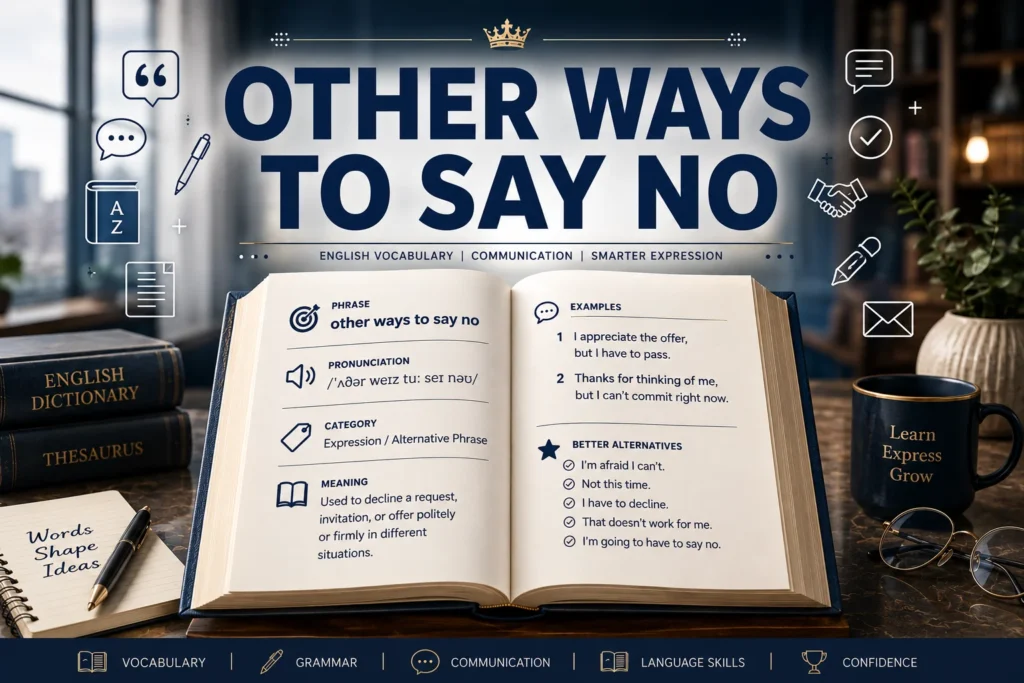
Saying “no” is a normal part of communication, but the way you say it can make a big difference. Whether you’re declining a request, turning down an invitation, or setting boundaries at work, using other ways to say no helps you sound polite, respectful, and professional.
Many people search for a professional way to say no, a formal alternative to no, or a synonym for no because they want to avoid sounding rude. The right phrase depends on the situation, especially in business emails, workplace communication, client conversations, networking, and customer service.
This guide covers the meaning of no, when to use it professionally, and the best alternatives with practical examples.
What Does “No” Mean?
The word “no” means refusing, declining, or not agreeing to a request, offer, or suggestion. Although it’s a simple word, it can sound too direct if not used carefully.
Literal Meaning
“No” means:
- I cannot agree.
- I must decline.
- That isn’t possible.
- I don’t accept the request.
Examples
- No, I can’t attend the meeting.
- No, thank you.
- Unfortunately, that’s not possible.
- I’m unable to help at this time.
Tone of “No”
The tone depends on how you say it.
- Direct: No.
- Professional: I’m afraid that’s not possible.
- Polite: Thank you, but I’ll have to decline.
- Friendly: Maybe another time!
Professional Usage
Emails
Instead of writing:
No.
Write:
Thank you for your invitation, but I’ll have to decline.
Workplace
Instead of:
No, I can’t.
Say:
I’m unable to take on another project right now.
Clients
Instead of:
No.
Use:
Unfortunately, we aren’t able to offer that service at this time.
Networking
I appreciate the opportunity, but I’ll have to pass this time.
Customer Service
I’m sorry, but we’re unable to fulfill that request.
Professional Alternatives to Say “No”
1. I’m Afraid That’s Not Possible
Tone: Professional
Best Use: Business emails
Example: I’m afraid that’s not possible at the moment.
2. Unfortunately, I Must Decline
Tone: Formal
Best Use: Client communication
Example: Unfortunately, I must decline your invitation.
3. I Appreciate the Offer, But…
Tone: Polite
Best Use: Networking
Example: I appreciate the offer, but I’ll have to pass.
4. I’m Unable to Do That
Tone: Professional
Best Use: Workplace
Example: I’m unable to assist today.
5. That Won’t Be Possible
Tone: Professional
Best Use: Business communication
Example: That won’t be possible this week.
6. I’ll Have to Pass
Tone: Friendly
Best Use: Casual conversations
Example: Thanks, but I’ll have to pass.
7. Maybe Another Time
Tone: Friendly
Best Use: Invitations
Example: Maybe another time. Thanks for asking!
8. I Have Other Commitments
Tone: Professional
Best Use: Workplace
Example: I have other commitments that day.
9. I Can’t Commit Right Now
Tone: Professional
Best Use: Projects
Example: I can’t commit to another project right now.
10. I’d Prefer Not To
Tone: Polite
Best Use: Personal boundaries
Example: I’d prefer not to discuss that.
11. I’m Not Available
Tone: Professional
Best Use: Scheduling
Example: I’m not available on Friday.
12. Regrettably, No
Tone: Formal
Best Use: Official communication
Example: Regrettably, no. We cannot approve the request.
13. Thank You, But No Thank You
Tone: Polite
Best Use: Offers
Example: Thank you, but no thank you.
14. I’ll Need to Decline
Tone: Professional
Best Use: Emails
Example: I’ll need to decline this opportunity.
15. That Doesn’t Work for Me
Tone: Friendly Professional
Best Use: Meetings
Example: That schedule doesn’t work for me.
Featured Snippet: Best Professional Ways to Say “No”
If you’re looking for a professional way to say no, try these alternatives:
- I’m afraid that’s not possible.
- Unfortunately, I must decline.
- I’m unable to do that.
- That won’t be possible.
- I’ll need to decline.
- I appreciate the offer, but…
- Thank you, but no thank you.
- I’m not available.
- I can’t commit right now.
- That doesn’t work for me.
These alternatives are ideal for business emails, workplace communication, client interactions, and professional communication because they help you decline requests politely while maintaining positive relationships.
Alternatives to Say “No”
Using a polite alternative instead of simply saying “no” helps maintain positive relationships in business and everyday conversations. Below are additional alternatives grouped by context.
Formal Alternatives
16. I Respectfully Decline
Tone: Formal
Best Use: Business letters
Example: I respectfully decline your invitation.
17. Regrettably, We Cannot Proceed
Tone: Formal
Best Use: Client communication
Example: Regrettably, we cannot proceed with the request.
18. I’m Unable to Approve This
Tone: Professional
Best Use: Management
Example: I’m unable to approve this proposal.
19. This Request Cannot Be Accommodated
Tone: Formal
Best Use: Customer service
Example: Unfortunately, this request cannot be accommodated.
20. We Must Decline
Tone: Professional
Best Use: Official emails
Example: We must decline the invitation.
21. It Isn’t Feasible
Tone: Business
Best Use: Projects
Example: It isn’t feasible within the current budget.
22. We Are Unable to Accept
Tone: Formal
Best Use: Applications
Example: We are unable to accept your request.
23. I Must Say No
Tone: Respectful
Best Use: Formal discussions
Example: I must say no at this time.
24. That Falls Outside Our Policy
Tone: Professional
Best Use: Customer service
Example: That request falls outside our company policy.
25. We Cannot Approve This Request
Tone: Formal
Best Use: Business decisions
Example: We cannot approve this request.
Friendly Alternatives
26. Not This Time
Tone: Friendly
Example: Thanks, but not this time.
27. Maybe Next Time
Tone: Casual
Example: Maybe next time!
28. I’ll Pass
Tone: Friendly
Example: I’ll pass, thanks.
29. I Think I’ll Skip It
Tone: Casual
Example: I think I’ll skip it today.
30. That’s Okay, Thanks
Tone: Polite
Example: That’s okay, thanks.
31. I’m Good, Thanks
Tone: Casual
Example: I’m good, thanks.
32. I’ll Sit This One Out
Tone: Friendly
Example: I’ll sit this one out.
33. Maybe Later
Tone: Casual
Example: Maybe later.
34. I’ll Pass This Time
Tone: Friendly
Example: I’ll pass this time.
35. Thanks Anyway
Tone: Friendly
Example: Thanks anyway!
Email Alternatives
36. Thank You for Thinking of Me, But…
Tone: Professional
Example: Thank you for thinking of me, but I’ll have to decline.
37. I Appreciate the Opportunity, However…
Tone: Professional
Example: I appreciate the opportunity; however, I must decline.
38. Unfortunately, My Schedule Won’t Allow It
Tone: Professional
Example: Unfortunately, my schedule won’t allow it.
39. I’m Unable to Participate
Tone: Professional
Example: I’m unable to participate this time.
40. I Won’t Be Able to Attend
Tone: Professional
Example: I won’t be able to attend tomorrow’s meeting.
41. I Appreciate Your Understanding
Tone: Professional
Example: I appreciate your understanding.
42. I’ll Need to Decline This Opportunity
Tone: Professional
Example: I’ll need to decline this opportunity.
43. My Current Workload Doesn’t Allow It
Tone: Professional
Example: My current workload doesn’t allow it.
44. I’m Unable to Commit at This Time
Tone: Professional
Example: I’m unable to commit at this time.
45. Thank You, But I’m Not Available
Tone: Professional
Example: Thank you, but I’m not available that day.
Workplace Alternatives
46. Let’s Revisit This Later
Tone: Professional
Example: Let’s revisit this later.
47. Let’s Explore Other Options
Tone: Collaborative
Example: Let’s explore other options.
48. This Isn’t a Priority Right Now
Tone: Professional
Example: This isn’t a priority right now.
49. We’ll Have to Pass
Tone: Professional
Example: We’ll have to pass on this proposal.
50. We Need to Decline
Tone: Formal
Example: We need to decline the request.
51. It Doesn’t Fit Our Current Goals
Tone: Business
Example: It doesn’t fit our current goals.
52. We Can’t Move Forward
Tone: Professional
Example: We can’t move forward at this stage.
53. Let’s Focus Elsewhere
Tone: Workplace
Example: Let’s focus elsewhere for now.
54. We’ll Pass on This
Tone: Friendly Professional
Example: We’ll pass on this opportunity.
55. We’ll Decline for Now
Tone: Professional
Example: We’ll decline for now.
Quick Comparison Table
| Alternative | Tone | Best Use |
| I’m afraid that’s not possible | Professional | Emails |
| Unfortunately, I must decline | Formal | Clients |
| I appreciate the offer, but… | Polite | Networking |
| I’m unable to do that | Professional | Workplace |
| That won’t be possible | Professional | Business |
| I’ll have to pass | Friendly | Casual |
| Maybe another time | Friendly | Invitations |
| I’m not available | Professional | Scheduling |
| Thank you, but no thank you | Polite | Offers |
| I respectfully decline | Formal | Business letters |
| I’m unable to participate | Professional | Meetings |
| Let’s revisit this later | Workplace | Projects |
| Let’s explore other options | Collaborative | Teams |
| It isn’t feasible | Business | Planning |
| We can’t move forward | Professional | Projects |
Featured Snippet: Best Alternatives to Say “No”
If you need a professional way to say no, consider these options:
- I’m afraid that’s not possible.
- Unfortunately, I must decline.
- I’m unable to do that.
- Thank you, but no thank you.
- I appreciate the opportunity, however…
- I’m unable to commit at this time.
- Let’s revisit this later.
- Let’s explore other options.
- My schedule won’t allow it.
- That won’t be possible.
These alternatives help you decline requests politely while maintaining strong professional relationships and following good email etiquette.
Email Examples
1. Client Email
Subject: Re: Service Request
Dear Sarah,
Thank you for your request. Unfortunately, we aren’t able to provide this service at the moment. We appreciate your understanding and hope to work with you in the future.
Kind regards,
Michael
2. Manager Email
Subject: Project Assignment
Hi David,
Thank you for considering me for this project. Due to my current workload, I’m unable to take on additional responsibilities right now.
Thank you for your understanding.
Best regards,
Emma
3. Colleague Email
Hi James,
Thanks for asking! I’d love to help, but I’m not available this afternoon. Maybe another time.
Have a great day!
4. Customer Email
Dear Customer,
Thank you for contacting us. Unfortunately, this request falls outside our company policy. Please let us know if there’s another way we can assist you.
Kind regards,
Customer Support
5. Networking Email
Hello Alex,
I truly appreciate the invitation. Unfortunately, I won’t be able to attend the event this time. I hope we can connect at a future opportunity.
Best wishes,
6. Meeting Follow-up Email
Hi Team,
Thank you for your suggestions during today’s meeting. At this stage, we’ll have to decline the proposal because it doesn’t align with our current priorities.
Thank you for your understanding.
Common Mistakes
1. Saying Only “No”
A one-word response can sound rude.
❌ No.
✅ I’m afraid that’s not possible at this time.
2. Not Giving a Reason
When appropriate, briefly explain why you’re declining.
Example:
I’m unable to attend because I have another commitment.
3. Being Too Casual
Avoid phrases like:
- Nope
- Nah
- No way
These are not suitable for business emails or client communication.
4. Apologizing Too Much
One brief apology is enough.
✅ Unfortunately, I can’t attend.
❌ I’m so, so sorry… (repeated multiple times)
5. Forgetting to Thank the Other Person
Start with appreciation whenever possible.
Example:
Thank you for the opportunity. Unfortunately, I’ll have to decline.
Related Phrases
| Phrase | Meaning | Example |
| I must decline | Formal refusal | I must decline the offer. |
| I’m unable to | Professional refusal | I’m unable to attend. |
| Maybe another time | Friendly refusal | Maybe another time. |
| I’ll pass | Casual refusal | I’ll pass, thanks. |
| Not at the moment | Temporary refusal | Not at the moment. |
| That won’t work | Scheduling conflict | That won’t work for me. |
| I’m unavailable | Can’t participate | I’m unavailable today. |
| I appreciate the offer | Polite refusal | I appreciate the offer, but… |
| Thank you, but no thank you | Polite decline | Thank you, but no thank you. |
| Regrettably | Formal refusal | Regrettably, we must decline. |
| Not this time | Casual | Not this time, thanks. |
| I can’t commit | Professional | I can’t commit right now. |
| It isn’t feasible | Business | It isn’t feasible currently. |
| Let’s revisit this later | Workplace | Let’s revisit this later. |
| We can’t move forward | Business | We can’t move forward today. |
Phrase Comparison
| Phrase | Tone | Formality | Best Use |
| No | Direct | Low | Casual |
| I’m unable to | Professional | High | Workplace |
| I must decline | Formal | High | Business |
| I’ll pass | Friendly | Low | Friends |
| Maybe another time | Friendly | Medium | Invitations |
| Thank you, but no thank you | Polite | Medium | Offers |
| That won’t be possible | Professional | High | Clients |
| I appreciate the offer, but… | Professional | High | Networking |
| Let’s revisit this later | Collaborative | Medium | Teams |
| We can’t move forward | Professional | High | Projects |
Cultural Usage
US English
Common polite alternatives include:
- I’m afraid I can’t.
- Unfortunately, I can’t.
- I’d love to, but…
- Maybe another time.
UK English
British English often uses softer expressions such as:
- I’m afraid not.
- I’m sorry, but…
- Regrettably…
- I’m unable to.
Corporate Communication
Businesses typically prefer:
- Unfortunately, we must decline.
- That won’t be possible.
- We can’t move forward.
- I’m unable to approve this.
Customer Service
Customer support teams often say:
- We’re unable to fulfill that request.
- Unfortunately, that isn’t available.
- Thank you for your understanding.
Networking
Professional networking messages commonly use:
- I appreciate the invitation.
- Thank you for thinking of me.
- I’ll have to decline this time.
FAQs
What is a professional way to say no?
Use phrases like I’m unable to, Unfortunately, I must decline, or That won’t be possible.
What is a formal alternative to no?
Formal alternatives include I respectfully decline, Regrettably, and I’m afraid that’s not possible.
How do I politely say no in an email?
Start by thanking the person, politely decline, and give a brief reason if appropriate.
Is “No, thanks” professional?
It’s acceptable in casual situations, but longer alternatives are better for business communication.
How do I decline a client politely?
Say:
Thank you for your request. Unfortunately, we’re unable to accommodate it at this time.
How do I refuse extra work professionally?
You can say:
I’m unable to take on additional work due to my current workload.
What’s a friendly way to say no?
Try Maybe another time, I’ll pass, or Not this time, thanks.
Why shouldn’t I say only “No”?
A one-word response can sound abrupt or impolite, especially in professional settings.
Can I explain why I’m saying no?
Yes. A short explanation often makes your response sound more respectful and understanding.
What is the best business email phrase for saying no?
Thank you for the opportunity. Unfortunately, I’ll have to decline.
Final Summary
Best Professional Options
- I’m unable to
- That won’t be possible
- I’ll need to decline
- I appreciate the offer, but…
- Unfortunately, I must decline
Best Formal Options
- I respectfully decline
- Regrettably
- We cannot approve this request
- It isn’t feasible
- I’m afraid that’s not possible
Best Casual Options
- I’ll pass
- Maybe another time
- Not this time
- I’m good, thanks
- Thanks anyway
Best Email Options
- Thank you for the opportunity, but…
- I’m unable to commit at this time
- Unfortunately, my schedule won’t allow it
- I appreciate your understanding
- Thank you, but I’ll have to decline
Conclusion
Knowing other ways to say no helps you decline requests politely while maintaining positive personal and professional relationships. Whether you’re responding to a client, manager, coworker, or customer, choosing respectful language shows professionalism and emotional intelligence. Phrases like I’m unable to, Unfortunately, I must decline, I appreciate the offer, but…, and That won’t be possible allow you to communicate clearly without sounding rude. By matching your response to the situation and following good email etiquette and professional communication practices, you can set healthy boundaries while preserving trust, respect, and strong workplace relationships.