Finding the right words to support someone can make a big difference in professional communication. The phrase “I’m here for you” shows that you care, want to help, and are available when someone needs support. However, it can sound personal or emotional in some business situations.
If you are looking for other ways to say I’m here for you, you may want a phrase that sounds more professional, formal, friendly, or suitable for an email. The best alternative depends on who you are speaking to, what they need, and how much personal warmth you want to express.
This guide explains 50 professional and polite alternatives for workplace communication, client emails, customer service, networking, and everyday conversations. You will also find real examples, tone comparisons, common mistakes, and answers to frequently asked questions.
What Does “I’m Here for You” Mean?
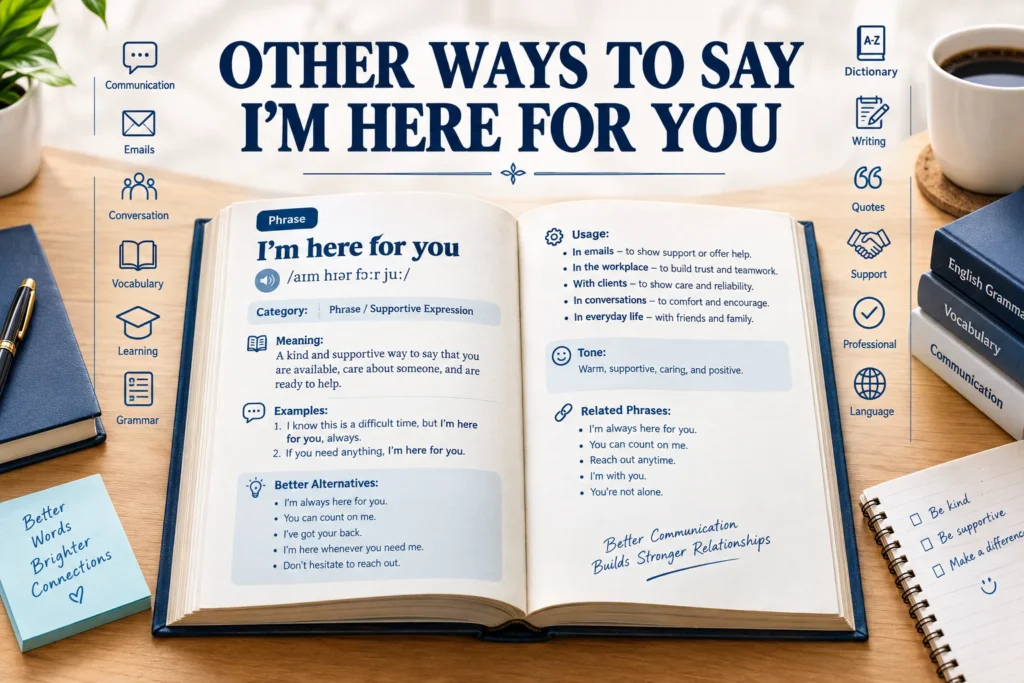
“I’m here for you” means that you are available to help, listen, or offer support. It tells another person that they do not have to face a problem alone.
Literal meaning
The phrase literally suggests that you are present and available. In everyday English, however, people usually use it to express emotional support, encouragement, or a willingness to help.
Tone and purpose
The phrase has a warm, caring, and reassuring tone. It can communicate:
- Emotional support during a difficult time.
- Willingness to help with a problem.
- Encouragement when someone feels uncertain.
- Availability for questions or guidance.
- Friendship and personal care.
Examples
Personal: “I’m sorry you’re going through this. I’m here for you.”
Professional: “Please let me know if you need any assistance with the project.”
Workplace: “I’m available if you would like to discuss the issue.”
The meaning stays similar, but the professional examples focus on practical help rather than emotional closeness.
When Should You Use This Phrase Professionally?
“I’m here for you” is not incorrect in business communication. You can use it with a trusted colleague, a supportive manager, or a client who needs reassurance. However, a more specific phrase often sounds clearer and more appropriate.
1. In emails
Use a professional alternative when you want to offer help without sounding overly personal.
Example:
“Please let me know if you need any further assistance.”
This works well for clients, customers, and business partners.
2. In the workplace
When a colleague faces a deadline, a difficult task, or a workplace problem, offer specific support.
Example:
“I’m available to help you work through the issue.”
This sounds helpful without assuming that the person wants emotional support.
3. With clients
Clients often need confidence that their concerns matter. A reassuring phrase can build trust while maintaining professional boundaries.
Example:
“We are committed to supporting you throughout this process.”
4. In networking
Networking conversations usually call for polite, future-focused language.
Example:
“I would be happy to stay in touch and help where I can.”
5. In customer service
Customer service messages should show empathy and provide a clear next step.
Example:
“We’re here to help resolve this issue.”
This is warmer than a generic promise while still sounding professional.
Professional Alternatives
These options work well with colleagues, clients, business partners, and managers.
1. I’m available to help.
Meaning: You are ready to provide assistance.
Tone: Professional, direct, and helpful.
Best use case: Workplace conversations and business emails.
Example: “I’m available to help if you have any questions about the report.”
2. Please let me know how I can help.
Meaning: You invite the person to explain what support they need.
Tone: Polite, supportive, and flexible.
Best use case: Client communication and team collaboration.
Example: “Please let me know how I can help you prepare for the presentation.”
3. I’m happy to assist.
Meaning: You are willing to provide help.
Tone: Professional and friendly.
Best use case: Customer service, workplace emails, and formal requests.
Example: “I’m happy to assist with the account setup.”
4. I’m here to support you.
Meaning: You want to help someone succeed or manage a challenge.
Tone: Reassuring and professional.
Best use case: Management, mentoring, and client relationships.
Example: “I’m here to support you as you take on this new responsibility.”
5. You can count on me.
Meaning: The person can rely on you.
Tone: Confident, warm, and trustworthy.
Best use case: Teamwork and professional relationships.
Example: “You can count on me to complete the analysis before Friday.”
6. I’m available if you need anything.
Meaning: You are open to providing assistance.
Tone: Friendly and supportive.
Best use case: Workplace conversations and follow-up emails.
Example: “I’m available if you need anything while preparing the proposal.”
7. I’d be glad to help.
Meaning: You are willing and pleased to offer assistance.
Tone: Polite and approachable.
Best use case: Requests from colleagues, clients, and customers.
Example: “I’d be glad to help you review the contract.”
8. Let me know if there’s anything I can do.
Meaning: You invite the person to request specific help.
Tone: Friendly, professional, and considerate.
Best use case: Supporting a colleague or client.
Example: “Let me know if there’s anything I can do to make the transition easier.”
9. I’m available to discuss this further.
Meaning: You are willing to continue the conversation.
Tone: Professional and calm.
Best use case: Business disagreements, client concerns, and difficult decisions.
Example: “I’m available to discuss this further and find a solution that works for everyone.”
10. I’m committed to helping you succeed.
Meaning: You intend to provide meaningful support toward a goal.
Tone: Encouraging and professional.
Best use case: Managers, mentors, and long-term clients.
Example: “I’m committed to helping you succeed in your new role.”
11. I’m ready to assist whenever needed.
Meaning: You are prepared to help when necessary.
Tone: Formal-leaning and dependable.
Best use case: Project coordination and business support.
Example: “I’m ready to assist whenever needed during the implementation phase.”
12. You have my full support.
Meaning: You approve of and support someone’s effort or decision.
Tone: Reassuring and confident.
Best use case: Team leadership and professional encouragement.
Example: “You have my full support as you move forward with this proposal.”
13. I’m willing to work through this with you.
Meaning: You will cooperate to solve a problem.
Tone: Collaborative and supportive.
Best use case: Workplace challenges and client issues.
Example: “I’m willing to work through this with you so we can meet the deadline.”
14. I can help you navigate this situation.
Meaning: You can offer guidance through a difficult or unfamiliar process.
Tone: Professional, thoughtful, and reassuring.
Best use case: Mentoring, management, and customer support.
Example: “I can help you navigate this situation and explain the next steps.”
15. I’m on hand to assist.
Meaning: You are available and ready to help.
Tone: Professional and slightly formal.
Best use case: Business announcements, team emails, and customer support.
Example: “Our support team is on hand to assist with any technical questions.”
Formal Alternatives
These expressions suit official correspondence, formal business relationships, and serious professional situations.
16. Please feel free to reach out if you require assistance.
Meaning: You invite the person to contact you for help.
Tone: Formal and courteous.
Best use case: Official emails and client communication.
Example: “Please feel free to reach out if you require assistance with the application process.”
17. I remain available to assist you.
Meaning: You continue to be available for support.
Tone: Formal, calm, and dependable.
Best use case: Business letters and ongoing client matters.
Example: “I remain available to assist you with any questions regarding your account.”
18. Please do not hesitate to contact me.
Meaning: You encourage the person to contact you without worry.
Tone: Formal and polite.
Best use case: Professional emails and customer service.
Example: “Please do not hesitate to contact me if you require further information.”
19. We are committed to providing our full support.
Meaning: An organization promises continued assistance.
Tone: Formal and reassuring.
Best use case: Corporate communication and client service.
Example: “We are committed to providing our full support throughout the transition.”
20. I would be pleased to assist you.
Meaning: You express willingness to help in a courteous way.
Tone: Formal and respectful.
Best use case: Formal emails and business requests.
Example: “I would be pleased to assist you with your inquiry.”
21. I am at your disposal.
Meaning: You are available to help whenever needed.
Tone: Very formal and traditional.
Best use case: Formal letters and some international business settings.
Example: “I am at your disposal should you require any additional information.”
22. You may rely on my assistance.
Meaning: You assure someone that you can provide help.
Tone: Formal and confident.
Best use case: Official communication and professional commitments.
Example: “You may rely on my assistance throughout the review process.”
23. I am available to provide any necessary support.
Meaning: You can offer the support required for a task.
Tone: Formal and precise.
Best use case: Project updates, business correspondence, and formal workplace communication.
Example: “I am available to provide any necessary support during the audit.”
24. We will be happy to address your concerns.
Meaning: A company or team is willing to respond to a customer’s problems.
Tone: Formal, courteous, and reassuring.
Best use case: Customer service and complaint responses.
Example: “We will be happy to address your concerns and review the matter promptly.”
25. Please let me know if further support would be beneficial.
Meaning: You offer additional help if the person needs it.
Tone: Formal and considerate.
Best use case: Follow-up emails and professional consultations.
Example: “Please let me know if further support would be beneficial as you finalize the proposal.”
Friendly Alternatives
These phrases sound natural in everyday conversations with colleagues, friends, and people you know well.
26. I’ve got your back.
Meaning: You will support or defend someone.
Tone: Casual, warm, and confident.
Best use case: Close colleagues and friends.
Example: “Don’t worry about the presentation. I’ve got your back.”
27. I’m always happy to help.
Meaning: You are willing to provide help whenever needed.
Tone: Friendly and positive.
Best use case: Workplace relationships and casual professional messages.
Example: “I’m always happy to help if you need another opinion.”
28. I’m in your corner.
Meaning: You support someone and want them to succeed.
Tone: Warm, encouraging, and informal.
Best use case: Friends, mentors, and trusted colleagues.
Example: “I know this project is challenging, but I’m in your corner.”
29. We’ll get through this together.
Meaning: You will work with someone to overcome a challenge.
Tone: Warm, encouraging, and collaborative.
Best use case: Teamwork and personal support.
Example: “The deadline is tight, but we’ll get through this together.”
30. I’m just a message away.
Meaning: You are easy to contact.
Tone: Friendly and reassuring.
Best use case: Casual workplace communication and personal conversations.
Example: “If you need help with the presentation, I’m just a message away.”
31. I’m happy to listen.
Meaning: You are willing to hear someone’s concerns.
Tone: Caring and approachable.
Best use case: Supportive conversations with colleagues or friends.
Example: “If you want to talk about what happened, I’m happy to listen.”
32. You don’t have to handle this alone.
Meaning: You offer companionship and support during a difficult situation.
Tone: Warm and empathetic.
Best use case: Personal support or a close professional relationship.
Example: “You don’t have to handle this alone. Let’s work out the next step.”
33. I’m here whenever you need me.
Meaning: You offer ongoing availability.
Tone: Caring and personal.
Best use case: Friends and close relationships.
Example: “Take your time. I’m here whenever you need me.”
34. We can figure this out together.
Meaning: You are willing to cooperate to solve a problem.
Tone: Friendly and encouraging.
Best use case: Teamwork and informal workplace communication.
Example: “The software is confusing at first, but we can figure this out together.”
35. I’m happy to lend a hand.
Meaning: You offer practical assistance.
Tone: Friendly and informal.
Best use case: Colleagues, friends, and everyday work situations.
Example: “I’m happy to lend a hand if you need help organizing the files.”
Email-Ready Alternatives
These phrases fit naturally into business emails and help you offer support without unnecessary emotion.
36. Please let me know if you need any further assistance.
Meaning: You offer additional help.
Tone: Polite and professional.
Best use case: Email closing and client follow-ups.
Example: “Please let me know if you need any further assistance with your order.”
37. I would be happy to help with the next steps.
Meaning: You offer assistance with what happens next.
Tone: Professional and friendly.
Best use case: Project updates and client emails.
Example: “I would be happy to help with the next steps once you approve the proposal.”
38. We’re here to support you throughout the process.
Meaning: Your team will provide ongoing assistance.
Tone: Professional and reassuring.
Best use case: Customer service and client onboarding.
Example: “We’re here to support you throughout the process, from setup to completion.”
39. I’m available to answer any questions you may have.
Meaning: You invite questions.
Tone: Polite and clear.
Best use case: Business emails and formal communication.
Example: “I’m available to answer any questions you may have about the new policy.”
40. I’m happy to work with you on this.
Meaning: You offer cooperation.
Tone: Friendly, professional, and collaborative.
Best use case: Workplace emails and business partnerships.
Example: “I’m happy to work with you on this and find a practical solution.”
41. Please reach out if you would like to discuss your concerns.
Meaning: You invite a conversation about problems or worries.
Tone: Polite and empathetic.
Best use case: Customer service and client communication.
Example: “Please reach out if you would like to discuss your concerns before the meeting.”
42. I’ll do my best to support you.
Meaning: You promise to make a genuine effort to help.
Tone: Sincere and professional.
Best use case: Workplace support and personal encouragement.
Example: “I’ll do my best to support you as you prepare for the interview.”
43. We are happy to work with you toward a solution.
Meaning: You offer cooperation to resolve an issue.
Tone: Professional and constructive.
Best use case: Client complaints and business negotiations.
Example: “We are happy to work with you toward a solution that meets your needs.”
44. I’m available to discuss any concerns.
Meaning: You are open to hearing and addressing problems.
Tone: Professional and reassuring.
Best use case: Managers, clients, and colleagues.
Example: “I’m available to discuss any concerns before we finalize the agreement.”
45. Thank you for sharing this. I’m happy to help.
Meaning: You acknowledge the person’s message and offer assistance.
Tone: Warm, polite, and professional.
Best use case: Emails involving questions, concerns, or requests.
Example: “Thank you for sharing this. I’m happy to help you review the available options.”
Workplace Alternatives
These expressions work well when supporting colleagues, managing teams, or collaborating on projects.
46. Let’s work through this together.
Meaning: You offer to cooperate on a problem.
Tone: Collaborative and supportive.
Best use case: Team meetings and workplace discussions.
Example: “Let’s work through this together and identify the best solution.”
47. I’m available to help you meet the deadline.
Meaning: You offer practical support toward a specific goal.
Tone: Professional and direct.
Best use case: Project management and teamwork.
Example: “I’m available to help you meet the deadline if you need another pair of hands.”
48. I can take care of that for you.
Meaning: You offer to handle a task.
Tone: Helpful and confident.
Best use case: Workplace requests and customer service.
Example: “I can take care of that for you before the end of the day.”
49. I’m happy to review this with you.
Meaning: You offer to examine a document or problem together.
Tone: Friendly and professional.
Best use case: Feedback, mentoring, and team collaboration.
Example: “I’m happy to review this with you before you send it to the client.”
50. Let’s find a way forward.
Meaning: You suggest focusing on a solution or next step.
Tone: Professional, constructive, and encouraging.
Best use case: Workplace challenges, negotiations, and client discussions.
Example: “I understand your concerns. Let’s find a way forward that works for both sides.”
Quick Comparison Table
| Alternative | Tone | Best Use |
| I’m available to help. | Professional | Workplace and emails |
| Please let me know how I can help. | Polite | Clients and colleagues |
| I’m happy to assist. | Professional | Customer service |
| You can count on me. | Warm | Teamwork |
| I’m here to support you. | Reassuring | Management |
| Please do not hesitate to contact me. | Formal | Business emails |
| I would be pleased to assist you. | Formal | Official correspondence |
| You have my full support. | Encouraging | Professional decisions |
| I’ve got your back. | Casual | Close colleagues |
| I’m in your corner. | Friendly | Trusted relationships |
| I’m just a message away. | Warm | Casual communication |
| We’ll get through this together. | Supportive | Team challenges |
| I’m available to answer any questions. | Professional | Email closing |
| We’re here to support you throughout the process. | Reassuring | Client service |
| Let’s work through this together. | Collaborative | Workplace |
| I can take care of that for you. | Helpful | Practical requests |
| I’m happy to review this with you. | Friendly | Feedback |
| Let’s find a way forward. | Constructive | Problem-solving |
Email Examples
1. Client email
Subject: Support With Your Project
“Hi Sarah,
Thank you for sharing your concerns about the project timeline. I understand the importance of meeting your deadline.
Please let me know how I can help. I’m happy to review the schedule with you and discuss practical solutions.
Best regards,
James”
2. Manager email
Subject: Support During Your New Role
“Hi David,
Congratulations on your promotion. I know you have several new responsibilities to manage.
I’m here to support you as you settle into your role. Please feel free to reach out if you would like to discuss any challenges or questions.
Best,
Maria”
3. Colleague email
Subject: Help With the Presentation
“Hi Alex,
I saw that you are preparing the presentation for Monday. I’m happy to review the slides with you if you need another opinion.
Let me know what time works best.
Thanks,
Tom”
4. Customer email
Subject: We’re Here to Help
“Dear Mr. Ahmed,
Thank you for contacting our support team. I’m sorry to hear about the issue with your order.
We’re here to help resolve this matter. Please provide your order number so we can review the details and assist you further.
Kind regards,
Customer Support Team”
5. Networking email
Subject: Great Connecting With You
“Hi Emily,
It was a pleasure meeting you at the business event. I enjoyed learning about your work.
I would be happy to stay in touch and help where I can. Please feel free to reach out if you would like to discuss any future opportunities.
Best regards,
Daniel”
6. Meeting follow-up
Subject: Follow-Up on Today’s Meeting
“Hi Team,
Thank you for the productive discussion today. We made good progress on the project plan.
Please let me know if you need any assistance with your assigned tasks. Let’s work through any remaining questions before our next meeting.
Best,
Michael”
Common Mistakes to Avoid
1. Using the same phrase in every situation
Repeating “I’m here for you” can make your messages sound generic. Choose language that matches the type of support you want to provide.
Instead of:
“I’m here for you.”
Try:
“I’m available to review the report with you.”
2. Choosing a tone that is too personal
“I’ve got your back” may sound natural with a close colleague but too casual in a formal client email.
For a client, choose:
“Please let me know how I can assist you.”
3. Sounding too formal
Some expressions, such as “I am at your disposal,” may sound stiff in everyday business conversations. Simple language often creates a more natural connection.
Instead of:
“I remain available to provide any necessary support.”
Try:
“Please let me know if you need any help.”
4. Offering vague support
A phrase that does not explain what you can do may leave the person unsure how to respond.
Weak:
“Let me know if you need anything.”
Better:
“I can help review the proposal or answer any questions about the budget.”
5. Making promises you cannot keep
Avoid saying “You can always count on me” if you cannot reliably provide the support you promise. Choose a phrase that reflects your actual availability.
6. Ignoring email etiquette
Professional communication should include a clear greeting, a helpful message, and an appropriate closing. Avoid excessive emojis, emotional language, or informal expressions when communicating with clients or senior managers.
Related Phrases
These expressions share a similar meaning but emphasize different kinds of support.
| Related Phrase | Meaning | Example |
| I’m on your side. | I support your position. | “I’m on your side as we discuss the issue.” |
| I’m rooting for you. | I hope you succeed. | “I’m rooting for you in your new role.” |
| I’m willing to listen. | I’m open to hearing your concerns. | “I’m willing to listen if you want to talk.” |
| You can rely on me. | I am dependable. | “You can rely on me to complete the task.” |
| I’m here to help. | I am available to assist. | “I’m here to help with your questions.” |
| I’m ready when you are. | I can begin when you are ready. | “I’m ready when you are to review the plan.” |
| I understand your concerns. | I recognize your worries. | “I understand your concerns about the deadline.” |
| I’m happy to work with you. | I offer cooperation. | “I’m happy to work with you on a solution.” |
| We can tackle this together. | We will face the challenge as a team. | “We can tackle this together before Friday.” |
| I’m here to listen. | I offer a listening ear. | “I’m here to listen if you want to share your thoughts.” |
| You have my confidence. | I believe in your ability. | “You have my confidence as you lead the team.” |
| I’m glad to be of assistance. | I am pleased to help. | “I’m glad to be of assistance with your request.” |
| We’re in this together. | We share responsibility for the situation. | “We’re in this together, so let’s find a solution.” |
| I’m available for a conversation. | I am open to discussing the matter. | “I’m available for a conversation whenever convenient.” |
| I’ll support you through this. | I will continue to offer help. | “I’ll support you through this transition.” |
| I’m willing to help. | I am ready to assist. | “I’m willing to help you prepare the report.” |
| We’ll work it out. | We will find a solution. | “We’ll work it out before the next meeting.” |
| I’m here if you need a sounding board. | I can listen and offer feedback. | “I’m here if you need a sounding board for your idea.” |
Phrase Comparison
“I’m here for y*u” vs. “I’m here to help”
“I’m here for you” often carries emotional support. “I’m here to help” focuses on practical assistance.
- I’m here for you: Warm, personal, and reassuring.
- I’m here to help: Professional, direct, and useful for customer service.
Example:
“I’m here for you” works well when a friend is g*ing through a difficult time.
“I’m here to help” w*rks well when a customer needs assistance with an order.
“I’m here for y*u” vs. “Please let me kn*w how I can help”
The second phrase sounds more professional because it invites the person to identify a specific need. It is especially effective in emails and workplace communication.
“I’m here for you” vs. “You can count on me”
Both phrases show support, but “You can count on me” emphasizes reliability. It works well when you want to reassure someone that you will complete a task or provide dependable assistance.
“I’m here for you” vs. “I’m here to support you”
“I’m here to support you” keeps the caring meaning while sounding more suitable for managers, mentors, and professional relationships. It is a useful formal alternative to the primary phrase.
“I’m here for you” vs. “I remain available to assist you”
The formal version is appropriate for official correspondence, business letters, and client communication. It focuses on availability rather than emotional closeness.
Cultural Usage
US English
American business communication often favors direct, friendly, and practical expressions. “Please let me know how I can help” and “I’m happy to help” sound natural in many professional settings.
UK English
British business communication often uses polite and measured language. Expressions such as “Please do not hesitate to contact me” and “I would be pleased to assist you” fit formal contexts.
Corporate communication
Corporate messages often use “We’re here to support you” or “We are committed to providing our full support.” These phrases communicate a company’s responsibility to its clients or employees.
Customer service
Customer service teams should combine empathy with action. A phrase such as “We’re here to help resolve this issue” reassures customers while focusing on the solution.
Networking
Networking conversations benefit from polite, future-focused expressions. “I would be happy to stay in touch” or “Please feel free to reach out” sounds more natural than an emotional statement.
FAQs
What is a professional way to say “I’m here for you”?
“Please let me know how I can help” is one of the best professional alternatives. It sounds polite, supportive, and appropriate for emails, clients, and colleagues.
What is a formal alternative to “I’m here for you”?
“I remain available to assist you” is a formal alternative. You can use it in official emails, business letters, and client correspondence.
What is a synonym for “I’m here for you”?
Common synonyms include “I’m here to support you,” “You can count on me,” “I’m available to help,” and “Please let me know how I can help.”
How do I say “I’m here for you” in a business email?
Use a phrase that matches the support you want to offer. For example: “Please let me know if you need any further assistance.”
How do you say “I’m here for you” to a colleague?
“I’m happy to help” or “Let’s work through this together” sounds natural and supportive in workplace communication.
How do you say “I’m here for you” to a client?
“We’re here to support you throughout the process” is a professional and reassuring option. It works well in client emails and service communication.
Is “I’m here for you” professional?
Yes, it can be professional in the right context. However, it may sound personal or emotional in formal business situations, so a specific alternative often works better.
Is “I’ve got your back” professional?
“I’ve got your back” is friendly and informal. It works with close colleagues but may sound too casual in a formal client email.
What is the best way to offer emotional support at work?
“I’m happy to listen” or “I’m here to support you” can show empathy while maintaining professional boundaries. Respect the other person’s privacy and avoid pressuring them to share personal details.
How do I offer help without sounding pushy?
Use a low-pressure invitation such as “Please let me know if you need any assistance.” This gives the person freedom to accept or decline your offer.
What is a professional way to say “You can always talk to me”?
“I’m available if you would like to discuss this further” sounds professional and welcoming.
How do I reassure a customer?
Acknowledge the concern and explain the next step. For example: “Thank you for bringing this to our attention. We’re here to help resolve the issue.”
What is the best phrase for a manager supporting an employee?
“I’m committed to helping you succeed” is a strong choice. It shows encouragement and a willingness to provide ongoing support.
How can I offer support in a formal letter?
Use “I would be pleased to assist you” or “Please do not hesitate to contact me if you require further information.”
What is a good closing phrase for a supportive email?
“Please let me know if you need any further assistance” is a clear, polite, and professional closing.
Final Summary
The best alternative to “I’m here for you” depends on your relationship, purpose, and tone. For professional communication, use “I’m available to help” or “Please let me know how I can help.” For formal emails, cho*se “I remain available to assist you” or “I would be pleased to assist you.” For friendly conversations, “I’ve got your back” and “We’ll get thr*ugh this together” sound natural. In customer service, “We’re here to support you throughout the process” provides reassurance while keeping the focus on practical help.
Choose language that sounds sincere, matches the situation, and offers meaningful support. The right phrase can strengthen trust, improve workplace communication, and make your emails more effective.
Conclusion
Finding the right way to say “I’m here for you” can make your communication more thoughtful, professional, and effective. Whether you area https://www.wordwebonline.com/en/SUPPORTING colleague, reassuring a client, or offering help in an email, the best phrase depends on the situation and your relationship with the reader. Use “Please let me know how I can help” for professional communication, “I remain available to assist you” for formal messages, and “I’ve got your back” for friendly conversations. Choose words that sound natural, show genuine support, and respect professional boundaries. A simple, sincere message can build trust and strengthen workplace relationships.