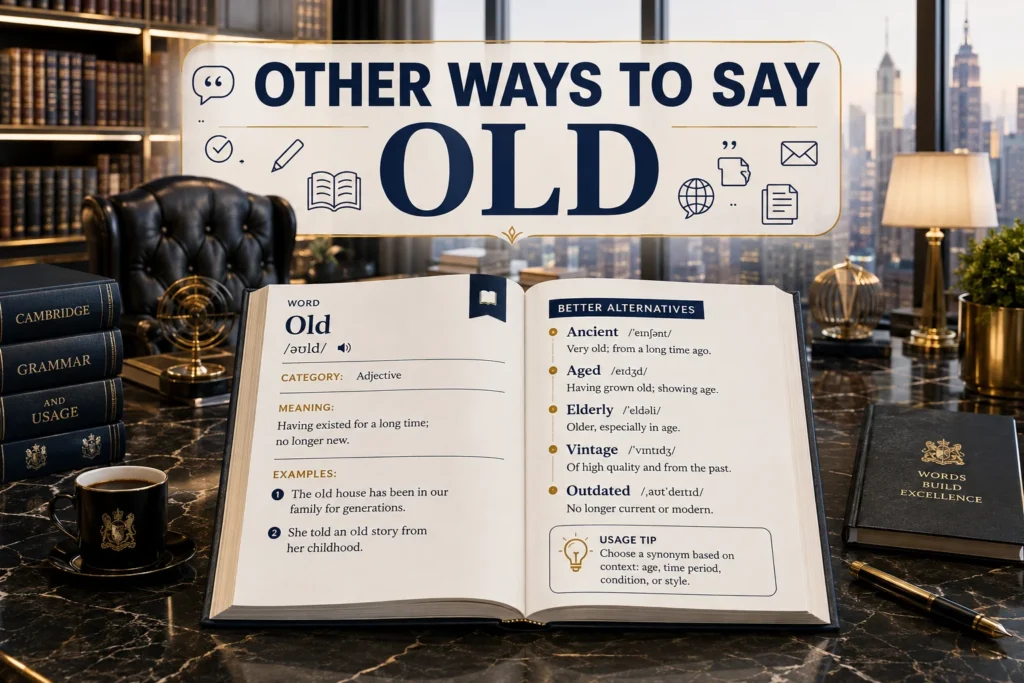
The word old is one of the most commonly used adjectives in English. It usually describes something or someone that has existed for a long time, has reached an advanced age, or is no longer new. While the word is accurate, it can sometimes sound blunt, insensitive, or repetitive—especially in professional communication.
Learning other ways to say old helps you choose language that matches your audience and situation. Whether you’re writing a business email, speaking with clients, creating marketing content, preparing workplace reports, or simply trying to sound more polite, using the right alternative improves clarity and professionalism.
In this guide, you’ll learn the meaning of old, when to use it, and the best professional alternatives for emails, workplace communication, customer service, networking, and everyday conversations.
What Does “Old” Mean?
Literal Meaning
Old describes a person, object, idea, building, relationship, or event that has existed for a long period of time.
Examples
- This is an old building.
- She is an old friend from college.
- We replaced the old software.
- The company follows an old policy.
Tone of “Old”
The tone depends on the context.
It can be:
- Neutral
- Respectful
- Informal
- Professional
- Negative (if describing a person’s age carelessly)
For example:
Neutral
This is an old document.
Professional
This is a legacy document.
Polite
She is a senior member of our team.
Purpose of Using “Old”
People use old to describe:
- Age
- Experience
- History
- Long-term relationships
- Outdated items
- Traditional methods
- Previous versions
The right alternative depends on what you’re describing.
Emotional Context
Unlike many adjectives, old can carry different emotional meanings.
Positive
We value our long-standing partnership.
Neutral
The old system requires maintenance.
Negative
The equipment is outdated.
Respectful
Our senior advisor has over 30 years of experience.
Professional Usage of “Old”
Choosing the right synonym helps you communicate professionally and respectfully.
1. Emails
Avoid calling something simply “old” if a more precise word works better.
Instead of
Please use the old file.
Try
Please use the previous version.
2. Workplace Communication
Use alternatives that sound accurate and professional.
Example
The legacy system will remain operational until next quarter.
3. Client Communication
Clients usually respond better to positive wording.
Instead of
Your old account
Use
Your previous account
4. Networking
When describing relationships, choose warmer language.
Example
He’s a long-time colleague.
Instead of
He’s my old colleague.
5. Customer Service
Use customer-friendly language.
Example
We’ll replace your existing device with the latest model.
Instead of
We’ll replace your old device.
Professional Alternatives to “Old”
1. Previous
Meaning: Existing before the current one.
Tone: Professional
Best Use Case: Emails, reports, projects
Example
Please refer to the previous agreement.
2. Existing
Meaning: Currently in place.
Tone: Professional
Best Use Case: Workplace communication
Example
The existing policy remains effective.
3. Legacy
Meaning: An older system or technology still in use.
Tone: Technical and professional
Best Use Case: IT and business
Example
The company still supports several legacy applications.
4. Long-Standing
Meaning: Continuing for many years.
Tone: Positive and professional
Best Use Case: Business relationships
Example
We appreciate our long-standing partnership.
5. Established
Meaning: Existing successfully for a long time.
Tone: Professional
Best Use Case: Organizations and businesses
Example
They are an established company with decades of experience.
6. Former
Meaning: Previous or earlier.
Tone: Professional
Best Use Case: Jobs and positions
Example
She is the former director of marketing.
7. Earlier
Meaning: Happening before the present.
Tone: Neutral
Best Use Case: Documents and conversations
Example
Please review the earlier draft.
8. Prior
Meaning: Before something else.
Tone: Formal
Best Use Case: Legal and business writing
Example
Prior approval is required.
9. Mature
Meaning: Fully developed or experienced.
Tone: Respectful
Best Use Case: People and organizations
Example
She brings a mature perspective to every discussion.
10. Seasoned
Meaning: Highly experienced.
Tone: Professional
Best Use Case: Workplace and resumes
Example
He is a seasoned project manager.
11. Veteran
Meaning: Someone with extensive experience.
Tone: Respectful
Best Use Case: Professional profiles
Example
She’s a veteran journalist with 25 years of experience.
12. Time-Tested
Meaning: Proven effective over time.
Tone: Positive
Best Use Case: Products and strategies
Example
We use a time-tested project management process.
13. Classic
Meaning: Traditional and respected.
Tone: Positive
Best Use Case: Products, styles, brands
Example
The company maintains a classic design philosophy.
14. Traditional
Meaning: Following established customs.
Tone: Neutral
Best Use Case: Business methods and culture
Example
The organization follows traditional hiring practices.
15. Experienced
Meaning: Having extensive knowledge gained over time.
Tone: Professional
Best Use Case: Employees and leaders
Example
We’re looking for experienced sales professionals.
Key Takeaways
- Old is a common word, but it isn’t always the best choice in professional communication.
- Use previous, former, or prior when referring to earlier versions.
- Use legacy for older systems or technology.
- Use seasoned, experienced, or veteran when describing skilled professionals.
- Use long-standing for relationships and partnerships.
- Selecting the right synonym helps improve workplace communication, business emails, and professional writing while maintaining a respectful tone.
Formal Alternatives to “Old”
These alternatives are ideal for reports, legal documents, academic writing, policies, and corporate communication.
16. Pre-Existing
Meaning: Existing before the current situation.
Tone: Formal
Best Use Case: Contracts, policies, and legal documents.
Example:
The agreement does not affect any pre-existing obligations.
17. Historical
Meaning: Related to the past or history.
Tone: Formal
Best Use Case: Reports, research, and presentations.
Example:
Historical data shows steady market growth.
18. Antiquated
Meaning: Extremely old and no longer suitable.
Tone: Formal
Best Use Case: Technology and processes.
Example:
The company replaced its antiquated filing system.
19. Obsolete
Meaning: No longer used because something better exists.
Tone: Formal
Best Use Case: Technology and business operations.
Example:
Several obsolete procedures have been removed.
20. Dated
Meaning: Appearing old-fashioned.
Tone: Neutral to Formal
Best Use Case: Designs, presentations, and branding.
Example:
The website looks dated and needs a redesign.
21. Conventional
Meaning: Traditional or commonly accepted.
Tone: Professional
Best Use Case: Business methods and policies.
Example:
The company follows conventional accounting practices.
22. Long-Established
Meaning: Existing successfully for many years.
Tone: Professional
Best Use Case: Businesses and organizations.
Example:
It is a long-established family business.
23. Enduring
Meaning: Lasting for a long time.
Tone: Positive
Best Use Case: Partnerships and reputation.
Example:
We have built an enduring relationship with our clients.
24. Age-Old
Meaning: Existing for a very long time.
Tone: Formal
Best Use Case: Traditions and ideas.
Example:
The company follows age-old craftsmanship techniques.
25. Time-Honored
Meaning: Respected because of its long history.
Tone: Positive
Best Use Case: Traditions, brands, and organizations.
Example:
The business is known for its time-honored values.
Friendly Alternatives to “Old”
These expressions sound natural, warm, and conversational.
26. Long-Time
Meaning: Existing for many years.
Tone: Friendly
Best Use Case: Friends, colleagues, and customers.
Example:
He’s a long-time customer.
27. Well-Known
Meaning: Familiar over many years.
Tone: Friendly
Best Use Case: People, brands, and businesses.
Example:
She’s a well-known expert in the industry.
28. Familiar
Meaning: Known from previous experience.
Tone: Warm
Best Use Case: Everyday conversations.
Example:
This process should feel familiar to everyone.
29. Trusted
Meaning: Proven reliable over time.
Tone: Positive
Best Use Case: Clients and marketing.
Example:
We’re your trusted business partner.
30. Reliable
Meaning: Dependable through experience.
Tone: Friendly
Best Use Case: Services and products.
Example:
This is a reliable solution for small businesses.
31. Well-Used
Meaning: Used often over time.
Tone: Neutral
Best Use Case: Equipment and resources.
Example:
This is a well-used reference guide.
32. Vintage
Meaning: Old in an attractive or valuable way.
Tone: Positive
Best Use Case: Products and fashion.
Example:
The office features vintage furniture.
33. Retro
Meaning: Inspired by an earlier style.
Tone: Casual
Best Use Case: Design and marketing.
Example:
The campaign uses a retro theme.
34. Beloved
Meaning: Loved for many years.
Tone: Warm
Best Use Case: Brands and products.
Example:
It’s one of our most beloved products.
35. Lifelong
Meaning: Lasting throughout life.
Tone: Friendly
Best Use Case: Relationships.
Example:
They have been lifelong friends.
Email Alternatives to “Old”
These phrases help business emails sound more professional and customer-friendly.
36. Previous
Meaning: Earlier than the current one.
Tone: Professional
Best Use Case: Client communication.
Example:
Please refer to your previous invoice.
37. Earlier Version
Meaning: A version before the current one.
Tone: Professional
Best Use Case: Documents and software.
Example:
I’ve attached the earlier version for comparison.
38. Existing Version
Meaning: The version currently in use.
Tone: Professional
Best Use Case: Projects and workflows.
Example:
We’ll continue using the existing version until testing is complete.
39. Current Replacement
Meaning: The new item replacing the old one.
Tone: Professional
Best Use Case: Customer service.
Example:
Your current replacement has already been shipped.
40. Earlier Record
Meaning: A past record or file.
Tone: Formal
Best Use Case: Administrative communication.
Example:
We have located your earlier record in our system.
Key Takeaways
- Formal alternatives like obsolete, historical, and time-honored work best in reports and official documents.
- Friendly alternatives such as long-time, trusted, and vintage create a warmer tone.
- Email-friendly alternatives like previous, earlier version, and existing version improve clarity and professionalism.
- Choosing the right synonym helps you communicate respectfully, avoid repetition, and strengthen your business writing..
Workplace Alternatives to “Old”
These alternatives are useful in business meetings, reports, presentations, project updates, customer service, and daily workplace communication.
41. Existing
Meaning: Currently in place or already available. Tone: Professional Best Use Case: Policies, systems, and processes. Example: We will continue using the existing software until the migration is complete.
42. Current
Meaning: The one presently being used. Tone: Neutral Best Use Case: Projects and documentation. Example: Please update the current version before sharing it.
43. Earlier
Meaning: From a previous time. Tone: Professional Best Use Case: Reports and meetings. Example: The earlier proposal included additional features.
44. Original
Meaning: The first version. Tone: Professional Best Use Case: Contracts and product development. Example: We still have the original design files.
45. Archived
Meaning: Stored for future reference. Tone: Professional Best Use Case: Records management. Example: The archived documents are available upon request.
46. Long-Running
Meaning: Continuing for many years. Tone: Positive Best Use Case: Projects and business initiatives. Example: It’s one of our longest-running customer programs.
47. Well-Established
Meaning: Recognized and successful for many years. Tone: Professional Best Use Case: Companies and brands. Example: They are a well-established consulting firm.
48. Earlier Edition
Meaning: A previous published version. Tone: Formal Best Use Case: Books, manuals, and reports. Example: The earlier edition is still available in the archive.
49. Prior Version
Meaning: A version before the current one. Tone: Professional Best Use Case: Software and documents. Example: Please compare the prior version with the revised draft.
50. Legacy Version
Meaning: An older version still supported. Tone: Technical Best Use Case: IT and software. Example: Some clients still rely on the legacy version of the application.
Quick Comparison Table
| Alternative | Tone | Best Use |
| Previous | Professional | Emails |
| Former | Professional | Positions |
| Legacy | Technical | IT & Software |
| Long-standing | Positive | Business relationships |
| Established | Professional | Companies |
| Seasoned | Professional | Employees |
| Veteran | Respectful | Professionals |
| Obsolete | Formal | Technology |
| Time-honored | Positive | Traditions |
| Existing | Professional | Workplace communication |
Email Examples
Client
Subject: Updated Proposal
Dear Sarah,
Please review the previous version alongside the revised proposal. The new document includes all requested updates.
Best regards,
Manager
Hello James,
I’ve replaced the earlier report with the updated version for your review.
Thank you.
Colleague
Hi Emma,
The legacy database is still active, so we’ll migrate the remaining files tomorrow.
Thanks!
Customer
Hello,
Your existing warranty remains valid until December 2027. If you have questions, we’re happy to help.
Kind regards,
Networking
Hi Michael,
I’ve followed your work for years and admire your long-standing contributions to the industry. I’d love to connect.
Best,
Meeting Follow-up
Hello Team,
As discussed, we’ll retire the obsolete process and begin using the updated workflow next Monday.
Thank you.
Common Mistakes
1. Using “Old” for People
Calling someone “old” can sound disrespectful.
Instead of:
Our old employee
Use:
Our experienced employee
or
Our senior team member
2. Using “Old” for Technology
Avoid:
The old software
Better:
The legacy software
or
The previous version
3. Confusing “Old” with “Outdated”
Not everything old is outdated.
- An old building may be historic.
- An outdated process needs improvement.
4. Choosing the Wrong Tone
Formal reports should avoid casual words like “old stuff.”
Instead use:
- Existing
- Previous
- Earlier
- Legacy
5. Email Etiquette
Choose respectful language.
Instead of:
Send me the old file.
Write:
Please send me the previous version of the file.
Related Phrases
| Phrase | Meaning | Example |
| Previous | Earlier | Please review the previous report. |
| Former | Earlier role | She is a former manager. |
| Prior | Before | Prior approval is required. |
| Existing | Current | Keep the existing process. |
| Legacy | Older system | The legacy platform is still supported. |
| Established | Long-standing | An established business. |
| Long-standing | Existing for years | A long-standing client. |
| Time-tested | Proven over time | A time-tested strategy. |
| Time-honored | Respected tradition | Time-honored values. |
| Experienced | Skilled through years | An experienced consultant. |
| Veteran | Highly experienced | A veteran engineer. |
| Mature | Fully developed | A mature business model. |
| Historical | From history | Historical records. |
| Traditional | Following customs | Traditional methods. |
| Original | First version | Original agreement. |
Phrase Comparison
| Phrase | Tone | Best Use |
| Old | Neutral | General conversation |
| Previous | Professional | Emails |
| Former | Professional | Positions |
| Legacy | Technical | IT |
| Experienced | Respectful | People |
| Established | Professional | Companies |
| Long-standing | Positive | Relationships |
| Obsolete | Formal | Outdated systems |
| Time-tested | Positive | Strategies |
| Traditional | Neutral | Methods |
Cultural Usage
US English
Business professionals often prefer previous, legacy, existing, and experienced instead of old.
UK English
British English commonly uses former, prior, established, and traditional in professional writing.
Corporate Communication
Large organizations avoid using old when speaking about employees or clients because it can sound insensitive.
Customer Service
Customer support teams often replace old with:
- Existing
- Current
- Previous
- Earlier
These terms sound more respectful and customer-focused.
Networking
Use positive alternatives such as long-standing, experienced, or established when describing people or professional relationships.
Frequently Asked Questions
What is the best professional way to say “old”?
Previous, existing, legacy, and former are excellent professional alternatives.
What is a formal alternative to “old”?
Formal options include prior, historical, obsolete, and time-honored.
What is the best synonym for “old” in business emails?
Previous is usually the best choice.
Is “legacy” a synonym for “old”?
Yes, especially when referring to older systems or software still in use.
Should I call an employee “old”?
No. Use experienced, senior, or seasoned instead.
What is a polite way to describe an older customer?
Use long-time customer, valued customer, or existing customer.
Is “obsolete” the same as “old”?
No. Obsolete means no longer useful or current.
Which alternative is best for reports?
Previous, prior, and historical.
Which synonym works best for software?
Legacy version or previous version.
Which alternative is best for relationships?
Long-standing.
Final Summary
The word old is useful, but it is not always the most professional or respectful choice. In workplace communication, business emails, and customer service, alternatives such as previous, existing, legacy, former, and long-standing create a clearer and more polished message. When describing people, use respectful terms like experienced, seasoned, or veteran instead of old. Choosing the right word improves professional communication, strengthens relationships, and helps you match the tone of every situation. By expanding your vocabulary, you’ll write more confidently, communicate more effectively, and leave a better impression in every professional setting.