The word because is one of the most common words in English. It connects a reason with an action, helping readers understand why something happened or why a decision was made. While because is clear and correct, using it repeatedly can make your writing sound repetitive, especially in business emails, workplace communication, reports, academic writing, and professional conversations.
Learning different ways to say because improves your writing style, makes your communication more professional, and helps you match the tone of different situations. Whether you are writing to a client, replying to your manager, preparing a report, or networking with professionals, choosing the right alternative can make your message sound more polished and natural.
In this guide, you’ll learn the meaning of because, when to use it, and the best professional alternatives for emails, business communication, customer service, and workplace conversations.
What Does “Because” Mean?
Literal Meaning
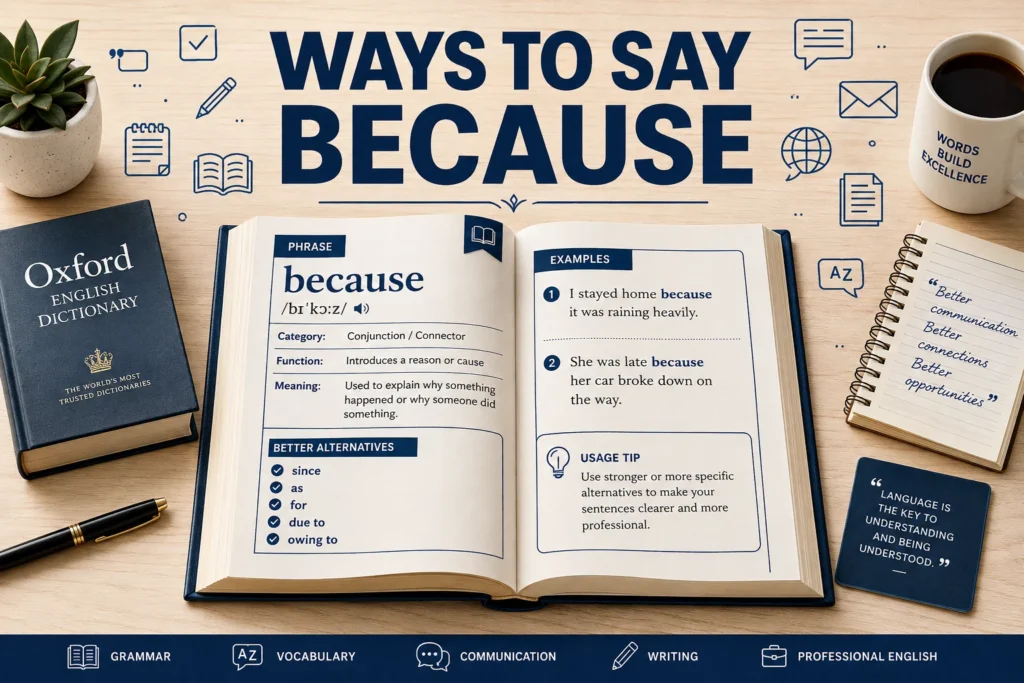
Because is a conjunction that introduces the reason or cause for something.
Simple definition: It answers the question “Why?”
Example:
- We canceled the meeting because the client was unavailable.
- She stayed home because she wasn’t feeling well.
- I accepted the offer because it matched my career goals.
Tone of “Because”
The tone of because is:
- Neutral
- Clear
- Natural
- Direct
- Easy to understand
It works in both casual conversations and professional writing. However, in formal documents or business communication, alternatives such as since, as, due to, or owing to often sound more polished.
Purpose of Using “Because”
People use because to:
- Explain a reason
- Justify a decision
- Clarify a situation
- Support an opinion
- Connect ideas logically
Without a reason, many sentences feel incomplete.
Example
❌ We postponed the launch.
✅ We postponed the launch because additional testing was required.
The second sentence immediately tells the reader why the action happened.
Emotional Context
Although because itself is emotionally neutral, the words that follow it can express different emotions.
Positive
We celebrated because the project was a success.
Negative
The flight was delayed because of bad weather.
Professional
We revised the proposal because the client requested additional information.
Personal
I started exercising because I wanted a healthier lifestyle.
When Should You Use “Because” Professionally?
Using because is completely acceptable in professional communication. It creates transparency and helps readers understand your reasoning. Still, varying your wording makes emails and reports sound more sophisticated.
1. Business Emails
Explain why you’re making a request or sharing information.
Example
We have updated the schedule because several team members are unavailable.
2. Workplace Communication
Managers and employees frequently explain decisions using because.
Example
The deadline has changed because the project scope increased.
3. Client Communication
Clients appreciate clear explanations.
Example
We recommend this solution because it provides better long-term value.
4. Networking
Explaining your motivation builds stronger professional relationships.
Example
I wanted to connect because I admire your work in digital marketing.
5. Customer Service
Giving customers a clear reason increases trust.
Example
Your order was delayed because severe weather affected shipping routes.
Professional Alternatives to “Because”
Below are professional alternatives that work well in business emails, workplace communication, reports, and formal writing.
1. Since
Meaning: Indicates the reason for something.
Tone: Professional, natural
Best use case: Emails and reports
Example:
Since the budget was approved, we can begin the project.
2. As
Meaning: Gives a reason politely.
Tone: Formal
Best use case: Business writing
Example:
As the deadline is approaching, please submit your feedback today.
3. Due to
Meaning: Indicates the cause of a situation.
Tone: Formal
Best use case: Official announcements
Example:
The event was postponed due to unexpected weather conditions.
4. Owing to
Meaning: Because of.
Tone: Very formal
Best use case: Reports and official documents
Example:
Owing to technical issues, the website was temporarily unavailable.
5. As a Result of
Meaning: Shows the consequence of a reason.
Tone: Professional
Best use case: Reports
Example:
As a result of customer feedback, we introduced new features.
6. Thanks to
Meaning: Indicates a positive reason.
Tone: Friendly and professional
Best use case: Recognition and appreciation
Example:
Thanks to your support, we completed the project ahead of schedule.
7. On Account of
Meaning: Because of.
Tone: Formal
Best use case: Business correspondence
Example:
The shipment was delayed on account of customs inspections.
8. In Light of
Meaning: Considering a particular reason.
Tone: Professional
Best use case: Corporate communication
Example:
In light of recent updates, we have revised our policy.
9. Given That
Meaning: Taking a fact into consideration.
Tone: Professional
Best use case: Meetings and presentations
Example:
Given that demand has increased, we will expand production.
10. Considering
Meaning: Taking something into account.
Tone: Neutral and professional
Best use case: Workplace discussions
Example:
Considering the circumstances, postponing the meeting is the best option.
11. Seeing That
Meaning: Since or because.
Tone: Conversational but professional
Best use case: Internal communication
Example:
Seeing that everyone has approved the proposal, we can move forward.
12. In View of
Meaning: Because of a situation.
Tone: Formal
Best use case: Business reports
Example:
In view of current market conditions, we adjusted our pricing strategy.
13. For the Reason That
Meaning: Explains a specific reason.
Tone: Highly formal
Best use case: Legal or policy documents
Example:
The application was declined for the reason that required documents were missing.
14. By Reason of
Meaning: Because of.
Tone: Formal
Best use case: Contracts and legal writing
Example:
Access was restricted by reason of security concerns.
15. As a Consequence of
Meaning: Indicates the result of a cause.
Tone: Formal
Best use case: Reports and analytical writing
Example:
As a consequence of increased demand, production costs also increased.
- Key Takeaways
- Because is the most common way to explain a reason.
- It works well in both casual and professional communication.
- Using alternatives improves readability and makes your writing sound more polished.
- In business emails and workplace communication, choose alternatives that match the level of formality.
- Words such as since, as, given that, due to, and in light of are excellent professional replacements for because.
Formal Alternatives to “Because”
These alternatives work best in reports, academic writing, official emails, legal documents, and corporate communication.
16. Inasmuch as
Meaning: Since or because.
Tone: Very formal
Best Use Case: Legal documents and formal reports.
Example:
Inasmuch as the contract has been signed, work may begin immediately.
17. Insofar as
Meaning: To the extent that.
Tone: Formal
Best Use Case: Business reports and policy documents.
Example:
Insofar as customer satisfaction is concerned, our results have improved.
18. In Consideration of
Meaning: Because of or in exchange for.
Tone: Highly formal
Best Use Case: Contracts and agreements.
Example:
In consideration of your continued partnership, we are offering a discount.
19. Pursuant to
Meaning: Following or because of an official rule.
Tone: Formal
Best Use Case: Legal and corporate communication.
Example:
Pursuant to company policy, all employees must complete the training.
20. In Response to
Meaning: Because of a request or event.
Tone: Professional
Best Use Case: Client emails and announcements.
Example:
In response to your inquiry, we have attached the requested documents.
21. Following
Meaning: After or because of something.
Tone: Professional
Best Use Case: Reports and workplace updates.
Example:
Following customer feedback, we updated the product.
22. Stemming From
Meaning: Originating from.
Tone: Professional
Best Use Case: Business reports.
Example:
The issue stemmed from a software configuration error.
23. Arising From
Meaning: Caused by.
Tone: Formal
Best Use Case: Legal and corporate writing.
Example:
The expenses arose from unexpected travel requirements.
24. As Indicated By
Meaning: Based on available evidence.
Tone: Formal
Best Use Case: Reports and presentations.
Example:
As indicated by recent data, customer satisfaction has increased.
25. Under the Circumstances
Meaning: Because of the current situation.
Tone: Professional
Best Use Case: Workplace decisions.
Example:
Under the circumstances, extending the deadline is appropriate.
Friendly Alternatives to “Because”
These expressions sound warm, natural, and conversational while remaining polite.
26. That’s Why
Meaning: Explains the reason.
Tone: Friendly
Best Use Case: Everyday conversations.
Example:
We finished early. That’s why everyone left before five.
27. For That Reason
Meaning: Therefore or because of that.
Tone: Friendly and professional.
Best Use Case: Emails and discussions.
Example:
The budget was reduced. For that reason, we postponed the campaign.
28. Which Is Why
Meaning: Explains the result.
Tone: Conversational
Best Use Case: Presentations.
Example:
Sales increased significantly, which is why we’re hiring more staff.
29. That’s the Reason
Meaning: Gives a direct explanation.
Tone: Friendly
Best Use Case: Everyday communication.
Example:
The software crashed. That’s the reason we restarted the system.
30. For This Reason
Meaning: Therefore.
Tone: Professional and friendly.
Best Use Case: Reports and emails.
Example:
Customer demand has grown. For this reason, production will increase.
31. Because of That
Meaning: As a result.
Tone: Casual
Best Use Case: Conversations.
Example:
Traffic was heavy. Because of that, I arrived late.
32. Due to That
Meaning: Because of the previous point.
Tone: Professional
Best Use Case: Workplace communication.
Example:
The supplier delayed delivery. Due to that, production started later.
33. As Such
Meaning: Therefore.
Tone: Professional
Best Use Case: Reports.
Example:
Demand continues to rise. As such, additional staff will be hired.
34. Therefore
Meaning: Consequently.
Tone: Formal and professional.
Best Use Case: Reports and presentations.
Example:
Costs have increased; therefore, prices will change next month.
35. Consequently
Meaning: As a result.
Tone: Professional
Best Use Case: Business writing.
Example:
Several employees resigned. Consequently, recruitment has started.
Email Alternatives to “Because”
Business emails often sound stronger when you replace because with more polished expressions.
36. As Requested
Meaning: Following someone’s request.
Tone: Professional
Best Use Case: Client emails.
Example:
As requested, I’ve attached the revised proposal.
37. Per Your Request
Meaning: Because you requested it.
Tone: Professional
Best Use Case: Customer service.
Example:
Per your request, we’ve updated your account information.
38. Based on Your Feedback
Meaning: Due to customer comments.
Tone: Professional
Best Use Case: Client communication.
Example:
Based on your feedback, we’ve improved the user interface.
39. To Better Serve You
Meaning: Explains the reason for an action.
Tone: Customer-friendly
Best Use Case: Service emails.
Example:
To better serve you, we’ve extended our support hours.
40. To Ensure
Meaning: Explains a purpose.
Tone: Professional
Best Use Case: Instructions and announcements.
Example:
To ensure accuracy, please review the attached document.
Key Takeaways
- Formal alternatives work best in reports, contracts, and official communication.
- Friendly alternatives create a natural and conversational tone.
- Email alternatives make business messages sound polished and customer-focused.
- Choosing the right expression improves professional communication, workplace writing, and email etiquette.
Workplace Alternatives to “Because”
These alternatives are especially useful in meetings, reports, presentations, project updates, and everyday workplace communication.
41. Based on
Meaning: Using specific information as the reason. Tone: Professional Best Use Case: Reports and project updates. Example: Based on customer feedback, we redesigned the homepage.
42. In Accordance With
Meaning: Following a rule or policy. Tone: Formal Best Use Case: Company policies. Example: In accordance with company policy, remote work requires manager approval.
43. According to
Meaning: Based on information from someone or something. Tone: Neutral Best Use Case: Reports and presentations. Example: According to the latest survey, customer satisfaction has increased.
44. Following the Decision
Meaning: As a result of an official decision. Tone: Professional Best Use Case: Workplace announcements. Example: Following the decision of the board, the project will begin next month.
45. As Explained
Meaning: Referring to an earlier reason. Tone: Professional Best Use Case: Follow-up emails. Example: As explained during the meeting, the deadline has changed.
46. Based Upon
Meaning: Using facts or evidence. Tone: Formal Best Use Case: Business reports. Example: Based upon our research, this strategy offers the best return.
47. Given the Situation
Meaning: Considering current circumstances. Tone: Professional Best Use Case: Team discussions. Example: Given the situation, postponing the launch is the safest choice.
48. In View of the Fact That
Meaning: Because of an important fact. Tone: Formal Best Use Case: Executive communication. Example: In view of the fact that demand has increased, production will expand.
49. On the Grounds That
Meaning: For a stated reason. Tone: Formal Best Use Case: Policies and legal communication. Example: The request was declined on the grounds that the required documents were incomplete.
50. Due to the Fact That
Meaning: Because. Tone: Formal Best Use Case: Official reports. Example: Due to the fact that the shipment arrived late, production was delayed.
Quick Comparison Table
| Alternative | Tone | Best Use |
| Since | Professional | Emails |
| As | Formal | Reports |
| Due to | Formal | Announcements |
| Given that | Professional | Meetings |
| In light of | Professional | Business updates |
| Thanks to | Friendly | Appreciation |
| Therefore | Formal | Reports |
| Consequently | Professional | Analysis |
| Based on | Professional | Project updates |
| According to | Neutral | Presentations |
Email Examples
Client
Thank you for your patience. Due to a system upgrade, your order required additional processing time.
Manager
Since the report is complete, I have attached it for your review.
Colleague
As we discussed yesterday, I have updated the presentation.
Customer
Based on your feedback, we have improved the checkout process.
Networking
I wanted to connect because I admire your work in the marketing industry.
Meeting Follow-up
Thank you for attending today’s meeting. As discussed, the next milestone is scheduled for Monday.
Common Mistakes
1. Overusing “Because”
Repeating because in every sentence makes your writing repetitive. Mix it with alternatives like since, as, or given that.
Poor: Because the meeting changed because the client canceled because of weather.
Better: Since the client canceled due to bad weather, the meeting has been rescheduled.
2. Choosing the Wrong Tone
Very formal alternatives like owing to or inasmuch as may sound unnatural in casual emails.
3. Formality Mismatch
Use simple words in everyday emails and reserve highly formal expressions for reports and legal documents.
4. Email Etiquette
Always explain the reason briefly and politely. Avoid long or complicated explanations when a simple alternative is enough.
Related Phrases
| Phrase | Meaning | Example |
| Therefore | Shows a result | Sales increased; therefore, we expanded. |
| Consequently | As a result | Production stopped; consequently, deliveries were delayed. |
| Thus | Therefore | Costs increased; thus, prices changed. |
| Hence | For that reason | Demand rose; hence, new staff were hired. |
| Accordingly | Therefore | The schedule changed accordingly. |
| For this reason | Because of this | For this reason, we postponed the event. |
| For that reason | Therefore | For that reason, we revised the plan. |
| As a result | Shows consequence | Revenue grew as a result of strong sales. |
| Due to | Because of | The delay was due to traffic. |
| Owing to | Because of | Owing to weather, flights were canceled. |
| In light of | Considering | In light of recent events, policies changed. |
| Given that | Considering | Given that demand is high, we’ll increase production. |
| Since | Because | Since you’re here, let’s begin. |
| As | Because | As the office is closed, we’ll meet online. |
| Thanks to | Positive reason | Thanks to your help, we succeeded. |
Phrase Comparison
| Phrase | Tone | Best Use |
| Because | Neutral | Everyday English |
| Since | Professional | Emails |
| As | Formal | Reports |
| Due to | Formal | Announcements |
| Given that | Professional | Meetings |
| Thanks to | Friendly | Positive outcomes |
| Therefore | Formal | Academic writing |
| Consequently | Professional | Business analysis |
Cultural Usage
US English
“Because,” “since,” and “due to” are the most common choices in professional communication.
UK English
British English frequently uses “as” and “owing to” in formal writing.
Corporate Communication
Clear explanations improve trust and make business writing more persuasive.
Customer Service
Simple alternatives such as “due to” or “based on your feedback” sound professional and customer-friendly.
Networking
Use natural language. Avoid overly formal expressions unless the situation requires them.
FAQs
What is the best professional alternative to “because”?
Since, due to, given that, and in light of are excellent choices.
Is “because” formal?
Yes. It is neutral and appropriate in most situations.
What is a formal synonym for “because”?
“As,” “due to,” “owing to,” and “inasmuch as.”
Can I use “since” instead of “because”?
Yes, especially in business emails.
Is “due to” always a replacement for “because”?
Not always. “Due to” is followed by a noun phrase, while “because” introduces a clause.
Which alternative sounds best in emails?
“Since,” “as requested,” and “based on your feedback.”
Which phrase is best for clients?
“In light of,” “due to,” and “based on your feedback.”
Which phrase is best for managers?
“Given that,” “since,” and “as.”
Which alternative is most formal?
“Inasmuch as” and “owing to.”
Which alternative is the friendliest?
“Thanks to” and “that’s why.”
Final Summary
The word because remains one of the clearest and most effective ways to explain a reason. However, using a variety of alternatives makes your communication more engaging, professional, and appropriate for different audiences. For business emails, choose expressions like since, given that, based on, or due to. For formal reports, use as, in light of, or owing to. In friendly conversations, phrases like thanks to and that’s why sound natural and approachable. By selecting the right alternative for the situation, you’ll improve your workplace communication, strengthen your professional writing, and create clearer, more persuasive messages.