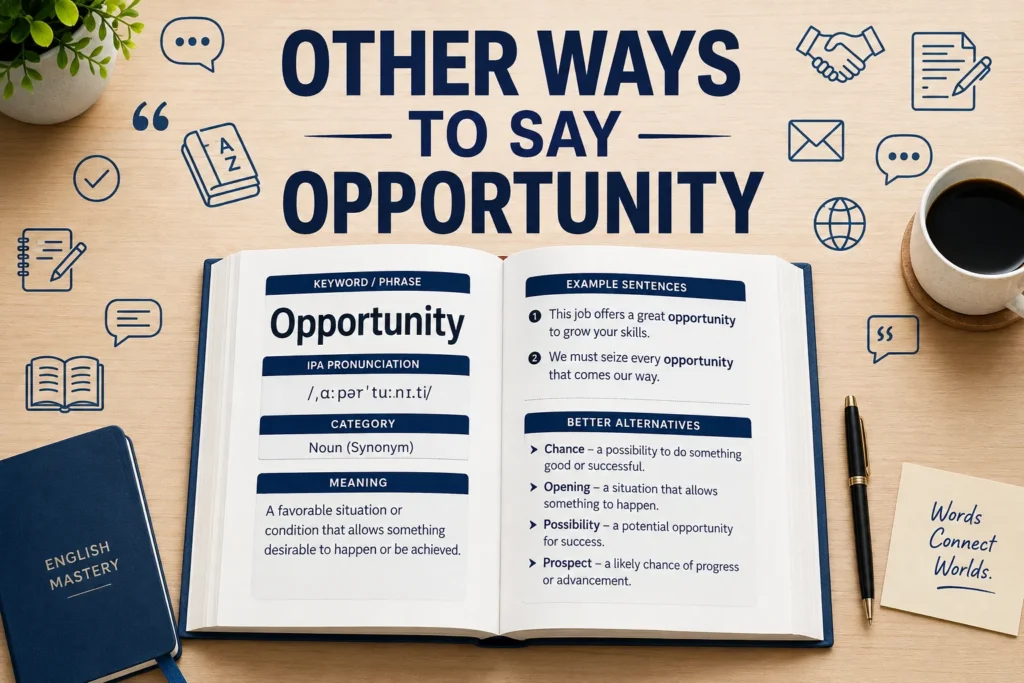
Finding other ways to say opportunity can make your writing and conversations sound more professional, engaging, and precise. Although “opportunity” is a common and useful word, using it repeatedly in emails, business meetings, presentations, LinkedIn messages, or workplace conversations can become repetitive.
Choosing the right alternative helps you communicate your ideas more effectively. For example, a hiring manager may prefer “career opportunity,” while a client proposal might sound stronger with “business prospect” or “strategic opening.” Likewise, casual conversations often call for simpler words like “chance” or “possibility.”
In this guide, you’ll learn professional, formal, and workplace-friendly alternatives to opportunity, along with meanings, tone, best use cases, and real-world examples. Whether you’re writing a business email, speaking with clients, networking, or improving your professional communication, these alternatives will help you choose the right word every time.
What Does “Opportunity” Mean?
An opportunity is a favorable situation or set of circumstances that allows someone to achieve a goal, solve a problem, or gain an advantage.
Literal Meaning
An opportunity is a chance to do something beneficial or valuable.
Tone
The word is generally:
- Positive
- Professional
- Hopeful
- Encouraging
- Goal-oriented
Purpose
People use opportunity to describe:
- Career growth
- Business expansion
- Learning experiences
- New projects
- Partnerships
- Personal development
- Financial possibilities
Emotional Context
The word often creates feelings of optimism, ambition, excitement, and progress. It suggests that something valuable is available if the person chooses to act.
Examples
Business
This partnership creates an excellent opportunity for future growth.
Workplace
Thank you for giving me the opportunity to lead this project.
Interview
I appreciate the opportunity to discuss the position with you.
Networking
It was a great opportunity to connect with industry professionals.
When Is It Appropriate to Use “Opportunity”?
The word fits almost every professional setting when referring to a beneficial chance or possibility.
Emails
Use it when thanking someone or discussing future plans.
Example
Thank you for the opportunity to interview for the position.
Workplace
Describe promotions, projects, training, or leadership roles.
Example
This opportunity will help me develop new leadership skills.
Clients
Use it when discussing partnerships or new business initiatives.
Example
We appreciate the opportunity to work with your organization.
Networking
Mention future collaboration or career growth.
Example
I appreciate the opportunity to meet you at the conference.
Customer Service
Use it to thank customers and strengthen relationships.
Example
Thank you for the opportunity to serve your business.
Professional Alternatives to “Opportunity”
These alternatives work well in business communication, professional emails, reports, presentations, and LinkedIn messages.
1. Chance
Meaning: A possibility to do something beneficial.
Tone: Neutral
Best Use Case: Everyday workplace communication
Example
Thank you for giving me the chance to contribute.
2. Possibility
Meaning: Something that may happen or become available.
Tone: Professional
Best Use Case: Planning and strategy
Example
There is a strong possibility for future collaboration.
3. Prospect
Meaning: A likely future opportunity or potential success.
Tone: Professional
Best Use Case: Sales, business, networking
Example
This partnership is an exciting business prospect.
4. Opening
Meaning: An available position or favorable situation.
Tone: Professional
Best Use Case: Job vacancies
Example
We currently have an opening in our marketing department.
5. Occasion
Meaning: A suitable time or event for action.
Tone: Neutral
Best Use Case: Formal writing
Example
This occasion allows us to celebrate our achievements.
6. Avenue
Meaning: A method or path toward achieving something.
Tone: Professional
Best Use Case: Business strategies
Example
Digital marketing offers a new avenue for growth.
7. Gateway
Meaning: Something that provides access to future success.
Tone: Professional
Best Use Case: Career development
Example
This internship is a gateway to a rewarding career.
8. Platform
Meaning: A foundation for future success.
Tone: Professional
Best Use Case: Leadership and career growth
Example
The conference provided a platform to share innovative ideas.
9. Pathway
Meaning: A route leading toward a goal.
Tone: Formal
Best Use Case: Education and careers
Example
This certification creates a pathway to promotion.
10. Possibility for Growth
Meaning: A chance to improve or expand.
Tone: Professional
Best Use Case: Business meetings
Example
We see significant possibilities for growth in this market.
11. Business Prospect
Meaning: A potential commercial opportunity.
Tone: Professional
Best Use Case: Sales and client communication
Example
The company is an excellent business prospect.
12. Career Opportunity
Meaning: A chance to advance professionally.
Tone: Professional
Best Use Case: Recruitment and HR
Example
This role is a fantastic career opportunity.
13. Strategic Opening
Meaning: A favorable moment for action.
Tone: Formal
Best Use Case: Corporate planning
Example
The market presents a strategic opening for expansion.
14. Growth Opportunity
Meaning: A chance to improve personally or professionally.
Tone: Professional
Best Use Case: Employee development
Example
Every project should become a growth opportunity.
15. Potential
Meaning: The capacity for future success.
Tone: Professional
Best Use Case: Performance reviews
Example
She has the potential to become an outstanding leader.
Formal Alternatives to “Opportunity”
These expressions fit executive communication, academic writing, official correspondence, and formal business documents.
16. Favorable Circumstance
Meaning: A situation that makes success more likely.
Tone: Formal
Best Use Case: Reports and proposals
Example
Current market conditions create a favorable circumstance for investment.
17. Advantageous Situation
Meaning: A condition that offers clear benefits.
Tone: Formal
Best Use Case: Business strategy
Example
This agreement places us in an advantageous situation.
18. Window of Opportunity
Meaning: A limited period during which action is most effective.
Tone: Professional
Best Use Case: Strategic planning
Example
We should act quickly while the window of opportunity remains open.
19. Fortuitous Occasion
Meaning: A fortunate event that creates new possibilities.
Tone: Very Formal
Best Use Case: Speeches and formal writing
Example
The merger created a fortuitous occasion for expansion.
20. Auspicious Moment
Meaning: A favorable time to begin something.
Tone: Formal
Best Use Case: Ceremonial or executive communication
Example
This is an auspicious moment to launch the new initiative.
21. Promising Prospect
Meaning: A future possibility with strong potential.
Tone: Professional
Best Use Case: Investment and recruitment
Example
The new market represents a promising prospect.
22. Valuable Opening
Meaning: An important chance that should not be missed.
Tone: Professional
Best Use Case: Career discussions
Example
This internship is a valuable opening for graduates.
23. Beneficial Circumstance
Meaning: A situation that provides clear advantages.
Tone: Formal
Best Use Case: Corporate reports
Example
The policy change created a beneficial circumstance for our team.
24. Strategic Advantage
Meaning: A condition that provides a competitive benefit.
Tone: Executive
Best Use Case: Business planning
Example
Early adoption gives us a strategic advantage over competitors.
25. Favorable Opening
Meaning: A suitable moment or position for progress.
Tone: Formal
Best Use Case: Business negotiations
Example
The current market presents a favorable opening for international expansion.
Featured Snippet: Best Professional Alternatives to “Opportunity”
If you’re looking for a professional way to say “opportunity,” some of the best alternatives include chance, possibility, prospect, opening, avenue, gateway, pathway, career opportunity, business prospect, strategic opening, growth opportunity, window of opportunity, potential, strategic advantage, and favorable circumstance. The right choice depends on whether you’re writing a business email, speaking in the workplace, communicating with clients, or networking professionally.
Friendly Alternatives to “Opportunity”
These alternatives sound natural in everyday conversations, social media posts, and informal workplace discussions.
26. Chance to Shine
Meaning: An opportunity to demonstrate skills or talent.
Tone: Friendly and encouraging
Best Use Case: Mentoring, coaching, education
Example:
This presentation is your chance to shine.
27. Big Break
Meaning: A significant opportunity that can change someone’s career or life.
Tone: Casual
Best Use Case: Career discussions
Example:
Landing this role could be your big break.
28. Golden Opportunity
Meaning: An exceptional opportunity that should not be missed.
Tone: Positive
Best Use Case: Business, education, careers
Example:
This scholarship is a golden opportunity for talented students.
29. Lucky Chance
Meaning: A fortunate opportunity.
Tone: Casual
Best Use Case: Informal conversations
Example:
It was a lucky chance that we met at the conference.
30. New Possibility
Meaning: A fresh option or direction.
Tone: Friendly
Best Use Case: Personal growth
Example:
Every challenge creates a new possibility.
31. Fresh Start
Meaning: A chance to begin again.
Tone: Encouraging
Best Use Case: Career changes
Example:
This job gives you a fresh start.
32. Great Opening
Meaning: An excellent chance to begin something.
Tone: Casual Professional
Best Use Case: Career advice
Example:
This internship is a great opening for graduates.
33. Perfect Timing
Meaning: A favorable moment to act.
Tone: Friendly
Best Use Case: Everyday conversation
Example:
This investment came at the perfect timing.
34. New Door
Meaning: A new path toward success.
Tone: Inspirational
Best Use Case: Motivation
Example:
This promotion opens a new door for your career.
35. Stepping Stone
Meaning: Something that leads to greater success.
Tone: Encouraging
Best Use Case: Career development
Example:
This certification can become a stepping stone to leadership.
Email Alternatives to “Opportunity”
These phrases are excellent for business email phrases, workplace communication, and client correspondence.
36. Privilege
Meaning: A special opportunity or honor.
Tone: Formal
Best Use Case: Thank-you emails
Example:
It was a privilege to work with your team.
37. Invitation
Meaning: A request to participate.
Tone: Professional
Best Use Case: Meetings and events
Example:
Thank you for the invitation to join the discussion.
38. Prospect for Collaboration
Meaning: A possible future partnership.
Tone: Professional
Best Use Case: Client emails
Example:
We look forward to the prospect for collaboration.
39. Partnership Opportunity
Meaning: A chance to build a business relationship.
Tone: Professional
Best Use Case: B2B communication
Example:
We appreciate the partnership opportunity your company has offered.
40. Future Possibility
Meaning: Something that may happen later.
Tone: Professional
Best Use Case: Follow-up emails
Example:
We hope to explore future possibilities together.
41. Business Opening
Meaning: A commercial opportunity.
Tone: Professional
Best Use Case: Sales
Example:
This project represents a valuable business opening.
42. Collaborative Opportunity
Meaning: A chance to work together.
Tone: Professional
Best Use Case: Networking
Example:
Thank you for discussing this collaborative opportunity.
43. Growth Initiative
Meaning: A project that supports development.
Tone: Corporate
Best Use Case: Internal communication
Example:
This growth initiative will benefit the entire company.
44. Professional Opportunity
Meaning: A chance related to career development.
Tone: Professional
Best Use Case: Recruitment
Example:
Thank you for considering me for this professional opportunity.
45. Expansion Opportunity
Meaning: A chance to grow a business.
Tone: Executive
Best Use Case: Corporate strategy
Example:
The international market offers an expansion opportunity.
Workplace Alternatives to “Opportunity”
These alternatives work well in professional communication, meetings, leadership discussions, and HR conversations.
46. Assignment
Meaning: A task that provides experience.
Tone: Professional
Best Use Case: Team management
Example:
This assignment will strengthen your leadership skills.
47. Role
Meaning: A position with responsibility.
Tone: Professional
Best Use Case: HR
Example:
This role offers excellent career growth.
48. Promotion Path
Meaning: A route toward advancement.
Tone: Professional
Best Use Case: Career planning
Example:
The company provides a clear promotion path.
49. Leadership Opportunity
Meaning: A chance to manage or guide others.
Tone: Professional
Best Use Case: Employee development
Example:
This project is a leadership opportunity.
50. Learning Experience
Meaning: An opportunity to gain knowledge.
Tone: Encouraging
Best Use Case: Training
Example:
Every challenge is a learning experience.
51. Development Opportunity
Meaning: A chance to improve skills.
Tone: Professional
Best Use Case: Performance reviews
Example:
This workshop is an excellent development opportunity.
52. Advancement Opportunity
Meaning: A chance to progress in a career.
Tone: Professional
Best Use Case: HR
Example:
The position offers strong advancement opportunities.
53. Project Opportunity
Meaning: A chance to participate in a project.
Tone: Professional
Best Use Case: Team meetings
Example:
This is a great project opportunity for new employees.
54. Leadership Position
Meaning: A senior role with responsibility.
Tone: Formal
Best Use Case: Executive communication
Example:
She accepted a leadership position within the company.
55. Career Path
Meaning: A long-term route for professional growth.
Tone: Professional
Best Use Case: Career planning
Example:
This certification supports your long-term career path.
Quick Comparison Table
| Alternative | Tone | Best Use |
| Chance | Neutral | Everyday communication |
| Prospect | Professional | Business development |
| Opening | Professional | Job postings |
| Avenue | Professional | Strategy discussions |
| Gateway | Professional | Career growth |
| Career Opportunity | Professional | Recruitment |
| Window of Opportunity | Formal | Strategic planning |
| Strategic Advantage | Executive | Business planning |
| Golden Opportunity | Friendly | Motivation |
| Big Break | Casual | Career conversations |
| Partnership Opportunity | Professional | Client communication |
| Collaborative Opportunity | Professional | Networking |
| Leadership Opportunity | Professional | Employee development |
| Development Opportunity | Professional | Performance reviews |
| Career Path | Professional | Career planning |
Email Examples
Client
Thank you for the opportunity to partner with your organization. We value your trust and look forward to achieving great results together.
Manager
I appreciate the opportunity to lead this project. Thank you for your confidence and support.
Colleague
Thank you for giving me the chance to contribute to the presentation. I enjoyed working with the team.
Customer
We appreciate the opportunity to serve your business and look forward to supporting your future success.
Networking Contact
Thank you for the opp*rtunity to c*nnect during yesterday’s event. I hope we can stay in touch and explore future collaborations.
Meeting Follow-Up
Thank you for taking the time to meet today. I appreciate the opportunity to discuss your goals and look forward to our next conversation.
Common Mistakes
1. Repeating “Opportunity” Too Often
Instead of writing:
Thank you for the opportunity. This opportunity is exciting and gives us another opportunity…
Use alternatives like:
- chance
- prospect
- opening
- avenue
- possibility
2. Choosing an Informal Word in a Formal Email
❌ Big break
✅ Career opportunity
✅ Professional opportunity
3. Using “Opportunity” When Another Word Fits Better
Sometimes a more specific term improves clarity.
Instead of:
We have an opportunity to hire.
Use:
We have an opening for a new team member.
4. Ignoring Email Etiquette
Always explain which opportunity you’re referring to.
Better:
Thank you for the opportunity to interview for the Marketing Manager position.
Related Phrases
| Phrase | Meaning | Example |
| Career growth | Professional advancement | This role supports career growth. |
| New beginning | Fresh start | This job is a new beginning. |
| Promotion | Higher position | Congratulations on your promotion. |
| Advancement | Career progress | She earned a well-deserved advancement. |
| Breakthrough | Major success | The product launch was a breakthrough. |
| Possibility | Potential option | There is a possibility of expansion. |
| Prospect | Future potential | The investment is a promising prospect. |
| Opening | Available position | We have an opening in sales. |
| Gateway | Entry point | The internship is a gateway to success. |
| Avenue | Method or path | Online marketing is a new avenue for growth. |
| Pathway | Route to success | Education creates new pathways. |
| Potential | Future ability | He has great leadership potential. |
| Window of Opportunity | Limited favorable time | Don’t miss this window of opportunity. |
| Strategic Advantage | Competitive benefit | Innovation provides a strategic advantage. |
| Stepping Stone | Stage toward a larger goal | This role is a stepping stone to management. |
Phrase Comparison: “Opportunity” vs. Common Alternatives
The best alternative depends on your audience, purpose, and level of formality. While opportunity is versatile, choosing a more specific word can make your message clearer and more engaging.
| Phrase | Tone | Formality | Best Use Case |
| Opportunity | Neutral | Medium | General business communication |
| Chance | Casual | Low | Everyday conversations |
| Possibility | Neutral | Medium | Planning and brainstorming |
| Prospect | Professional | Medium | Sales, business, investments |
| Opening | Professional | Medium | Job vacancies and positions |
| Avenue | Professional | High | Strategy and growth discussions |
| Gateway | Inspirational | Medium | Career and education |
| Pathway | Formal | High | Academic and professional development |
| Career Opportunity | Professional | Medium | Recruitment and HR |
| Business Prospect | Professional | High | Sales and client communication |
| Strategic Opening | Executive | High | Corporate planning |
| Window of Opportunity | Formal | High | Time-sensitive decisions |
| Leadership Opportunity | Professional | Medium | Employee development |
| Development Opportunity | Professional | Medium | Performance reviews |
| Stepping Stone | Friendly | Low | Career advice and mentoring |
Which Alternative Should You Choose?
- Business emails: Career opportunity, business prospect, professional opportunity.
- Formal documents: Strategic opening, favorable circumstance, window of opportunity.
- Workplace conversations: Development opportunity, leadership opportunity, assignment.
- Networking: Collaborative opportunity, prospect, future possibility.
- Casual conversations: Chance, big break, golden opportunity.
Cultural Usage
US English
In American English, opportunity is used frequently in business, education, and daily conversations. Short, direct alternatives are also common.
Examples:
- Career opportunity
- Chance
- Great opportunity
- Big break
- New opportunity
American business communication often values clear and encouraging language.
UK English
British English generally uses slightly more formal vocabulary.
Common alternatives include:
- Prospect
- Opening
- Possibility
- Opportunity
- Favourable circumstance
These expressions sound professional without being overly enthusiastic.
Corporate Communication
Companies often replace opportunity with more specific business terms.
Examples include:
- Strategic initiative
- Growth opportunity
- Business prospect
- Expansion opportunity
- Development opportunity
These phrases sound more precise in reports, presentations, and executive meetings.
Customer Service
Customer service teams usually use positive and appreciative language.
Examples:
- Thank you for the opportunity to assist you.
- We appreciate the opportunity to serve you.
- We value the opportunity to support your business.
- Thank you for choosing us.
These expressions build trust and strengthen customer relationships.
Networking
Networking conversations benefit from warm but professional wording.
Examples:
- Thank you for the opportunity to connect.
- I appreciate the opportunity to learn more about your work.
- I hope we have another opportunity to collaborate.
- Let’s explore future opportunities together.
FAQs
What is another word for “opportunity”?
Some of the best alternatives include chance, possibility, prospect, opening, avenue, gateway, pathway, and potential.
What is the most professional synonym for “opportunity”?
Excellent professional alternatives include:
- Career opportunity
- Business prospect
- Strategic opening
- Development opportunity
- Growth opportunity
Can I use “chance” instead of “opportunity”?
Yes. Chance is suitable for casual conversations, but opportunity sounds more professional in business and academic writing.
What is a formal alternative to “opportunity”?
Good formal options include:
- Favorable circumstance
- Strategic opening
- Window of opportunity
- Advantageous situation
- Auspicious moment
Which word should I use in a business email?
Professional choices include:
- Career opportunity
- Business opportunity
- Prospect
- Development opportunity
- Collaborative opportunity
Is “prospect” the same as “opportunity”?
Not exactly. A prospect usually refers to future potential, while an opportunity is a favorable situation that already exists or is immediately available.
How do I thank someone for an opportunity professionally?
Example:
Thank you for the opportunity to interview for this position. I appreciate your time and consideration.
What is the best synonym for job opportunity?
The most common alternatives are:
- Job opening
- Position
- Vacancy
- Career opportunity
- Employment opportunity
Which synonym works best in sales?
Business prospect, sales opportunity, client opportunity, and growth opportunity are widely used in sales and business development.
Is “window of opportunity” appropriate in business writing?
Yes. It is commonly used when discussing time-sensitive decisions or strategic planning.
What word should I use instead of “opportunity” on a resume?
Good resume-friendly options include:
- Achievement
- Leadership role
- Project
- Responsibility
- Initiative
Choose the word that best describes your actual experience.
Which alternative is best for networking?
Collaborative opportunity, future possibility, connection, and prospect all work well in networking conversations.
What’s the difference between “opportunity” and “possibility”?
An opportunity is a favorable chance to act, while a possibility simply means something could happen. Not every possibility is a real opportunity.
Should I avoid repeating “opportunity” in writing?
Yes. Repeating the same word too often can make your writing sound repetitive. Use suitable alternatives based on the context.
Why should I use different alternatives?
Using different words improves readability, strengthens professional communication, and helps your emails, reports, and presentations sound more polished.
Final Summary
Best Professional Alternatives
- Career opportunity
- Business prospect
- Development opportunity
- Growth opportunity
- Strategic opening
- Collaborative opportunity
- Professional opportunity
- Expansion opportunity
Best F*rmal Alternatives
- Favorable circumstance
- Advantageous situation
- Window of opportunity
- Strategic advantage
- Auspicious moment
- Beneficial circumstance
Best Casual Altern*tives
- Chance
- Big break
- Golden opportunity
- Fresh start
- New door
- Stepping stone
B*st Email Alternatives
- Thank you for the opportunity
- Professional opportunity
- Partnership opportunity
- Collaborative opportunity
- Future possibility
- Business opening
Conclusion
Using other ways to say “opportunity” helps you communicate with greater clarity, professionalism, and confidence. Whether you’re writing a business email, preparing a report, updating your resume, speaking with clients, or networking with industry professionals, selecting the right alternative improves both your message and your credibility. From simple words like chance and possibility to professional expressions such as business prospect, development opportunity, and strategic opening, each alternative serves a different purpose. Match your wording to the situation, audience, and level of formality to create stronger workplace communication, better email etiquette, and more effective professional communication.