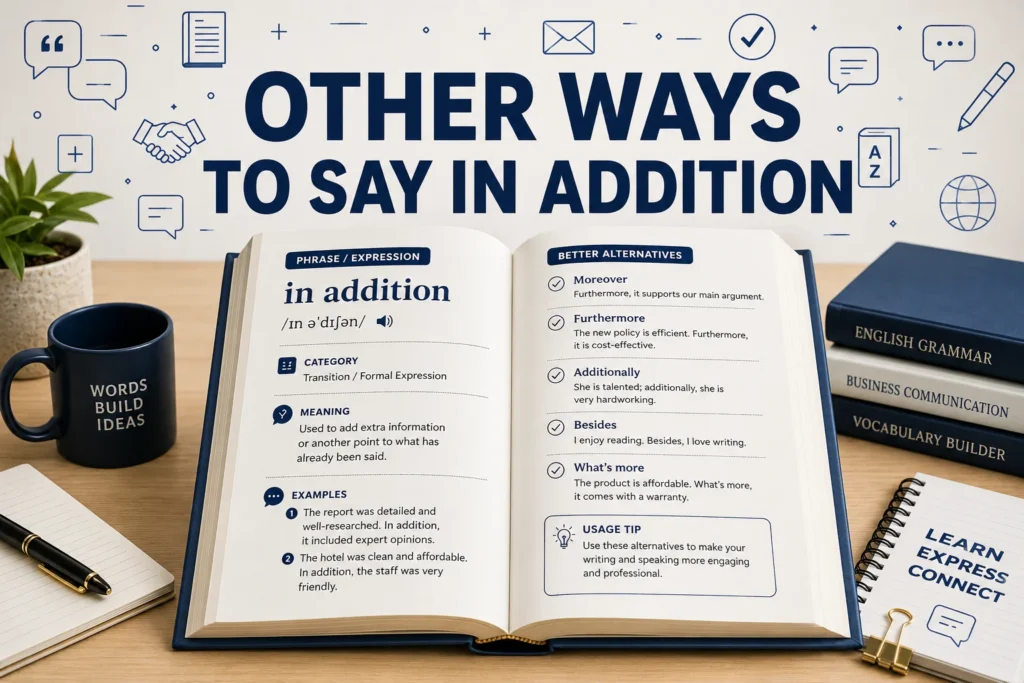
Whether you’re writing an email, preparing a business report, giving a presentation, or having a conversation, the phrase “in addition” is useful for adding extra information. However, using the same transition repeatedly can make your writing sound repetitive and less engaging.
Learning other ways to say “in addition” helps you communicate more naturally, improve the flow of your writing, and sound more professional. The right alternative can make your emails, workplace communication, client messages, and academic writing clearer and more polished.
For example, instead of writing “In addition, we have updated the proposal,” you could say “Furthermore, we have updated the proposal” or “Additionally, we have updated the proposal.” Small changes like these make your communication more varied and effective.
In this guide, you’ll learn the meaning of “in addition,” when to use it, and the best professional alternatives for business emails, workplace communication, customer service, networking, and everyday writing. Every alternative includes its meaning, tone, best use case, and an example.
What Does “In Addition” Mean?
“In addition” is a transition phrase used to introduce extra information, another point, or an additional idea. It signals that what follows adds to what has already been said.
Literal Meaning
The phrase simply means:
“Also,” “as well,” or “besides that.”
It connects two related ideas while showing that the second point is an addition to the first.
Tone
The phrase has a neutral tone and works well in:
- Professional writing
- Business emails
- Academic papers
- Workplace communication
- Formal conversations
Purpose
People use “in addition” to:
- Add supporting information
- Introduce another benefit
- Expand an explanation
- Strengthen an argument
- Improve the flow of writing
Emotional Context
Unlike emotional phrases, “in addition” is factual and objective. It helps organize ideas without changing the emotional tone of your message.
Examples
Business Email
We completed the project on time. In addition, we stayed within budget.
Presentation
Sales increased by 18%. In addition, customer satisfaction reached a record high.
Workplace
Sarah finished the report. In addition, she prepared the presentation slides
Why Do People Search for Other Ways to Say “In Addition”?
Many writers look for alternatives because they want to:
- Avoid repeating the same transition
- Improve professional communication
- Write stronger business emails
- Sound more natural
- Enhance academic writing
- Improve workplace communication
- Create smoother transitions
- Expand vocabulary
Using a variety of transition words also improves readability and makes your writing more engaging.
When Should You Use “In Addition”?
Emails
Use it to introduce another point or provide extra details.
Example
In addition, I’ve attached the updated contract for your review.
Workplace
Helpful when discussing projects, meetings, or reports.
Example
In addition, our team completed all assigned tasks before the deadline.
Clients
Shows professionalism when presenting extra benefits or information.
Example
In addition, your package includes free technical support.
Networking
Useful when highlighting additional qualifications or opportunities.
Example
In addition, I’d be happy to introduce you to members of our team.
Customer Service
Great for explaining additional services or solutions.
Example
In addition, we offer free setup assistance for all new customers.
Professional Ways to Say “In Addition”
Below are some of the best professional alternatives suitable for emails, reports, meetings, proposals, and workplace communication.
1. Additionally
Meaning: Also; as another point.
Tone: Professional
Best Use: Business emails, reports
Example
Additionally, we’ve included a detailed budget breakdown.
2. Furthermore
Meaning: Introduces another important point.
Tone: Formal
Best Use: Reports and presentations
Example
Furthermore, customer satisfaction increased by 12%.
3. Moreover
Meaning: Adds supporting information.
Tone: Formal
Best Use: Academic and professional writing
Example
Moreover, the new process reduces operating costs.
4. Also
Meaning: Another simple way to add information.
Tone: Neutral
Best Use: Everyday communication
Example
We also updated the training materials.
5. As Well
Meaning: Too; in addition.
Tone: Friendly
Best Use: Conversations and emails
Example
I’ll attend the meeting as well.
6. Besides
Meaning: Another reason or point.
Tone: Neutral
Best Use: Informal writing and conversations
Example
Besides, the new software is easier to use.
7. What’s More
Meaning: Adds emphasis to another point.
Tone: Friendly
Best Use: Presentations and conversations
Example
What’s more, the upgrade is completely free.
8. Along With That
Meaning: Together with the previous point.
Tone: Conversational
Best Use: Workplace discussions
Example
Along with that, we’ll provide staff training.
9. On Top of That
Meaning: Adds another benefit or point.
Tone: Casual
Best Use: Team conversations
Example
On top of that, we finished ahead of schedule.
10. Plus
Meaning: Also.
Tone: Casual
Best Use: Everyday communication
Example
Plus, you’ll receive lifetime updates.
11. Likewise
Meaning: Similarly; in addition.
Tone: Professional
Best Use: Reports and formal writing
Example
Likewise, our support team achieved its monthly goals.
12. Equally Important
Meaning: Introduces another key point.
Tone: Professional
Best Use: Presentations and reports
Example
Equally important, employee safety remains our priority.
13. Coupled With
Meaning: Combined with.
Tone: Formal
Best Use: Business proposals
Example
Coupled with our experience, this strategy delivers excellent results.
14. Not Only That
Meaning: Adds emphasis before another idea.
Tone: Friendly
Best Use: Speeches and conversations
Example
Not only that, the solution is affordable.
15. Another Point Is
Meaning: Introduces one more idea.
Tone: Professional
Best Use: Meetings and presentations
Example
Another point is that customer demand continues to grow.
16. In the Same Vein
Meaning: Continuing the same idea.
Tone: Formal
Best Use: Articles and reports
Example
In the same vein, our research supports this conclusion.
17. To Add to That
Meaning: Introduces extra information.
Tone: Friendly Professional
Best Use: Meetings and workplace discussions
Example
To add to that, our marketing costs decreased this quarter.
18. As an Added Benefit
Meaning: Introduces an extra advantage.
Tone: Professional
Best Use: Sales and customer communication
Example
As an added benefit, you’ll receive free onboarding support.
19. Another Advantage Is
Meaning: Adds another benefit.
Tone: Professional
Best Use: Product presentations
Example
Another advantage is its low maintenance cost.
20. In the First Place… Also
Meaning: Builds on an earlier point.
Tone: Neutral
Best Use: Structured explanations
Example
The software is easy to use. Also, it’s highly secure.
Quick Comparison Table
| Alternative | Tone | Best Use |
| Additionally | Professional | Business Emails |
| Furthermore | Formal | Reports |
| Moreover | Formal | Academic Writing |
| Also | Neutral | Everyday Writing |
| As Well | Friendly | Conversations |
| Besides | Neutral | Informal Writing |
| What’s More | Friendly | Presentations |
| Along With That | Conversational | Workplace |
| On Top of That | Casual | Team Discussions |
| Plus | Casual | Everyday Speech |
| Likewise | Professional | Reports |
| Equally Important | Professional | Presentations |
| Coupled With | Formal | Business Proposals |
| Not Only That | Friendly | Conversations |
| Another Point Is | Professional | Meetings |
| In the Same Vein | Formal | Reports |
| To Add to That | Friendly Professional | Workplace |
| As an Added Benefit | Professional | Sales |
| Another Advantage Is | Professional | Marketing |
| Also | Neutral | General Writing |
21. In Addition To That
Meaning: Adds another related point.
Tone: Professional
Best Use: Reports and business emails
Example
In addition to that, we’ve improved our customer support process.
22. As a Further Point
Meaning: Introduces another important idea.
Tone: Formal
Best Use: Presentations
Example
As a further point, employee training has increased productivity.
23. Another Consideration Is
Meaning: Adds another factor.
Tone: Professional
Best Use: Meetings and proposals
Example
Another consideration is the project’s long-term maintenance cost.
24. Beyond That
Meaning: Adds more information.
Tone: Neutral
Best Use: Emails and discussions
Example
Beyond that, we’ll provide ongoing technical support.
25. Over and Above That
Meaning: More than what has already been mentioned.
Tone: Formal
Best Use: Business writing
Example
Over and above that, our solution reduces operating expenses.
26. In the Second Place
Meaning: Introduces another reason.
Tone: Formal
Best Use: Structured arguments
Example
In the second place, the proposal offers better long-term value.
27. To Go a Step Further
Meaning: Adds an even stronger point.
Tone: Professional
Best Use: Presentations
Example
To go a step further, we’ve expanded our warranty coverage.
28. Beyond This
Meaning: Adds another point.
Tone: Neutral
Best Use: Reports
Example
Beyond this, additional testing will improve product quality.
29. In Conjunction With
Meaning: Together with.
Tone: Formal
Best Use: Business documents
Example
In conjunction with our partners, we’ll launch the campaign next month.
30. Added to This
Meaning: Combined with previous information.
Tone: Professional
Best Use: Formal writing
Example
Added to this, customer retention increased by 15%.
Formal Alternatives
31. Additionally Speaking
Tone: Formal
Example
Additionally speaking, several new opportunities have emerged.
32. More Importantly
Meaning: Introduces a stronger point.
Tone: Formal
Example
More importantly, customer satisfaction has improved.
33. Further to This
Meaning: Adds supporting information.
Tone: Business English
Example
Further to this, we’ve revised the implementation plan.
34. In Like Manner
Meaning: Similarly and additionally.
Tone: Very Formal
Example
In like manner, other departments adopted the same process.
35. Correspondingly
Meaning: Adds a related point.
Tone: Formal
Example
Correspondingly, production costs declined.
36. Supplementing This
Meaning: Adds supporting information.
Tone: Academic
Example
Supplementing this, recent studies confirm the findings.
37. As an Extension
Meaning: Builds on a previous point.
Tone: Formal
Example
As an extension of this initiative, we’ll offer additional training.
38. Following This
Meaning: Introduces the next related point.
Tone: Neutral
Example
Following this, we’ll begin the testing phase.
39. Concurrently
Meaning: At the same time and additionally.
Tone: Professional
Example
Concurrently, our marketing team launched a new campaign.
40. In Parallel
Meaning: Happening alongside another action.
Tone: Business
Example
In parallel, the finance team completed its audit.
Friendly Alternatives
41. Not to Mention
Meaning: Adds another interesting point.
Tone: Friendly
Example
Not to mention, shipping is completely free.
42. And
Meaning: Simple connector.
Tone: Neutral
Example
We finished the report, and we updated the presentation.
43. Too
Meaning: Also.
Tone: Casual
Example
I’ll join the meeting too.
44. As a Bonus
Meaning: Introduces an extra benefit.
Tone: Friendly
Example
As a bonus, you’ll receive free templates.
45. Better Yet
Meaning: Introduces an even better point.
Tone: Conversational
Example
Better yet, the upgrade won’t cost you anything.
46. Even Better
Meaning: Adds another advantage.
Tone: Friendly
Example
Even better, installation takes less than five minutes.
47. To Make Things Better
Meaning: Introduces an additional benefit.
Tone: Casual
Example
To make things better, customer support is available 24/7.
48. Besides That
Meaning: Adds another point.
Tone: Neutral
Example
Besides that, our pricing is highly competitive.
49. As an Extra
Meaning: Includes an additional feature.
Tone: Friendly
Example
As an extra, every customer receives a free guide.
50. On Another Note
Meaning: Introduces another related topic.
Tone: Conversational
Example
On another note, next week’s meeting has been rescheduled.
Email Examples
Client
We’ve completed the requested updates. Additionally, we’ve included a detailed implementation timeline for your review.
Manager
Furthermore, I’ve attached the revised budget and supporting documents.
Colleague
Also, I’ve shared the presentation with the entire team.
Customer
In addition, your purchase includes free setup assistance and priority support.
Networking
Moreover, I’d be happy to introduce you to colleagues in my network who may be able to help.
Meeting Follow-up
Following today’s meeting, I’ve summarized the action items. Additionally, I’ve attached the updated project schedule.
Common Mistakes
1. Repeating “In Addition” Too Often
Using the same transition multiple times in one document makes your writing repetitive.
Instead, rotate between:
- Additionally
- Furthermore
- Moreover
- Also
- To add to that
- What’s more
- Beyond that
2. Choosing a Tone That Doesn’t Match the Audience
Avoid casual phrases like “Plus” or “On top of that” in formal reports or executive emails.
3. Using Formal Alternatives in Casual Conversations
Phrases like “In conjunction with” or “Correspondingly” can sound unnatural in everyday speech.
4. Adding Unnecessary Transition Words
Don’t use an addition phrase if no extra information follows.
❌ Additionally, thank you.
✅ Additionally, we’ve updated the report based on your feedback.
Email Etiquette Tips
- Match the level of formality to your audience.
- Use formal transitions in client and executive emails.
- Keep sentences concise and easy to read.
- Avoid overusing the same connector.
- Choose natural transitions that improve the flow of your writing.
- Proofread emails to ensure transitions fit the context.
Using a variety of transition phrases makes your business emails, reports, and workplace communication more polished, engaging, and professional.
Related Phrases to “In Addition”
If you want to make your writing more engaging, try these related expressions. Each one adds information while creating a slightly different tone.
| Phrase | Meaning | Example |
| Additionally | Adds another point. | Additionally, we’ve updated the proposal. |
| Furthermore | Introduces another important point. | Furthermore, sales increased this quarter. |
| Moreover | Adds supporting evidence. | Moreover, customer satisfaction improved. |
| Also | Adds simple information. | We also hired two new employees. |
| As Well | Means “also.” | The manager attended as well. |
| Besides | Introduces another reason or fact. | Besides, the deadline has been extended. |
| What’s More | Adds emphasis to another point. | What’s more, the service is free. |
| To Add to That | Builds on the previous idea. | To add to that, support is available 24/7. |
| On Top of That | Adds another benefit. | On top of that, shipping is free. |
| Along With That | Combines related ideas. | Along with that, training is included. |
| Another Benefit Is | Highlights an extra advantage. | Another benefit is lower maintenance costs. |
| In the Same Vein | Continues a similar idea. | In the same vein, our research supports this view. |
| Likewise | Adds a similar point. | Likewise, our regional offices reported growth. |
| Coupled With | Combines two ideas. | Coupled with our expertise, this creates excellent value. |
| Beyond That | Introduces additional information. | Beyond that, we’ll monitor progress monthly. |
Phrase Comparison
Choosing the right alternative depends on your audience and writing style.
| Phrase | Tone | Formality | Best Use |
| In Addition | Neutral | Medium | General writing |
| Additionally | Professional | High | Business emails |
| Furthermore | Formal | High | Reports |
| Moreover | Formal | High | Academic writing |
| Also | Neutral | Low | Everyday writing |
| As Well | Friendly | Low | Conversations |
| Besides | Neutral | Medium | Emails and discussions |
| What’s More | Friendly | Low | Presentations |
| To Add to That | Friendly Professional | Medium | Workplace communication |
| Along With That | Conversational | Low | Team discussions |
Cultural Usage
US English
In American English, these alternatives are common:
- Additionally
- Also
- Plus
- On top of that
- What’s more
Professional emails usually favor “Additionally” and “Furthermore,” while everyday conversations often use “Also” or “Plus.”
UK English
British English commonly uses:
- Furthermore
- Moreover
- Besides
- As well
- In addition
These expressions tend to sound slightly more formal, especially in business writing.
Corporate Communication
Clear transitions improve readability in reports, proposals, and executive emails.
Recommended choices include:
- Additionally
- Furthermore
- Moreover
- In addition to that
- As an added benefit
These expressions make ideas flow logically while maintaining a professional tone.
Customer Service
When explaining extra features or benefits, use positive transition phrases such as:
- Additionally
- As an added benefit
- What’s more
- Beyond that
- Another advantage is
These phrases help customers understand the full value of a product or service.
Networking
Professional networking often involves highlighting additional experience, skills, or opportunities.
Useful expressions include:
- Furthermore
- Additionally
- Beyond that
- To add to that
- Another point is
These transitions keep conversations organized and professional.
FAQs
What is the best professional way to say “in addition”?
“Additionally,” “Furthermore,” and “Moreover” are the most professional alternatives.
What is a formal alternative to “in addition”?
Formal options include:
- Furthermore
- Moreover
- In addition to that
- Coupled with
- In conjunction with
Is “additionally” better than “in addition”?
Both are correct. “Additionally” often sounds smoother and is commonly used in business writing.
Can I use “also” instead of “in addition”?
Yes. “Also” is a simple and natural alternative, especially in everyday writing and conversations.
Which transition is best for business emails?
Good choices include:
- Additionally
- Furthermore
- To add to that
- As an added benefit
Is “plus” professional?
It’s acceptable in informal workplace communication but should generally be avoided in formal reports and executive emails.
What is the best synonym for “in addition”?
The most common synonyms are:
- Additionally
- Furthermore
- Moreover
- Also
- As well
Should I avoid repeating “in addition”?
Yes. Repeating the same transition word makes your writing less engaging. Use a variety of alternatives.
Which alternative is best for academic writing?
“Furthermore” and “Moreover” are excellent choices for essays, research papers, and reports.
Which phrase sounds most natural in conversation?
“Also,” “Besides,” “As well,” and “Plus” are the most natural options.
Can I begin a sentence with “Additionally”?
Yes. Starting a sentence with “Additionally,” is grammatically correct and common in professional writing.
What’s the difference between “furthermore” and “moreover”?
Both add information, but “Moreover” often strengthens an argument, while “Furthermore” simply introduces another supporting point.
Is “in addition” too formal?
No. It works well in both formal and neutral writing, although casual conversations usually prefer “also” or “plus.”
Which alternative works best in customer service?
“Additionally,” “As an added benefit,” and “What’s more” clearly communicate extra value.
Why should I learn different ways to say “in addition”?
Using different transition words improves readability, strengthens professional communication, avoids repetition, and helps your writing sound more polished.
Final Summary
Knowing other ways to say “in addition” helps you write with greater clarity, variety, and professionalism. Whether you’re creating business emails, reports, proposals, presentations, or everyday messages, using different transition phrases keeps your writing engaging and easy to follow.
For professional communication, choose “Additionally,” “Furthermore,” and “Moreover.” In workplace conversations, “To add to that,” “Along with that,” and “Another point is” sound natural and collaborative. For casual writing, “Also,” “As well,” and “Plus” are simple and effective.
Selecting the right phrase for the context improves email etiquette, workplace communication, and overall writing quality.
Conclusion
Using a variety of other ways to say “in addition” makes your writing more engaging, professional, and easier to read. Instead of repeating the same transition, choose alternatives that match your audience and purpose. Formal phrases like “Furthermore,” “Moreover,” and “Additionally” work well in reports and business emails, while conversational options such as “Also,” “As well,” and “Plus” are perfect for everyday communication. By expanding your vocabulary and choosing the right transition for each situation, you’ll strengthen your professional communication, improve workplace writing, and create clear, well-organized messages that leave a lasting impression.