
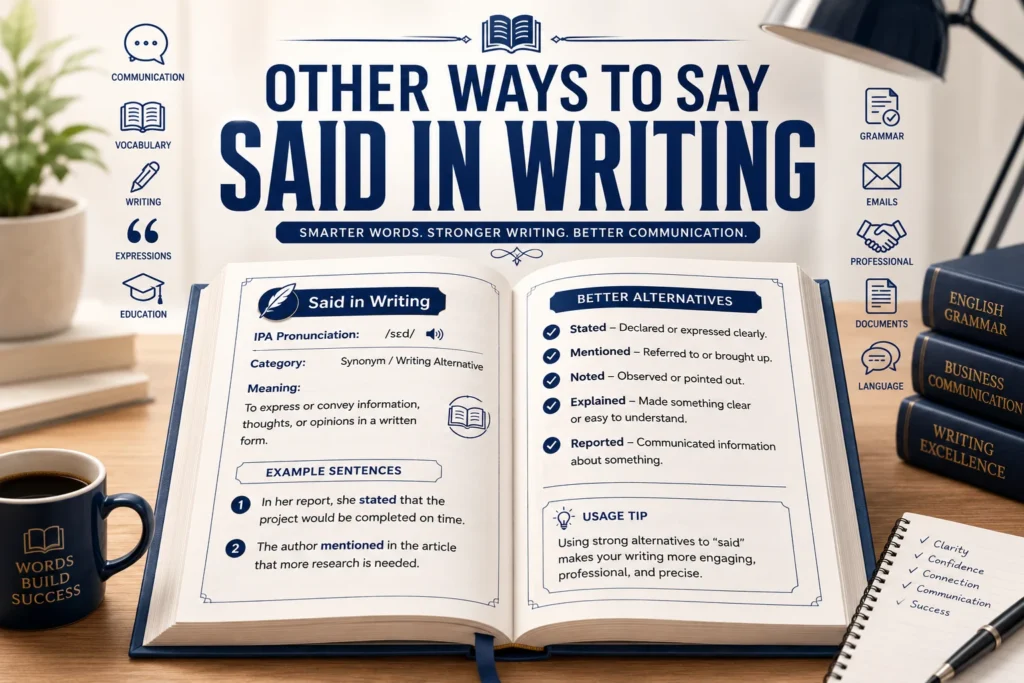
If you’ve ever written an essay, story, blog post, or business email, you’ve probably used the word “said” many times. While “said” is a perfectly correct dialogue tag, repeating it too often can make your writing feel repetitive and less engaging.
Learning other ways to say “said” in writing helps you add variety, show emotion, and make conversations sound more natural. The best alternative depends on the speaker’s tone, purpose, and the situation. For example, a character might whisper, explain, or announce, while a manager in a business email might state, confirm, or clarify.
In this guide, you’ll discover more than 50 alternatives to “said”, organized by tone and purpose. You’ll also learn when to use each word, avoid common mistakes, and improve your writing with practical examples.
What Does “Said” Mean in Writing?
“Said” is the most common reporting verb in English. It tells readers that someone spoke or communicated something.
Literal Meaning
Said means:
To speak words aloud or express something verbally.
Example:
“I’ll finish the report today,” Sarah said.
Why Is “Said” Used So Often?
Writers use “said” because it’s simple, clear, and almost invisible to readers. Most people don’t notice it, allowing the dialogue to stand out.
However, when “said” appears in nearly every sentence, your writing can feel repetitive. Replacing it occasionally with a more specific verb adds variety and helps readers understand how something was spoken.
Why Use Alternatives to “Said”?
Using different dialogue tags helps you:
- Make conversations more interesting.
- Show emotion instead of telling it.
- Avoid repetitive writing.
- Improve creative and business writing.
- Match the speaker’s tone.
- Create more engaging dialogue.
For example:
Repeated
“I’m ready,” John said.
“Let’s go,” Emma said.
“Don’t forget the tickets,” David said.
Improved
“I’m ready,” John replied.
“Let’s go,” Emma called.
“Don’t forget the tickets,” David reminded.
The second version feels more natural because each verb adds context.
When Should You Replace “Said”?
You don’t need to replace every instance of “said.” In fact, professional writers often keep “said” because it doesn’t distract readers.
Instead, use alternatives when they:
- Show emotion.
- Clarify how something was spoken.
- Improve the flow.
- Prevent repetition.
- Add useful detail.
Choose a stronger verb only when it adds meaning.
Professional Uses of “Said” Alternatives
Many alternatives work well outside of fiction. They can improve emails, reports, meetings, and workplace communication.
Business Emails
Instead of:
The manager said the meeting was postponed.
Use:
The manager confirmed the meeting was postponed.
Workplace Communication
Instead of:
Sarah said the report was complete.
Use:
Sarah reported that the report was complete.
Client Communication
Instead of:
The client said they approved the proposal.
Use:
The client confirmed their approval of the proposal.
Customer Service
Instead of:
The customer said the package arrived late.
Use:
The customer reported a delayed delivery.
Networking
Instead of:
She said she’d like to stay in touch.
Use:
She mentioned that she’d like to stay in touch.
Professional Alternatives to “Said”
These words are suitable for business writing, workplace communication, reports, and professional emails.
1. Stated
Meaning: Expressed something clearly and formally.
Tone: Professional
Best Use: Reports and official documents
Example:
The director stated that the policy would take effect immediately.
2. Explained
Meaning: Gave more information or clarification.
Tone: Professional
Best Use: Meetings and presentations
Example:
The engineer explained the new process.
3. Confirmed
Meaning: Verified that something is true.
Tone: Professional
Best Use: Client communication
Example:
The client confirmed the appointment.
4. Clarified
Meaning: Made something easier to understand.
Tone: Professional
Best Use: Workplace discussions
Example:
The manager clarified the project requirements.
5. Reported
Meaning: Shared information or findings.
Tone: Formal
Best Use: Reports and updates
Example:
The supervisor reported a successful inspection.
6. Mentioned
Meaning: Briefly referred to something.
Tone: Neutral
Best Use: Emails and conversations
Example:
She mentioned the upcoming conference.
7. Noted
Meaning: Pointed out an important detail.
Tone: Professional
Best Use: Business writing
Example:
The analyst noted a rise in sales.
8. Added
Meaning: Included extra information.
Tone: Neutral
Best Use: Conversations and reports
Example:
He added that more testing was needed.
9. Suggested
Meaning: Offered an idea or recommendation.
Tone: Professional
Best Use: Meetings
Example:
Maria suggested holding another review session.
10. Recommended
Meaning: Advised a course of action.
Tone: Professional
Best Use: Client communication
Example:
The consultant recommended updating the software.
11. Emphasized
Meaning: Gave special importance to something.
Tone: Professional
Best Use: Presentations
Example:
The CEO emphasized the importance of teamwork.
12. Observed
Meaning: Made a thoughtful remark.
Tone: Formal
Best Use: Reports and discussions
Example:
The researcher observed a significant improvement.
13. Indicated
Meaning: Suggested or pointed to something.
Tone: Professional
Best Use: Business reports
Example:
The survey indicated higher customer satisfaction.
14. Replied
Meaning: Responded to a question or statement.
Tone: Neutral
Best Use: Emails and conversations
Example:
She replied within a few minutes.
15. Responded
Meaning: Answered or reacted to something.
Tone: Professional
Best Use: Customer service and workplace communication
Example:
The support team responded promptly.
Formal Alternatives to “Said”
These verbs are ideal for academic writing, official documents, legal writing, and formal business communication.
1. Declared
Meaning: Announced something officially.
Tone: Formal
Example:
The committee declared the results.
2. Announced
Meaning: Made information public.
Tone: Formal
Example:
The company announced its expansion plans.
3. Asserted
Meaning: Stated something confidently.
Tone: Formal
Example:
The lawyer asserted that the evidence was sufficient.
4. Affirmed
Meaning: Confirmed something positively.
Tone: Formal
Example:
The witness affirmed the statement.
5. Remarked
Meaning: Made a spoken comment.
Tone: Formal
Example:
The professor remarked on the latest research.
Formal Alternatives to “Said”
6. Proclaimed
Meaning: Announced something publicly or officially.
Tone: Very Formal
Best Use: Speeches, announcements, historical writing
Example:
The mayor proclaimed the opening of the new community center.
7. Declared
Meaning: Stated something firmly or officially.
Tone: Formal
Best Use: Official statements and reports
Example:
The organization declared its commitment to sustainability.
8. Addressed
Meaning: Spoke about a specific issue or audience.
Tone: Professional
Best Use: Meetings, presentations, and conferences
Example:
The CEO addressed employee concerns during the meeting.
9. Commented
Meaning: Shared an opinion or observation.
Tone: Neutral Formal
Best Use: Business communication and articles
Example:
The manager commented on the team’s excellent performance.
10. Acknowledged
Meaning: Recognized or accepted something.
Tone: Formal
Best Use: Workplace communication and reports
Example:
The director acknowledged the challenges facing the project.
Friendly Alternatives to “Said”
These words make conversations sound more natural and engaging.
1. Told
Meaning: Gave information to someone.
Tone: Casual
Example:
Emma told me about the event.
2. Shared
Meaning: Communicated thoughts or experiences.
Tone: Friendly
Example:
He shared his ideas with the group.
3. Asked
Meaning: Requested information.
Tone: Neutral
Example:
She asked if I needed help.
4. Answered
Meaning: Replied to a question.
Tone: Neutral
Example:
James answered immediately.
5. Replied
Meaning: Responded to someone.
Tone: Friendly
Example:
Sarah replied with a smile.
6. Agreed
Meaning: Expressed the same opinion.
Tone: Positive
Example:
Everyone agreed with the proposal.
7. Promised
Meaning: Gave a commitment.
Tone: Warm
Example:
She promised to call tomorrow.
8. Joked
Meaning: Said something humorous.
Tone: Casual
Example:
Mark joked about the weather.
9. Admitted
Meaning: Confessed or accepted something.
Tone: Honest
Example:
He admitted making a mistake.
10. Encouraged
Meaning: Spoke to inspire confidence.
Tone: Supportive
Example:
The coach encouraged the team to stay focused.
Emotion-Based Alternatives to “Said”
These verbs show how something was spoken, making your writing more vivid.
1. Whispered
Meaning: Spoke very quietly.
Example:
“Be careful,” she whispered.
2. Shouted
Meaning: Spoke very loudly.
Example:
“Watch out!” he shouted.
3. Cried
Meaning: Spoke while upset or emotional.
Example:
“Please don’t leave,” she cried.
4. Exclaimed
Meaning: Spoke with excitement or surprise.
Example:
“That’s amazing!” she exclaimed.
5. Murmured
Meaning: Spoke softly and unclearly.
Example:
“I understand,” he murmured.
6. Sighed
Meaning: Spoke with tiredness or relief.
Example:
“Finally,” she sighed.
7. Laughed
Meaning: Spoke while laughing.
Example:
“You’re hilarious,” he laughed.
8. Complained
Meaning: Expressed dissatisfaction.
Example:
The customer complained about the delay.
9. Warned
Meaning: Gave advice about possible danger.
Example:
The teacher warned students about the deadline.
Meaning: Spoke firmly.
10. Insisted
Example:
She insisted on paying the bill.
Email & Workplace Alternatives to “Said”
These are especially useful in professional writing and business communication.
| Alternative | Meaning | Best Use | Example |
| Confirmed | Verified information | Client emails | The client confirmed the meeting. |
| Clarified | Made something clear | Workplace | HR clarified the new policy. |
| Explained | Gave details | Reports | The manager explained the changes. |
| Noted | Pointed out | Business emails | She noted an important issue. |
| Mentioned | Briefly referred to | Emails | He mentioned the deadline. |
| Recommended | Suggested action | Consulting | The advisor recommended new software. |
| Suggested | Offered an idea | Team meetings | She suggested another option. |
| Reported | Shared findings | Reports | The inspector reported no problems. |
| Responded | Replied professionally | Customer service | Support responded quickly. |
| Emphasized | Highlighted importance | Presentations | The CEO emphasized innovation. |
Quick Reference Table
| Instead of “Said” | Best For |
| Stated | Formal reports |
| Explained | Giving details |
| Confirmed | Business emails |
| Clarified | Meetings |
| Mentioned | Casual writing |
| Suggested | Recommendations |
| Recommended | Professional advice |
| Responded | Emails |
| Replied | Conversations |
| Whispered | Quiet dialogue |
| Shouted | Loud dialogue |
| Exclaimed | Excitement |
| Warned | Giving caution |
| Insisted | Strong opinions |
| Encouraged | Motivation |
Before and After Examples
Example 1
Before
“Let’s begin,” the manager said.
After
“Let’s begin,” the manager announced.
Example 2
Before
Sarah said the report was complete.
After
Sarah confirmed the report was complete.
Example 3
Before
The teacher said we should study harder.
After
The teacher encouraged us to study harder.
Example 4
Before
The customer said the order arrived late.
After
The customer reported a delayed delivery.
Example 5
Before
“That’s fantastic!” Emma said.
After
“That’s fantastic!” Emma exclaimed.
Common Mistakes When Replacing “Said”
1. Replacing Every “Said”
Not every dialogue tag needs a synonym. Sometimes “said” is still the best choice because it is simple and unobtrusive.
2. Choosing the Wrong Emotion
Don’t use whispered, shouted, or laughed unless they accurately describe how the words were spoken.
3. Using Fancy Words Unnecessarily
Words like pontificated or expostulated may confuse readers. Choose clear, natural alternatives.
4. Using Business Verbs in Fiction
Words like confirmed or reported fit professional writing better than casual dialogue.
5. Forgetting the Context
Always ask:
- How was it spoken?
- Who is speaking?
- What emotion should readers understand?
The best dialogue tags add meaning without distracting from the conversation.
Related Phrases to “Said” in Writing
These expressions are closely related to “said” and are commonly used in creative writing, business communication, academic writing, and everyday conversations.
| Phrase | Meaning | Example |
| Spoke | Talked or communicated verbally. | She spoke confidently during the meeting. |
| Told | Gave information to someone. | He told me the deadline had changed. |
| Mentioned | Briefly referred to something. | She mentioned the new project. |
| Explained | Made something clear. | The manager explained the policy. |
| Confirmed | Verified information. | The client confirmed the appointment. |
| Clarified | Removed confusion. | HR clarified the updated guidelines. |
| Replied | Responded to someone. | Emma replied politely. |
| Responded | Answered or reacted. | Customer support responded quickly. |
| Announced | Made something public. | The company announced a new product. |
| Stated | Expressed something formally. | The report stated the findings clearly. |
| Declared | Announced officially. | The committee declared the winner. |
| Suggested | Offered an idea. | David suggested another solution. |
| Recommended | Advised a course of action. | The consultant recommended updating the system. |
| Emphasized | Gave special importance to something. | The CEO emphasized teamwork. |
| Observed | Made a thoughtful remark. | The researcher observed an interesting trend. |
Phrase Comparison
Choosing the right alternative depends on the tone, purpose, and type of writing.
| Alternative | Tone | Formality | Best Use |
| Said | Neutral | Medium | General dialogue |
| Stated | Professional | High | Reports and official writing |
| Explained | Helpful | Medium | Instructions and presentations |
| Confirmed | Professional | High | Emails and client communication |
| Clarified | Professional | High | Meetings and workplace discussions |
| Mentioned | Neutral | Low | Casual conversations |
| Suggested | Professional | Medium | Recommendations |
| Recommended | Professional | High | Business writing |
| Whispered | Emotional | Low | Fiction and storytelling |
| Shouted | Strong | Low | Action scenes |
| Replied | Neutral | Medium | Conversations |
| Responded | Professional | Medium | Customer service |
| Announced | Formal | High | Public statements |
| Warned | Serious | Medium | Safety messages |
| Encouraged | Positive | Medium | Motivation and leadership |
Cultural Usage
US English
In American English, “said” is the standard dialogue tag in books, blogs, and articles. Writers often replace it with words like explained, replied, or confirmed only when those verbs add useful meaning.
UK English
British English follows a similar style. Good writing usually keeps “said” as the default and uses alternatives only when they accurately describe the speaker’s tone or intent.
Business Communication
Professional writing often avoids the generic word “said” in favor of more precise verbs.
Examples include:
- Confirmed
- Clarified
- Explained
- Stated
- Reported
- Recommended
These alternatives sound more professional in reports, proposals, and emails.
Customer Service
Customer service teams often use reporting verbs that clearly describe conversations.
Examples:
- The customer reported an issue.
- The agent explained the process.
- The representative confirmed the refund.
- The supervisor clarified the policy.
These verbs improve clarity and professionalism.
Creative Writing
In fiction, “said” remains the best choice most of the time because it is nearly invisible to readers. However, words like whispered, muttered, shouted, or exclaimed can add emotion when used sparingly.
FAQs
What are the best alternatives to “said” in writing?
Some of the best alternatives include stated, explained, confirmed, replied, responded, clarified, mentioned, suggested, recommended, and announced.
Should I avoid using “said” in writing?
No. Professional authors often use “said” because it is simple and easy for readers to follow. Replace it only when another verb adds useful meaning or emotion.
What is the most professional synonym for “said”?
Professional alternatives include:
- Stated
- Confirmed
- Clarified
- Explained
- Reported
- Noted
These work well in workplace communication and business writing.
What can I use instead of “said” in dialogue?
You can use:
- Replied
- Whispered
- Shouted
- Asked
- Murmured
- Exclaimed
- Insisted
- Warned
Choose the verb that matches the speaker’s emotion.
Which alternatives are best for business emails?
The best options are:
- Confirmed
- Clarified
- Explained
- Mentioned
- Stated
- Recommended
These sound professional and clear.
Is “stated” more formal than “said”?
Yes. “Stated” sounds more formal and is commonly used in reports, contracts, official emails, and academic writing.
Can I use “mentioned” instead of “said”?
Yes, when someone briefly refers to a topic rather than making a detailed statement.
Example:
She mentioned the upcoming conference.
What words show emotion better than “said”?
Use:
- Whispered
- Cried
- Exclaimed
- Murmured
- Shouted
- Laughed
- Complained
- Warned
These help readers understand how something was spoken.
What is the best synonym for “said” in formal writing?
Excellent choices include:
- Stated
- Declared
- Asserted
- Affirmed
- Reported
These fit academic, legal, and business documents.
How can I avoid repeating “said”?
Mix “said” with meaningful alternatives like replied, explained, confirmed, and suggested, but only when they naturally fit the context. Don’t replace every instance just for variety.
Final Summary
Using other ways to say “said” in writing can make your work more engaging, expressive, and professional. While “said” remains the best choice in many situations because of its simplicity, carefully chosen alternatives such as stated, explained, confirmed, clarified, replied, and recommended add precision and variety. Whether you’re writing a business email, a report, an academic paper, or a novel, selecting the right reporting verb helps readers understand the speaker’s tone and intent. Use stronger alternatives only when they add meaningful context, and let “said” remain your reliable default for clear, natural writing.
Conclusion
Learning other ways to say “said” in writing improves both clarity and style. The key is not to replace every use of “said,” but to choose alternatives that accurately reflect the speaker’s tone, emotion, or purpose. Professional verbs like “confirmed,” “clarified,” and “stated” strengthen business writing, while expressive words such as “whispered,” “shouted,” and “exclaimed” make creative writing more vivid. By using dialogue tags thoughtfully, you can avoid repetition, create more engaging content, and communicate ideas more effectively in emails, workplace documents, stories, and everyday writing.