
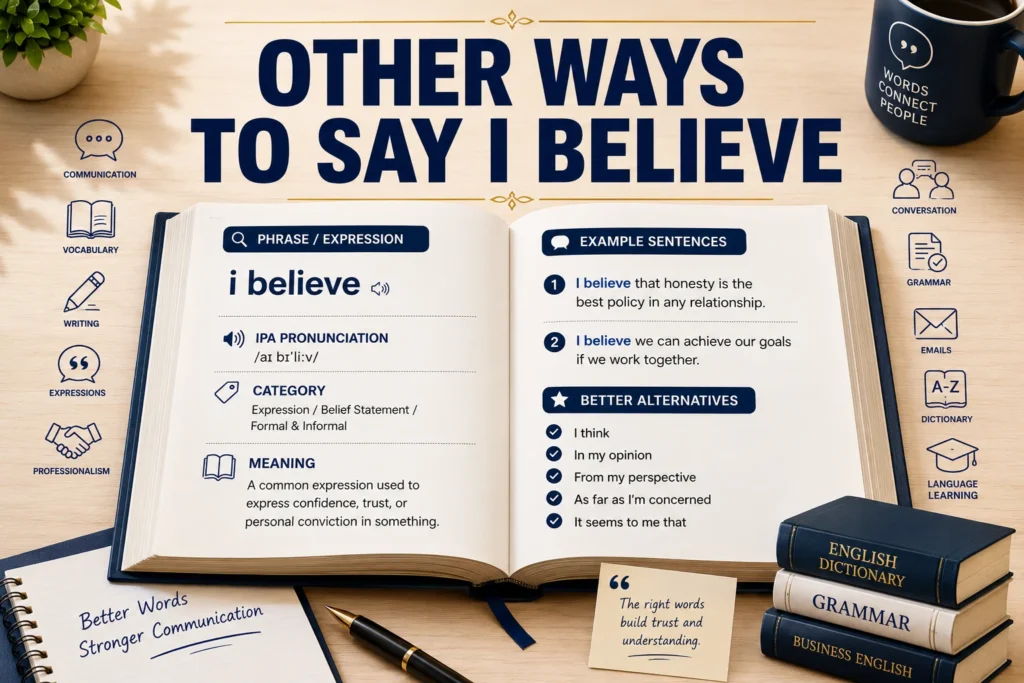
The phrase “I believe” is one of the most common ways to express an opinion, share a perspective, or present an idea in English. Whether you’re writing a business email, speaking in a meeting, giving feedback, or having a casual conversation, knowing other ways to say “I believe” can make your communication sound more confident, professional, and engaging.
Although “I believe” is polite and widely accepted, using it repeatedly can make your writing feel repetitive. In professional communication, choosing the right alternative helps you match the tone of your audience, whether you’re emailing a client, discussing ideas with coworkers, networking with professionals, or responding to customers.
This guide explores the best professional ways to say “I believe,” formal alternatives, friendly expressions, and workplace phrases. You’ll also learn when to use each expression, complete with practical examples to improve your professional communication, business email writing, and workplace communication.
What Does “I Believe” Mean?
“I believe” is used to express a personal opinion, judgment, assumption, or level of confidence about something. It signals that the speaker thinks something is true, even if it is not presented as an absolute fact.
Unlike phrases such as “I know”, which express certainty, “I believe” leaves room for discussion and shows humility.
Literal Meaning
The phrase means:
“In my opinion, I think this is true.”
It expresses a viewpoint rather than a proven fact
Tone
“I believe” usually sounds:
- Professional
- Respectful
- Thoughtful
- Confident
- Open-minded
Its tone makes it appropriate in both formal and informal conversations.
Purpose
People use “I believe” to:
- Share opinions
- Make recommendations
- Present ideas
- Express confidence politely
- Avoid sounding too forceful
- Encourage discussion
Emotional Context
“I believe” strikes a balance between confidence and respect. It allows you to express your thoughts without sounding overly assertive or dismissive of others’ opinions.
For example:
Less Collaborative
This is the best solution.
More Collaborative
I believe this is the best solution because it reduces costs.
The second version invites discussion while still expressing confidence.
Examples of “I Believe” in Different Situations
Business Email
I believe the proposed timeline will meet the client’s expectations.
Workplace Meeting
I believe we should review the budget before making a final decision.
Customer Service
I believe we’ve identified the issue, and our team is working on a solution.
Networking
I believe our organizations could work well together.
Everyday Conversation
I believe that’s the restaurant we visited last year.
Why People Look for Other Ways to Say “I Believe”
Although “I believe” is a useful phrase, repeating it too often can make your communication sound predictable. Different situations call for different levels of confidence and formality.
People search for alternatives because they want to:
- Sound more professional in business emails.
- Avoid repeating the same phrase.
- Express opinions with greater confidence.
- Match the level of formality.
- Improve workplace communication.
- Write stronger reports and presentations.
- Build credibility with clients and colleagues.
- Follow professional email etiquette.
Using a variety of expressions makes your communication more natural and persuasive.
Professional Usage of “I Believe”
Knowing when and how to use “I believe” is an important part of professional communication.
1. In Business Emails
“I believe” is ideal when presenting suggestions without sounding demanding.
Example:
I believe this approach will improve customer satisfaction.
This wording sounds confident while inviting discussion.
2. In the Workplace
Managers and employees often use “I believe” when proposing ideas or solving problems.
Example:
I believe we can complete the project ahead of schedule.
3. With Clients
Client communication should sound confident but respectful.
Example:
I believe this solution best meets your business requirements.
4. During Networking
Networking conversations benefit from language that expresses confidence without appearing arrogant.
Example:
I believe there’s an opportunity for us to collaborate in the future.
5. In Customer Service
Support teams often use “I believe” when explaining information that is likely correct but still being verified.
Example:
I believe your order has already been shipped, but I’ll confirm that for you.
Professional Alternatives to “I Believe”
These alternatives are excellent for business communication, reports, meetings, and professional emails.
1. I Think
Meaning: Expresses an opinion naturally.
Tone: Neutral Professional
Best Use: Everyday workplace conversations
Example:
I think this strategy offers the best long-term results.
2. In My Opinion
Meaning: Clearly introduces a personal viewpoint.
Tone: Professional
Best Use: Discussions and presentations
Example:
In my opinion, the second proposal is more practical.
3. From My Perspective
Meaning: Shares your viewpoint respectfully.
Tone: Professional
Best Use: Meetings
Example:
From my perspective, improving customer support should be our priority.
4. I Would Suggest
Meaning: Politely recommends an idea.
Tone: Professional
Best Use: Emails and workplace communication
Example:
I would suggest scheduling another review before launch.
5. It Seems to Me
Meaning: Expresses a thoughtful observation.
Tone: Professional
Best Use: Team discussions
Example:
It seems to me that demand is increasing.
6. I Am of the Opinion That
Meaning: A formal way to express an opinion.
Tone: Formal
Best Use: Reports and official documents
Example:
I am of the opinion that additional testing is necessary.
7. I Feel
Meaning: Shares a personal opinion or judgment.
Tone: Warm Professional
Best Use: Feedback sessions
Example:
I feel this process could be simplified.
8. My View Is
Meaning: States your viewpoint directly.
Tone: Professional
Best Use: Meetings
Example:
My view is that customer feedback should guide our next steps.
9. I Would Say
Meaning: Offers an opinion conversationally.
Tone: Friendly Professional
Best Use: Discussions
Example:
I would say the project has been successful overall.
10. As I See It
Meaning: Introduces a personal perspective.
Tone: Professional
Best Use: Presentations
Example:
As I see it, expanding our online presence is essential.
11. I Assume
Meaning: Expresses a reasonable expectation.
Tone: Neutral
Best Use: Clarifying information
Example:
I assume the meeting will begin at 10 a.m.
12. I Expect
Meaning: Shows confidence about a likely outcome.
Tone: Professional
Best Use: Planning and forecasting
Example:
I expect sales to increase next quarter.
13. I Understand
Meaning: Indicates your current understanding.
Tone: Professional
Best Use: Confirming information
Example:
I understand the report will be finalized tomorrow.
14. It Appears That
Meaning: Makes an evidence-based observation.
Tone: Formal
Best Use: Reports and analysis
Example:
It appears that customer demand is growing steadily.
15. Based on My Experience
Meaning: Supports your opinion with experience.
Tone: Professional
Best Use: Leadership and consulting
Example:
Based on my experience, early planning leads to better outcomes.
Formal Alternatives to “I Believe”
These expressions are ideal for executive communication, academic writing, official correspondence, legal documents, and formal business reports.
1. I Am Convinced That
Meaning: Expresses strong confidence in an opinion.
Tone: Very Formal
Best Use: Reports and presentations
Example:
I am convinced that this strategy will strengthen our market position.
2. It Is My View That
Meaning: Introduces a formal opinion.
Tone: Formal
Best Use: Official documents
Example:
It is my view that additional research is required.
3. I Hold the View That
Meaning: States a carefully considered opinion.
Tone: Formal
Best Use: Professional reports
Example:
I hold the view that customer satisfaction should remain our highest priority.
4. I Maintain That
Meaning: Confidently supports an opinion.
Tone: Formal
Best Use: Debates and persuasive writing
Example:
I maintain that investing in employee training will improve performance.
5. It Is My Understanding That
Meaning: Shares your current understanding politely.
Tone: Professional
Best Use: Business emails and client communication
Example:
It is my understanding that the agreement will take effect next month.
6. I Am Inclined to Believe
Meaning: Expresses a thoughtful opinion based on available information.
Tone: Formal
Best Use: Reports, meetings, and professional discussions
Example:
I am inclined to believe this approach offers the greatest long-term value.
7. I Consider That
Meaning: States a carefully formed opinion.
Tone: Formal
Best Use: Business reports and presentations
Example:
I consider that improving customer support should be our top priority.
8. It Appears to Me That
Meaning: Shares an observation without sounding overly certain.
Tone: Formal
Best Use: Analysis and workplace communication
Example:
It appears to me that the current process can be improved.
9. I Am Confident That
Meaning: Expresses a strong, positive belief.
Tone: Professional
Best Use: Leadership communication and client meetings
Example:
I am confident that our team can achieve this goal.
10. I Firmly Believe
Meaning: Shows strong personal conviction.
Tone: Formal
Best Use: Speeches, proposals, and persuasive writing
Example:
I firmly believe this investment will benefit the company.
Friendly Alternatives to “I Believe”
These expressions are ideal for conversations with friends, teammates, classmates, and people you know well.
1. I Think
Meaning: A simple way to share an opinion.
Tone: Casual
Best Use: Everyday conversations
Example:
I think that’s a great idea.
2. I’d Say
Meaning: Offers a relaxed opinion.
Tone: Friendly
Best Use: Informal discussions
Example:
I’d say this is our best option.
3. If You Ask Me
Meaning: Introduces a personal opinion.
Tone: Casual
Best Use: Friendly conversations
Example:
If you ask me, we should leave early.
4. As Far As I’m Concerned
Meaning: Shares your personal viewpoint.
Tone: Friendly
Best Use: Group discussions
Example:
As far as I’m concerned, the project is ready.
5. Personally
Meaning: Gives your individual opinion.
Tone: Casual
Best Use: Conversations
Example:
Personally, I like the first design.
6. From What I Can Tell
Meaning: Shares an opinion based on what you’ve observed.
Tone: Friendly
Best Use: Everyday discussions
Example:
From what I can tell, everything is running smoothly.
7. My Guess Is
Meaning: Makes an educated guess.
Tone: Casual
Best Use: Informal situations
Example:
My guess is they’ll arrive around noon.
8. I’d Imagine
Meaning: Expresses a likely opinion.
Tone: Friendly
Best Use: Conversations
Example:
I’d imagine they’ll accept the proposal.
9. It Looks Like
Meaning: Shares an observation.
Tone: Casual
Best Use: Everyday communication
Example:
It looks like we’re almost finished.
10. I’d Imagine So
Meaning: Politely agrees or expresses belief.
Tone: Friendly
Best Use: Casual conversations
Example:
I’d imagine so, based on what we’ve heard.
Email Alternatives to “I Believe”
These alternatives sound polished and follow good business email etiquette.
1. I Understand
Meaning: Shares your current understanding.
Tone: Professional
Best Use: Client emails
Example:
I understand the project is scheduled for next Monday.
2. It Appears That
Meaning: Makes an evidence-based observation.
Tone: Professional
Best Use: Reports and updates
Example:
It appears that demand has increased significantly.
3. Based on the Information Available
Meaning: Shows your opinion is based on facts.
Tone: Formal
Best Use: Business emails
Example:
Based on the information available, the proposal meets our requirements.
4. From My Perspective
Meaning: Shares your viewpoint respectfully.
Tone: Professional
Best Use: Team communication
Example:
From my perspective, this timeline is realistic.
5. In My Opinion
Meaning: Clearly states your opinion.
Tone: Professional
Best Use: Recommendations
Example:
In my opinion, the revised plan is more efficient.
6. I Recommend
Meaning: Gives a professional recommendation.
Tone: Professional
Best Use: Client communication
Example:
I recommend approving the updated proposal.
7. I Suggest
Meaning: Offers an idea politely.
Tone: Professional
Best Use: Workplace emails
Example:
I suggest reviewing the budget before moving forward.
8. I Am Confident
Meaning: Shows confidence.
Tone: Professional
Best Use: Leadership emails
Example:
I am confident our team will meet the deadline.
9. My Recommendation Is
Meaning: Introduces advice professionally.
Tone: Formal
Best Use: Business proposals
Example:
My recommendation is to begin implementation next month.
10. It Is My View That
Meaning: Presents a formal opinion.
Tone: Formal
Best Use: Executive communication
Example:
It is my view that this strategy offers the strongest return.
Workplace Alternatives to “I Believe”
These expressions are ideal for meetings, presentations, teamwork, and leadership communication.
1. I Recommend
Meaning: Gives professional advice.
Tone: Professional
Best Use: Meetings
Example:
I recommend moving forward with option two.
2. My Recommendation Is
Meaning: Presents your preferred option.
Tone: Professional
Best Use: Reports
Example:
My recommendation is to extend the deadline.
3. I Suggest
Meaning: Offers a solution politely.
Tone: Professional
Best Use: Team discussions
Example:
I suggest reviewing customer feedback first.
4. From My Experience
Meaning: Supports your opinion with experience.
Tone: Professional
Best Use: Leadership
Example:
From my experience, early planning prevents delays.
5. I Am Confident
Meaning: Shows certainty.
Tone: Professional
Best Use: Presentations
Example:
I am confident we’ll reach our targets.
6. I Would Recommend
Meaning: Makes a respectful suggestion.
Tone: Professional
Best Use: Client meetings
Example:
I would recommend updating the proposal.
7. It Makes Sense To
Meaning: Suggests a logical action.
Tone: Professional
Best Use: Problem-solving
Example:
It makes sense to review the data first.
8. The Best Approach Is
Meaning: Recommends a course of action.
Tone: Professional
Best Use: Strategy meetings
Example:
The best approach is to complete testing before launch.
9. I See It This Way
Meaning: Shares your viewpoint.
Tone: Friendly Professional
Best Use: Team discussions
Example:
I see it this way: improving communication will increase productivity.
10. My View Is
Meaning: Expresses your opinion clearly.
Tone: Professional
Best Use: Meetings
Example:
My view is that customer satisfaction should remain our priority.
Expert Tip: Choose the Right Alternative
Instead of using “I believe” in every situation, match your wording to your audience.
- Clients: I recommend, I am confident, Based on the information available
- Managers: From my perspective, I suggest, My recommendation is
- Coworkers: I think, I’d say, My view is
- Presentations: I am convinced, I firmly believe, It is my view that
- Emails: I understand, It appears that, In my opinion
Using varied expressions makes your communication more natural, persuasive, and professional.
Quick Comparison Table
| Alternative | Tone | Best Use |
| I Think | Casual | Everyday conversations |
| In My Opinion | Professional | Meetings and discussions |
| From My Perspective | Professional | Workplace communication |
| I Suggest | Professional | Business emails |
| I Recommend | Professional | Client communication |
| I Am Confident | Professional | Leadership and presentations |
| It Appears That | Formal | Reports and analysis |
| I Understand | Professional | Email communication |
| My Recommendation Is | Formal | Business proposals |
| I Firmly Believe | Formal | Speeches and persuasive writing |
| Based on My Experience | Professional | Consulting and leadership |
| My View Is | Professional | Team meetings |
| I’d Say | Friendly | Informal workplace discussions |
| Personally | Casual | Everyday conversations |
| It Makes Sense To | Professional | Problem-solving meetings |
Email Examples
Client
I recommend proceeding with the updated strategy, as it better aligns with your business objectives.
Manager
From my perspective, extending the deadline by one week will improve the quality of the final deliverable.
Colleague
I think we should review the presentation one more time before sending it.
Customer
I understand your concern, and we’re reviewing the matter carefully.
Networking
I believe our experience could complement each other, and I’d welcome the opportunity to connect further.
Meeting Follow-up
My recommendation is to finalize the action items before our next meeting.
Common Mistakes
1. Repeating “I Believe”
Using the same phrase throughout an email or presentation can make your communication sound repetitive.
2. Sounding Too Uncertain
Avoid weak combinations like:
I believe maybe we could possibly…
Instead, write:
I recommend moving forward with this option.
3. Being Too Forceful
Don’t present opinions as facts unless you have evidence.
4. Using Casual Language in Formal Emails
Avoid phrases like “I’d guess” or “If you ask me” when writing to clients or senior leaders.
5. Ignoring Your Audience
Choose language that matches the situation. Professional alternatives improve clarity, confidence, and credibility.
Related Phrases to “I Believe”
These expressions are closely related to “I believe” and help you express opinions, assumptions, confidence, recommendations, or observations in both professional and everyday communication.
| Phrase | Meaning | Example |
| I Think | A simple way to express an opinion. | I think this strategy will work well. |
| In My Opinion | Introduces a personal viewpoint. | In my opinion, the second proposal is stronger. |
| From My Perspective | Shares your point of view respectfully. | From my perspective, customer feedback is essential. |
| As I See It | Explains how you view a situation. | As I see it, we should wait for more data. |
| I Feel | Expresses a personal opinion. | I feel this approach is more practical. |
| It Seems to Me | Makes a thoughtful observation. | It seems to me that demand is increasing. |
| I Assume | Indicates a reasonable expectation. | I assume the meeting begins at 10 a.m. |
| I Understand | Shows your current understanding. | I understand the report is complete. |
| I Expect | Expresses confidence about the future. | I expect sales to improve next quarter. |
| I Suspect | Suggests an opinion with some uncertainty. | I suspect we’ll receive approval soon. |
| I Am Convinced | Shows strong confidence. | I am convinced this plan will succeed. |
| Based on My Experience | Supports an opinion with experience. | Based on my experience, planning reduces delays. |
| My View Is | States your viewpoint directly. | My view is that quality should come first. |
| I Would Say | Gives a conversational opinion. | I would say this is our best option. |
| It Appears That | Makes an evidence-based observation. | It appears that customer demand is growing. |
Phrase Comparison
Choosing the right alternative depends on how confident, formal, or collaborative you want to sound.
| Phrase | Tone | Formality | Best Use |
| I Believe | Professional | Medium | General business communication |
| I Think | Casual | Low | Everyday conversations |
| In My Opinion | Professional | Medium | Meetings and discussions |
| From My Perspective | Professional | Medium | Workplace communication |
| I Recommend | Professional | Medium | Client communication |
| I Suggest | Professional | Medium | Emails and teamwork |
| I Am Confident | Strong | High | Leadership and presentations |
| It Appears That | Objective | High | Reports and analysis |
| Based on My Experience | Credible | Medium | Consulting and management |
| I Firmly Believe | Convincing | High | Speeches and persuasive writing |
| My View Is | Professional | Medium | Team meetings |
| I Understand | Neutral | Medium | Email communication |
| I Assume | Careful | Medium | Clarifying information |
| I’d Say | Friendly | Low | Informal workplace discussions |
| Personally | Casual | Low | Friendly conversations |
Cultural Usage
US English
In American English, “I believe” is widely used in business meetings, presentations, and emails. However, professionals often vary their language with phrases like “I think,” “I recommend,” or “From my perspective” to sound more natural and engaging.
UK English
British English tends to use softer expressions that sound less direct. Common alternatives include:
- I would suggest…
- It seems to me…
- I would say…
- In my view…
These phrases promote collaboration and polite discussion.
Corporate Communication
In corporate settings, opinions should sound confident while remaining respectful.
Instead of writing:
I believe this is correct.
Many professionals write:
Based on the available data, I recommend this approach.
This sounds more evidence-based and persuasive.
Customer Service
Customer service representatives often avoid making absolute statements. Helpful alternatives include:
- I understand…
- It appears that…
- Based on the information available…
- I believe…
These expressions provide reassurance while allowing room to verify information if needed.
Networking
When networking, confidence matters, but humility builds stronger relationships.
Examples include:
- I believe our experience aligns well.
- From my perspective, there’s a great opportunity to collaborate.
- I would love to hear your thoughts.
These phrases encourage open and respectful conversations.
FAQs
What are other ways to say “I believe” professionally?
Professional alternatives include I recommend, From my perspective, In my opinion, I am confident, My view is, and Based on my experience.
What is a formal alternative to “I believe”?
Formal alternatives include I am convinced that, It is my view that, I maintain that, I hold the view that, and I am inclined to believe.
Is “I believe” professional?
Yes. “I believe” is professional because it expresses confidence while leaving room for discussion. It is commonly used in emails, meetings, reports, and presentations.
What is the best alternative to “I believe” in a business email?
Some of the best choices are:
- I recommend
- From my perspective
- I understand
- It appears that
- Based on the information available
These sound professional and polished.
Is “I think” less professional than “I believe”?
Generally, yes. “I think” is more conversational, while “I believe” often sounds more thoughtful and confident in formal communication.
What should I use instead of “I believe” in a presentation?
Try:
- I am confident that…
- Based on our findings…
- It is my view that…
- I firmly believe…
These phrases sound persuasive and authoritative.
Which phrase is best for client communication?
I recommend, I am confident, and Based on the available information are excellent choices because they sound clear, respectful, and solution-focused.
Can I use “I believe” in workplace communication?
Yes. It is suitable for meetings, project discussions, feedback sessions, and internal emails because it expresses ideas respectfully.
How can I avoid repeating “I believe” in writing?
Use alternatives such as:
- In my opinion
- From my perspective
- I recommend
- It appears that
- Based on my experience
- I suggest
These add variety and improve readability.
What is the best synonym for “I believe”?
The best synonym depends on the context:
- Professional: I recommend
- Formal: I am convinced that
- Email: From my perspective
- Workplace: I suggest
- Casual: I think
Final Summary
Knowing other ways to say “I believe” helps you communicate your ideas with greater confidence and professionalism. While “I believe” is a respectful and versatile phrase, using alternatives such as “From my perspective,” “I recommend,” “I am confident,” or “Based on my experience” allows you to match the tone to your audience and purpose. Whether you’re writing business emails, speaking with clients, collaborating with coworkers, or networking with professionals, choosing the right expression improves clarity, strengthens credibility, and makes your communication more engaging.
Conclusion
Learning other ways to say “I believe” allows you to express opinions more effectively in every situation. The right phrase depends on your audience, your level of confidence, and the formality of the conversation. In professional settings, alternatives such as “I recommend,” “From my perspective,” and “I am confident” create a polished and credible impression. In casual conversations, expressions like “I think” and “I’d say” sound natural and friendly. By expanding your vocabulary and choosing the most appropriate alternative, you can communicate your ideas clearly, build stronger relationships, and enhance your professional communication skills.