
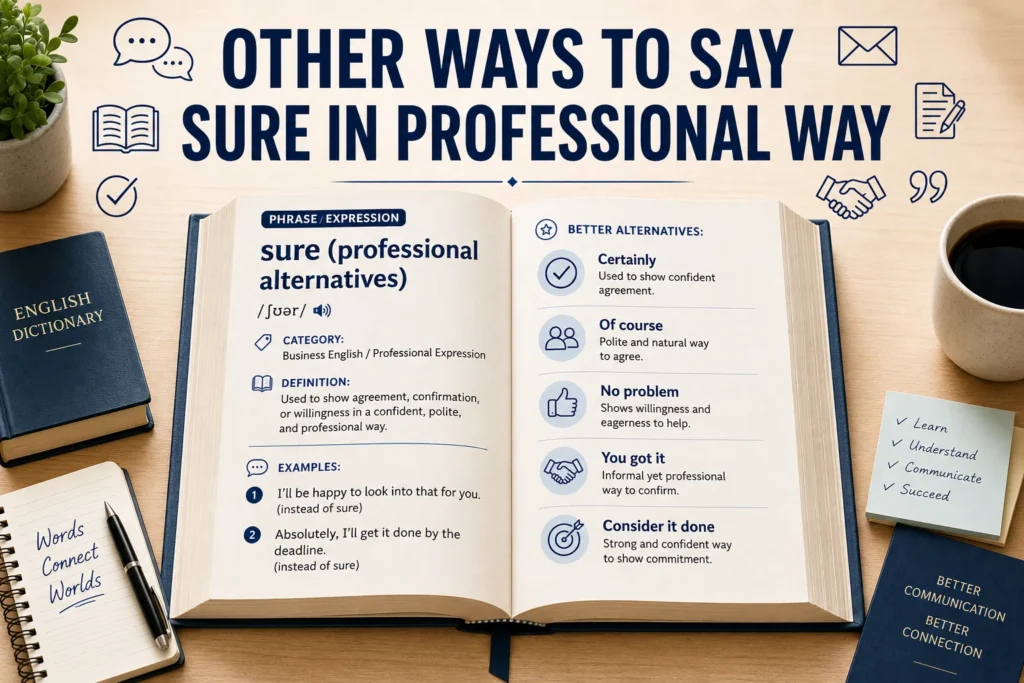
Looking for other ways to say sure in a professional way? You’re not alone. While sure is one of the most common responses in English, it can sound too casual in business emails, workplace conversations, and client communication. Choosing a more professional alternative helps you sound confident, respectful, and polished.
Whether you’re replying to a manager, client, colleague, or customer, using the right words can improve your professional communication and create a positive impression. Instead of saying sure every time, you can use expressions that better match the tone of the conversation.
In this guide, you’ll learn professional, formal, and workplace-friendly alternatives to sure, along with meanings, examples, and best use cases. These phrases will help you write better emails, communicate effectively at work, and build stronger business relationships.
What Does “Sure” Mean?
The word sure is commonly used to show agreement, willingness, confirmation, or confidence. It simply means yes, certainly, or I agree.
Although it’s natural in everyday conversations, it may sound too informal in professional settings. That’s why many people look for a professional way to say sure when writing business emails or speaking with clients.
Examples
- Casual: Sure, I’ll send it today.
- Professional: Certainly. I’ll send it by the end of the day.
- Casual: Sure, I can help.
- Professional: I’d be happy to assist.
- Casual: Sure, that’s fine.
- Professional: That works perfectly for me.
Using the right alternative depends on your audience and the level of formality.
Why Do People Search for Alternatives to “Sure”?
Many professionals replace sure with stronger expressions to make their communication sound more polished.
1. To Sound More Professional
Words like certainly, absolutely, or I’d be happy to create a better impression in business communication.
2. To Avoid Repetition
Using sure repeatedly in emails or meetings can make your communication feel repetitive.
3. To Match the Situation
Different situations require different tones. A client email should sound more formal than a quick message to a colleague.
4. To Improve Workplace Communication
Professional alternatives help build trust, show respect, and demonstrate confidence.
5. To Write Better Business Emails
Replacing sure with more precise language improves email etiquette and makes your writing more effective.
When Should You Use Professional Alternatives to “Sure”?
Business Emails
Professional replies make emails sound courteous and polished.
Example:
Certainly. I’ll send the updated proposal this afternoon.
Workplace Communication
Managers and colleagues often appreciate clear and respectful responses.
Example:
Absolutely. I’ll complete the report before tomorrow’s meeting.
Client Communication
Clients expect confident and professional language.
Example:
I’d be happy to assist you with your request.
Customer Service
Helpful and reassuring language creates a better customer experience.
Example:
Of course. We’ll be glad to help resolve the issue.
Networking
Professional wording helps create a positive first impression.
Example:
I’d be delighted to connect and discuss future opportunities.
Professional Alternatives to “Sure”
1. Certainly
Meaning: A polite and confident way to say yes.
Tone: Professional
Best Use: Business emails, clients
Example:
Certainly. I’ll send the requested documents today.
2. Absolutely
Meaning: Strong agreement or willingness.
Tone: Professional
Best Use: Workplace communication
Example:
Absolutely. I’d be happy to help with the project.
3. Of Course
Meaning: Showing willingness without hesitation.
Tone: Friendly Professional
Example:
Of course. Let me know if you need anything else.
4. I’d Be Happy To
Meaning: A polite offer to help.
Tone: Professional
Best Use: Client emails
Example:
I’d be happy to answer any additional questions.
5. I’d Be Glad To
Meaning: A courteous way to accept a request.
Tone: Professional
Example:
I’d be glad to schedule the meeting for next week.
6. Definitely
Meaning: Strong confirmation.
Tone: Professional
Best Use: Internal workplace communication
Example:
Definitely. I’ll complete the task before the deadline.
7. Without a Doubt
Meaning: Expresses complete confidence.
Tone: Formal
Example:
Without a doubt, we’ll support your team throughout the project.
8. By All Means
Meaning: Giving permission politely.
Tone: Formal
Example:
By all means, feel free to contact me if you have questions.
9. It Would Be My Pleasure
Meaning: A highly polite way to accept a request.
Tone: Formal
Example:
It would be my pleasure to assist with your presentation.
10. Consider It Done
Meaning: Confirming that a task will be completed.
Tone: Professional
Example:
Consider it done. I’ll update the document today.
11. You Can Count on Me
Meaning: Promising reliability.
Tone: Professional
Example:
You can count on me to finish the report on time.
12. I’m Happy to Help
Meaning: Offering assistance politely.
Tone: Friendly Professional
Example:
I’m happy to help if you need further clarification.
13. That Works for Me
Meaning: Agreeing with a suggestion.
Tone: Workplace
Example:
Thursday at 2 PM works perfectly for me.
14. No Problem
Meaning: Accepting a request casually.
Tone: Casual Professional
Example:
No problem. I’ll take care of it.
15. I’ll Take Care of It
Meaning: Confirming responsibility for a task.
Tone: Professional
Example:
I’ll take care of it and keep you updated on the progress.
Professional Alternatives to “Sure”
In this section, you’ll find more ways to say sure in a professional way. These alternatives are grouped by category to help you choose the right expression for business emails, workplace communication, client interactions, networking, and customer service.
Formal Alternatives
16. Certainly Not a Problem
Meaning: A polite way to accept a request.
Tone: Formal
Best Use: Client emails
Example:
Certainly not a problem. I’ll prepare the report today.
17. With Pleasure
Meaning: Showing willingness to help.
Tone: Formal
Example:
With pleasure. I’ll arrange the meeting.
18. I Can Certainly Do That
Meaning: Confidently accepting a task.
Tone: Professional
Example:
I can certainly do that before the deadline.
19. It Will Be Done
Meaning: Confirming that the task will be completed.
Tone: Formal
Example:
It will be done by Friday afternoon.
20. You Have My Confirmation
Meaning: Official approval or agreement.
Tone: Formal
Example:
You have my confirmation for the proposed schedule.
21. That’s Acceptable
Meaning: Agreeing professionally.
Tone: Formal
Example:
That’s acceptable. Let’s move forward.
22. I Agree Completely
Meaning: Showing full agreement.
Tone: Professional
Example:
I agree completely with your recommendation.
23. You Have My Full Support
Meaning: Showing commitment.
Tone: Professional
Example:
You have my full support throughout the project.
24. Please Proceed
Meaning: Giving permission.
Tone: Formal
Example:
Please proceed with the next phase.
25. That Is Perfectly Fine
Meaning: Politely agreeing.
Tone: Professional
Example:
That is perfectly fine with me.
Friendly Alternatives
26. Sounds Good
Meaning: Informal agreement.
Tone: Friendly
Example:
Sounds good. I’ll see you tomorrow.
27. Happy to Do So
Meaning: Willing to help.
Tone: Friendly Professional
Example:
Happy to do so. I’ll send the details shortly.
28. No Worries
Meaning: Casual reassurance.
Tone: Friendly
Example:
No worries. I’ll handle it.
29. Happy to Help
Meaning: Offering assistance.
Tone: Friendly Professional
Example:
Happy to help if you need anything else.
30. I’d Love To
Meaning: Enthusiastic agreement.
Tone: Friendly
Example:
I’d love to join the meeting.
Email Alternatives
31. I’ll Be Happy to Assist
Meaning: Professional offer to help.
Tone: Business Email
Example:
I’ll be happy to assist with your request.
32. I’ll Handle It
Meaning: Taking responsibility.
Tone: Professional
Example:
I’ll handle it and update you once it’s completed.
33. Thank You for Letting Me Know
Meaning: Acknowledging information politely.
Tone: Professional
Example:
Thank you for letting me know. I’ll make the necessary changes.
34. I’ll Get Right on It
Meaning: Starting the task immediately.
Tone: Professional
Example:
I’ll get right on it and keep you updated.
35. I’d Be Delighted To
Meaning: Formal willingness to help.
Tone: Formal
Example:
I’d be delighted to discuss this opportunity further.
Workplace Alternatives
36. I Can Take Care of That
Meaning: Accepting responsibility.
Tone: Workplace
Example:
I can take care of that before lunch.
37. Let’s Move Forward
Meaning: Agreeing to continue.
Tone: Professional
Example:
Everything looks good. Let’s move forward.
38. I Fully Support This
Meaning: Showing approval.
Tone: Workplace
Example:
I fully support this proposal.
39. That Makes Sense
Meaning: Agreeing with an idea.
Tone: Professional
Example:
That makes sense. Let’s implement the new process.
40. I Appreciate the Opportunity
Meaning: Accepting politely while showing gratitude.
Tone: Professional
Example:
I appreciate the opportunity and would be happy to contribute.
Quick Comparison Table
| Alternative | Tone | Best Use |
| Certainly | Professional | Client emails |
| Absolutely | Professional | Workplace |
| Of Course | Friendly Professional | General emails |
| I’d Be Happy To | Professional | Clients |
| Consider It Done | Professional | Task confirmation |
| You Can Count on Me | Professional | Teamwork |
| Happy to Help | Friendly | Customer service |
| Please Proceed | Formal | Approvals |
| Sounds Good | Friendly | Colleagues |
| I’ll Handle It | Professional | Workplace |
| Let’s Move Forward | Professional | Meetings |
| I Fully Support This | Workplace | Projects |
| That Works for Me | Professional | Scheduling |
| Definitely | Professional | Internal communication |
| It Would Be My Pleasure | Formal | VIP clients |
Professional Email Examples
Client
Certainly. I’ll send the revised proposal before the end of the day.
Manager
Absolutely. I’ll complete the report before tomorrow’s meeting.
Colleague
Sounds good. I’ll update the shared document.
Customer
I’d be happy to assist you with your request.
Networking
It would be my pleasure to connect and discuss future opportunities.
Meeting Follow-Up
Thank you for your time today. I’ll handle the action items and keep you informed of our progress.
Common Mistakes When Saying “Sure” Professionally
Although sure is a common and friendly response, it’s not always the best choice in professional communication. Here are the most common mistakes and how to avoid them.
1. Using “Sure” in Every Email
Repeating sure in every reply can make your writing sound casual and repetitive. Instead, vary your responses with words like certainly, absolutely, or I’d be happy to.
Poor Example:
- Sure, I’ll do it.
- Sure, I’ll send the file.
- Sure, thanks.
Better Example:
- Certainly. I’ll complete it today.
- Absolutely. I’ll send the file shortly.
- I’d be happy to help.
2. Choosing the Wrong Tone
Some alternatives are too casual for business communication.
❌ Client Email: No worries!
✅ Better: Certainly. I’ll take care of that immediately.
Always match your language to your audience.
3. Being Too Formal
Very formal phrases can sound unnatural in everyday workplace conversations.
Instead of:
It would be my utmost pleasure…
Use:
I’d be happy to help.
It sounds warm, professional, and natural.
4. Ignoring Email Etiquette
A simple sure may sound rushed in professional emails.
Instead of:
Sure.
Write:
Certainly. I’ll send the requested information by this afternoon.
Adding a complete sentence sounds more respectful and professional.
15 Related Phrases
These expressions are closely related to sure and are useful in professional communication.
| Phrase | Meaning | Example |
| Certainly | Polite yes | Certainly, I’ll help. |
| Absolutely | Strong agreement | Absolutely, I agree. |
| Of course | Willing agreement | Of course, I’d be happy to. |
| Definitely | Strong confirmation | Definitely, I’ll attend. |
| By all means | Giving permission | By all means, continue. |
| Consider it done | Task accepted | Consider it done. |
| Happy to help | Offering assistance | I’m happy to help. |
| My pleasure | Polite response | It’s my pleasure. |
| Gladly | Happy agreement | I’ll gladly assist. |
| Without a doubt | Complete confidence | Without a doubt. |
| You can count on me | Promise support | You can count on me. |
| I’ll handle it | Taking responsibility | I’ll handle it today. |
| That works for me | Agreeing | Tuesday works for me. |
| Please proceed | Giving approval | Please proceed with the plan. |
| Rest assured | Providing confidence | Rest assured, we’ll resolve it. |
Phrase Comparison
Choosing the right alternative depends on the situation.
| Phrase | Tone | Best Use |
| Sure | Casual | Friends, informal chats |
| Certainly | Professional | Business emails |
| Absolutely | Professional | Workplace communication |
| Of course | Friendly Professional | Everyday business |
| I’d be happy to | Professional | Clients |
| Consider it done | Professional | Task confirmation |
| That works for me | Workplace | Scheduling meetings |
| Happy to help | Friendly Professional | Customer service |
| Please proceed | Formal | Approvals |
| My pleasure | Professional | Thank-you replies |
Best Alternatives by Situation
Client Emails
- Certainly
- I’d be happy to
- Absolutely
Manager
- Certainly
- I’ll take care of it
- Definitely
Colleague
- Sounds good
- That works for me
- I’ll handle it
Customer Service
- Happy to help
- Of course
- Rest assured
Networking
- It would be my pleasure
- I’d be delighted to
- Absolutely
Cultural Usage
US English
In American English, sure is very common in daily conversations. However, professionals often replace it with certainly, absolutely, or I’d be happy to in emails and business meetings.
UK English
British English tends to use slightly more formal expressions, such as certainly, of course, I’d be delighted to, and please proceed, especially in workplace communication.
Corporate Communication
Businesses usually avoid replying with just sure because it can sound brief or informal. Instead, complete responses such as Certainly. I’ll take care of it or I’d be happy to assist sound more polished.
Customer Service
Customer support teams often use:
- Certainly
- Happy to help
- Rest assured
- Of course
These phrases sound friendly while maintaining professionalism.
Networking
During networking, choose expressions that sound respectful and enthusiastic, such as:
- I’d be delighted to
- It would be my pleasure
- Absolutely
FAQs
What is a professional way to say “sure”?
The best professional alternatives include certainly, absolutely, I’d be happy to, and of course.
What is the best formal alternative to “sure”?
Certainly is one of the most formal and widely accepted alternatives.
Can I use “sure” in business emails?
Yes, but it’s better to use certainly or I’d be happy to when writing to clients or managers.
Which alternative is best for workplace communication?
Absolutely, definitely, and that works for me are excellent workplace choices.
What should I say instead of “sure” to a client?
Use Certainly, I’d be happy to, or It would be my pleasure.
Is “of course” professional?
Yes. It is professional when used politely and in the right context.
Is “no problem” appropriate in business emails?
It can work with colleagues, but certainly or my pleasure is usually better for clients.
How do I avoid repeating “sure”?
Rotate between certainly, absolutely, definitely, happy to help, and consider it done.
Which phrase sounds the most confident?
Absolutely and certainly both express confidence and professionalism.
Why should I use alternatives to “sure”?
Using varied expressions improves business writing, avoids repetition, and helps you sound more professional.
Conclusion
Using other ways to say sure in a professional way can make your emails, workplace conversations, and client communication sound more confident and polished. While sure is acceptable in casual situations, alternatives like certainly, absolutely, I’d be happy to, of course, and consider it done create a stronger professional impression. Choosing the right phrase based on your audience and context improves communication, builds trust, and shows respect. By using these alternatives naturally, you can write more effective business emails, strengthen workplace relationships, and communicate with confidence in any professional setting.