
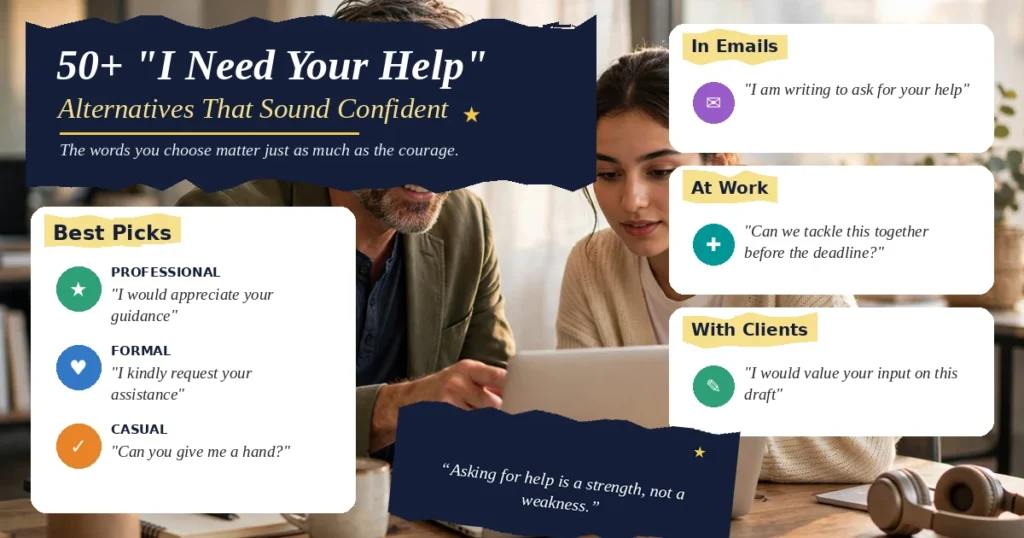
Asking for help at work takes confidence, but the words you choose matter just as much as the courage. “I need your help” is honest, yet it can sound blunt or demanding in a professional email. That is why so many people look for other ways to say I need your help — phrases that sound polite, respectful, and professional while still being clear about what you need.
This guide gives you 50 professional, formal, friendly, and email-ready alternatives with real examples for each one. You will learn what the phrase really means, when to use softer wording with managers and clients, and which version fits every workplace situation. By the end, you will ask for help with confidence and never worry about sounding pushy or weak again.
Meaning of “I need your help”
“I need your help” means you cannot easily do something alone and you are asking someone to support you. People say it to request guidance, assistance, or teamwork. The tone is direct and honest, but it can sound demanding, so softer alternatives often work better in professional settings.
Literal meaning: you require someone’s assistance, advice, or effort to complete a task or solve a problem.
Tone: direct and honest. It shows vulnerability, which can build trust, but it can also sound blunt without softening words.
Purpose: to request support, to invite collaboration, or to admit that a task is beyond your current knowledge or capacity.
Emotional context: people use it when they feel stuck, overloaded, or unsure. At work it often appears in emails to managers, mentors, and teammates during busy or difficult projects.
Here are a few natural examples:
- “I need your help with the budget report before Friday.”
- “I need your help understanding this new software.”
- “I need your help, and I would really appreciate your advice.”
Professional usage of “I need your help”
At work, asking for help is a strength, not a weakness. The key is to sound respectful of the other person’s time while being clear about what you need. Here is how to frame the request in each setting.
Emails
In a professional email, soften the direct phrase with polite framing. “I would appreciate your guidance on this” or “I am writing to ask for your help with the timeline” sounds respectful. Always state exactly what you need and by when.
Workplace
With teammates, be specific and collaborative. “Could you walk me through this?” or “Can we tackle this together?” invites teamwork. Vague requests like “I need help” with no details frustrate busy colleagues.
Clients
With clients, frame the request around their goals, not your problems. “I would value your input on this draft” works well. Never sound helpless to a client — sound thorough and careful instead.
Networking
When you ask a contact for help, show you respect their time. “I am hoping you can point me in the right direction” is polite and low-pressure. Always offer something in return, even if it is just gratitude and a future favor.
Customer service
Service staff ask customers for help too, usually to solve a problem faster. “Could you help me understand what happened?” sounds caring and professional. It turns the customer into a partner instead of a complainer.
50 other ways to say “I need your help”
These 50 alternatives are grouped by tone so you can pick the right one fast. Each entry shows the tone, the best situation for it, and a real example you can copy or adapt.
Professional alternatives
I would appreciate your guidance. Respectful; best for asking a manager or mentor. Example: “I would appreciate your guidance on the client presentation.”
I could use your expertise on this. Flattering and professional; best for a specialist. Example: “I could use your expertise on this data analysis.”
I would value your input. Polite; best for asking opinions in a team. Example: “I would value your input before I send this proposal.”
Your support would make a real difference. Warm; best when you need visible backing. Example: “Your support would make a real difference in getting this approved.”
I am looking for your advice on this matter. Formal-professional; best for serious decisions. Example: “I am looking for your advice on this matter before Friday.”
I would welcome your assistance. Courteous; best for formal requests. Example: “I would welcome your assistance with the audit preparation.”
Could you lend me your expertise? Friendly-professional; best for a skilled colleague. Example: “Could you lend me your expertise on the new system?”
I need your insight on this. Direct but respectful; best for quick questions. Example: “I need your insight on this before the meeting starts.”
Your help would be greatly appreciated. Grateful; best for email requests. Example: “Your help would be greatly appreciated with the year-end reports.”
I am hoping you can point me in the right direction. Humble; best for networking contacts. Example: “I am hoping you can point me in the right direction on this career move.”
I would be grateful for your support. Sincere; best for important favors. Example: “I would be grateful for your support during the launch.”
Could you help me think this through? Collaborative; best for complex problems. Example: “Could you help me think this through? I keep going in circles.”
I am counting on your experience here. Trusting; best for a senior colleague. Example: “I am counting on your experience here to avoid past mistakes.”
Your perspective would really help. Inclusive; best for group decisions. Example: “Your perspective would really help us choose the right vendor.”
I would appreciate your help with this task. Clear and polite; best for direct task requests. Example: “I would appreciate your help with this task by Thursday.”
Formal alternatives
I kindly request your assistance. Very formal; best for official letters. Example: “I kindly request your assistance with this legal matter.”
I would be obliged if you could assist me. Traditional formal; best for senior officials. Example: “I would be obliged if you could assist me with the paperwork.”
May I request your support? Polite formal; best for written proposals. Example: “May I request your support for this community project?”
I seek your counsel on this matter. Formal and serious; best for legal or advisory contexts. Example: “I seek your counsel on this matter before we proceed.”
I would be grateful for your guidance. Formal; best for mentors and advisors. Example: “I would be grateful for your guidance on my thesis.”
Please lend me your assistance. Direct formal; best for official requests. Example: “Please lend me your assistance in resolving this dispute.”
I respectfully ask for your help. Humble formal; best for sensitive requests. Example: “I respectfully ask for your help with this personal matter.”
Your cooperation would be appreciated. Formal; best for administrative requests. Example: “Your cooperation would be appreciated in completing the survey.”
I turn to you for your expertise. Formal and flattering; best for expert consultations. Example: “I turn to you for your expertise on this rare case.”
I humbly request your aid. Very formal; best for solemn or serious letters. Example: “I humbly request your aid in this difficult time.”
Friendly alternatives
Can you give me a hand? Casual and warm; best for friends and close colleagues. Example: “Can you give me a hand moving these boxes?”
I could really use your help. Honest; best when you feel stuck. Example: “I could really use your help with this math homework.”
Could you do me a favor? Friendly; best for small personal requests. Example: “Could you do me a favor and water my plants?”
I am stuck. Can you help? Direct; best for urgent problems. Example: “I am stuck. Can you help me fix this bug?”
Mind helping me out? Relaxed; best for casual teammates. Example: “Mind helping me out with the dishes after the party?”
I need a hand with this. Simple; best for physical or quick tasks. Example: “I need a hand with this heavy table.”
Can you bail me out? Playful; best for close friends. Example: “Can you bail me out? I double-booked myself tonight.”
I could use a second pair of eyes. Collaborative; best for reviews and proofreading. Example: “I could use a second pair of eyes on this report.”
Would you mind pitching in? Polite-casual; best for group efforts. Example: “Would you mind pitching in with the decorations?”
I am in over my head here. Honest; best when you feel overwhelmed. Example: “I am in over my head here with these tax forms.”
Email alternatives
I am writing to ask for your help. Clear; best for opening a request email. Example: “I am writing to ask for your help with the event planning.”
I am reaching out because I need your input. Professional; best for advice requests. Example: “I am reaching out because I need your input on the design.”
I hope you can assist me with this. Polite; best for general email requests. Example: “I hope you can assist me with this scheduling issue.”
I am hoping you can help me with a quick question. Low-pressure; best for short requests. Example: “I am hoping you can help me with a quick question about the invoice.”
I wanted to ask for your guidance on this. Respectful; best for mentor emails. Example: “I wanted to ask for your guidance on this career decision.”
I would love your help with this if you have a moment. Warm; best for busy colleagues. Example: “I would love your help with this if you have a moment today.”
I am turning to you for help with this issue. Trusting; best for difficult problems. Example: “I am turning to you for help with this issue because you know it best.”
Could I ask for your help with something? Gentle; best for softening a request. Example: “Could I ask for your help with something after lunch?”
Workplace alternatives
Could you walk me through this? Learning-focused; best for new processes. Example: “Could you walk me through this software setup?”
I need your backup on this one. Team-oriented; best for tough meetings. Example: “I need your backup on this one during the client call.”
Can we tackle this together? Collaborative; best for shared tasks. Example: “Can we tackle this together before the deadline?”
I need your sign-off and your help. Direct; best for approvals plus action. Example: “I need your sign-off and your help to move this forward.”
Could you show me how this works? Humble; best for learning from experts. Example: “Could you show me how this works when you have time?”
I am going to need your help to hit this deadline. Honest; best for urgent teamwork. Example: “I am going to need your help to hit this deadline on Friday.”
Can I borrow your brain for a minute? Playful; best for close work friends. Example: “Can I borrow your brain for a minute on this puzzle?”
Quick comparison table
Use this table to pick the right phrase at a glance. These are the ten most useful picks from the full list above.
| Alternative | Tone | Best use |
|---|---|---|
| I would appreciate your guidance | Professional | Managers and mentors |
| I kindly request your assistance | Formal | Official letters and requests |
| Can you give me a hand? | Friendly | Friends and close colleagues |
| I am writing to ask for your help | Polite | Email openers |
| Could you walk me through this? | Workplace | Learning new processes |
| I could use your expertise on this | Professional | Specialists and experts |
| I would be grateful for your guidance | Formal | Advisors and mentors |
| I could use a second pair of eyes | Friendly | Reviews and proofreading |
| Your help would be greatly appreciated | Polite | Email requests |
| Can we tackle this together? | Workplace | Shared team tasks |
Email examples using “I need your help” alternatives
Copy these short email examples and adjust the names and details. Each one asks for help politely in a realistic work setting.
For a client
Subject: Your input on the draft
Hi James,
I would value your input on the attached draft before we move to the final version. Your view on the pricing section would be especially useful. Could you share your thoughts by Thursday? Thank you in advance for your time.
Best regards,
Anna
For a manager
Subject: Guidance on the budget report
Hi Ms. Carter,
I would appreciate your guidance on the budget report before I submit it on Friday. I am unsure about the new expense categories and want to get them right. Would you have 15 minutes tomorrow to review the draft with me?
Warm regards,
Tom
For a colleague
Subject: Quick favor
Hi Rachel,
I could use a second pair of eyes on this client proposal. You always catch the details I miss. Would you have time to review it today? I would really appreciate your help.
Cheers,
Mike
For a customer
Subject: Help us solve this faster
Hi there,
Could you help me understand what happened with your order? A few details from you will let me fix this much faster. Just reply to this email with your order number and a short description of the issue. Thank you for your patience.
Warmly,
The Support Team
For networking
Subject: Quick question
Hi Daniel,
I am hoping you can point me in the right direction. I am exploring roles in product marketing and noticed you made a similar move last year. Would you be open to a 15-minute call next week? I would be grateful for any advice.
Best,
Lisa
For a meeting follow-up
Subject: Next steps on the launch plan
Hi Karen,
Thanks for the productive meeting yesterday. Could you help me think this through? I want to make sure the timeline is realistic before I share it with the team. Your experience with last year’s launch would really help here.
Kind regards,
Steve
Common mistakes to avoid
Small wording errors can make a polite request sound demanding or weak. Watch out for each one.
1. Demanding help without asking
“I need your help with this” stated as an order sounds rude. Add a polite frame like “Could you” or “I would appreciate.”
2. Being vague about what you need
“I need help” with no details forces the reader to guess. Always name the task, the problem, and the deadline.
3. Apologizing too much
“I am so sorry to bother you” three times sounds insecure. One brief apology is enough, then state your request clearly.
4. Asking without a deadline
Requests without timing get ignored. Give a clear date so the person can plan, like “by Thursday.”
5. Using casual slang with senior leaders
“Can you bail me out?” is fine for friends but wrong for executives. Match your tone to the person’s seniority.
6. Forgetting to say thank you
A request without gratitude feels transactional. End every ask with thanks, and follow up with thanks again after they help.
Related phrases
These expressions carry a similar meaning and work well alongside the alternatives above.
Lend me a hand. Means to help with a task. Example: “Could you lend me a hand with these files?”
Give me a hand. A casual request for help. Example: “Give me a hand carrying this upstairs.”
I need a favor. Asks for a personal kindness. Example: “I need a favor. Can you feed my cat this weekend?”
Could you assist me? A polite, slightly formal request. Example: “Could you assist me with the projector?”
I need your advice. Asks for guidance, not action. Example: “I need your advice on choosing a laptop.”
I need your support. Asks for backing or encouragement. Example: “I need your support at tomorrow’s meeting.”
Help me out. A short, casual plea. Example: “Help me out and proofread this paragraph.”
I am counting on you. Shows trust in someone’s help. Example: “I am counting on you to cover my shift.”
Do me a favor. A friendly request. Example: “Do me a favor and call me when you land.”
I need guidance. Asks for direction. Example: “I need guidance on my career path.”
Pitch in. Means to join in and help. Example: “Everyone pitched in to finish the project.”
Walk me through it. Asks for a step-by-step explanation. Example: “Walk me through it one more time.”
Show me the ropes. Asks to be taught the basics. Example: “Show me the ropes on my first day.”
I could use some help. A soft, humble request. Example: “I could use some help with dinner tonight.”
Team up with me. Invites collaboration. Example: “Team up with me on this presentation.”
Phrase comparison: “I need your help” vs top alternatives
“I need your help” is the most direct option. Its honesty is a strength with close colleagues and friends, because it shows trust. But in formal settings it can sound blunt or demanding, and with clients it can sound helpless, which is the opposite of the confidence they expect.
“I would appreciate your guidance” softens the same request with respect. The tone is professional and humble, and it works beautifully with managers, mentors, and senior colleagues. It frames the other person as a valued advisor rather than a servant, which makes people more willing to help.
“I kindly request your assistance” sits at the formal end. It suits official letters, legal matters, and requests to senior officials. The dignity of the phrasing protects both sides, but it would sound stiff between teammates, so reserve it for truly formal contexts.
“Can you give me a hand?” is the friendly everyday version. It is warm, casual, and free of pressure, which makes it perfect for friends, family, and close colleagues. It works best for small, concrete tasks rather than big professional favors.
“I am writing to ask for your help” is the email specialist of the group. It opens a request email with clarity and politeness, and it works for almost any recipient. When you are unsure how to start a help request by email, this is the safest first line.
Cultural usage
How people ask for help changes with culture and setting. These notes help you choose phrasing that lands well with your reader.
US English
Americans value directness, so “I need your help” is common even at work. Softer versions like “I would appreciate your guidance” still sound natural. Casual phrases like “give me a hand” appear in everyday speech.
UK English
British speakers often add extra politeness, such as “I wonder if you might help me” or “Would you mind helping?” A blunt “I need your help” can feel pushy in British professional settings, so soften it.
Corporate communication
In corporate settings, frame requests around shared goals. “Your support would make a real difference” and “Could you help me think this through?” are standard. Always include a deadline and a clear description of the task.
Customer service
Service staff ask for the customer’s help to solve problems faster. “Could you help me understand what happened?” turns the customer into a partner. The tone stays patient, grateful, and free of blame.
Networking
In networking, keep requests small and specific. “I am hoping you can point me in the right direction” respects the contact’s time. Always offer value in return, even if it is only sincere thanks and a future favor.
Frequently asked questions
What is a professional way to say “I need your help”?
The most professional way to say “I need your help” is “I would appreciate your guidance.” It sounds respectful and frames the other person as a valued advisor. Other strong options include “I could use your expertise on this” and “Your help would be greatly appreciated.”
How do you ask for help in a formal email?
Open with “I am writing to ask for your help” or “I hope you can assist me with this.” State exactly what you need and include a deadline. Good email etiquette means being clear, polite, and grateful in every request.
Is it okay to say “I need your help” at work?
Yes, asking for help at work is a strength, not a weakness. But softer phrasing often works better, such as “Could you help me think this through?” or “Can we tackle this together?” Clear workplace communication always names the task and the deadline.
What is a polite way to ask a client for help?
Try “I would value your input on this draft.” It keeps the focus on the client’s goals instead of your problems. Never sound helpless to a client — sound thorough and careful, and always thank them for their time.
How do you ask your manager for help?
Say “I would appreciate your guidance on this” and explain what you have already tried. Managers respect team members who attempt a solution first. Ask for a short meeting and come with specific questions, not vague worry.
What is a formal synonym for “I need your help”?
The best formal synonym for “I need your help” is “I kindly request your assistance.” Other formal options include “I would be obliged if you could assist me” and “I respectfully ask for your help.” These suit official letters and serious requests.
How do you ask for help without sounding weak?
Frame the request around the task, not your limits. “I could use your expertise on this” sounds confident and collaborative. Avoid over-apologizing, state what you need clearly, and show you value the other person’s skills.
What should I write instead of “I need your help” in a business email?
Use “I am reaching out because I need your input” or “Your help would be greatly appreciated.” Both are standard business email phrases that sound professional. Always include the task details and a deadline.
How do you ask a colleague for a quick favor?
Keep it short and specific: “Could I ask for your help with something after lunch?” or “I could use a second pair of eyes on this.” Respect their time by explaining exactly what you need and how long it will take.
What is a friendly way to ask for help?
Try “Can you give me a hand?” or “Would you mind pitching in?” Both feel warm and pressure-free. For close friends, even “Can you bail me out?” works when said with a smile.
Can I say “I need your help” to my boss?
You can, but softer wording usually lands better. “I would appreciate your guidance on this” shows respect for your boss’s time and experience. Always explain the situation briefly and suggest what kind of help you need.
How do British people ask for help politely?
British speakers often add extra softening, such as “I wonder if you might help me” or “Would you mind helping?” A blunt “I need your help” can feel pushy in British professional settings, so the gentler versions work better.
What is the best way to ask for help by email?
Start with a clear subject line, open with “I am writing to ask for your help,” and state the task, the deadline, and what you have tried so far. End with thanks. Short, specific, polite emails get the fastest replies.
How do you ask for help in customer service?
Turn the customer into a partner: “Could you help me understand what happened?” This phrasing sounds caring and gathers the facts you need. Keep your tone patient, grateful, and free of blame.
Should you always say thank you when asking for help?
Yes. A request without thanks feels transactional and cold. Thank the person in the same message, and thank them again after they help. Gratitude makes people happy to help you the next time too.
Conclusion
Quick picks — Professional: “I would appreciate your guidance” and “I could use your expertise on this.” Formal: “I kindly request your assistance” and “May I request your support?” Friendly-casual: “Can you give me a hand?” and “I could use a second pair of eyes.” Email: “I am writing to ask for your help” and “Your help would be greatly appreciated.”
Asking for help is a strength, not a weakness — the trick is matching your words to your listener. Name exactly what you need, give a clear deadline, and close with thanks. People say yes far more often when the request is specific and polite. The right phrase turns a hard ask into an easy conversation.
Related Articles
- Other Ways to Say Please Advise (2026 Guide)
- Other Ways to Say As Soon As Possible: 50 Alternatives
- 50 Other Ways to Say Let Me Know What You Think
- 45 Ways to Say “In Order To” Professionally (2026 Guide)
- Other Ways to Say Such As: 50+ Professional Alternatives
- 50+ “I Am Reaching Out to You” Email Alternatives
- 55+ “Please Be Patient” Alternatives That Sound Polite




