
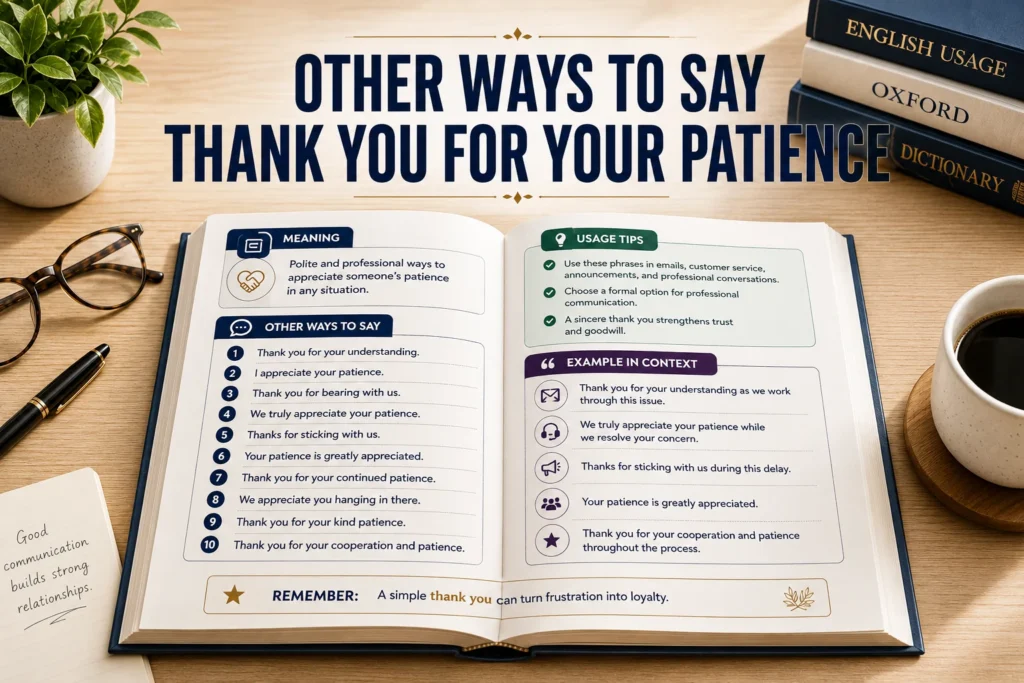
“Thank you for your patience” is a polite way to acknowledge that someone has waited, experienced a delay, or allowed extra time for a situation to be resolved. It works well in business emails, customer service, workplace communication, professional communication, and everyday conversations.
However, repeating the same phrase in every email can make your writing feel predictable. That is why many people search for other ways to say thank you for your patience, especially when they need a professional, formal, friendly, or email-ready alternative.
The best alternative depends on the situation. If a customer has waited for a delayed order, you might say, “We appreciate your patience while we resolve this matter.” If a colleague has waited for your response, “Thank you for waiting” may sound more natural.
This guide provides practical alternatives for emails, clients, managers, colleagues, customers, networking contacts, and workplace situations.
What Does “Thank You for Your Patience” Mean?
“Thank you for your patience” means:
I appreciate that you waited calmly and gave me or us time to handle a situation.
The phrase often appears when someone has experienced:
- a delay
- a technical problem
- a slow response
- a service interruption
- a longer-than-expected process
- a difficult situation
- a scheduling change
- a pending decision
- a customer service issue
Example
Thank you for your patience while we investigate the issue.
The speaker acknowledges that the recipient had to wait and expresses appreciation.
Literal Meaning
The phrase combines two ideas:
Thank you = I appreciate your action.
Your patience = I appreciate your willingness to wait without becoming frustrated.
Together:
Thank you for remaining patient while we handled the situation.
Tone
“Thank you for your patience” usually sounds:
- polite
- respectful
- professional
- appreciative
- neutral
- customer-friendly
It works particularly well when you want to acknowledge someone’s time without placing blame.
Purpose
The phrase can serve several purposes in professional communication:
- Acknowledge a delay.
- Show appreciation.
- Maintain a positive relationship.
- Reduce frustration.
- Reassure the recipient.
- Close a customer-service message politely.
- Recognize someone’s cooperation.
Emotional Context
The phrase can also communicate empathy.
Compare:
Your request is still being processed.
with:
Thank you for your patience while we process your request.
The second sentence sounds warmer because it recognizes the recipient’s experience.
When Should You Say “Thank You for Your Patience”?
In Emails
Use it when the recipient has waited for:
- a response
- a document
- an update
- a decision
- a refund
- technical support
- a project
- a delivery
Example
Thank you for your patience while we finalize the report.
In the Workplace
Use it when a colleague or employee has waited for information or assistance.
Thank you for your patience while I reviewed the figures.
You can also make the sentence more personal:
I appreciate your patience while I worked through the details.
With Clients
This phrase works particularly well when a client experiences a delay.
Thank you for your patience while our team reviews your request.
For a more personal tone:
We appreciate your patience and understanding while we work to resolve this matter.
In Customer Service
Customer service teams frequently use patience-related expressions because customers may need to wait for a resolution.
Thank you for your patience while we investigate the issue.
A stronger version combines appreciation with an update:
Thank you for your patience. Our team has identified the issue and is working on a solution.
In Networking
You may need this expression when a professional contact waits for a response.
Thank you for your patience. I wanted to take some time to review the information before responding.
In networking, a shorter alternative may sound more natural:
Thanks for waiting for my response.
Professional Alternatives
1. We Appreciate Your Patience
Meaning: You value the recipient’s willingness to wait.
Tone: Professional, warm, and respectful.
Best use: Client emails, customer service, business announcements.
Example:
We appreciate your patience while we complete the review.
This is one of the strongest general-purpose alternatives.
2. I Appreciate Your Patience
Meaning: You personally recognize the recipient’s patience.
Tone: Professional and personal.
Best use: One-to-one emails.
Example:
I appreciate your patience while I work through the remaining details.
3. Thank You for Waiting
Meaning: You directly acknowledge the person’s wait.
Tone: Simple, friendly, and professional.
Best use: Workplace messages and customer communication.
Example:
Thank you for waiting while I checked the information.
4. We Appreciate Your Understanding
Meaning: You appreciate the recipient’s acceptance of the situation.
Tone: Professional and diplomatic.
Best use: Delays, policy changes, service interruptions.
Example:
We appreciate your understanding as we work through this temporary disruption.
5. Thank You for Your Understanding
Meaning: You recognize the person’s willingness to accept a difficult or delayed situation.
Tone: Polite and professional.
Best use: Business emails and notices.
Example:
Thank you for your understanding while we address this issue.
6. We Value Your Patience
Meaning: You emphasize that the recipient’s patience matters.
Tone: Professional and appreciative.
Best use: Customer service and client communication.
Example:
We value your patience as we work toward a resolution.
7. Your Patience Is Greatly Appreciated
Meaning: You strongly express gratitude for someone’s patience.
Tone: Formal and respectful.
Best use: Official notices and customer communication.
Example:
Your patience is greatly appreciated while we complete the necessary checks.
8. We’re Grateful for Your Patience
Meaning: You express sincere appreciation.
Tone: Warm and professional.
Best use: Client relationships and service recovery.
Example:
We’re grateful for your patience during this unexpected delay.
9. Thank You for Bearing With Us
Meaning: You appreciate someone’s willingness to tolerate a delay or difficulty.
Tone: Friendly and professional.
Best use: Service delays and technical problems.
Example:
Thank you for bearing with us while we resolve the technical issue.
10. Thank You for Your Continued Patience
Meaning: The recipient has already waited for some time.
Tone: Professional and appreciative.
Best use: Long-running issues.
Example:
Thank you for your continued patience as we work toward a permanent solution.
11. We Appreciate Your Continued Understanding
Meaning: You recognize ongoing cooperation.
Tone: Professional and diplomatic.
Best use: Extended delays or repeated updates.
Example:
We appreciate your continued understanding as we complete the transition.
12. Thank You for Giving Us Time to Resolve This
Meaning: You recognize that the recipient allowed time for a solution.
Tone: Personal and appreciative.
Best use: Customer service and workplace issues.
Example:
Thank you for giving us time to resolve this matter.
13. Thank You for Allowing Us Time to Review This
Meaning: You appreciate the opportunity to investigate something carefully.
Tone: Professional and precise.
Best use: Business disputes, client requests, reviews.
Example:
Thank you for allowing us time to review your request.
14. We Appreciate the Time You’ve Given Us
Meaning: You acknowledge the recipient’s time and cooperation.
Tone: Warm and professional.
Best use: Complex projects and negotiations.
Example:
We appreciate the time you’ve given us while we evaluate the proposal.
15. Thank You for Your Cooperation
Meaning: You appreciate the person’s active assistance.
Tone: Professional and direct.
Best use: Workplace communication, procedures, customer service.
Example:
Thank you for your cooperation while we complete the verification process.
Formal Alternatives
16. We Sincerely Appreciate Your Patience
Meaning: A stronger expression of gratitude.
Tone: Formal and respectful.
Best use: Important client communications.
Example:
We sincerely appreciate your patience during this process.
17. Please Accept Our Sincere Thanks for Your Patience
Meaning: A formal expression of appreciation.
Tone: Very formal.
Best use: Official correspondence.
Example:
Please accept our sincere thanks for your patience during the review.
18. We Are Grateful for Your Understanding
Meaning: You sincerely appreciate their acceptance of the circumstances.
Tone: Formal and warm.
Best use: Corporate communication.
Example:
We are grateful for your understanding during this period of transition.
19. Your Understanding Is Much Appreciated
Meaning: You recognize the recipient’s understanding.
Tone: Formal.
Best use: Notices and professional correspondence.
Example:
Your understanding is much appreciated as we implement these changes.
20. We Appreciate Your Consideration
Meaning: You recognize someone’s thoughtful consideration of the situation.
Tone: Formal and polished.
Best use: Business correspondence.
Example:
We appreciate your consideration while we review the available options.
21. Thank You for Your Continued Cooperation
Meaning: You appreciate ongoing assistance.
Tone: Formal and professional.
Best use: Long-term projects.
Example:
Thank you for your continued cooperation throughout this process.
22. We Are Grateful for the Time You Have Allowed Us
Meaning: You appreciate the time provided to complete something.
Tone: Formal.
Best use: Legal, corporate, or formal business writing.
Example:
We are grateful for the time you have allowed us to complete our assessment.
23. We Appreciate Your Consideration and Understanding
Meaning: You recognize both thoughtfulness and acceptance.
Tone: Formal and diplomatic.
Best use: Sensitive communications.
Example:
We appreciate your consideration and understanding regarding this matter.
24. Thank You for Your Courtesy and Understanding
Meaning: You recognize someone’s respectful behavior.
Tone: Formal.
Best use: Customer relations and official correspondence.
Example:
Thank you for your courtesy and understanding throughout the process.
25. We Remain Grateful for Your Patience
Meaning: You continue to value their patience.
Tone: Formal and polished.
Best use: Extended business situations.
Example:
We remain grateful for your patience as we finalize the necessary arrangements.
Friendly Alternatives
26. Thanks for Waiting
Meaning: A casual way to thank someone for waiting.
Tone: Friendly and relaxed.
Best use: Colleagues, friends, informal workplace communication.
Example:
Thanks for waiting! I’ve got the information you requested.
27. Thanks for Bearing With Me
Meaning: You appreciate someone’s tolerance during a delay or difficulty.
Tone: Friendly and personal.
Best use: Colleagues and one-to-one communication.
Example:
Thanks for bearing with me while I sorted this out.
28. Thanks for Hanging In There
Meaning: You appreciate someone staying patient during a difficult or lengthy process.
Tone: Casual and friendly.
Best use: Informal workplace communication.
Example:
Thanks for hanging in there while we worked through the issue.
29. I Really Appreciate You Waiting
Meaning: You personally express gratitude.
Tone: Warm and friendly.
Best use: Colleagues and professional relationships.
Example:
I really appreciate you waiting while I finished the report.
30. Thanks for Giving Me Some Time
Meaning: You appreciate someone’s willingness to wait.
Tone: Casual and natural.
Best use: Personal professional messages.
Example:
Thanks for giving me some time to look into this.
31. I Appreciate You Giving Me Time
Meaning: You recognize the person’s flexibility.
Tone: Friendly and respectful.
Best use: Managers, colleagues, and clients with established relationships.
Example:
I appreciate you giving me time to review the proposal.
32. Thanks for Sticking With Us
Meaning: You appreciate continued support despite a problem.
Tone: Friendly and warm.
Best use: Customer relationships and service recovery.
Example:
Thanks for sticking with us while we worked through the problem.
33. Thanks for Your Understanding
Meaning: You appreciate someone’s acceptance of the situation.
Tone: Friendly but professional.
Best use: Everyday business communication.
Example:
Thanks for your understanding. I’ll send the update shortly.
34. I’m Grateful for Your Understanding
Meaning: You express sincere personal appreciation.
Tone: Warm and friendly.
Best use: Sensitive professional situations.
Example:
I’m grateful for your understanding while I work through this.
35. Thanks for Your Flexibility
Meaning: You appreciate someone’s willingness to adjust.
Tone: Friendly and professional.
Best use: Scheduling changes and workplace situations.
Example:
Thanks for your flexibility with the revised meeting time.
Email-Friendly Alternatives
36. Thank You for Waiting While We Look Into This
Tone: Professional and reassuring.
Best use: Customer service.
Example:
Thank you for waiting while we look into this. We’ll update you shortly.
37. We Appreciate Your Patience While We Review Your Request
Tone: Professional and direct.
Best use: Client emails.
Example:
We appreciate your patience while we review your request.
38. Thank You for Allowing Us Time to Investigate
Tone: Professional and precise.
Best use: Complaints and technical issues.
Example:
Thank you for allowing us time to investigate the matter.
39. We Appreciate Your Understanding During This Process
Tone: Polite and diplomatic.
Best use: Business emails.
Example:
We appreciate your understanding during this process and will provide an update soon.
40. Thank You for Your Continued Support and Patience
Tone: Warm and appreciative.
Best use: Long-term client relationships.
Example:
Thank you for your continued support and patience as we complete the project.
41. Thank You for Giving Us the Opportunity to Resolve This
Tone: Professional and customer-focused.
Best use: Complaints and service recovery.
Example:
Thank you for giving us the opportunity to resolve this matter.
42. We Appreciate Your Time and Understanding
Tone: Polite and professional.
Best use: Client and business emails.
Example:
We appreciate your time and understanding as we work through the remaining steps.
43. Thank You for Your Cooperation While We Complete the Process
Tone: Professional.
Best use: Administrative communication.
Example:
Thank you for your cooperation while we complete the verification process.
44. We Appreciate Your Flexibility During the Delay
Tone: Professional and appreciative.
Best use: Scheduling and project delays.
Example:
We appreciate your flexibility during the delay and will confirm the new schedule shortly.
45. Thank You for Staying With Us Through This Process
Tone: Warm and relationship-focused.
Best use: Customers and clients.
Example:
Thank you for staying with us through this process. We’re pleased to share that the issue has now been resolved.
Workplace Alternatives
46. Thanks for Waiting for My Update
Tone: Friendly and professional.
Best use: Colleagues.
Example:
Thanks for waiting for my update. I’ve attached the revised figures.
47. I Appreciate Your Flexibility
Tone: Professional and warm.
Best use: Scheduling and deadlines.
Example:
I appreciate your flexibility while we adjust the project timeline.
48. Thank You for Giving Me Time to Review This
Tone: Professional.
Best use: Managers and colleagues.
Example:
Thank you for giving me time to review this before our meeting.
49. I Appreciate Your Understanding While I Work Through This
Tone: Personal and professional.
Best use: One-to-one workplace communication.
Example:
I appreciate your understanding while I work through the remaining issues.
50. Thank You for Your Continued Support
Tone: Professional and appreciative.
Best use: Teams, managers, clients, and long-term projects.
Example:
Thank you for your continued support as we complete this project.
Quick Comparison Table
| Alternative | Tone | Best Use |
| We appreciate your patience | Professional | Clients and customers |
| I appreciate your patience | Personal | One-to-one emails |
| Thank you for waiting | Neutral | General use |
| Thank you for your understanding | Professional | Delays and changes |
| We appreciate your understanding | Professional | Corporate communication |
| Your patience is greatly appreciated | Formal | Official messages |
| We sincerely appreciate your patience | Formal | Important clients |
| Thank you for your cooperation | Professional | Processes |
| Thanks for waiting | Friendly | Colleagues |
| Thanks for bearing with me | Friendly | Informal workplace |
| Thanks for your flexibility | Friendly/professional | Scheduling |
| Thank you for allowing us time | Formal | Investigations |
| We value your patience | Professional | Customer service |
| We’re grateful for your patience | Warm | Client relationships |
| Thank you for your continued patience | Professional | Extended delays |
| Thank you for your continued support | Professional | Long-term relationships |
| We appreciate your time and understanding | Professional | Business emails |
| Thank you for giving us time to resolve this | Professional | Complaints |
| Thanks for sticking with us | Friendly | Customer relationships |
| Thank you for your courtesy and understanding | Formal | Official correspondence |
Email Examples
Client Email
:::writing{variant=”email” id=”85217″ subject=”Update on Your Request”} Dear [Client Name],
We appreciate your patience while our team reviews your request. We are completing the final checks and expect to provide you with an update shortly.
Thank you for your understanding.
Best regards,
[Name]
Manager Email
Dear [Manager Name],
Thank you for giving me time to review the project details. I have completed the analysis and attached the revised document for your review.
Best regards,
[Name]
Colleague Email
Hi [Name],
Thanks for waiting for my update. I’ve now confirmed the figures and attached the latest version.
Best,
[Name]
Customer Email
Dear [Customer Name],
Thank you for your patience while we investigated the issue. We have now identified the cause and are working to resolve it.
We appreciate your understanding.
Kind regards,
[Name]
Networking Email
Hi [Name],
Thank you for your patience while I reviewed the information you shared. I appreciate the opportunity to learn more about your work.
I’d be happy to continue the conversation.
Best regards,
[Name]
Meeting Follow-Up
Dear Team,
Thank you for your patience while we finalized the meeting notes. I have attached the completed version for your review.
Please let me know if you notice anything that needs to be updated.
Best regards,
[Name]
Common Mistakes to Avoid
1. Using the Same Phrase Too Often
“Thank you for your patience” is useful, but repeating it in every customer email can sound automated or predictable.
Instead, vary your wording based on the situation:
We appreciate your understanding.
Thank you for waiting.
We appreciate your flexibility.
Thank you for giving us time to investigate.
2. Saying “Thank You for Your Patience” Without an Update
If someone has waited a long time, gratitude alone may not satisfy them.
Weak:
Thank you for your patience.
Better:
Thank you for your patience. Our team has completed the review, and we will send the final update by Friday.
A useful email should combine appreciation with information whenever possible.
3. Using “Bear With Us” Incorrectly
The correct expression is:
Please bear with us.
Not:
Please bare with us.
Bear means tolerate or endure.
Bare means uncovered or exposed.
4. Sounding Too Formal
A sentence such as:
Please accept our profound appreciation for your continued patience and cooperation.
may sound excessive in an ordinary workplace email.
A simpler version works better:
We appreciate your patience and understanding.
Professional communication should sound natural.
5. Sounding Too Casual With Customers
“Thanks for hanging in there” may work with familiar customers, but it may not suit a formal complaint.
For a serious customer issue, use:
We sincerely appreciate your patience while we work to resolve this matter.
6. Using Patience When You Really Mean Flexibility
These concepts differ.
Patience means someone waited.
Flexibility means someone accepted a change or adjusted their plans.
If a meeting moved from Tuesday to Thursday, say:
Thank you for your flexibility.
If someone waited two weeks for an answer, say:
Thank you for your patience.
7. Ignoring the Recipient’s Frustration
If someone has experienced a serious service problem, “Thank you for your patience” may sound insufficient by itself.
Consider:
We understand how frustrating this delay has been, and we sincerely appreciate your patience while we work to resolve it.
This combines empathy with appreciation.
Related Phrases
Thank You for Your Understanding
Shows appreciation for someone’s acceptance of a situation.
Thank you for your understanding regarding the delay.
Thank You for Your Cooperation
Shows appreciation for active assistance.
Thank you for your cooperation during the review.
Thank You for Your Flexibility
Recognizes someone’s willingness to adjust.
Thank you for your flexibility with the revised schedule.
Thank You for Your Time
Recognizes someone’s investment of time.
Thank you for your time during today’s meeting.
Thank You for Waiting
Directly acknowledges a wait.
Thank you for waiting while I checked the details.
We Appreciate Your Support
Shows appreciation for ongoing assistance.
We appreciate your support throughout the project.
We Appreciate Your Understanding
A professional alternative for delays or changes.
We appreciate your understanding during this transition.
Thank You for Bearing With Us
Acknowledges tolerance during a difficult situation.
Thank you for bearing with us while we resolve the issue.
Thanks for Sticking With Us
Shows appreciation for continued support.
Thanks for sticking with us while we fixed the problem.
Thank You for Your Continued Support
Works well for long-term relationships.
Thank you for your continued support of our team.
We Value Your Time
Recognizes the importance of the recipient’s time.
We value your time and will keep the meeting brief.
We Appreciate Your Consideration
Recognizes thoughtful consideration.
We appreciate your consideration of our proposal.
Thank You for Your Courtesy
Shows appreciation for respectful behavior.
Thank you for your courtesy throughout the discussion.
Thank You for Your Cooperation and Understanding
Combines two forms of appreciation.
Thank you for your cooperation and understanding during the transition.
We Appreciate Your Continued Understanding
Useful when an issue takes longer than expected.
We appreciate your continued understanding as we work toward a solution.
Phrase Comparison
“Thank You for Your Patience” vs “Thank You for Waiting”
Thank you for your patience sounds more professional and polished.
Thank you for waiting sounds simpler and more conversational.
Use the first for clients and customers. Use the second for colleagues and everyday interactions.
“Thank You for Your Patience” vs “Thank You for Your Understanding”
These expressions are related but not identical.
Patience focuses on waiting.
Understanding focuses on accepting or recognizing the situation.
Example:
Thank you for your patience while we process your order.
Thank you for your understanding regarding the revised delivery date.
“Thank You for Your Patience” vs “Thank You for Your Flexibility”
Use patience when someone waits.
Use flexibility when someone adjusts.
Example:
Thank you for your patience while we prepare the report.
Thank you for your flexibility with the meeting time.
“Thank You for Your Patience” vs “Thank You for Your Cooperation”
Patience focuses on waiting calmly.
Cooperation focuses on actively helping.
Example:
Thank you for your patience while we investigate the issue.
Thank you for your cooperation during the verification process.
“We Appreciate Your Patience” vs “I Appreciate Your Patience”
Use we when speaking for a company, department, or team.
We appreciate your patience.
Use I when you personally handled the situation.
I appreciate your patience.
Both sound professional.
Cultural Usage
US English
“Thank you for your patience” is extremely common in American business communication.
It appears frequently in:
- customer service
- corporate emails
- support messages
- public notices
- professional correspondence
American business writing often favors concise alternatives such as:
We appreciate your patience.
Thanks for your understanding.
UK English
British English uses the same expression naturally.
Thank you for your patience while we resolve this matter.
British professional writing may sometimes favor slightly more reserved wording, depending on the organization and context.
Corporate Communication
Companies often use:
We appreciate your patience and understanding.
This works because it acknowledges both the delay and the recipient’s acceptance of the situation.
However, companies should avoid using the phrase as a substitute for meaningful communication.
If a delay occurs, provide:
- An acknowledgment.
- A reason when appropriate.
- A current status.
- A realistic next step.
- Appreciation.
For example:
We appreciate your patience while our technical team investigates the issue. We have identified the cause and expect to provide another update tomorrow.
Customer Service
Customer service messages should combine empathy and action.
Instead of:
Thank you for your patience.
Try:
We understand how frustrating this delay may be. We appreciate your patience while our team works to resolve the issue.
Even better, include a clear update:
We appreciate your patience. Our team has completed the investigation, and your replacement is now being processed.
Networking
Networking messages should usually sound personal rather than scripted.
Instead of:
Thank you for your patience during this matter.
Use:
Thanks for waiting while I reviewed the information you sent.
Or:
I appreciate your patience while I considered your proposal.
The right choice depends on your relationship with the person.
How to Choose the Best Alternative
Use this quick guide:
If the person waited
Say:
Thank you for waiting.
If the situation caused a delay
Say:
We appreciate your patience.
If the person accepted a difficult situation
Say:
Thank you for your understanding.
If the person adjusted their schedule
Say:
Thank you for your flexibility.
If the person actively helped
Say:
Thank you for your cooperation.
If the situation lasted a long time
Say:
Thank you for your continued patience.
If you want a warm customer-service tone
Say:
We’re grateful for your patience.
If you want a casual workplace tone
Say:
Thanks for bearing with me.
If you want a formal corporate tone
Say:
We sincerely appreciate your patience and understanding.
Best Professional Options
For most professional situations, these choices work especially well:
- We appreciate your patience.
- I appreciate your patience.
- Thank you for your understanding.
- We appreciate your understanding.
- Thank you for your continued patience.
- Thank you for your cooperation.
- We appreciate your time and understanding.
- Thank you for allowing us time to resolve this.
These phrases are clear without sounding unnecessarily formal.
Best Formal Options
For highly formal communication, consider:
- We sincerely appreciate your patience.
- Your patience is greatly appreciated.
- We are grateful for your understanding.
- Please accept our sincere thanks for your patience.
- We appreciate your consideration and understanding.
- Thank you for your continued cooperation.
- We remain grateful for your patience.
Use formal expressions carefully. The goal is professional communication, not complicated communication.
Best Casual Options
For colleagues and familiar professional contacts:
- Thanks for waiting.
- Thanks for bearing with me.
- Thanks for your understanding.
- Thanks for giving me some time.
- I really appreciate you waiting.
- Thanks for sticking with us.
- Thanks for your flexibility.
Best Email Options
If you need a professional way to say “thank you for your patience” in an email, these are strong choices:
We appreciate your patience while we review your request.
Thank you for your understanding while we work through this matter.
Thank you for allowing us time to investigate the issue.
We appreciate your continued patience as we work toward a resolution.
Thank you for your cooperation while we complete the process.
We appreciate your time and understanding.
These alternatives fit most business email phrases without sounding artificial.
Faqs
What is another way to say “thank you for your patience”?
Common alternatives include “We appreciate your patience,” “Thank you for your understanding,” “Thank you for waiting,” and “We appreciate your continued patience.” Choose the option that matches the situation.
What is a professional way to say “thank you for your patience”?
A strong professional option is:
We appreciate your patience while we work to resolve this matter.
It sounds polite, clear, and appropriate for clients and customers.
What is a formal alternative to “thank you for your patience”?
You can write:
We sincerely appreciate your patience and understanding during this process.
For highly formal correspondence:
Your patience is greatly appreciated.
How do you say “thank you for your patience” in an email?
Keep the wording specific to the situation:
Thank you for your patience while we review your request. We expect to provide an update by Friday.
Adding a useful update makes the email more effective.
What can I say instead of “thank you for your patience” to a customer?
Try:
We appreciate your patience while we work to resolve this issue.
Or:
Thank you for your understanding while our team investigates the matter.
Is “we appreciate your patience” professional?
Yes. It is one of the most natural and widely useful professional alternatives to “thank you for your patience.”
Is “thanks for bearing with me” professional?
It can be professional in a friendly workplace setting, but it sounds less formal than “I appreciate your patience.”
Use it with colleagues or familiar contacts rather than in highly formal correspondence.
What is the difference between patience and understanding?
Patience means someone waited calmly. Understanding means someone accepts or recognizes the circumstances.
For a delay, “patience” often fits best. For a policy change, “understanding” may work better.
What is the difference between patience and flexibility?
Patience relates to waiting. Flexibility relates to adjusting to a change.
Thank you for your patience while we complete the work.
Thank you for your flexibility with the revised schedule.
Can I say “thank you for your continued patience”?
Yes. Use it when the person has already waited for some time and the situation remains unresolved.
Thank you for your continued patience as we work toward a solution.
Is “thank you for waiting” rude?
No. “Thank you for waiting” is polite and natural. It sounds more direct and conversational than “thank you for your patience.”
What is the best phrase for a delayed customer order?
A useful option is:
We appreciate your patience while we work to complete your order.
If you have a specific update, include it.
How can I apologize for a delay professionally?
Combine an apology with appreciation and an update:
We apologize for the delay and appreciate your patience. Our team is completing the final review and expects to provide an update tomorrow.
What is the best alternative for workplace communication?
For colleagues, use:
Thanks for waiting.
or:
I appreciate your patience while I worked through the issue.
These sound natural without becoming overly formal.
Should I always say “thank you for your patience” after a delay?
No. Choose wording based on what actually happened. Use patience for waiting, understanding for acceptance, flexibility for adjustments, and cooperation for active assistance.
Final Summary
The best alternative to “thank you for your patience” depends on your audience and situation. For professional emails, “We appreciate your patience” is a strong general choice. For formal communication, use “We sincerely appreciate your patience and understanding.” For friendly workplace messages, “Thanks for waiting” or “Thanks for bearing with me” feels more natural. For schedule changes, choose “Thank you for your flexibility,” while customer-service situations often benefit from “We appreciate your patience while we work to resolve this matter.” Good professional communication combines appreciation with empathy and, whenever possible, a clear update or next step.
Conclusion
There are many effective other ways to say “thank you for your patience,” and the best choice depends on your audience and situation. For professional emails, “We appreciate your patience” is a clear and natural option. For formal communication, “We sincerely appreciate your patience and understanding” works well. In friendly workplace conversations, “Thanks for waiting” sounds more natural. For customers and clients, combine appreciation with a helpful update whenever possible. Choosing the right expression helps you sound respectful, empathetic, and professional while making your business communication more natural and effective.