
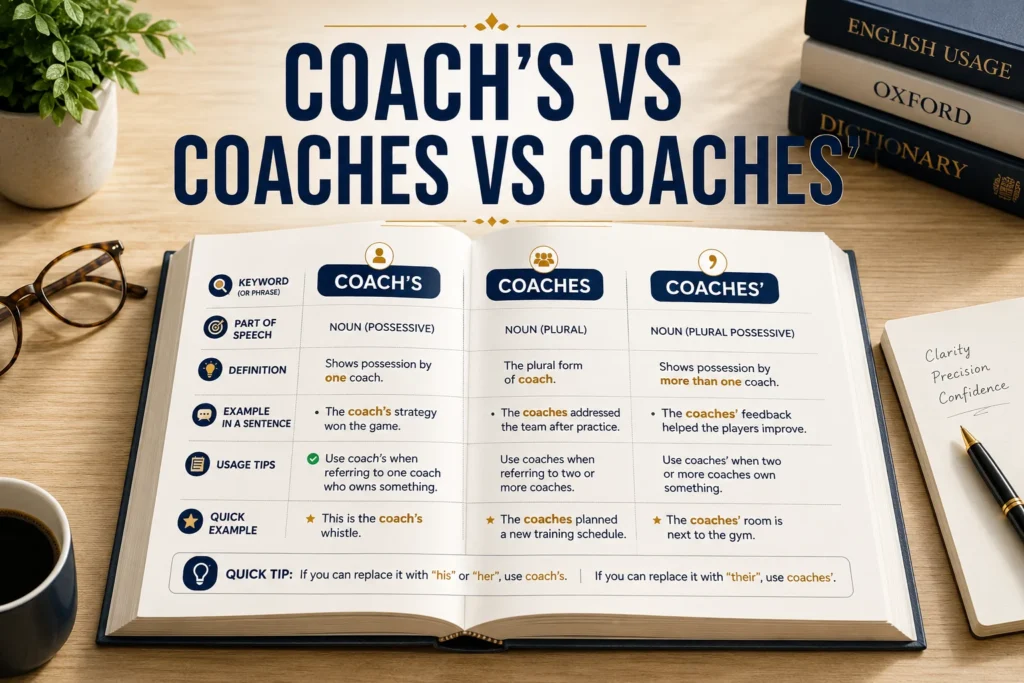
Understanding coach’s vs coaches vs coaches’ can be confusing because all three forms look almost the same, but they serve different grammatical purposes. The difference depends mainly on whether you mean one coach, more than one coach, or possession.
In professional communication, workplace writing, emails, reports, sports organizations, education, training, and customer communication, using the correct form helps your writing look polished and trustworthy.
The three forms are:
- coach — one coach; singular noun
- coach’s — something belonging to one coach, or a contraction of coach is/coach has
- coaches — more than one coach; plural noun
- coaches’ — something belonging to two or more coaches
For example:
The coach reviewed the team’s performance.
The coach’s report was detailed.
The coaches discussed the training plan.
The coaches’ meeting starts at 10 a.m.
Although people often search for a professional way to say coach’s vs coaches vs coaches’, this topic is not really about replacing these words with synonyms. It is about choosing the correct grammatical form and using professional alternatives when the context calls for a different expression.
Coach’s vs Coaches vs Coaches’: Quick Answer
The easiest way to remember the difference is:
| Form | Meaning | Example |
| coach | One coach | The coach arrived early. |
| coach’s | Belonging to one coach / coach is / coach has | The coach’s office is upstairs. |
| coaches | Two or more coaches | The coaches arrived early. |
| coaches’ | Belonging to two or more coaches | The coaches’ meeting starts soon. |
Simple rule
One coach + possession = coach’s
The coach’s strategy was effective.
More than one coach = coaches
The coaches discussed the strategy.
More than one coach + possession = coaches’
The coaches’ strategy was effective.
This small apostrophe difference can change the meaning of an entire sentence.
What Does “Coach” Mean?
Coach is a singular noun when it refers to one person who trains, teaches, guides, or supports someone.
It can refer to a:
- sports trainer
- business coach
- life coach
- career coach
- executive coach
- academic coach
- fitness coach
- communication coach
- professional development coach
Examples
The coach reviewed our performance.
I spoke with the coach after the meeting.
Our coach provided useful feedback.
The company hired a leadership coach.
The word itself does not need an apostrophe when you simply mean one coach.
Tone
The word coach sounds:
- professional
- neutral
- direct
- widely understood
It works well in emails, reports, meetings, presentations, and casual conversations.
What Does “Coach’s” Mean?
Coach’s has two main uses.
Use 1: Possession
It can show that something belongs to one coach.
The coach’s office is near the gym.
Here, the office belongs to one coach.
I received the coach’s feedback.
The feedback came from one coach.
We followed the coach’s instructions.
The instructions came from one coach.
Use 2: Contraction
Coach’s can also mean:
- coach is
- coach has
For example:
The coach’s ready for the meeting.
This means:
The coach is ready for the meeting.
Another example:
The coach’s already reviewed the report.
This means:
The coach has already reviewed the report.
However, contractions such as coach’s = coach is often sound more conversational. In highly formal business writing, spelling out coach is or coach has can sometimes create a more polished tone.
What Does “Coaches” Mean?
Coaches is the plural form of coach.
It means two or more coaches.
There is no apostrophe when you are simply making coach plural.
Examples
The coaches attended the conference.
Several coaches reviewed the proposal.
Our coaches meet every Friday.
The company employs five executive coaches.
A common mistake is writing coach’s when you actually mean several coaches.
Incorrect
The three coach’s attended the event.
Correct
The three coaches attended the event.
The apostrophe does not make a noun plural.
What Does “Coaches’” Mean?
Coaches’ shows possession involving two or more coaches.
The apostrophe comes after the s because coaches is already plural.
Examples
The coaches’ meeting starts at 9 a.m.
This means the meeting involves or belongs to several coaches.
We reviewed the coaches’ recommendations.
The recommendations came from multiple coaches.
The coaches’ offices are on the second floor.
The offices belong to multiple coaches.
Remember
For a regular plural noun ending in s, add only an apostrophe:
coaches → coaches’
managers → managers’
clients → clients’
employees → employees’
Coach’s vs Coaches vs Coaches’: The Main Difference
The most important difference is number + possession.
Singular
The coach called me.
One coach.
Singular possessive
The coach’s office is closed.
One coach owns or is associated with the office.
Plural
The coaches called me.
More than one coach.
Plural possessive
The coaches’ offices are closed.
The offices belong to multiple coaches.
This pattern works with many professional nouns:
manager → manager’s → managers → managers’
client → client’s → clients → clients’
employee → employee’s → employees → employees’
Professional Usage
In Emails
Choosing the right form matters in professional email communication.
One coach
I have attached the coach’s evaluation.
Multiple coaches
I have attached the coaches’ evaluations.
Simply referring to several coaches
The coaches will review the proposal tomorrow.
In business email phrases, accuracy matters because an apostrophe can change the meaning.
In the Workplace
Workplace communication often involves managers, trainers, mentors, and coaches.
Singular
The coach provided valuable guidance.
Singular possessive
The coach’s feedback helped improve the program.
Plural
The coaches discussed the new policy.
Plural possessive
The coaches’ feedback will inform our next training session.
With Clients
When communicating with clients, use the form that accurately reflects the relationship.
Our coach will contact you tomorrow.
Your coach’s recommendations are included below.
Our coaches are available for individual consultations.
We have incorporated the coaches’ suggestions into the program.
In Networking
Professional networking messages often mention coaches, mentors, trainers, and consultants.
For example:
I recently spoke with my coach about leadership development.
Or:
My coach’s advice helped me prepare for the presentation.
When discussing multiple professionals:
Several coaches attended the networking event.
In Customer Service
Customer-facing communication should prioritize clarity.
Instead of:
We will forward this to the coach’s.
Write:
We will forward this to the coach.
If you mean several coaches:
We will forward this to the coaches.
If you mean something belonging to several coaches:
We will forward the coaches’ recommendations.
Professional Alternatives
1. Trainer
Meaning: A person who provides instruction or training.
Tone: Professional and neutral.
Best use: Sports, fitness, workplace training.
The trainer reviewed our performance.
2. Mentor
Meaning: Someone who provides guidance based on experience.
Tone: Professional and supportive.
Best use: Career and workplace communication.
My mentor offered valuable advice.
3. Advisor
Meaning: A person who gives professional advice.
Tone: Formal and business-focused.
Best use: Corporate, financial, academic, and professional settings.
The advisor recommended a different approach.
4. Consultant
Meaning: A specialist hired to provide expert advice.
Tone: Highly professional.
Best use: Business and corporate environments.
The consultant reviewed our development plan.
5. Instructor
Meaning: Someone who teaches a skill or subject.
Tone: Professional and educational.
The instructor explained the process clearly.
6. Facilitator
Meaning: Someone who helps a group communicate or work effectively.
Tone: Corporate and formal.
The facilitator guided the discussion.
7. Specialist
Meaning: Someone with advanced knowledge in a particular area.
Tone: Professional and authoritative.
The leadership specialist provided useful recommendations.
8. Professional Mentor
Meaning: An experienced professional who provides career guidance.
Tone: Formal and supportive.
My professional mentor helped me prepare for the interview.
9. Performance Advisor
Meaning: Someone who helps improve performance.
Tone: Corporate and specialized.
The performance advisor reviewed the team’s results.
10. Development Advisor
Meaning: A professional who supports personal or professional development.
Tone: Formal.
Your development advisor can help create a training plan.
11. Leadership Mentor
Meaning: Someone who guides people in leadership development.
Tone: Professional.
Her leadership mentor encouraged her to take the next step.
12. Training Professional
Meaning: A professional responsible for training or development.
Tone: Neutral and business-friendly.
Please contact your training professional for assistance.
13. Guidance Professional
Meaning: Someone who provides structured guidance.
Tone: Formal.
The guidance professional reviewed the available options.
14. Performance Specialist
Meaning: A professional focused on improving performance.
Tone: Corporate.
The performance specialist provided detailed feedback.
15. Development Specialist
Meaning: Someone who supports professional or personal development.
Tone: Professional.
The development specialist prepared the workshop.
Formal Alternatives
16. Professional Advisor
Please consult your professional advisor before proceeding.
17. Executive Advisor
The executive advisor will attend the meeting.
18. Career Advisor
I discussed the opportunity with my career advisor.
19. Leadership Advisor
The leadership advisor provided recommendations.
20. Training Consultant
The training consultant will deliver the session.
21. Development Consultant
The development consultant reviewed the program.
22. Strategic Advisor
Our strategic advisor recommended several changes.
23. Subject-Matter Specialist
The subject-matter specialist reviewed the proposal.
24. Professional Consultant
The professional consultant prepared the assessment.
25. Development Professional
The development professional will support the project.
26. Training Coordinator
The training coordinator will confirm the schedule.
27. Program Advisor
Please contact the program advisor for further information.
28. Performance Consultant
The performance consultant evaluated the team’s progress.
29. Leadership Consultant
The leadership consultant will lead the workshop.
30. Career Development Professional
The career development professional offered practical guidance.
Friendly Alternatives
Not every communication needs a formal word. In friendly workplace conversations, these options can sound more natural.
31. Guide
My guide helped me understand the process.
32. Support Person
Your support person can help with the next step.
33. Mentor
My mentor gave me some great advice.
34. Trainer
I’ll check with my trainer first.
35. Advisor
Let me ask my advisor about it.
36. Team Mentor
Our team mentor will join us tomorrow.
37. Personal Mentor
I discussed it with my personal mentor.
38. Career Guide
My career guide helped me prepare.
39. Training Partner
I’ll discuss the issue with my training partner.
40. Development Partner
Our development partner can help us plan the next phase.
Email-Friendly Alternatives
In emails, clarity usually matters more than trying to sound sophisticated.
41. Your Coach
Your coach will contact you shortly.
42. Our Coach
Our coach will review the request.
43. Your Trainer
Your trainer can provide additional information.
44. Our Training Team
Our training team will review your request.
45. Your Advisor
Your advisor can assist you with this matter.
46. Our Advisor
Our advisor will follow up with you.
47. Our Coaching Team
Our coaching team will review your feedback.
48. The Coaching Team
The coaching team will provide an update tomorrow.
49. Our Professional Team
Our professional team will review the information.
50. Your Assigned Coach
Your assigned coach will contact you directly.
Workplace-Specific Alternatives
For workplace communication, you can also use:
| Expression | Meaning | Example |
| Training team | Group responsible for training | The training team will respond. |
| Coaching team | Group of coaches | The coaching team reviewed the results. |
| Mentor | Experienced guide | My mentor gave me advice. |
| Advisor | Professional adviser | Please contact your advisor. |
| Consultant | External expert | The consultant reviewed the plan. |
| Trainer | Person providing training | The trainer led the session. |
| Facilitator | Person guiding a group | The facilitator opened the meeting. |
| Specialist | Expert in a field | The specialist reviewed the case. |
| Program lead | Person leading a program | The program lead approved the schedule. |
| Training manager | Person managing training | The training manager confirmed the session. |
Quick Comparison Table
| Form / Alternative | Tone | Best Use |
| coach | Neutral | One coach |
| coach’s | Neutral | One coach’s possession |
| coaches | Neutral | Multiple coaches |
| coaches’ | Neutral | Multiple coaches’ possession |
| trainer | Professional | Training |
| mentor | Professional | Career guidance |
| advisor | Formal | Advice |
| consultant | Formal | Business expertise |
| instructor | Professional | Teaching |
| facilitator | Corporate | Meetings |
| specialist | Professional | Expertise |
| coaching team | Professional | Multiple coaches |
| training team | Corporate | Workplace training |
| assigned coach | Professional | Client communication |
| executive coach | Corporate | Leadership development |
| career advisor | Formal | Career support |
Email Examples
Client Email
Why it works: “Your coach” clearly identifies one professional without unnecessary formality.
Manager Email
Here, coach’s is correct because the feedback comes from one coach.
Colleague Email
Here, coaches is correct because more than one coach reviewed the plan.
Customer Email
“Coaching team” works well when you want to avoid repeatedly saying coaches.
Networking Message
“Mentor” may sound more natural than “coach” when the relationship focuses on long-term professional guidance.
Meeting Follow-Up
Coaches’ is correct because the recommendations belong to or came from multiple coaches.
Common Mistakes
Using an Apostrophe to Make “Coach” Plural
Incorrect:
We have three coach’s.
Correct:
We have three coaches.
An apostrophe does not normally make a noun plural.
Writing “Coaches’s”
Incorrect:
The coaches’s meeting begins at noon.
Correct:
The coaches’ meeting begins at noon.
Because coaches already ends in s, add only an apostrophe.
Confusing “Coach’s” With “Coaches’”
Compare:
The coach’s office.
One coach owns the office.
The coaches’ offices.
Multiple coaches own or use the offices.
Using “Coach’s” When You Mean “Coach Is”
In casual writing:
The coach’s ready.
This can mean:
The coach is ready.
In formal business communication, consider:
The coach is ready.
This removes ambiguity.
Overusing Formal Alternatives
You do not need to replace coach with complicated terms such as “performance development professional” in every sentence.
Simple wording is often more professional.
Instead of:
The performance development professional will contact you.
Use:
Your coach will contact you.
Clear communication usually beats unnecessarily complex vocabulary.
Related Phrases
Here are useful expressions connected with coaching and professional guidance.
Coaching session
A scheduled period of coaching.
We have a coaching session tomorrow.
Coaching program
An organized coaching service.
She joined a leadership coaching program.
Coaching team
A group of coaches.
The coaching team reviewed the results.
Training session
A period of structured training.
The training session begins at 2 p.m.
Professional development
Activities that improve workplace skills.
Professional development is part of our annual plan.
Career guidance
Advice related to career decisions.
I received useful career guidance.
Leadership development
Training designed to improve leadership skills.
The company invests in leadership development.
Performance review
A formal assessment of someone’s work.
The manager scheduled a performance review.
Performance feedback
Comments intended to improve performance.
The coach provided detailed performance feedback.
Development plan
A plan for improving skills or performance.
We created a professional development plan.
Training plan
A structured plan for learning.
The training plan covers six weeks.
Mentoring program
A program that connects experienced professionals with learners.
She joined the company’s mentoring program.
Career mentor
An experienced person who offers career guidance.
My career mentor helped me prepare for the interview.
Executive coaching
Coaching focused on leadership and business performance.
He enrolled in an executive coaching program.
Personal development
Efforts to improve skills, habits, or knowledge.
Personal development can support career growth.
Strategic guidance
Expert advice related to long-term decisions.
The consultant provided strategic guidance.
Professional guidance
Advice intended to support someone’s work or career.
Please seek professional guidance before making a decision.
Training support
Help provided during a training process.
Our team provides training support to new employees.
Phrase Comparison
| Phrase | Meaning | Formality | Best Use |
| coach | One coach | Medium | General communication |
| coach’s | One coach’s possession | Medium | Possessive sentences |
| coaches | Multiple coaches | Medium | General plural |
| coaches’ | Multiple coaches’ possession | Medium | Possessive plural |
| trainer | Training professional | Medium | Training |
| mentor | Experienced guide | Medium | Career/workplace |
| advisor | Person providing advice | High | Professional advice |
| consultant | Expert adviser | High | Business |
| instructor | Person who teaches | Medium | Education/training |
| facilitator | Discussion/process guide | High | Meetings |
| coaching team | Group of coaches | Medium | Organizations |
| training team | Group handling training | Medium | Workplace |
Coach’s vs Coaches vs Coaches’: Easy Memory Trick
Use this four-step pattern:
One person
coach
The coach called.
One person’s possession
coach’s
The coach’s phone rang.
Several people
coaches
The coaches called.
Several people’s possession
coaches’
The coaches’ phones rang.
Think:
one → coach’s
many → coaches
many + ownership → coaches’
This simple pattern solves most questions about these three forms.
US English Usage
American English uses the same basic rules:
coach
coach’s
coaches
coaches’
For example:
The coach’s office is closed.
The coaches’ offices are closed.
American business communication generally follows these possessive rules consistently.
UK English Usage
British English also uses the same basic distinction:
The coach’s report was helpful.
The coaches’ meeting starts tomorrow.
The difference between US and UK English does not normally change the apostrophe rule for these forms.
However, vocabulary can differ depending on the context. For example, British organizations may use terms such as trainer, manager, or advisor in situations where American organizations might use coach.
Corporate Communication
Corporate writing often uses coach, coaching, mentor, advisor, and consultant.
Choose the word according to the actual role.
Use coach when someone helps improve performance or skills.
The executive coach helped the manager improve communication skills.
Use mentor when the relationship focuses on experience, guidance, and long-term development.
Her mentor helped her navigate the transition into management.
Use consultant when an external expert provides specialized advice.
The consultant reviewed the company’s leadership program.
Use advisor when the main role involves giving advice.
The advisor recommended several changes.
This approach makes professional communication more precise.
Customer Service Usage
Customer service writing should avoid ambiguity.
Less clear
The coach’s will contact you.
The reader may wonder whether coach’s means possession or coach is.
Better
Your coach will contact you.
If you mean several professionals:
Our coaches will contact you.
If you mean recommendations from multiple coaches:
We will review the coaches’ recommendations.
Clear nouns and verbs improve email etiquette and reduce confusion.
Networking Usage
Networking communication benefits from natural language.
Instead of forcing formal synonyms, use familiar professional terms:
I spoke with my mentor about the opportunity.
My career advisor recommended the program.
Our executive coach helped us prepare.
Several coaches attended the event.
The coaches’ discussion focused on leadership development.
The best professional communication sounds confident without sounding complicated.
Professional Way to Say “Coach’s”
If you need a professional way to say coach’s, you usually do not need a replacement. The correct grammatical form is already professional.
Examples:
The coach’s recommendation was helpful.
The coach’s report is attached.
We reviewed the coach’s assessment.
If you want to avoid the possessive construction, you can restructure the sentence:
The recommendation from the coach was helpful.
We reviewed the assessment provided by the coach.
The report prepared by the coach is attached.
These alternatives can be useful when you want variety in formal writing.
Formal Alternative to “Coach’s”
Depending on meaning, possible formal alternatives include:
- the trainer’s
- the mentor’s
- the advisor’s
- the consultant’s
- the instructor’s
- the specialist’s
- the facilitator’s
- the coaching professional’s
- the training professional’s
- the assigned advisor’s
Example
Original:
We followed the coach’s recommendations.
Formal alternative:
We followed the advisor’s recommendations.
But only use advisor if that person actually serves as an advisor. Do not change a title simply to sound more formal.
Synonym for “Coaches”
Possible synonyms depend on the role:
- trainers
- mentors
- advisors
- instructors
- consultants
- facilitators
- specialists
- coaching professionals
- training professionals
- development specialists
For example:
The coaches reviewed the plan.
Could become:
The trainers reviewed the plan.
But trainers may describe a different role. Therefore, context matters more than simply finding a synonym.
FAQs
What is the difference between coach’s and coaches?
Coach’s refers to one coach, usually showing possession, while coaches refers to two or more coaches.
Example: The coach’s office is closed. / The coaches are meeting today.
What is the difference between coach’s and coaches’?
Coach’s shows possession by one coach, while coaches’ shows possession by multiple coaches.
Example: The coach’s advice was helpful. / The coaches’ advice was helpful.
Is coaches the plural of coach?
Yes. Coaches is the correct plural form of coach.
Example: One coach, two coaches, and several coaches.
When should I use coach’s?
Use coach’s when something belongs to or is connected with one coach.
Example: We followed the coach’s instructions.
When should I use coaches’?
Use coaches’ when something belongs to or is connected with two or more coaches.
Example: We reviewed the coaches’ recommendations.
Is coach’s always possessive?
No. Coach’s can also be a contraction of coach is or coach has.
Example: The coach’s ready. = The coach is ready.
Is coaches’ the correct possessive form?
Yes. When the plural noun coaches shows possession, place the apostrophe after the s: coaches’.
Example: The coaches’ meeting starts at 10 a.m.
Is “coaches’s” correct English?
No. Coaches’s is not the standard possessive form. The correct form is coaches’.
Example: The coaches’ offices are upstairs.
Which is correct: coach’s meeting or coaches’ meeting?
Both can be correct, depending on how many coaches you mean. Coach’s meeting refers to one coach, while coaches’ meeting refers to multiple coaches.
Example: The coach’s meeting is at 9 a.m. / The coaches’ meeting is at 9 a.m.
What is the easiest way to remember coach’s, coaches, and coaches’?
Remember this simple pattern: coach = one, coach’s = one + possession, coaches = many, and coaches’ = many + possession.
Example: The coach arrived. / The coach’s car arrived. / The coaches arrived. / The coaches’ cars arrived.
Final Summary
The difference between coach’s, coaches, and coaches’ is simple once you focus on number and possession. Coach means one person, coach’s usually means something belonging to one coach, coaches means more than one coach, and coaches’ shows possession by multiple coaches. In professional communication, choose the simplest accurate form rather than replacing common words with unnecessarily complex synonyms. For emails, workplace communication, clients, and networking, clarity should come first. Use coach’s for one coach’s property, coaches for several coaches, and coaches’ for something associated with several coaches. Correct apostrophe placement makes your professional communication clearer, more polished, and easier to trust.
Conclusion
Coach’s, coaches, and coaches’ may look similar, but each form has a different grammatical function. Use coach for one coach, coach’s for something belonging to one coach, coaches for two or more coaches, and coaches’ for something belonging to multiple coaches. In professional emails and workplace communication, choosing the correct form improves clarity and professionalism. Remember the simple rule: one coach → coach’s; multiple coaches → coaches; multiple coaches showing possession → coaches’. Using these forms correctly will help you write clearer, more accurate, and more polished English.