The phrase “no way” is one of the most common expressions in everyday English. People use it to show surprise, disbelief, excitement, or strong disagreement. While it works well in casual conversations, it isn’t always the best choice in professional communication.
Many people search for ways to say no way because they want a more professional, polite, or formal expression for emails, meetings, customer conversations, networking events, and workplace discussions. Choosing the right words helps you sound confident, respectful, and clear without appearing rude or overly emotional.
Whether you’re writing a business email, speaking with a client, responding to your manager, or chatting with colleagues, there are many better alternatives depending on the situation.
In this guide, you’ll learn the meaning of “no way,” when to use it, when to avoid it, and dozens of professional alternatives with practical examples.
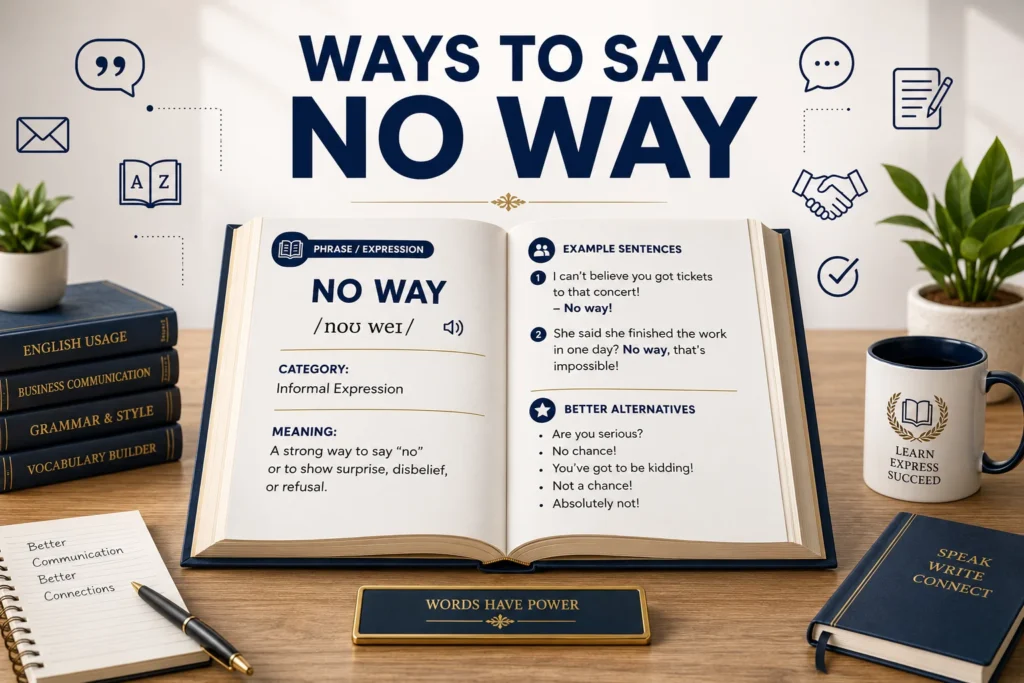
What Does “No Way” Mean?
Simple Meaning
“No way” is an informal expression used to show:
- Surprise
- Disbelief
- Strong disagreement
- Refusal
- Excitement
- Shock
It can express either positive or negative emotions depending on the situation.
Literal Meaning
Literally, “no way” means something is impossible, unacceptable, or cannot happen.
Example
“There’s no way we can finish this project today.”
Tone of “No Way”
The tone depends entirely on the conversation.
It can sound:
- Casual
- Emotional
- Friendly
- Excited
- Strong
- Blunt
- Sometimes rude if used in business communication
Purpose of the Phrase
People use “no way” to:
- Reject an idea
- Show disbelief
- Express excitement
- Refuse a request
- React to unexpected news
Emotional Context
Surprise
“No way! You won the competition?”
Disbelief
“No way that’s true.”
Excitement
“No way! We got front-row tickets!”
Refusal
“No way I’m agreeing to those terms.”
Is “No Way” Professional?
Usually no.
Although native English speakers say it every day, “no way” sounds informal. It may sound too emotional in business settings.
Instead, choose expressions that communicate the same idea professionally.
For example:
Instead of:
“No way we can do that.”
Say:
“Unfortunately, that isn’t feasible.”
Or:
“I’m afraid that won’t be possible.”
These alternatives sound more respectful and professional.
When Is It Appropriate to Use “No Way”?
Emails
Avoid using “no way” in professional emails.
Better options include:
- That won’t be possible.
- Unfortunately, we cannot.
- I’m afraid that’s not feasible.
Workplace
With close coworkers, “no way” may be acceptable in casual conversations.
Example:
“No way! You already finished the report?”
During meetings, use more professional language.example
Clients
Avoid it.
Clients expect respectful and polished communication.
Instead say:
“Unfortunately, we’re unable to accommodate that request.”
Networking
Networking requires professionalism.
Replace:
“No way.”
With:
“I don’t believe that’s possible.”
Or:
“That may be difficult to arrange.”
Customer Service
Customer service representatives should avoid saying “no way.”
Instead use:
- I’m sorry, but we’re unable to…
- Unfortunately, that option isn’t available.
- I appreciate your understanding.
Professional Ways to Say “No
1. That Isn’t Possible
Meaning: The request cannot be completed.
Tone: Professional
Best Use Case: Business emails
Example:
Unfortunately, that isn’t possible within the current timeline.
2. I’m Afraid That Won’t Be Possible
Meaning: A polite refusal.
Tone: Formal and respectful
Best Use Case: Clients
Example:
I’m afraid that won’t be possible due to company policy.
3. Unfortunately, We Can’t Do That
Meaning: A courteous rejection.
Tone: Professional
Best Use Case: Customer support
Example:
Unfortunately, we can’t offer that service at this time.
4. That Isn’t Feasible
Meaning: The idea isn’t practical.
Tone: Executive
Best Use Case: Meetings
Example:
That isn’t feasible with our current budget.
5. I Don’t Believe That’s Possible
Meaning: A softer disagreement.
Tone: Diplomatic
Best Use Case: Professional discussions
Example:
I don’t believe that’s possible given the deadline.
6. We Are Unable to Approve That
Meaning: Formal refusal.
Tone: Corporate
Best Use Case: Official emails
Example:
We are unable to approve that request.
7. That Doesn’t Appear to Be an Option
Meaning: Indicates limited choices.
Tone: Professional
Best Use Case: Business planning
Example:
Based on our resources, that doesn’t appear to be an option.
8. I Must Decline
Meaning: Respectful refusal.
Tone: Formal
Best Use Case: Invitations
Example:
Thank you for the invitation. I must decline.
9. We Cannot Accommodate That Request
Meaning: Unable to fulfill a request.
Tone: Client-friendly
Best Use Case: Customer communication
Example:
At this time, we cannot accommodate that request.
10. Regrettably, That Cannot Be Done
Meaning: Formal rejection.
Tone: Polite
Best Use Case: Official correspondence
Example:
Regrettably, that cannot be done under current regulations.
11. That Falls Outside Our Scope
Meaning: Beyond available services.
Tone: Professional
Best Use Case: Agencies and consultants
Example:
That request falls outside our current scope of work.
12. We Don’t Have the Capacity
Meaning: Limited resources.
Tone: Honest
Best Use Case: Project management
Example:
We don’t have the capacity to take on another project this month.
13. I’m Unable to Agree
Meaning: Respectful disagreement.
Tone: Professional
Best Use Case: Negotiations
Example:
After reviewing the proposal, I’m unable to agree to those terms.
14. That Wouldn’t Be Appropriate
Meaning: Politely rejects unsuitable actions.
Tone: Formal
Best Use Case: HR and management
Example:
That wouldn’t be appropriate under company guidelines.
15. We Need to Decline
Meaning: Official refusal.
Tone: Corporate
Best Use Case: Business emails
Example:
After careful consideration, we need to decline your request.
16. That’s Beyond Our Current Capabilities
Meaning: Indicates technical or operational limits.
Tone: Professional
Best Use Case: IT, engineering, and service teams
Example:
That’s beyond our current capabilities, but we’re exploring future solutions.
17. We Can’t Commit to That
Meaning: Avoids making unrealistic promises.
Tone: Diplomatic
Best Use Case: Project planning and client discussions
Example:
At this stage, we can’t commit to that delivery date.
18. That Doesn’t Align With Our Policy
Meaning: Explains a refusal based on established rules.
Tone: Formal and authoritative
Best Use Case: Compliance, HR, and customer service
Example:
Thank you for your request. Unfortunately, that doesn’t align with our company policy.
Formal Alternatives to Say “No
19. Certainly Not
Meaning: A firm but formal refusal.
Tone: Formal
Best Use Case: Official discussions
Example:
Certainly not. That would violate our agreement.
20. Under No Circumstances
Meaning: Expresses that something is completely unacceptable.
Tone: Strong and formal
Best Use Case: Policies and legal communication
Example:
Under no circumstances should confidential information be shared.
21. By No Means
Meaning: Strongly emphasizes that something is not true or acceptable.
Tone: Formal
Best Use Case: Reports and presentations
Example:
This is by no means a final decision.
22. I Regret to Inform You
Meaning: Introduces disappointing news politely.
Tone: Highly formal
Best Use Case: Official emails
Example:
I regret to inform you that your request has been declined.
23. That Cannot Be Authorized
Meaning: Indicates a lack of approval.
Tone: Corporate
Best Use Case: Management approvals
Example:
At this time, that cannot be authorized.
24. It Is Not Permitted
Meaning: States that an action is prohibited.
Tone: Formal
Best Use Case: Workplace policies
Example:
It is not permitted under company regulations.
25. We Must Respect Existing Guidelines
Meaning: Refers to company rules when declining a request.
Tone: Diplomatic
Best Use Case: HR and compliance
Example:
We must respect existing guidelines, so we can’t approve the exception.
26. That Request Cannot Be Approved
Meaning: Official refusal after review.
Tone: Formal
Best Use Case: Administrative communication
Example:
After reviewing the application, that request cannot be approved.
27. We Are Not in a Position to Proceed
Meaning: Indicates that circumstances prevent moving forward.
Tone: Executive
Best Use Case: Contracts and partnerships
Example:
At present, we are not in a position to proceed with the proposal.
28. We Must Decline at This Time
Meaning: A polite way to refuse while leaving room for future opportunities.
Tone: Professional
Best Use Case: Vendor and partnership emails
Example:
We appreciate your offer, but we must decline at this time.
29. The Proposal Cannot Be Accepted
Meaning: States that an offer or suggestion has been rejected.
Tone: Formal
Best Use Case: Procurement and negotiations
Example:
After careful evaluation, the proposal cannot be accepted.
30. That Is Outside Our Approved Process
Meaning: Explains that a request doesn’t fit established procedures.
Tone: Corporate
Best Use Case: Internal operations and compliance
Example:
Unfortunately, that is outside our approved process.
Friendly Ways to Say “No Way
These expressions work best with friends, family, close coworkers, and casual conversations. Most are not suitable for formal emails or business communication.
31. Absolutely Not
Meaning: A firm refusal or strong disagreement.
Tone: Casual, direct
Best Use Case: Informal conversations
Example:
“Absolutely not! I’m not missing the concert.”
32. Not a Chance
Meaning: Something has no possibility of happening.
Tone: Casual
Best Use Case: Friendly conversations
Example:
“Not a chance I’m waking up at 5 a.m.”
33. No Chance
Meaning: There is no possibility.
Tone: Informal
Best Use Case: Everyday speech
Example:
“There’s no chance we’ll finish in ten minutes.”
34. You’re Kidding!
Meaning: Expresses surprise or disbelief.
Tone: Friendly
Best Use Case: Reacting to unexpected news
Example:
“You’re kidding! You met the CEO?”
35. Seriously?
Meaning: Shows surprise or doubt.
Tone: Casual
Best Use Case: Conversations with friends
Example:
“Seriously? That’s amazing!”
36. I Can’t Believe It
Meaning: Expresses shock or excitement.
Tone: Friendly
Best Use Case: Good or bad news
Example:
“I can’t believe it—you got the promotion!”
37. That’s Impossible
Meaning: Something cannot happen.
Tone: Neutral
Best Use Case: General conversations
Example:
“That’s impossible without more time.”
38. You Must Be Joking
Meaning: Expresses disbelief.
Tone: Friendly
Best Use Case: Surprising situations
Example:
“You must be joking! You finished already?”
39. Get Out of Here!
Meaning: An informal expression of surprise.
Tone: Very casual
Best Use Case: Close friends only
Example:
“Get out of here! You won the lottery?”
40. Are You Serious?
Meaning: Questions whether something is true.
Tone: Casual
Best Use Case: Expressing disbelief
Example:
“Are you serious? That’s incredible!”
Email Alternatives
Professional emails require polite and respectful wording. These alternatives maintain professionalism while delivering a clear message.
41. Unfortunately, That Won’t Be Possible
Meaning: A courteous refusal.
Tone: Professional
Best Use Case: Client emails
Example:
Unfortunately, that won’t be possible due to our current schedule.
42. We Appreciate Your Understanding
Meaning: Softens a refusal.
Tone: Warm and professional
Best Use Case: Customer service
Example:
We appreciate your understanding as we work within our current policies.
43. We Regret Any Inconvenience
Meaning: Acknowledges disappointment.
Tone: Formal
Best Use Case: Service emails
Example:
We regret any inconvenience this decision may cause.
44. At This Time, We Are Unable To…
Meaning: Indicates a temporary limitation.
Tone: Professional
Best Use Case: Business communication
Example:
At this time, we are unable to provide same-day delivery.
45. After Careful Review…
Meaning: Introduces a thoughtful decision.
Tone: Formal
Best Use Case: Approval emails
Example:
After careful review, we cannot approve the request.
46. We Respectfully Decline
Meaning: Polite refusal.
Tone: Formal
Best Use Case: Invitations and proposals
Example:
We respectfully decline your proposal at this time.
47. We Are Unable To Proceed
Meaning: Indicates that work cannot continue.
Tone: Corporate
Best Use Case: Contracts
Example:
We are unable to proceed until all required documents are received.
48. We Cannot Confirm That Request
Meaning: Declines confirmation.
Tone: Professional
Best Use Case: Administrative emails
Example:
At this stage, we cannot confirm that request.
49. We Must Decline the Opportunity
Meaning: Politely turns down an offer.
Tone: Formal
Best Use Case: Partnership discussions
Example:
We sincerely appreciate the opportunity but must decline.
50. We Are Unable to Support That Option
Meaning: Indicates an unavailable solution.
Tone: Professional
Best Use Case: Technical support
Example:
Unfortunately, we are unable to support that option.
Workplace Alternatives
These expressions sound confident, respectful, and appropriate in meetings, presentations, and internal discussions.
51. Let’s Consider Another Approach
Meaning: Suggests an alternative instead of rejecting an idea outright.
Tone: Collaborative
Best Use Case: Team meetings
Example:
Let’s consider another approach that fits our timeline.
52. That May Not Be the Best Option
Meaning: Offers constructive feedback.
Tone: Professional
Best Use Case: Brainstorming sessions
Example:
That may not be the best option given our budget.
53. I’d Recommend a Different Solution
Meaning: Redirects the conversation positively.
Tone: Helpful
Best Use Case: Project discussions
Example:
I’d recommend a different solution to reduce costs.
54. We Should Reconsider
Meaning: Encourages further evaluation.
Tone: Diplomatic
Best Use Case: Decision-making meetings
Example:
We should reconsider before moving forward.
55. That Doesn’t Meet Our Requirements
Meaning: Explains why an idea cannot be accepted.
Tone: Professional
Best Use Case: Quality reviews
Example:
That doesn’t meet our technical requirements.
56. We’d Need to Explore Other Options
Meaning: Suggests flexibility.
Tone: Positive
Best Use Case: Planning discussions
Example:
We’d need to explore other options before making a decision.
57. I Have Some Concerns
Meaning: Introduces disagreement politely.
Tone: Respectful
Best Use Case: Team collaboration
Example:
I have some concerns about the proposed timeline.
58. That Doesn’t Fit Our Priorities
Meaning: Aligns decisions with business goals.
Tone: Executive
Best Use Case: Strategic planning
Example:
That doesn’t fit our current priorities.
59. We Need More Information Before Proceeding
Meaning: Delays a decision without rejecting it completely.
Tone: Professional
Best Use Case: Project approvals
Example:
We need more information before proceeding.
60. I Recommend Holding Off for Now
Meaning: Suggests waiting rather than refusing immediately.
Tone: Diplomatic
Best Use Case: Risk management
Example:
I recommend holding off for now until we receive the final report.
Quick Comparison Table
| Alternative | Tone | Best Use |
| That isn’t possible | Professional | Business emails |
| I’m afraid that won’t be possible | Formal | Clients |
| Unfortunately, we can’t do that | Professional | Customer service |
| That isn’t feasible | Executive | Meetings |
| I don’t believe that’s possible | Diplomatic | Negotiations |
| Absolutely not | Casual | Friends |
| Not a chance | Friendly | Everyday conversation |
| I can’t believe it | Friendly | Surprise |
| We appreciate your understanding | Professional | Customer emails |
| Let’s consider another approach | Collaborative | Team meetings |
| That may not be the best option | Professional | Workplace discussions |
| We need more information | Neutral | Decision-making |
Professional Email Examples
Client
Subject: Project Timeline
Hello Sarah,
Thank you for your request. Unfortunately, that won’t be possible within the agreed timeline. However, we’d be happy to discuss an alternative schedule that meets your needs.
Kind regards,
Manager
Hi Alex,
After reviewing the workload, I don’t believe that’s possible this week. I recommend adjusting the deadline or reallocating resources.
Thank you.
Colleague
Hi Emma,
That approach may not be the best option. Let’s discuss another solution during tomorrow’s meeting.
Thanks!
Customer
Dear Customer,
Thank you for contacting us. We appreciate your interest. Unfortunately, we are unable to offer this feature at the moment.
Thank you for your understanding.
Networking
Hello David,
Thank you for reaching out. I truly appreciate the invitation. Unfortunately, I must decline due to prior commitments.
I hope we can connect another time.
Best regards,
Meeting Follow-up
Hi Team,
After today’s discussion, we’ve concluded that the proposed solution isn’t feasible within the current budget. Let’s review alternative approaches during our next meeting.
Thank you.
Common Mistakes
1. Overusing the Phrase
Saying “no way” repeatedly can make your communication sound emotional instead of thoughtful.
Better:
Mix in alternatives such as:
- That isn’t feasible.
- Unfortunately, we can’t.
- I don’t believe that’s possible.
2. Using the Wrong Tone
“No way” may sound rude when speaking with clients, managers, or senior leaders.
Instead, choose polite and professional language that explains your reasoning.
3. Formal vs. Casual Mismatch
Avoid casual expressions like:
- No way!
- Not a chance!
- Get out of here!
in business emails or formal meetings.
Likewise, avoid overly formal language in relaxed conversations with friends where a simple “No way!” sounds natural.
4. Ignoring Email Etiquette
A professional refusal should include:
- Appreciation
- A clear explanation
- Respectful wording
- An alternative when possible
For example:
Thank you for your request. Unfortunately, we aren’t able to accommodate it at this time. We appreciate your understanding and would be happy to discuss other options.
Related Phrases to “No Way”
If you want more variety in your speech or writing, these related expressions can communicate surprise, disbelief, refusal, or disagreement in different tones.
| Phrase | Meaning | Example |
| No chance | Impossible | “There’s no chance we’ll finish today.” |
| Absolutely not | Strong refusal | “Absolutely not. That isn’t acceptable.” |
| Not at all | Polite disagreement | “Not at all. I don’t mind helping.” |
| I don’t think so | Gentle refusal | “I don’t think so. The timing isn’t right.” |
| Certainly not | Formal refusal | “Certainly not. That violates company policy.” |
| By no means | Strong formal denial | “This is by no means complete.” |
| Under no circumstances | Never acceptable | “Under no circumstances should passwords be shared.” |
| That’s unlikely | Probably won’t happen | “That’s unlikely before Friday.” |
| That’s impossible | Cannot happen | “That’s impossible with our current resources.” |
| I can’t agree | Respectful disagreement | “I can’t agree with that proposal.” |
| I have reservations | Expresses concern | “I have reservations about this approach.” |
| I’d advise against it | Recommends not doing something | “I’d advise against making changes today.” |
| That’s not feasible | Not practical | “That’s not feasible this quarter.” |
| That won’t work | Doesn’t solve the problem | “That won’t work for our clients.” |
| We need another solution | Suggests an alternative | “We need another solution before launch.” |
| Let’s revisit this later | Postpones a decision | “Let’s revisit this after the audit.” |
Phrase Comparison
Choosing the right alternative depends on your audience and purpose.
| Phrase | Tone | Formality | Best Use |
| No way | Casual | Low | Friends, family |
| That isn’t possible | Professional | High | Business emails |
| I’m afraid that won’t be possible | Very polite | High | Clients |
| Unfortunately, we can’t | Professional | High | Customer service |
| That isn’t feasible | Executive | High | Meetings |
| Absolutely not | Direct | Low | Informal conversations |
| Not a chance | Friendly | Low | Casual speech |
| I don’t believe that’s possible | Diplomatic | Medium-High | Negotiations |
| Let’s consider another approach | Collaborative | High | Workplace |
| We need another solution | Positive | Medium | Team discussions |
Which Alternative Should You Choose?
- For clients: I’m afraid that won’t be possible.
- For managers: That isn’t feasible.
- For colleagues: Let’s consider another approach.
- For customer service: Unfortunately, we can’t offer that option.
- For networking: I appreciate the opportunity, but I must decline.
Cultural Usage
US English
American English speakers frequently use “No way!” to express excitement, surprise, or disbelief.
Examples:
- “No way! You got promoted?”
- “No way that’s happening.”
In professional settings, Americans generally replace it with more polite expressions.
UK English
British English speakers also use “No way,” but they often prefer softer wording in formal conversations.
Examples include:
- “I’m afraid that’s not possible.”
- “I don’t think that’s going to work.”
These phrases sound more reserved and diplomatic.
Corporate Communication
In business, avoid emotional language whenever possible.
Instead of:
“No way.”
Use:
- That isn’t feasible.
- We cannot accommodate that request.
- Unfortunately, that won’t be possible.
- We recommend another approach.
These alternatives improve professional communication, strengthen email etiquette, and build trust with clients and colleagues.
Customer Service
Customer service representatives should avoid blunt refusals.
A better structure is:
- Thank the customer.
- Explain the limitation.
- Offer an alternative.
- End politely.
Example:
Thank you for contacting us. Unfortunately, we’re unable to process that request. However, we’d be happy to help you with another solution.
Networking
Networking is about maintaining positive relationships.
Instead of saying:
No way.
Try:
- I appreciate the opportunity.
- Unfortunately, I have a scheduling conflict.
- I must respectfully decline.
- Perhaps another time.
These phrases leave a professional impression.
(FAQs)
What is another way to say “no way”?
Some excellent alternatives include:
- That isn’t possible
- I’m afraid that won’t be possible
- Absolutely not
- Not a chance
- Unfortunately, we can’t
- That isn’t feasible
What is the most professional way to say “no way”?
“I’m afraid that won’t be possible” and “That isn’t feasible” are among the best professional alternatives.
Is “no way” rude?
Not always. It’s perfectly acceptable in casual conversations, but it may sound abrupt or unprofessional in business settings.
Can I use “no way” in a business email?
It’s better to avoid it. Choose a more polite phrase such as:
Unfortunately, that won’t be possible.
What’s a formal alternative to “no way”?
Formal alternatives include:
- Certainly not
- By no means
- Under no circumstances
- That cannot be authorized
- We must decline
What’s a polite synonym for “no way”?
A polite synonym is:
I don’t believe that’s possible.
or
I’m afraid we cannot accommodate that request.
How do I politely refuse a request?
Start with appreciation, explain the limitation clearly, and, if appropriate, suggest an alternative.
What can I say instead of “no way” at work?
Professional workplace alternatives include:
- Let’s consider another approach.
- That doesn’t meet our requirements.
- We’d need more information.
- That may not be the best option.
Is “absolutely not” more polite than “no way”?
No. “Absolutely not” is often stronger and more direct. In formal situations, softer alternatives are usually better.
What is the best phrase for customer service?
A customer-friendly option is:
Unfortunately, we’re unable to offer that option at this time.
What is a professional way to disagree?
Use phrases such as:
- I have some concerns.
- I respectfully disagree.
- That may not be the best option.
- I’d recommend another approach.
Which phrase works best for clients?
“I’m afraid that won’t be possible” is respectful, clear, and professional.
Can “no way” express excitement?
Yes. It often expresses excitement or pleasant surprise.
Example:
“No way! We won the award!”
What’s the difference between “no way” and “not a chance”?
“No way” can express surprise, excitement, or refusal. “Not a chance” almost always means a firm refusal or impossibility.
Why should I use alternatives to “no way”?
Using different expressions improves your vocabulary, strengthens workplace communication, enhances professional communication, and helps you match the right tone for every audience.
Final Summary
The phrase “no way” is common in everyday English, but it isn’t always the best choice for professional communication. In business emails, meetings, customer service, and networking, polite alternatives create a more respectful and confident impression. Expressions such as “I’m afraid that won’t be possible,” “That isn’t feasible,” and “Unfortunately, we can’t” communicate the same message with greater professionalism. For casual conversations, options like “Not a chance,” “Absolutely not,“ or “I can’t believe it” work naturally. Expanding your vocabulary helps you communicate more effectively, improve email etiquette, strengthen workplace relationships, and choose the right tone for every situation.
Best Casual Options
- Absolutely not
- Not a chance
- No chance
- You’re kidding!
- I can’t believe it
Best Email Options
- Unfortunately, that won’t be possible.
- We appreciate your understanding.
- We regret any inconvenience.
- We are unable to proceed.
- After careful review, we must decline.