
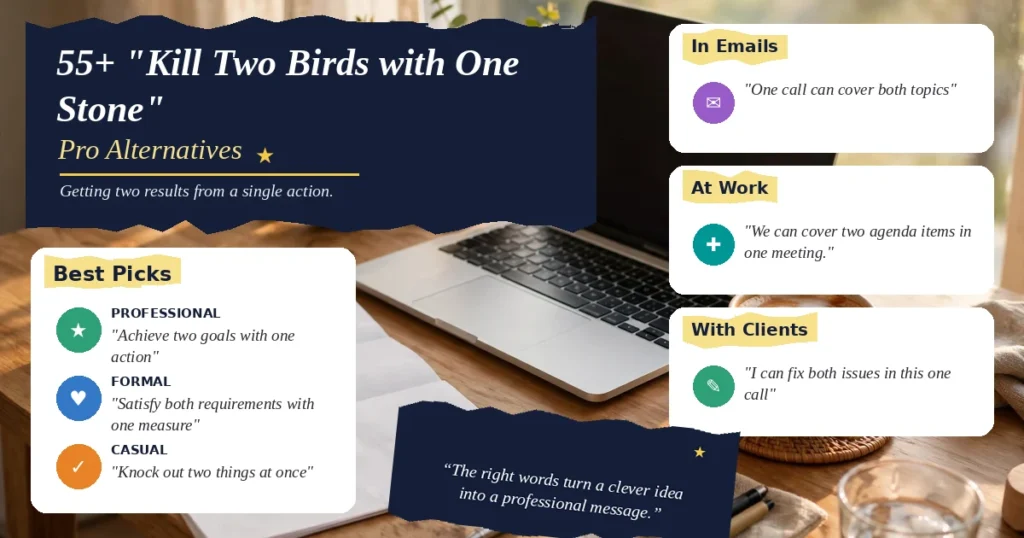
If you are looking for other ways to say “kill two birds with one stone,” you are not alone. The phrase means getting two results from a single action, but its violent image makes many people avoid it at work. Managers, clients, and hiring teams often prefer calmer, more professional language.
This guide gives you 55 professional and polite alternatives you can use in emails, meetings, and everyday conversation. Each one comes with a one-line usage note and a short real-world example, so you can pick the tone that fits your situation in seconds. You will find formal options for reports, friendly options for teammates, and ready-made lines for business emails.
Whether you need a professional way to say “kill two birds with one stone” in a client proposal or a casual swap for team chat, you will find it below. By the end, you will know exactly what to say when one smart move solves two problems — without mentioning birds or stones at all.
What “kill two birds with one stone” means
“Kill two birds with one stone” means to achieve two goals with a single action. For example, biking to work saves money and gives you exercise at the same time. People use this synonym for “kill two birds with one stone” moments when one smart decision solves two problems at once.
The phrase sounds casual and a little old-fashioned. It works in friendly conversation, but the word “kill” can bother animal lovers and feels too rough for formal writing. Many workplaces now treat it as a phrase to avoid in official emails and reports.
People usually say it with pride or cleverness. It celebrates efficiency — the speaker feels smart for finding one move that fixed two things. That positive energy explains why the idea stays popular even as the wording falls out of favor.
Example in conversation: “I scheduled my dentist appointment next to the office, so I killed two birds with one stone.” A softer version: “I scheduled my dentist appointment near the office, so I handled two errands in one trip.” Both carry the same meaning; only the tone changes.
When to use it professionally
In emails
Skip the original phrase in emails. Clients and senior leaders may read it as careless. Use “address both items in one update” or “resolve two issues with one solution” instead. These business email phrases sound thoughtful and keep your message professional.
In the workplace
With close teammates, the original phrase usually passes without trouble. In meetings with mixed groups, choose a neutral alternative. “Let’s cover both topics in one call” keeps the friendly tone without the rough image, and it strengthens everyday workplace communication.
With clients
Avoid the original with clients. It can sound flippant about their problems. Say “this plan meets both of your requirements” to show you take each need seriously while still highlighting the efficiency of your approach.
In networking
At events and in introductions, polished language builds trust. “One conversation covered both of my questions” sounds warm and smart. Save the idiom for casual chats after you know someone well.
In customer service
Support agents should avoid the phrase completely. Customers want care, not cleverness. “I can fix both issues in this one call” reassures the customer, shows competence, and follows good email etiquette.
55 professional and polite alternatives
Professional alternatives
Achieve two goals with one action. Direct and confident; works in reports and presentations. Example: “This upgrade lets us achieve two goals with one action.”
Address two needs at once. Warm and client-friendly; ideal for service emails. Example: “We can address two needs at once during Thursday’s visit.”
Cover both objectives in a single step. Clear and managerial; suits project updates. Example: “The new process covers both objectives in a single step.”
Hit two targets with one effort. Energetic but professional; good for team talks. Example: “This campaign hits two targets with one effort.”
Resolve two issues simultaneously. Calm and precise; perfect for support tickets. Example: “The patch resolves two issues simultaneously.”
Combine both tasks into one. Simple and practical; great for daily planning. Example: “Let’s combine both tasks into one to save the afternoon.”
Get double value from one decision. Persuasive; works in proposals and pitches. Example: “You get double value from one decision with this plan.”
Solve two problems with one solution. Straightforward; ideal for problem-solving discussions. Example: “This tool solves two problems with one solution.”
Handle both priorities in one move. Decisive; suits leadership updates. Example: “We can handle both priorities in one move this quarter.”
Meet two requirements at once. Compliance-friendly; good for formal documentation. Example: “The design meets two requirements at once.”
Accomplish two outcomes in one go. Upbeat and efficient; fits status meetings. Example: “We accomplished two outcomes in one go today.”
Tackle both items in a single pass. Action-oriented; works for checklists and reviews. Example: “I’ll tackle both items in a single pass this afternoon.”
Streamline two processes into one. Process-focused; ideal for operations talk. Example: “We streamlined two processes into one last quarter.”
Deliver two results from one initiative. Results-driven; strong in executive summaries. Example: “The initiative delivered two results from one launch.”
Maximize one effort for two gains. Strategic; good for planning sessions. Example: “Let’s maximize one effort for two gains this month.”
Formal alternatives
Achieve dual objectives concurrently. Highly formal; suits board reports. Example: “The policy achieves dual objectives concurrently.”
Address both matters in one proceeding. Legal in tone; fits official correspondence. Example: “We can address both matters in one proceeding.”
Realize two aims through a single undertaking. Academic and dignified; good for formal writing. Example: “The program realizes two aims through a single undertaking.”
Satisfy both requirements with one measure. Precise; ideal for regulatory contexts. Example: “This single measure satisfies both requirements.”
Attain two ends by one means. Classic and literary; suits speeches. Example: “We attain two ends by one means with this reform.”
Consolidate two priorities into a single effort. Corporate; strong in strategy documents. Example: “Let’s consolidate two priorities into a single effort.”
Fulfill dual purposes with one action. Balanced and formal; fits mission statements. Example: “The event fulfills dual purposes with one action.”
Serve both interests at once. Diplomatic; good for negotiations. Example: “This compromise serves both interests at once.”
Effect two outcomes in a single stroke. Elegant; suits written announcements. Example: “The decision effects two outcomes in a single stroke.”
Accomplish a dual purpose. Compact and formal; fits headlines and memos. Example: “The visit accomplished a dual purpose.”
Friendly alternatives
Knock out two things at once. Casual and lively; great with teammates. Example: “I knocked out two things at once this morning.”
Get two for the price of one. Playful; works in light conversation. Example: “This trip gets us two for the price of one.”
Do double duty. Short and punchy; fits quick chats. Example: “This software does double duty for our team.”
Win on two fronts. Sporty and upbeat; good for celebrating results. Example: “We won on two fronts with that launch.”
Check off two boxes in one go. Relaxed; ideal for to-do talk. Example: “I checked off two boxes in one go today.”
Two wins with one move. Cheerful; suits team messages. Example: “That decision was two wins with one move.”
Take care of both at the same time. Warm and simple; works anywhere casual. Example: “I’ll take care of both at the same time.”
Bundle the two together. Practical; good for planning chats. Example: “Let’s bundle the two together on Friday.”
Make one trip count twice. Concrete and visual; fits errands and travel. Example: “We made one trip count twice yesterday.”
Wrap up two things together. Easygoing; suits end-of-day updates. Example: “I wrapped up two things together before lunch.”
Email alternatives
“This lets us resolve both items in one update.” Polite and efficient; perfect for status emails. Example: “This lets us resolve both items in one update, so no extra meeting is needed.”
“One call can cover both topics.” Helpful; ideal for scheduling messages. Example: “One call can cover both topics — does Tuesday work for you?”
“Let’s combine both requests into a single reply.” Organized; good for busy inboxes. Example: “Let’s combine both requests into a single reply to keep things simple.”
“We can handle this in the same meeting.” Reassuring; suits client emails. Example: “We can handle this in the same meeting, so you won’t need extra time.”
“This solution covers both concerns.” Confident; strong in proposal emails. Example: “This solution covers both concerns you raised last week.”
“One change fixes both issues.” Clear; great for technical updates. Example: “One change fixes both issues, and it goes live tonight.”
“Let’s address both points in our next email.” Forward-looking; fits ongoing threads. Example: “Let’s address both points in our next email so nothing slips.”
“This update answers both questions.” Direct; ideal for Q&A follow-ups. Example: “This update answers both questions from your last message.”
“We can settle both matters today.” Decisive; good for closing loops. Example: “We can settle both matters today if you approve the draft.”
“A single message will cover both.” Minimal and clean; suits quick notes. Example: “A single message will cover both — I’ll send it by noon.”
Workplace alternatives
Double up on the outcome. Bold; fits ambitious team goals. Example: “This sprint lets us double up on the outcome.”
Cover two agenda items in one meeting. Practical; perfect for scheduling. Example: “We can cover two agenda items in one meeting.”
Fold both tasks into one sprint. Agile-friendly; suits development teams. Example: “Let’s fold both tasks into one sprint.”
Merge the two action items. Crisp; good for meeting notes. Example: “I’ll merge the two action items into one ticket.”
Get twice the return on one effort. Business-minded; strong in reviews. Example: “We got twice the return on one effort.”
Knock out two deadlines with one push. Driven; fits fast-paced teams. Example: “We knocked out two deadlines with one push.”
Use one process for both teams. Collaborative; ideal for cross-team work. Example: “Let’s use one process for both teams.”
Roll both updates into a single report. Tidy; great for reporting. Example: “I’ll roll both updates into a single report.”
Pair the two goals in one plan. Strategic; suits quarterly planning. Example: “We paired the two goals in one plan.”
Let one decision serve both sides. Fair-minded; good for negotiations. Example: “Let one decision serve both sides here.”
Quick comparison table
| Alternative | Tone | Best use |
|---|---|---|
| Achieve two goals with one action | Professional | Reports and presentations |
| Address two needs at once | Warm | Client and service emails |
| Satisfy both requirements with one measure | Formal | Official documents |
| Knock out two things at once | Friendly | Teammate chats |
| One call can cover both topics | Polite | Scheduling emails |
| Resolve two issues simultaneously | Precise | Support tickets |
| Consolidate two priorities into a single effort | Corporate | Strategy documents |
| Get double value from one decision | Persuasive | Proposals and pitches |
| Cover two agenda items in one meeting | Practical | Workplace scheduling |
| Serve both interests at once | Diplomatic | Negotiations |
Email examples
Email to a client
“Hi Daniel, the revised proposal covers both concerns you raised — pricing and timeline — so we can finalize everything in one review. I have attached the updated draft for your approval. Please let me know if Friday works for a short call to close this out.”
Email to a manager
“Hi Priya, I combined both reports into a single document to save review time. It covers the Q3 numbers and the hiring plan in one place. I can walk you through the highlights in our one-on-one tomorrow morning.”
Email to a colleague
“Hey Alex, one trip to the warehouse can cover both pickups. I’ll grab your samples while I’m there — just send me the list by 3 p.m. so I don’t miss anything.”
Email to a customer
“Hello Maria, good news — this update fixes both issues you reported. Your account access is restored, and the billing error is corrected. Reply to this message if anything still looks wrong, and I’ll sort it out right away.”
Networking email
“Hi James, great meeting you at yesterday’s event. One coffee chat could cover both topics we discussed — the mentorship program and the referral partnership. Are you free next Tuesday morning?”
Meeting follow-up email
“Team, today’s session let us settle both agenda items at once. The action steps are listed below with owners and deadlines. Our next check-in is Monday at 10 a.m. — please come prepared with your updates.”
Common mistakes to avoid
1. Using the original phrase in formal emails
The violent image can distract from your message. Swap in a neutral alternative before you hit send.
2. Overusing efficiency phrases
Dropping a “two for one” line into every update sounds gimmicky. Save these phrases for moments when the double win is real.
3. Mixing casual and formal tones
“Knock out two things at once” charms teammates but jars clients. Match the phrase to the reader, not to your mood.
4. Forgetting the audience’s feelings about animals
Some readers find the bird image genuinely upsetting. When in doubt, choose the kinder wording.
5. Sounding like you cut corners
Efficiency phrases can imply rushed work. Add one detail that shows care, not shortcuts.
6. Using it when only one goal exists
Forcing a “double win” where there is none confuses readers. Use the phrase only when two real outcomes exist.
Related phrases
Hit the nail on the head — get something exactly right. Example: “You hit the nail on the head with that summary.”
Two sides of the same coin — two connected aspects of one thing. Example: “Risk and reward are two sides of the same coin.”
The best of both worlds — benefits from two different options. Example: “The hybrid schedule gives us the best of both worlds.”
Streamline — make a process simpler and faster. Example: “We streamlined onboarding this year.”
Dual-purpose — designed for two uses. Example: “The lobby is a dual-purpose event space.”
Multitasking — handling more than one task at a time. Example: “Multitasking during meetings hurts focus.”
One fell swoop — in a single decisive action. Example: “He cleared the backlog in one fell swoop.”
In one go — in a single attempt. Example: “She read the whole report in one go.”
At a stroke — with one decisive action. Example: “The new policy changed everything at a stroke.”
Do double duty — serve two functions. Example: “The app does double duty as a calendar.”
Pull double duty — work in two roles at once. Example: “He pulled double duty during the launch.”
Win-win — a result that benefits everyone. Example: “The partnership was a win-win.”
Efficient — achieving results without wasted effort. Example: “An efficient workflow saves hours every week.”
Productive — producing strong results. Example: “It was a productive meeting.”
Consolidate — combine into a single unit. Example: “We consolidated three reports into one.”
Economical — using resources without waste. Example: “Her solution was economical with everyone’s time.”
Phrase comparison: the idiom vs. its alternatives
The original phrase is vivid but risky. It paints a clear picture, which helps memory, yet the violent verb can offend animal lovers and feels dated in formal settings. Its tone is casual and slightly boastful — fine for friends, weak for executives.
Professional alternatives like “achieve two goals with one action” trade color for clarity. They state the outcome without imagery, which suits reports, emails, and mixed audiences. The cost is memorability; nobody quotes them at dinner, but nobody misunderstands them either.
Formal options such as “satisfy both requirements with one measure” add weight and precision. They fit legal, academic, and official writing, but they sound stiff in conversation. Use them where accuracy matters more than warmth.
Friendly picks like “knock out two things at once” keep the energy of the original without the violence. They work with teammates and friends but can feel too loose with clients or in official documents.
The smart move: keep the idiom for casual speech, and choose a neutral alternative for anything written or professional. Match the wording to the room, not to habit, and your message will land exactly as intended.
Cultural usage
United States
Americans use the idiom freely in casual speech and even in business meetings. Still, corporate style guides increasingly flag it, and younger professionals often prefer “two wins with one move.”
United Kingdom
British speakers know the phrase well, but formal British business writing favors understatement. “Address both matters at once” fits the local preference for polite, measured language.
Corporate communication
Most large companies avoid violent idioms in official documents. Employee handbooks and brand guidelines often list neutral replacements, so check yours before publishing anything external.
Customer service
Support scripts in every market avoid the phrase. “I can resolve both issues in one call” keeps the focus on the customer’s relief, not the agent’s cleverness.
Networking
At conferences, polished phrasing signals professionalism. International contacts may not know the idiom, so plain alternatives also prevent confusion across cultures.
Frequently asked questions
What is a professional way to say “kill two birds with one stone”?
“Achieve two goals with one action” is the safest professional choice. It is clear, neutral, and works in emails, reports, and meetings. For client messages, try the warmer “address two needs at once.”
Is “kill two birds with one stone” offensive?
It can be. Animal lovers may find the violent image upsetting, and many workplaces now treat the phrase as outdated. A neutral alternative is the safer choice in any professional setting.
What is a polite alternative to “kill two birds with one stone”?
“Handle both at the same time” is polite and simple. It keeps the full meaning without any harsh imagery. Use it in conversation, emails, and customer messages.
Can I say “kill two birds with one stone” in a business email?
Avoid it in business emails. The phrase can sound careless to clients and senior leaders. “Resolve both items in one update” carries the same meaning with a professional tone.
What is the origin of “kill two birds with one stone”?
The saying dates back centuries and appears in English writing from the 1600s. It comes from hunting, where one thrown stone could strike two birds. The modern meaning — two results from one action — developed over time.
What is a formal synonym for “kill two birds with one stone”?
“Satisfy both requirements with one measure” is formal and precise. It suits official documents, legal writing, and academic work. “Achieve dual objectives concurrently” is another strong formal alternative.
How do you say “kill two birds with one stone” in a meeting?
Try “let’s cover both topics in one call.” It sounds natural and keeps the meeting moving. For written minutes, use “addressed two agenda items in one session.”
What does “kill two birds with one stone” mean in simple words?
It means one action gives you two good results. For example, walking to the store gives you exercise and groceries. One effort, two wins.
Is there a kinder version of “kill two birds with one stone”?
Yes — “feed two birds with one seed” is a popular kinder rewrite. It keeps the rhythm while removing the violence. “Two wins with one move” is another gentle option.
What can I say instead of “kill two birds with one stone” at work?
“Cover two agenda items in one meeting” fits most workplace situations. For written updates, “deliver two results from one initiative” sounds strong. Pick the version that matches your audience.
Do British people say “kill two birds with one stone”?
Yes, British speakers know and use it in casual conversation. In formal British business writing, though, plainer phrasing is preferred. “Address both matters at once” fits well.
What is the difference between “kill two birds with one stone” and “two birds, one stone”?
They mean the same thing. “Two birds, one stone” is just a shorter, punchier version. Both carry the same violent image, so the same polite alternatives apply to each.
Can I use this phrase with clients?
It is risky with clients. Some may find it flippant or off-putting. Show respect for their concerns with “this plan meets both of your requirements.”
What is a one-word synonym for “kill two birds with one stone”?
No single word captures it perfectly. “Streamline” comes close when you merge processes into one. “Consolidate” works when you combine tasks or reports.
How do you explain “kill two birds with one stone” to a child?
Say it means doing one thing that helps in two ways — like cleaning your room while listening to a story. Skip the literal meaning and use the kinder versions with kids.
Conclusion
Quick picks — Professional: “Achieve two goals with one action” and “Address two needs at once.” Formal: “Satisfy both requirements with one measure” and “Achieve dual objectives concurrently.” Friendly-casual: “Knock out two things at once” and “Do double duty.” Email: “One call can cover both topics” and “This lets us resolve both items in one update.”
The idiom is vivid, but its violent image can distract from your message. Trade color for clarity in writing, and save the original for casual speech. Match the phrase to your reader — neutral for clients, lively for teammates. Efficiency sounds best when it also sounds kind.
Related Articles
- Other Ways to Say Such As: 50+ Professional Alternatives
- 45 Ways to Say “In Order To” Professionally (2026 Guide)
- Other Ways to Say I Don’t Care: 50 Alternatives
- Other Ways to Say Good Job: 60 Professional Alternatives
- Other Ways to Say As Soon As Possible: 50 Alternatives
- Other Ways to Say Please Advise: Professional & Polite Alternatives in 2026
- 50+ “I Am Reaching Out to You” Email Alternatives




