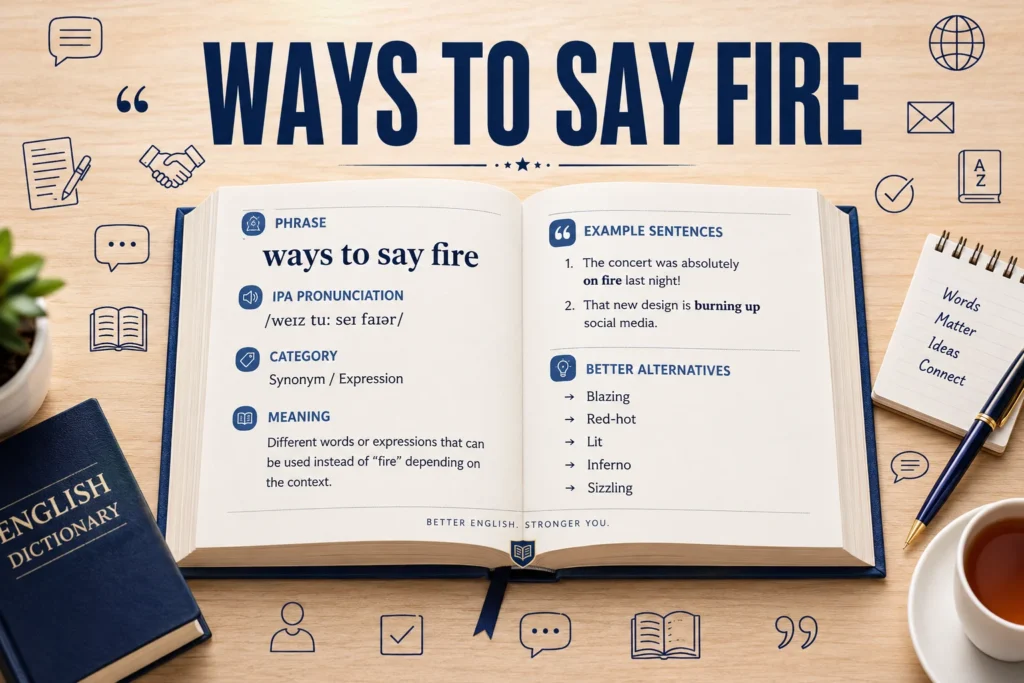
Editor’s Note: The word “fire” has several meanings. In business communication, it can refer to terminating an employee, showing enthusiasm (“That’s fire!”), or starting or causing something. This guide focuses on choosing the right alternative based on your audience and situation.
Professi*nal Ways to Say “Fire”
If you’re looking for a professional way to say “fire,” the best alternative depends on your meaning. If you mean ending someone’s employment, words like terminate, dismiss, let go, or end employment sound more professional. If you mean something is excellent or exciting, you can say outst*nding, excellent, impressive, or exceptional instead.
Choosing the right phrase improves professional communication, strengthens business email etiquette, and helps you avoid language that sounds harsh or inappropriate.
The word “fire” is one of the most common words in English, but it can also be one of the easiest to misunderstand. It has several meanings depending on the situation. It can describe real flames, the act of dismissing an employee, launching something such as a question or message, or even praising something as exciting in casual conversation.
Because of these different meanings, many people search for a professional way to say “fire,” a formal alternative to “fire,” or a better syn*nym for “fire” that fits workplace communication.
In professional settings, word choice matters. Using the wrong expression can sound rude, insensitive, or unclear. Whether you’re writing a business email, speaking with a client, leading a meeting, or networking with professionals, choosing the right alternative creates a better impression.
This guide will help you understand when to use “fire,” when to avoid it, and which alternatives work best in emails, workplaces, customer service, and business conversations.
What Does “Fire” Mean?
The meaning of “fire” changes depending on the context.
1. Literal Meaning
The most common meaning is burning flames or combustion.
Examples:
- The firefighters quickly controlled the fire.
- Never leave a fire unattended.
2. Employment Meaning
In business, fire means ending someone’s job because of performance, misconduct, or company policy.
Examples:
- The company fired the employee after repeated violations.
- Management decided to terminate his employment.
3. Informal Meaning
In casual English, fire means amazing, exciting, or excellent.
Examples:
- That presentation was fire.
- Your new logo looks fire.
This meaning is common among younger speakers but should usually be avoided in formal business communication.
4. Action Meaning
Sometimes “fire” means launching or sending something.
Examples include:
- Fire a question.
- Fire a warning.
- Fire an email.
- Fire a shot.
Professional alternatives often sound smoother in workplace communication.
Tone of the Word “Fire”
The tone depends on how it’s used.
| Meaning | Tone |
| Flames | Neutral |
| Dismiss an employee | Direct and harsh |
| Amazing or exciting | Casual and informal |
| Launch or send | Neutral |
Purpose of Using Alternatives
People often replace “fire” because:
- It sounds too blunt.
- It may feel insensitive.
- A client expects professional wording.
- Business emails require polite language.
- Human resources communication needs respectful terminology.
Choosing the right wording improves clarity while maintaining professionalism.
Emotional Context
When discussing employment, the word “fire” can f*el emotional because it directly refers to someone losing their job.
Compare these examples:
❌ We fired John yesterday.
✅ John’s empl*yment has ended.
✅ We had to let John go.
✅ The company termin*ted his employment.
The alternatives sound more respectful and appropriate.
When Is It Appropriate to Use “Fire”?
In Emails
Avoid saying:
We fired the employee.
Better:
The employee’s employment has been terminated.
or
The employee is no longer with the company.
In the Workplace
Managers often prefer:
- let go
- terminate employment
- dismiss
- separate from employment
These expressions sound more professional.
With Clients
Clients rarely need to know someone was “fired.”
Instead say:
- The account has been reassigned.
- Your new point of contact is Sarah.
- We have updated your support representative.
During Networking
Never joke about firing people.
Professional conversations should remain respectful.
Instead disc*ss:
- staffing changes
- organizational restructuring
- leadership transitions
In Customer Service
Customer-facing employees should avoid negative wording.
Instead of:
We fired the technician.
Say:
The technician is no longer assigned to your account.
Professional Alternatives to “Fire”
1. Terminate Employment
Meaning: Officially end someone’s employment.
Tone: Highly professional
Best Use Case: HR documents and formal emails
Example:
The company decided to terminate the employee’s contract after the investigation.
2. Let Go
Meaning: End employment politely.
Tone: Professional and respectful
Best Use Case: Conversations and internal communication
Example:
Unfortunately, we had to let several employees go due to budget cuts.
3. Dismiss
Meaning: Officially remove someone from a position.
Tone: Formal
Best Use Case: HR reports
Example:
The employee was dismissed for repeated policy violations.
4. End Employment
Meaning: Conclude an employee’s role.
Tone: Neutral
Best Use Case: Business communication
Example:
The organization decided to end his employment effective Friday.
5. Separate from Employment
Meaning: End the employment relationship.
Tone: Professional
Best Use Case: HR meetings
Example:
The employee has been separated from employment.
6. Release
Meaning: Allow someone to leave the organization.
Tone: Gentle
Best Use Case: Contract employees
Example:
The company released the consultant after project completion.
7. Remove from Position
Meaning: Take someone out of a role.
Tone: Formal
Best Use Case: Leadership positions
Example:
The board voted to remove him from his position.
8. Relieve of Duties
Meaning: Stop someone’s responsibilities.
Tone: Very formal
Best Use Case: Executive communication
Example:
She was relieved of her duties pending the investigation.
9. Discontinue Employment
Meaning: Stop employment.
Tone: HR terminology
Best Use Case: Official notices
Example:
The organization has decided to discontinue his employment.
10. Conclude Employment
Meaning: Bring employment to an end.
Tone: Respectful
Best Use Case: Formal letters
Example:
We have concluded your employment with the company.
11. Part Ways
Meaning: End a working relationship mutually or respectfully.
Tone: Friendly professional
Best Use Case: Public statements
Example:
The company and the employee have agreed to part ways.
12. Offboard
Meaning: Complete the employee exit process.
Tone: Modern corporate
Best Use Case: HR and operations
Example:
The HR team will begin offboarding procedures today.
13. End the Working Relationship
Meaning: Stop working together.
Tone: Neutral
Best Use Case: Client contracts and partnerships
Example:
We have decided to end the working relationship.
14. Remove from the Team
Meaning: Take someone off a team or project.
Tone: Professional
Best Use Case: Project management
Example:
He has been removed from the project team.
15. Transition Out of the Organization
Meaning: Leave the company in a structured way.
Tone: Very professional
Best Use Case: Corporate announcements
Example:
She will transition out of the organization at the end of the month.
Quick Comparison Table
| Alternative | Tone | Best Use |
| Terminate employment | Very formal | HR documents |
| Let go | Professional | Conversations |
| Dismiss | Formal | Policy violations |
| End employment | Neutral | Business writing |
| Separate from employment | Formal | HR communication |
| Release | Gentle | Contract work |
| Remove from position | Formal | Leadership changes |
| Relieve of duties | Very formal | Executive roles |
| Discontinue employment | HR | Official notices |
| Conclude employment | Respectful | Formal letters |
| Part ways | Friendly professional | Public announcements |
| Offboard | Corporate | HR process |
| End the working relationship | Neutral | Contracts |
| Remove from the team | Professional | Projects |
| Transition out of the organization | Corporate |
Pr*fessional & Polite Alternatives to “Fire”
In this section, you’ll find additional alternatives grouped by context. Each option includes its meaning, tone, best use case, and example.
Professional Alternatives
16. Terminate
Meaning: Officially end employment.
Tone: Formal, direct
Best Use Case: HR policies and legal documents
Example: The company decided to terminate the employee for repeated misconduct.
17. Discharge
Meaning: Release an employee from service.
Tone: Formal
Best Use Case: Government, military, or legal settings
Example: The organization discharged the employee following the investigation.
18. Lay Off
Meaning: End employment due to business reasons rather than performance.
Tone: Neutral
Best Use Case: Budget cuts or restructuring
Example: The company laid off 50 employees during the merger.
19. Make Redundant
Meaning: Eliminate a position rather than dismiss a person.
Tone: Formal (UK English)
Best Use Case: UK business communication
Example: Several positions were made redundant after the reorganization.
20. Conclude the Employment Relationship
Meaning: End the employer–employee relationship.
Tone: Very formal
Best Use Case: Legal or HR communication
Example: The organization concluded the employment relationship effective immediately.
21. End the Contract
Meaning: Finish an employment or service agreement.
Tone: Neutral
Best Use Case: Contractors and temporary staff
Example: The company decided to end the contractor’s agreement.
22. Separate
Meaning: Officially part ways with an employee.
Tone: Professional
Best Use Case: HR conversations
Example: The employee separated from the company this week.
23. Remove from Employment
Meaning: Officially remove someone from the workforce.
Tone: Formal
Best Use Case: Internal HR records
Example: He was removed from employment after the disciplinary process.
24. End the Appointment
Meaning: Conclude someone’s official position.
Tone: Formal
Best Use Case: Executive or board positions
Example: The board ended the CEO’s appointment.
25. Reassign Responsibilities
Meaning: Shift duties without emphasizing dismissal.
Tone: Diplomatic
Best Use Case: Client communication
Example: We have reassigned project responsibilities to another team member.
26. Replace
Meaning: Appoint someone else to the role.
Tone: Neutral
Best Use Case: Announcements
Example: The company replaced the department manager.
27. Withdraw Employment
Meaning: Cancel an employment arrangement.
Tone: Formal
Best Use Case: Legal correspondence
Example: The company withdrew the employment agreement.
28. End Service
Meaning: Finish someone’s service with the organization.
Tone: Respectful
Best Use Case: Retirement or departure notices
Example: Her service with the company ended last Friday.
29. Transition to New Opportunities
Meaning: A positive way to describe a departure.
Tone: Diplomatic
Best Use Case: Public announcements
Example: He is transitioning to new opportunities outside the organization.
30. Exit the Organization
Meaning: Leave the company.
Tone: Corporate
Best Use Case: Internal communication
Example: She will exit the organization next month.
Formal Alternatives
| Alternative | Meaning | Tone | Best Use Case | Example |
| Cease Employment | End employment | Very formal | Legal notices | The company will cease his employment. |
| End Tenure | Finish a period of service | Formal | Leadership | Her tenure ended in June. |
| Revoke Appointment | Cancel an appointment | Formal | Government/Boards | The board revoked his appointment. |
| Release from Duties | Remove responsibilities | Formal | Executive roles | She was released from her duties. |
| Discontinue Services | End work | Formal | Contracts | We discontinued his services. |
| Terminate the Agreement | End a contract | Formal | Legal | The agreement has been terminated. |
| Cancel the Contract | End a contract | Neutral | Contractors | The company canceled the contract. |
| End the Engagement | Finish professional work | Formal | Consulting | The engagement ended successfully. |
| Revoke Employment | Withdraw employment | Formal | HR | Employment was revoked. |
| Conclude the Appointment | Finish a role | Formal | Official notices | The appointment has concluded. |
Friendly Alternatives
- Part ways
- Move on
- Leave the company
- Step away from the role
- Take a new direction
- Continue elsewhere
- Pursue another opportunity
- Begin a new chapter
- Transition into a new role
- Explore new opportunities
Example:
“After five years with the company, Maria decided to pursue another opportunity.”
Email-Friendly Alternatives
These phrases sound professional and respectful in business emails.
- No longer with the company
- Employment has ended
- Has left the organization
- Is no longer part of our team
- Has transitioned out of the role
- Has moved on to another opportunity
- Is no longer assigned to this account
- Will no longer be handling this project
- A new representative has been assigned
- We have updated your point of contact
Example Email Sentence:
“Please note that Alex is no longer with the company. Your new account manager will be Sarah Johnson.”
Workplace Alternatives
- Transition responsibilities
- Reassign duties
- Change reporting structure
- Fill the vacancy
- Replace the position
- Appoint a successor
- Complete the offboarding process
- Begin recruitment
- Update team assignments
- Reorganize the department
Example:
“Following the leadership change, we have updated team assignments to ensure a smooth transition.”
Quick Comparison Table
| Alternative | Tone | Best Use |
| Terminate | Formal | HR |
| Lay off | Neutral | Budget reductions |
| Make redundant | Formal (UK) | Position elimination |
| Part ways | Friendly professional | Public statements |
| No longer with the company | Professional | Client emails |
| Transition out | Corporate | Internal announcements |
| Pursue another opportunity | Positive | LinkedIn or farewell messages |
| Reassign responsibilities | Diplomatic | Client communication |
| Offboard | Corporate | HR processes |
| Leave the company | Neutral | General communication |
In professional communication, avoid saying “fire” unless the context specifically requires direct language. Alternatives such as “let go,” “terminate employment,” “part ways,” or “no longer with the company” are often more respectful and better aligned with modern workplace communication and email etiquette.
Phrase Comparison
Choosing the right alternative to “fire” depends on your audience, the level of formality, and the reason for the conversation. The table below compares the most common options.
| Phrase | Tone | Formality | Best Use |
| Fire | Direct | Low | Casual speech, informal conversations |
| Terminate employment | Professional | Very High | HR documents, legal notices |
| Let go | Respectful | Medium | Workplace conversations |
| Dismiss | Formal | High | Performance or disciplinary actions |
| Lay off | Neutral | High | Business restructuring or budget cuts |
| Part ways | Friendly professional | Medium | Public announcements, press releases |
| End employment | Neutral | High | Business emails, HR communication |
| Separate from employment | Corporate | Very High | HR records and internal documents |
| No longer with the company | Polite | Medium | Client emails and customer communication |
| Transition out of the organization | Professional | High | Leadership changes and executive announcements |
| Pursue another opportunity | Positive | Medium | Farewell messages, LinkedIn posts |
| Reassign responsibilities | Diplomatic | High | Client and project updates |
Which Option Should You Choose?
- For HR documents: Terminate employment, dismiss, or end employment.
- For client communication: No longer with the company or your new point of contact is….
- For public announcements: Part ways or transition out of the organization.
- For casual workplace conversations: Let go is generally acceptable.
- Avoid using fire in professional emails unless the situation requires direct legal wording.
Cultural Usage
1. US English
In American English, “fire” is common in everyday speech. However, professional organizations usually prefer softer expressions such as:
- Let go
- Terminate employment
- Part ways
- No longer with the company
These alternatives sound more respectful and reduce unnecessary tension.
2. UK English
In British English, people often use:
- Dismiss
- Make redundant
- End employment
- Terminate employment
The phrase “make redundant” is especially common when a role is eliminated because of restructuring rather than employee performance.
3. Corporate Communication
Large companies typically avoid emotionally charged language. Instead of saying:
We fired the employee.
They often write:
- The employee has left the organization.
- The employee is no longer with the company.
- We have completed a staffing transition.
These phrases sound more professional and protect employee privacy.
4. Customer Service
Customers rarely need to know why an employee left.
Instead of:
We fired your account manager.
Use:
- Your account has been assigned to a new representative.
- Your new point of contact is Emily.
- We have updated your support team.
This *eps the focus on helping the customer rather than discussing internal personnel matters.
5. Networking
Professional networking requires positive language.
Instead of saying:
I got fired.
You might say:
- I’m exploring new career opportunities.
- I’m seeking my next professional challenge.
- I’m looking for a new role.
- I’m open to new opportunities.
These phrases create a stronger first impression during networking events or LinkedIn conversations.
FAQs
What is a professional way to say “fire”?
The most professional alternatives include terminate employment, let go, dismiss, part ways, and end employment, depending on the context.
What is the most p*lite alternative to “f*re”?
Let go and part ways are generally considered the most polite and respectful options.
Is “terminate” more formal than “fire”?
Yes. Terminate employment is much more formal and is commonly used in HR, legal, and corporate communication.
Can I use “fire” in a business email?
It’s usually better to avoid it. Choose more professional wording unless direct language is legally necessary.
What sh*uld I say to clients instead of “the employee was fired”?
You can say:
- The employee is no longer with the company.
- Your account has been reassigned.
- Your new contact will be Sarah.
Is “let go” the same as “laid off”?
No. Let go is a broad, polite expression. Laid off specifically means employment ended because of business reasons, not employee performance.
What is the best HR term for “f*re”?
Terminate employment is the most widely accepted HR term.
Which alternative is best for LinkedIn?
Try phrases such as:
- Exploring new opportunities
- Pursuing a new career path
- Open to work
- Seeking my next opportunity
Is “dismiss” too harsh?
Not necessarily. It is formal and appropriate in disciplinary or legal contexts, but it can sound more severe than let go.
What is a formal alternative to “fire” in the UK?
Make redundant is commonly used when a position is eliminated due to organizational changes.
What is the best synonym for “f*re” in profession*l communication?
The best choice depends on cont*xt, but terminate employment, end employment, let go, and part ways are among the most effective.
How do companies announce employee departures?
Companies often use phrases like:
- Has left the organization
- Is no longer with the company
- Has transitioned out of the role
Should managers avoid using the word “fire”?
In most workplace situations, yes. More respectful language helps maintain professionalism and empathy.
What is the difference between “dismiss” and “terminate”?
Dismiss often implies misconduct or poor performance. Terminate employment is a broader HR term that covers various reasons for ending employment.
Why is word choice important in workplace communication?
Professional wording builds trust, reduces misunderstandings, and reflects strong business communication skills.
Final Summary
The word “fire” has several meanings, but in professional communication it is usually best to choose a more respectful and precise alternative. Expressions such as terminate employment, let go, part ways, end employment, and no longer with the company help maintain professionalism while showing empathy. The right phrase depends on your audience, purpose, and level of formality. Whether you’re writing business emails, communicating with clients, managing employees, or networking, thoughtful word choice strengthens workplace communication and supp*rts good email etiquette. By selecting the most appropriate alternative, you can communicate clearly, confidently, and respectfully in every professional setting.
Conclusion
Using the right alternative to “fire” can significantly improve your professional communication. While the word itself is clear, it often sounds abrupt or insensitive in workplace conversations, business emails, and client interactions. Choosing respectful phrases like “let go,” “terminate employment,” “part ways,” or “no longer with the company” demonstrates empathy while maintaining clarity. Always consider your audience, the purpose of your message, and the level of formality before deciding which expression to use. Strong communication is not only about choosing accurate words—it is also about selecting language that builds trust, preserves professionalism, and reflects respect for everyone involved.