Knowing other ways to say as soon as possible can make your communication sound more professional, polite, and appropriate for the situation. While “as soon as possible” is common and clear, repeating it in every email or workplace message can sometimes sound demanding, vague, or overly urgent.
The right alternative depends on your relationship with the reader and the level of urgency. A message to a client may need a softer expression, while a message to a colleague can be more direct. In a formal business email, phrases such as “at your earliest convenience” may work better than a casual request.
This guide covers professional communication, workplace communication, customer service, networking, business emails, and everyday conversations. You will find practical examples so you can choose the right professional way to say “as soon as possible” without sounding rude or impatient.
Whether you need a formal alternative to “as soon as possible,” a polite email phrase, or a friendly synonym, the examples below will help you communicate urgency with the right tone.
What Does “As Soon As Possible” Mean?
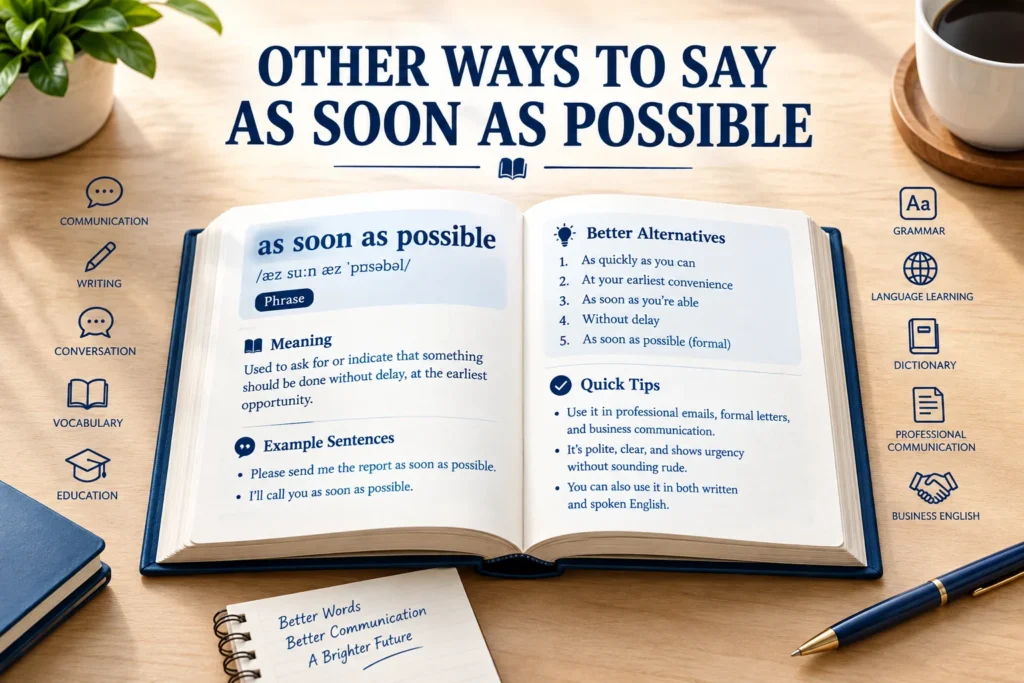
“As soon as possible” means at the earliest practical or available time.
It tells someone that you would like an action completed quickly, but it does not always give a specific deadline.
Literal meaning
The phrase combines three ideas:
- As soon as = at the earliest time when something can happen
- Possible = when circumstances allow it
- As soon as possible = at the earliest reasonable opportunity
Example
Please send me the updated report as soon as possible.
This means:
Please send the report at the earliest practical time.
Tone
“As soon as possible” usually sounds:
- Direct
- Neutral
- Professional
- Urgent
- Sometimes demanding, depending on context
The phrase itself is not rude. However, repeated use can make a request sound pressuring.
Purpose
People use “as soon as possible” when they want to:
- Speed up a task
- Request information quickly
- Ask for a response
- Communicate urgency
- Move a project forward
- Resolve a customer issue
- Get a document or approval
Emotional context
The emotional effect depends heavily on the surrounding message.
Compare:
Please send the documents as soon as possible.
with:
When you have a moment, could you please send the documents?
The first creates urgency. The second feels more relaxed and considerate.
When Should You Use “As Soon As Possible”?
“As soon as possible” works well when the timing matters but you do not have a specific deadline.
In emails
You can use it when you genuinely need something quickly.
Example:
Could you please send the signed agreement as soon as possible?
However, if the recipient is a senior executive, important client, or external partner, a softer alternative may sound better.
In the workplace
The phrase works well for internal requests when a task affects another part of a project.
Example:
Please review the proposal as soon as possible so we can submit it today.
For coworkers, direct language often saves time.
With clients
Use more diplomatic wording with clients.
Instead of:
Send the information as soon as possible.
Consider:
We would appreciate it if you could provide the information at your earliest convenience.
This approach communicates urgency without sounding like an order.
In networking
Networking messages usually benefit from a relaxed tone.
Instead of:
Please respond as soon as possible.
Try:
I’d be glad to hear your thoughts when you have a chance.
This sounds warmer and avoids unnecessary pressure.
In customer service
Customer-service communication should acknowledge urgency while remaining respectful.
Instead of:
We need your information as soon as possible.
Try:
Please provide the requested information at your earliest convenience so we can assist you further.
Professional Alternatives
1. At Your Earliest Convenience
Meaning: Please do this when you have the earliest reasonable opportunity.
Tone: Professional and polite.
Best use: Clients, managers, business emails.
Example:
Please review the attached proposal at your earliest convenience.
This is one of the most common professional ways to say “as soon as possible.”
2. At the Earliest Opportunity
Meaning: Do it when the first suitable opportunity becomes available.
Tone: Professional and neutral.
Best use: Workplace communication and formal emails.
Example:
Please contact the supplier at the earliest opportunity.
3. At Your Earliest Opportunity
Meaning: Complete the task when you can reasonably do so.
Tone: Polite and professional.
Best use: Requests to colleagues, clients, or business partners.
Example:
Please send the revised figures at your earliest opportunity.
4. As Quickly as Possible
Meaning: Complete something quickly.
Tone: Direct and professional.
Best use: Urgent workplace requests.
Example:
We need to resolve this issue as quickly as possible.
5. As Soon as You Can
Meaning: Please do it when you are able.
Tone: Polite and natural.
Best use: Colleagues, friends, and everyday workplace communication.
Example:
Please send me the updated file as soon as you can.
6. At the Earliest Possible Time
Meaning: At the first time when the task can reasonably happen.
Tone: Formal and direct.
Best use: Business communication and official requests.
Example:
Please provide the requested documentation at the earliest possible time.
7. At the First Opportunity
Meaning: Do it at the first available chance.
Tone: Professional.
Best use: Workplace communication.
Example:
Please call the customer at the first opportunity.
8. Without Delay
Meaning: Do something immediately or without unnecessary waiting.
Tone: Firm and formal.
Best use: Serious or time-sensitive situations.
Example:
Please notify the appropriate department without delay.
Use this carefully because it sounds stronger than “as soon as possible.”
9. Promptly
Meaning: Quickly and without unnecessary delay.
Tone: Concise and professional.
Best use: Business writing, customer service, reports, and official communication.
Example:
We will respond to your request promptly.
10. In a Timely Manner
Meaning: Within an appropriate or expected period.
Tone: Professional and neutral.
Best use: Corporate communication.
Example:
Please complete the form in a timely manner.
This option is useful when you care about reasonable timing rather than immediate action.
11. At the Earliest Possible Convenience
Meaning: When the recipient can reasonably handle it as early as possible.
Tone: Polite and formal.
Best use: Business letters and formal requests.
Example:
Kindly provide the information at the earliest possible convenience.
12. As Early as Possible
Meaning: At the earliest time available.
Tone: Neutral and professional.
Best use: Deadlines and scheduling.
Example:
Please arrive as early as possible for the meeting.
13. With Minimal Delay
Meaning: Complete something with very little waiting.
Tone: Formal.
Best use: Business and operational communication.
Example:
We aim to process your request with minimal delay.
14. As Quickly as Practicable
Meaning: As quickly as circumstances reasonably allow.
Tone: Formal and precise.
Best use: Policies, procedures, and official communication.
Example:
The issue will be addressed as quickly as practicable.
15. On an Urgent Basis
Meaning: Treat something as requiring immediate attention.
Tone: Formal and businesslike.
Best use: Corporate or administrative communication.
Example:
Please review this request on an urgent basis.
Formal Alternatives
These expressions work especially well in formal letters, official correspondence, business documents, and professional emails.
16. At the Earliest Possible Opportunity
We would appreciate your response at the earliest possible opportunity.
Tone: Highly professional and formal.
17. Without Unnecessary Delay
Please submit the documents without unnecessary delay.
Tone: Formal and firm.
This is useful when you want urgency without explicitly demanding immediate action.
18. Forthwith
Meaning: Immediately or without delay.
Please provide the requested documentation forthwith.
Tone: Very formal.
“Forthwith” can sound old-fashioned, so avoid it in casual workplace communication.
19. With Immediate Effect
Meaning: Starting immediately.
The new procedure will take effect with immediate effect.
Best use: Policies, announcements, and formal notices.
Note that this does not always mean “please do this quickly.” It often refers to when a decision or rule begins.
20. At the First Available Opportunity
Please contact us at the first available opportunity.
Tone: Formal and courteous.
21. As a Matter of Priority
Please treat this request as a matter of priority.
Meaning: Give this task higher importance.
Tone: Formal and firm.
22. As a Priority
Kindly review the attached document as a priority.
Tone: Professional.
This phrase works well when several tasks compete for attention.
23. With Urgency
Please address the matter with urgency.
Tone: Formal and serious.
24. With All Due Speed
Please proceed with all due speed.
Tone: Formal and somewhat traditional.
Use it selectively because it can sound old-fashioned.
25. Without Further Delay
Please send the final version without further delay.
Tone: Firm and formal.
Use this when a delay has already occurred.
Friendly Alternatives
Sometimes you need to ask for something quickly without making the person feel pressured.
26. When You Get a Chance
Please send me the file when you get a chance.
Tone: Friendly and relaxed.
27. When You Have a Moment
Could you review this when you have a moment?
Tone: Friendly and polite.
28. When You Can
Please let me know when you can.
Tone: Casual and considerate.
29. Whenever You Get a Chance
Send me the details whenever you get a chance.
Tone: Friendly.
30. As Soon as You Have a Chance
Please call me as soon as you have a chance.
Tone: Friendly with some urgency.
31. When You Have Time
Could you take a look when you have time?
Tone: Casual and respectful.
32. When It’s Convenient for You
Please send the document when it’s convenient for you.
Tone: Very polite and considerate.
33. Whenever Possible
Please join the meeting whenever possible.
Tone: Flexible and friendly.
34. When You’re Able
Please send the information when you’re able.
Tone: Gentle and understanding.
35. When You Get Around to It
Please send me the photos when you get around to it.
Tone: Very casual.
Avoid this phrase when you need genuine urgency because it suggests that the task is not important.
Email-Friendly Alternatives
These phrases work particularly well in professional emails.
36. At Your Earliest Convenience
Could you please review the document at your earliest convenience?
Best for: Clients, managers, and external contacts.
37. When You Have a Moment
Could you please confirm the details when you have a moment?
Best for: Colleagues and friendly professional communication.
38. At Your Earliest Opportunity
Please provide your feedback at your earliest opportunity.
Best for: Business emails.
39. When Possible
Please send the completed form when possible.
Best for: Low-to-moderate urgency.
40. As Early as You Can
Please let me know as early as you can.
Best for: Scheduling and planning.
41. At Your Earliest Convenience, Please
At your earliest convenience, please confirm whether the proposed date works for you.
Tone: Polite and formal.
42. We Would Appreciate a Prompt Response
We would appreciate a prompt response regarding this matter.
Tone: Professional and courteous.
43. We Would Appreciate Your Prompt Attention
We would appreciate your prompt attention to this request.
Tone: Formal and professional.
44. Please Prioritize This Request
Please prioritize this request so we can meet the project deadline.
Tone: Direct and professional.
45. Your Prompt Attention Would Be Appreciated
Your prompt attention to this matter would be greatly appreciated.
Tone: Formal.
Workplace Alternatives
46. Please Prioritize This
Please prioritize this task so we can stay on schedule.
Tone: Direct and professional.
47. Please Handle This as Soon as You Can
Please handle this as soon as you can so we can move forward.
Tone: Friendly but urgent.
48. Please Get Back to Me When You Can
Please get back to me when you can regarding the proposal.
Tone: Casual professional.
49. Could You Make This a Priority?
Could you make this a priority for today?
Tone: Polite but direct.
50. Please Address This Promptly
Please address this issue promptly so we can avoid further delays.
Tone: Professional and firm.
Quick Comparison Table
| Alternative | Tone | Best Use |
| At your earliest convenience | Polite | Clients and emails |
| At your earliest opportunity | Professional | Business communication |
| As quickly as possible | Direct | Urgent tasks |
| As soon as you can | Friendly | Colleagues |
| Promptly | Professional | Customer service |
| Without delay | Firm | Urgent matters |
| In a timely manner | Neutral | Corporate writing |
| At the first opportunity | Formal | Workplace |
| When you have a moment | Friendly | Colleagues |
| When possible | Flexible | General emails |
| Please prioritize this | Direct | Workplace |
| Could you make this a priority? | Polite/direct | Managers and teams |
| Without unnecessary delay | Formal | Official writing |
| At the first available opportunity | Formal | Business correspondence |
| We would appreciate a prompt response | Polite | Clients |
| Please address this promptly | Professional | Problems/issues |
| As early as possible | Neutral | Scheduling |
| With urgency | Formal | Serious matters |
| When convenient for you | Friendly | Low-pressure requests |
| Your prompt attention is appreciated | Formal | Business emails |
Email Examples
1. Client Email
Instead of:
Please send the documents as soon as possible.
Try:
Could you please provide the requested documents at your earliest convenience? This will allow us to complete the next stage of the process.
This sounds professional without placing unnecessary pressure on the client.
2. Email to a Manager
Could you please review the attached proposal at your earliest convenience? Your feedback will help me finalize the document.
This version clearly explains why you need the response.
3. Email to a Colleague
When you have a moment, could you please check the updated figures and let me know if everything looks correct?
This feels cooperative rather than demanding.
4. Customer-Service Email
We would appreciate your prompt response so we can verify your information and resolve the issue as quickly as possible.
This combines urgency with courtesy.
5. Networking Email
When you have a chance, I’d love to hear your thoughts on the proposal.
This is warmer than:
Please respond as soon as possible.
6. Meeting Follow-Up
Please share your feedback at your earliest convenience so we can finalize the meeting outcomes.
This creates a clear reason for the request.
How to Make “As Soon As Possible” More Professional
One of the best ways to improve this phrase is to explain why you need quick action.
Instead of:
Please reply as soon as possible.
Write:
Please reply at your earliest convenience so we can finalize the schedule.
The second version gives the recipient useful context.
You can also include a specific deadline when one exists.
Instead of:
Please send the report as soon as possible.
Write:
Please send the report by 3:00 p.m. today so we can include it in the final submission.
A specific deadline is usually clearer than vague urgency.
Common Mistakes When Using “As Soon As Possible”
1. Using It Too Often
If every request says “as soon as possible,” the phrase loses impact.
Use different expressions based on urgency and relationship.
2. Creating Unclear Urgency
“As soon as possible” does not tell the reader exactly when you need something.
If the deadline matters, give a date and time.
Better:
Could you please send the document by Thursday afternoon?
3. Sounding Too Demanding
Compare:
Send this as soon as possible.
with:
Could you please send this at your earliest convenience?
The second version sounds more courteous.
4. Using Very Formal Language in Casual Messages
Avoid:
Please provide the requested information forthwith.
when messaging a close colleague about a simple task.
A better choice:
Could you send me the details when you get a chance?
5. Using Casual Language With Clients
Avoid:
Send it when you get a chance.
if the client needs to complete an important business task.
Try:
Could you please provide the information at your earliest convenience?
6. Ignoring the Relationship
Your choice should depend on who receives the message.
A colleague, customer, manager, supplier, and close friend may all need different wording.
7. Forgetting Email Etiquette
Good email etiquette means communicating urgency without making unnecessary demands.
Words such as “please,” “could you,” “would you,” and “we would appreciate” can soften requests.
Related Phrases and Expressions
Here are related expressions that can replace or complement “as soon as possible.”
1. Promptly
Means quickly and without unnecessary delay.
We will respond promptly.
2. Immediately
Means right now or without waiting.
Please contact the office immediately.
3. Right Away
Means immediately.
I’ll take care of it right away.
4. Without Delay
Means without waiting.
Please notify the team without delay.
5. At Once
Means immediately.
Please address the issue at once.
6. As Early as Possible
Means at the earliest available time.
Please arrive as early as possible.
7. At Your Earliest Convenience
Means when you can reasonably do something soon.
Please review the document at your earliest convenience.
8. At the First Opportunity
Means at the first suitable chance.
Please call me at the first opportunity.
9. When Possible
Means whenever circumstances allow.
Please send the details when possible.
10. When You Can
Means when you have the ability or time.
Please reply when you can.
11. In Due Course
Means at the appropriate time.
We will contact you in due course.
This does not necessarily mean immediately.
12. In a Timely Manner
Means within an appropriate period.
Please complete the request in a timely manner.
13. With Urgency
Means with serious attention to speed.
Please treat this matter with urgency.
14. As a Priority
Means give something higher importance.
Please handle this as a priority.
15. Without Further Delay
Means do not allow additional waiting.
Please submit the application without further delay.
16. At the Earliest Opportunity
Means at the first practical chance.
We will review your request at the earliest opportunity.
17. In the Shortest Possible Time
Means complete something in the least amount of time reasonably possible.
We aim to resolve the issue in the shortest possible time.
18. Forthwith
Means immediately.
The payment must be made forthwith.
This expression is highly formal and can sound legalistic.
“As Soon As Possible” vs. Other Alternatives
As Soon As Possible vs. At Your Earliest Convenience
As soon as possible sounds more urgent.
At your earliest convenience sounds more polite and gives the recipient some flexibility.
Best choice:
Use as soon as possible for genuine urgency.
Use at your earliest convenience for polite business requests.
As Soon As Possible vs. Promptly
“Promptly” is concise and professional.
We will respond promptly.
It works particularly well when you are describing your own action.
As Soon As Possible vs. Immediately
“Immediately” is much stronger.
Please call me immediately.
This implies that waiting is not acceptable.
Use it only when the situation truly requires immediate action.
As Soon As Possible vs. When You Can
“When you can” is much softer.
Please send the file when you can.
Use it when the task matters but does not have a strict deadline.
As Soon As Possible vs. Without Delay
“Without delay” sounds firm and formal.
Please address the complaint without delay.
It is useful when a problem needs quick attention.
As Soon As Possible vs. In a Timely Manner
“In a timely manner” focuses on appropriate timing rather than speed.
Please complete the form in a timely manner.
It does not necessarily mean “immediately.”
As Soon As Possible vs. Please Prioritize This
“Please prioritize this” tells someone how important the task is.
Please prioritize this request.
It can be more useful than “as soon as possible” when the recipient has several competing tasks.
Cultural Usage
US English
American business communication often favors clear, direct language.
Common expressions include:
- As soon as possible
- As quickly as possible
- As soon as you can
- When you have a chance
- At your earliest convenience
- Please prioritize this
A specific deadline often works better than vague urgency.
UK English
British professional communication frequently uses polite and indirect phrasing.
Examples include:
- At your earliest convenience
- At the earliest opportunity
- When you have a moment
- When convenient
- At the first available opportunity
However, “as soon as possible” remains completely natural in UK English.
Corporate Communication
Corporate writing often favors concise phrases such as:
Please prioritize this request.
We would appreciate your prompt attention.
Please address the matter promptly.
Avoid excessive formality when a simple sentence communicates the same idea.
Customer Service
Customer-service communication should balance urgency and courtesy.
Instead of:
Send the information immediately.
Try:
Please provide the requested information at your earliest convenience so we can assist you promptly.
This keeps the customer experience positive.
Networking
Networking messages usually work better when they sound warm rather than urgent.
Instead of:
Please respond as soon as possible.
Try:
I’d be happy to hear from you when you have a chance.
This encourages a response without creating pressure.
Faqs
What is the most professional way to say “as soon as possible”?
“At your earliest convenience” is one of the safest professional alternatives. It sounds polite, respectful, and appropriate for business emails.
What is a formal alternative to “as soon as possible”?
Good formal alternatives include “at the earliest opportunity,” “without unnecessary delay,” “at the earliest possible opportunity,” and “with urgency.”
What is a polite way to say “as soon as possible”?
Try:
Could you please send this at your earliest convenience?
This communicates urgency without sounding demanding.
What is a professional synonym for “as soon as possible”?
Depending on context, useful synonyms include promptly, immediately, quickly, without delay, and at the earliest opportunity.
How do I say “as soon as possible” politely in an email?
Use:
We would appreciate it if you could provide the information at your earliest convenience.
This is especially suitable for clients and external contacts.
Is “as soon as possible” professional?
Yes. “As soon as possible” is professional and widely understood. However, the phrase can sound demanding when used without context or a polite request structure.
Is “ASAP” professional?
“ASAP” is common in workplace communication, but it can sound abrupt. In formal emails, writing “as soon as possible” or using a specific deadline often sounds more polished.
Is “at your earliest convenience” rude?
No. It is generally polite. However, it can sometimes be interpreted as urgent depending on the surrounding context.
What is a softer way to say “as soon as possible”?
Try:
When you have a moment.
or:
When you get a chance.
These phrases reduce pressure.
What is a stronger way to say “as soon as possible”?
Use:
Immediately.
or:
Without delay.
These phrases communicate stronger urgency.
How do I ask my boss for something as soon as possible?
Try:
Could you please review this at your earliest convenience? Your feedback will help me move forward with the project.
This sounds respectful and professional.
How do I ask a client to respond quickly?
Try:
We would appreciate your prompt response so we can proceed with the next step.
This communicates the reason for the request.
What is the best alternative for workplace communication?
For most workplace situations, “as soon as you can,” “at your earliest opportunity,” and “please prioritize this” work well.
What should I say instead of ASAP in a formal email?
Use:
At your earliest convenience
or:
At your earliest opportunity
For important deadlines, give a specific date and time instead.
What is the best way to communicate urgency professionally?
Be specific about the requested action and deadline.
For example:
Could you please send the revised proposal by 2:00 p.m. tomorrow so we can submit it on time?
This is usually clearer than simply saying “ASAP.”
Best Alternatives by Situation
| Situation | Recommended Phrase |
| Formal client email | At your earliest convenience |
| Important business request | At your earliest opportunity |
| Urgent workplace task | Please prioritize this |
| Customer service | We would appreciate your prompt response |
| Colleague | As soon as you can |
| Friendly request | When you have a moment |
| Serious issue | Without delay |
| Immediate emergency | Immediately |
| Corporate writing | In a timely manner |
| Scheduling | As early as possible |
| Networking | When you have a chance |
| Formal notice | Without unnecessary delay |
| Project deadline | Please prioritize this request |
| Follow-up email | At your earliest convenience |
| General business email | At the earliest opportunity |
How to Choose the Right Alternative
Choosing the right synonym is not simply about replacing one phrase with another. You should consider four factors.
1. Urgency
How quickly do you actually need the task completed?
- Low urgency → When convenient
- Moderate urgency → At your earliest convenience
- High urgency → Promptly
- Extreme urgency → Immediately
2. Relationship
Who are you talking to?
A friend can receive:
When you get a chance.
A client may receive:
At your earliest convenience.
A team member may receive:
Please prioritize this request.
3. Formality
Match your language to the setting.
Casual:
When you have a moment.
Professional:
At your earliest opportunity.
Highly formal:
Without unnecessary delay.
4. Clarity
If the deadline matters, avoid vague phrases.
Instead of:
Please send this ASAP.
Use:
Please send this by 4:00 p.m. today.
Clear deadlines improve professional communication and reduce confusion.
Professional Email Phrases You Can Copy
Here are several ready-to-use business email phrases.
Requesting a document
Could you please send the requested document at your earliest convenience?
Requesting feedback
We would appreciate your prompt feedback on the attached proposal.
Requesting approval
Could you please review and approve the document at your earliest opportunity?
Following up
I’m following up on my previous email and would appreciate your response when you have a moment.
Urgent request
Please prioritize this request so we can meet the project deadline.
Customer issue
We are working to resolve the issue as quickly as possible.
Scheduling
Please let me know as early as possible whether you can attend.
Team request
Could you please address this promptly so we can keep the project on track?
The Best Alternatives to Remember
If you do not want to memorize all 50 alternatives, these ten cover most professional situations:
- At your earliest convenience
- At your earliest opportunity
- As soon as you can
- As quickly as possible
- Promptly
- Please prioritize this
- At the earliest possible opportunity
- Without delay
- When you have a moment
- We would appreciate your prompt response
Each expression carries a slightly different level of urgency and politeness.
Final Summary
The best other ways to say “as soon as possible” depend on your audience, urgency, and communication setting. For professional emails, “at your earliest convenience” and “at your earliest opportunity” are excellent choices. For workplace communication, “please prioritize this” and “as soon as you can” sound natural. For customers and clients, “we would appreciate your prompt response” communicates urgency politely. For casual conversations, “when you have a moment” or “when you get a chance” feels more relaxed.
Remember that clear deadlines often work better than vague urgency. When timing is important, state exactly when you need the task completed. Good email etiquette, appropriate tone, and clear expectations make your professional communication more effective.
Conclusion
“As soon as possible” remains a useful phrase, but choosing a more precise alternative can make your message sound more polished and considerate. Use “at your earliest convenience” for polite business requests, “at your earliest opportunity” for formal communication, and “please prioritize this” when you need to emphasize importance. For friendly workplace messages, try “when you have a moment.” When the matter is https://dictionary.cambridge.org/dictionary/english/genuinelyurgent, “promptly” or “without delay” can communicate stronger urgency. Most importantly, use a specific deadline whenever possible. Clear timing, respectful wording, and the right level of formality create stronger professional communication.