Introduction
You just finished a job interview, landed a new client, or received a big chance at work. You want to sound grateful, but you have typed “thank you for the opportunity” a hundred times and it feels stale. Learning other ways to say thank you for the opportunity helps you sound sincere instead of robotic. The right words can make your message stand out, show real appreciation, and even strengthen your relationship with the reader.
This guide gives you fresh, natural alternatives for every situation. You will find professional options for emails, warm phrases for mentors, and quick lines for everyday chats. Each section includes real examples you can copy and adjust. By the end, you will never stare at a blank screen trying to thank someone again.
Meaning
“Thank you for the opportunity” is a polite expression used to show gratitude when someone gives you a chance, role, or experience. People say it after job interviews, new projects, mentorship, awards, or any favor that opens a door for them. The phrase acknowledges that someone invested time, trust, or resources in you.
The words work in both formal and casual settings, which is why so many people rely on them. But overuse can make the phrase feel empty. A listener may hear it and wonder if you truly mean it. Choosing a fresher alternative shows that you thought about your message and genuinely value what you received.
Professional usage
In the workplace, “thank you for the opportunity” appears most often in job applications, interview follow-ups, resignation letters, and project kickoff emails. Hiring managers read it dozens of times a week, so the exact wording matters less than the specificity around it. A message that names what you learned or what excites you will always beat a generic thank-you note.
Use the phrase when you want to show respect without overstepping. It fits formal emails to executives, polite notes to recruiters, and thank-you messages to clients. Pair it with a forward-looking line, such as what you hope to contribute. This turns a polite closing into a confident statement.
Avoid the phrase when the moment calls for warmth or detail. After a mentor spends an hour coaching you, a flat “thank you for the opportunity” can feel thin. A sentence like “Your advice on handling client calls gave me a clear plan for Monday” shows real gratitude. Match the depth of your words to the depth of what you received.
Alternatives
Professional alternatives
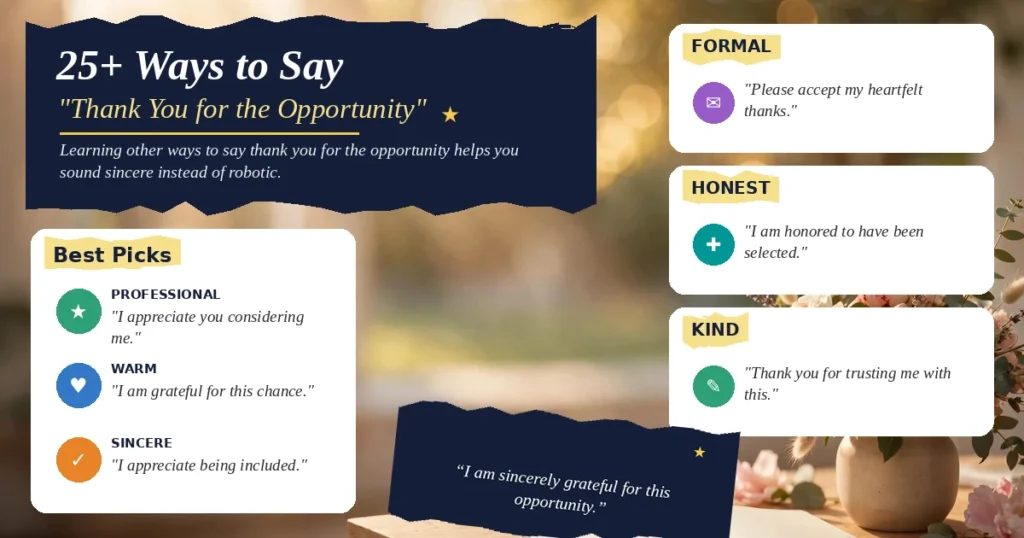
- I appreciate you considering me. Polite and direct. Best for interview follow-ups and recruiter emails. Example: I appreciate you considering me for the marketing analyst role.
- I am grateful for this chance. Warm but still office-safe. Works in emails to managers and hiring panels. Example: I am grateful for this chance to lead the onboarding project.
- Thank you for trusting me with this. Shows respect for the trust placed in you. Use with new clients or senior leaders. Example: Thank you for trusting me with this account; I will not take it lightly.
- I value the opportunity you have given me. Slightly formal. Good for written letters and official thank-you notes. Example: I value the opportunity you have given me to represent our team at the summit.
- I appreciate the chance to contribute. Team-focused tone. Ideal when joining a new project or department. Example: I appreciate the chance to contribute to the product launch.
- Thank you for having confidence in me. Humble and confident at once. Fits performance reviews and promotions. Example: Thank you for having confidence in me during the restructure.
- I am thankful for your support. Acknowledges ongoing help. Best for mentors, sponsors, and long-term contacts. Example: I am thankful for your support throughout my first year here.
- I appreciate being included. Simple and sincere. Use when invited to meetings, panels, or special projects. Example: I appreciate being included in the strategy workshop.
Formal alternatives
- I am sincerely grateful for this opportunity. Classic formal tone. Perfect for letters to executives and award committees. Example: I am sincerely grateful for this opportunity to join your fellowship program.
- Please accept my heartfelt thanks. Very polite and ceremonial. Use in formal letters and acceptance notes. Example: Please accept my heartfelt thanks for the scholarship.
- I am indebted to you for this chance. Strong and respectful. Best for major favors or life-changing opportunities. Example: I am indebted to you for this chance to study abroad.
- I wish to express my deep appreciation. Formal and measured. Fits official correspondence and printed letters. Example: I wish to express my deep appreciation for your nomination.
- Your generosity means a great deal to me. Personal yet formal. Works when someone invested real resources in you. Example: Your generosity means a great deal to me and my family.
- I am honored to have been selected. Dignified tone. Ideal for awards, grants, and competitive programs. Example: I am honored to have been selected for the leadership cohort.
- Allow me to convey my sincere gratitude. Very formal phrasing. Best for first contact with senior figures. Example: Allow me to convey my sincere gratitude for the invitation to speak.
- I remain grateful for your consideration. Elegant closing line. Use at the end of formal applications. Example: I remain grateful for your consideration of my proposal.
Friendly alternatives
- Thanks so much for this chance. Warm and relaxed. Great for mentors and friendly colleagues. Example: Thanks so much for this chance to shadow you on Friday.
- I really appreciate this. Short and genuine. Works in texts, chats, and casual emails. Example: I really appreciate this; the training has already helped me a lot.
- This means a lot to me. Emotional and honest. Best when someone did you a personal favor. Example: This means a lot to me, especially with my schedule this month.
- I cannot thank you enough. Enthusiastic and heartfelt. Use when someone went out of their way for you. Example: I cannot thank you enough for recommending me to the team.
- You have no idea how much I appreciate this. Conversational and warm. Fits close colleagues and friends at work. Example: You have no idea how much I appreciate this referral.
- I am so thankful for this shot. Casual and upbeat. Good for creative teams and informal workplaces. Example: I am so thankful for this shot at the design lead role.
- Thanks a million for believing in me. Playful but sincere. Use with mentors who know you well. Example: Thanks a million for believing in me when I doubted myself.
- I owe you one for this. Light and friendly. Best among peers after a helpful introduction. Example: I owe you one for this intro to your client.
Email-ready alternatives
- Thank you for taking the time to speak with me. Interview standard. Shows you respect their schedule. Example: Thank you for taking the time to speak with me about the analyst position today.
- I appreciate the opportunity to interview. Direct and expected. Best in post-interview thank-you emails. Example: I appreciate the opportunity to interview for the customer success role.
- Thank you for considering my application. Polite follow-up line. Use after submitting resumes or proposals. Example: Thank you for considering my application; I would welcome the chance to discuss it further.
- I am excited about the possibility of joining your team. Forward-looking and positive. Great as an email closing. Example: I am excited about the possibility of joining your team this spring.
- Thank you for the insightful conversation. Specific and memorable. Best when the discussion taught you something. Example: Thank you for the insightful conversation about your growth plans.
- I appreciate you sharing these details. Acknowledges their effort. Works in follow-ups after long calls. Example: I appreciate you sharing these details about the role’s first 90 days.
- Thank you for walking me through the next steps. Clear and practical. Ideal right after an interview round. Example: Thank you for walking me through the next steps in the hiring process.
- It was a pleasure learning more about the role. Warm and professional. Fits first-round interview emails. Example: It was a pleasure learning more about the role and your team’s goals.
Interview and workplace alternatives
- I am thrilled about this opportunity. Energetic and positive. Best when you want to show real enthusiasm. Example: I am thrilled about this opportunity to join the data team.
- This is exactly the kind of challenge I have been looking for. Confident and specific. Great in second-round interviews. Example: This is exactly the kind of challenge I have been looking for since graduation.
- I am eager to get started. Action-oriented. Shows motivation without overpromising. Example: I am eager to get started on the migration plan next week.
- Thank you for opening this door for me. Figurative and warm. Use with mentors and sponsors. Example: Thank you for opening this door for me; I will make the most of it.
- I will not waste this chance. Bold and committed. Best when someone took a risk on you. Example: I will not waste this chance you have given me on the client account.
- I am ready to prove myself. Confident tone. Fits new hires and internal moves. Example: I am ready to prove myself in the regional sales role.
- Thank you for seeing potential in me. Humble and personal. Works with managers who advocated for you. Example: Thank you for seeing potential in me when I applied for the stretch assignment.
- I am looking forward to contributing. Future-focused. A strong closing line for acceptance emails. Example: I am looking forward to contributing to the team’s Q3 goals.
Quick comparison
| Alternative | Tone | Best use |
|---|---|---|
| I appreciate you considering me | Professional | Interview follow-ups |
| I am sincerely grateful for this opportunity | Formal | Letters to executives |
| Thanks so much for this chance | Friendly | Mentors and colleagues |
| Thank you for taking the time to speak with me | Email-ready | Post-interview emails |
| I am thrilled about this opportunity | Enthusiastic | Showing excitement for a role |
| I value the opportunity you have given me | Formal | Official thank-you notes |
| This means a lot to me | Warm | Personal favors at work |
| I appreciate the chance to contribute | Professional | Joining new projects |
| I am honored to have been selected | Dignified | Awards and fellowships |
| I will not waste this chance | Committed | When someone took a risk on you |
Email examples
Job interview thank-you
Subject: Thank you for today’s interview
Dear Ms. Carter,
Thank you for taking the time to speak with me about the marketing coordinator role. I enjoyed hearing about your team’s plans for the spring campaign, and I am excited about the possibility of joining your team. I appreciate the opportunity to interview, and I look forward to hearing about the next steps.
Best regards,
Daniel
Client thank-you
Subject: Grateful for your trust
Dear Mr. Lawson,
Thank you for trusting me with your account. I am grateful for this chance to support your expansion plans, and my team is already working on the first draft. I appreciate the chance to contribute to your goals, and I will keep you updated every Friday.
Warm regards,
Priya
Thank-you to a manager
Subject: Thank you
Hi Sarah,
I wanted to say I am thankful for your support this quarter. Your feedback on my client presentations helped me grow fast. I appreciate you considering me for the lead role on the Phoenix project, and I am eager to get started.
Thanks again,
Marcus
Networking thank-you
Subject: Great meeting you
Hi James,
It was a pleasure learning more about your work at the conference. Thank you for the insightful conversation about AI in customer service. I appreciate being included in your panel discussion, and I hope we stay in touch.
Best,
Lena
Follow-up thank-you
Subject: Following up with thanks
Dear Dr. Patel,
Thank you for walking me through the next steps last week. I appreciate you sharing these details about the fellowship timeline. I remain grateful for your consideration, and I look forward to your call next month.
Sincerely,
Amara
Common mistakes
1. Saying it too many times in one message
Repeating the phrase in the greeting, body, and closing sounds robotic. Say it once, then add a specific detail.
2. Using it without any specifics
A bare “thank you for the opportunity” tells the reader nothing. Name the role, project, or conversation to make it real.
3. Sending it too late
A thank-you email sent a week after the interview loses its impact. Send it within 24 hours for the best effect.
4. Making it sound like a form letter
Generic wording makes hiring managers tune out. Add one personal detail from your conversation to stand out.
5. Forgetting to proofread
A thank-you note with typos does more harm than good. Read it twice before you hit send.
6. Using casual slang in formal emails
Phrases like “thanks a ton, dude” can offend in professional settings. Match your tone to the relationship.
7. Thanking the wrong person
Address your message to the person who actually helped you. A misdirected thank-you looks careless.
8. Adding it as an afterthought
Burying your thanks in a P.S. line makes it feel unimportant. Place it near the opening of your message.
Related phrases
- I appreciate your time. Means you value their schedule. Example: I appreciate your time on yesterday’s call.
- Thank you for your consideration. A polite line for applications. Example: Thank you for your consideration of my proposal.
- I am grateful for your guidance. Thanks someone who mentored you. Example: I am grateful for your guidance during my internship.
- Thanks for the vote of confidence. Acknowledges their belief in you. Example: Thanks for the vote of confidence on the client pitch.
- I appreciate your faith in me. Similar but more personal. Example: I appreciate your faith in me during the trial period.
- Thank you for the warm welcome. Use when joining a new team. Example: Thank you for the warm welcome on my first day.
- I am thankful for this experience. Reflects on what you learned. Example: I am thankful for this experience, whatever the outcome.
- Thanks for taking a chance on me. Honest and humble. Example: Thanks for taking a chance on me as a junior hire.
- I appreciate your mentorship. Specific to mentors. Example: I appreciate your mentorship over the past six months.
- Thank you for the referral. Thanks someone who recommended you. Example: Thank you for the referral to the hiring manager.
- I am grateful to be part of this team. Team-oriented gratitude. Example: I am grateful to be part of this team during the launch.
- Thanks for believing in my potential. Acknowledges long-term trust. Example: Thanks for believing in my potential since day one.
- I appreciate the learning opportunity. Focuses on growth. Example: I appreciate the learning opportunity this project gave me.
- Thank you for your trust. Short and powerful. Example: Thank you for your trust in handling the merger.
- I am humbled by this chance. Shows deep respect. Example: I am humbled by this chance to speak at the conference.
- Grateful for the platform. Thanks someone who gave you visibility. Example: Grateful for the platform to share my research.
Phrase comparison
“Thank you for the opportunity” is the safest choice. It works everywhere, offends no one, and needs no explanation. Its weakness is familiarity. Readers have seen it so often that it can slide past them without registering any real feeling.
“I appreciate you considering me” shifts the focus to the other person’s effort. It feels more personal because it names what they did: they considered you. This makes it stronger for interviews and applications, where the reader’s time and judgment are the real gift.
“I am honored to have been selected” raises the formality level. It suits awards, fellowships, and competitive programs where being chosen is itself the achievement. It would sound stiff in a casual chat with a friendly manager, so save it for moments with real ceremony.
“Thanks so much for this chance” trades polish for warmth. It fits mentors, peers, and relaxed workplaces where sounding human matters more than sounding corporate. In a formal email to an executive, though, it can read as too casual.
The smart move is to pick based on two questions. First, how formal is the relationship? Second, what exactly are you thanking them for? When you can answer both, the right phrase picks itself. Specificity always beats a perfect phrase: “thank you for the detailed feedback on my portfolio” will outperform any polished alternative used alone.
Cultural usage
US English
Americans use thank-you phrases often and casually. “Thanks so much for this opportunity” is normal even in semi-formal emails. Enthusiasm is expected, so phrases like “I am thrilled” or “I am excited” fit well. Short, upbeat notes usually work better than long formal letters.
UK English
British professionals tend to be more reserved. “I am most grateful for the opportunity” or “Many thanks for considering me” sound natural. Understatement beats enthusiasm, so avoid overly emotional phrases in first contact. A polite, measured tone earns the most respect.
Corporate communication
In corporate settings, gratitude phrases serve as relationship tools. Executives expect concise, confident thanks without gushing. “I appreciate the chance to contribute” signals you are a team player. Keep the message short, and always connect your thanks to a business outcome when you can.
Customer service
Service teams thank customers for chances to fix problems. “Thank you for giving us the opportunity to make this right” turns a complaint into loyalty. The phrase shows accountability, not weakness. Pair it with a clear action so the customer sees the thanks are real.
Frequently asked questions
What is the best way to say thank you for the opportunity in an email?
The best version names the specific opportunity. Write “Thank you for the opportunity to interview for the analyst role” instead of the bare phrase. Add one line about what you enjoyed or learned. Keep the whole email under 150 words so it gets read.
Is “thank you for the opportunity” too formal?
No, it sits in the middle of the formality scale. It works in formal emails and casual chats alike, which is exactly why it gets overused. If the setting is relaxed, try “Thanks so much for this chance” instead. If it is very formal, use “I am sincerely grateful for this opportunity.”
How do you thank someone for giving you a chance at work?
Be specific and forward-looking. Say what the chance means to you and what you plan to do with it. For example: “Thank you for trusting me with the client account; I have a plan ready for Monday.” Specific thanks feel real, and a next step shows maturity.
What can I say instead of thank you for the opportunity in an interview?
Try “I appreciate the opportunity to interview” or “Thank you for taking the time to speak with me.” Both are standard and expected after interviews. When you follow up and want to keep the conversation warm, add a detail from the discussion so your note stands out from the rest.
How do you express gratitude professionally without sounding stiff?
Use plain language and one concrete detail. “I really appreciate the training; the new system finally makes sense to me” sounds human and professional. Avoid stacking formal phrases like “I wish to express my profound gratitude.” One warm sentence beats three stiff ones every time.
Should I say thank you for the opportunity in a resignation letter?
Yes, it is a graceful way to leave. Write “Thank you for the opportunity to grow with this team over the past three years.” Keep the tone positive even if you are leaving for a better offer. Burning bridges in writing is never worth it.
What is a short alternative to thank you for the opportunity?
“I really appreciate this” works in almost any quick message. “This means a lot” is even shorter and very sincere. For texts and chats, brevity reads as honesty. Save the longer phrases for emails and letters.
How do you thank a mentor for an opportunity?
Name what their help changed for you. Try “Thank you for opening this door for me; your advice gave me a clear plan.” Mentors value seeing their impact, so describe the result. If they went out of their way, you might also offer to return the favor with your own skills someday.
Is it okay to say thank you for the opportunity twice?
Saying it twice in one message sounds repetitive. Say it once near the start, then use different words later if you want to repeat the sentiment. You can close with “I am excited about what is ahead” instead of thanking them again.
What should I write in a thank-you email after getting the job?
Celebrate briefly and look forward. Write “I am thrilled about this opportunity and eager to get started.” Mention your start date or first project to show you are ready. When you need to ask for details about onboarding, keep that in a separate short paragraph.
How do you thank a client for their business politely?
Focus on trust and partnership. “Thank you for trusting us with this project” respects the relationship. Add a concrete next step, like a delivery date, so the thanks feel backed by action. Clients remember reliability more than fancy wording.
Can I use thank you for the opportunity on LinkedIn?
Yes, it works well in public posts about new roles. Write “Thank you for the opportunity to join such a talented team” and tag the company. Keep it genuine and short; long emotional posts can feel performative. A simple, confident announcement usually performs best.
What is the difference between “thank you for the opportunity” and “I appreciate it”?
The first names a specific gift: the opportunity. The second is a general expression of thanks. If you want to learn more about using that shorter phrase well, note that it fits quick, everyday moments. Use the full phrase when the moment matters more.
How do you respond when someone thanks you for an opportunity?
Accept it warmly and encourage them. Say “You earned it” or “I am glad we could make it happen.” Keep the focus on their effort rather than your generosity. A gracious reply strengthens the relationship for the future.
What tone should a thank-you note for an opportunity have?
Match the tone to the relationship and the setting. Formal for executives and official letters, warm for mentors, upbeat for creative teams. When in doubt, aim slightly more formal than the other person’s style. You can always relax later; you cannot undo sounding careless.
Conclusion
Pick your phrase by tone. For professional settings, use “I appreciate you considering me” or “I appreciate the chance to contribute.” For formal moments, choose “I am sincerely grateful for this opportunity” or “I am honored to have been selected.” For friendly notes, “Thanks so much for this chance” or “This means a lot to me” work beautifully. In emails, lean on “Thank you for taking the time to speak with me” or “I appreciate the opportunity to interview.” For interviews and new roles, “I am thrilled about this opportunity” or “I am eager to get started” show the right energy.
Whatever phrase you choose, add one specific detail about what you received. Specificity is what turns polite words into genuine gratitude. The next time someone opens a door for you, thank them in words that prove you noticed. When you reach out to thank a new contact, that small effort can turn a single opportunity into a lasting relationship.