
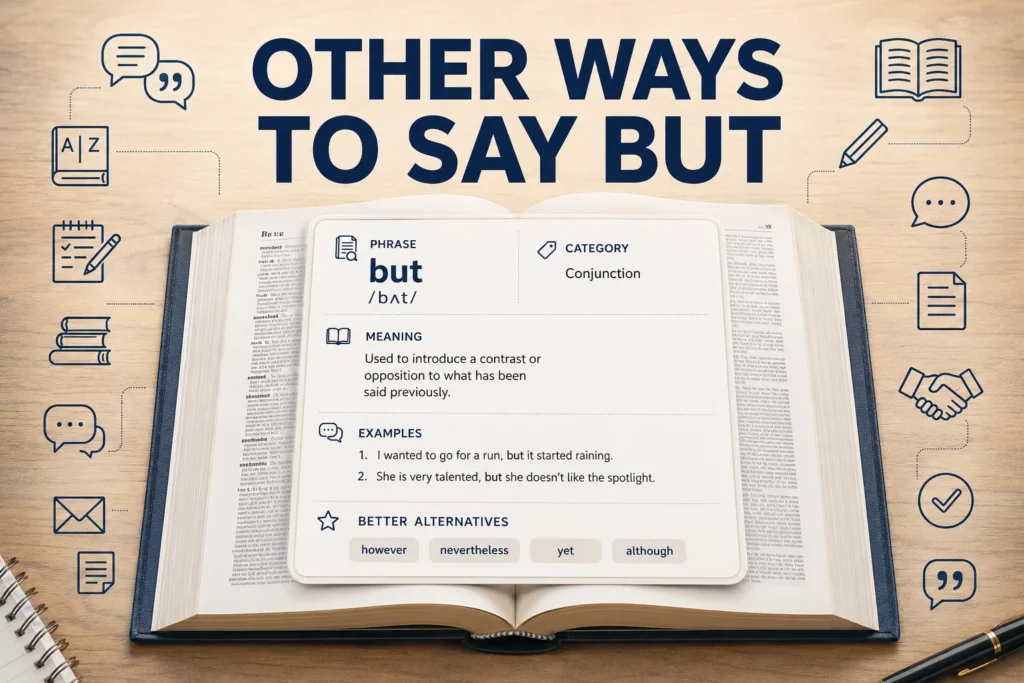
The word “but” is one of the most useful conjunctions in English. We use it to introduce a contrast, correct an idea, add an exception, or show that two points do not completely agree. However, using “but” repeatedly can make professional writing sound predictable or less polished. That is why many people search for other ways to say but, especially when writing emails, business messages, reports, proposals, or workplace communication.
The good news is that you do not always need a direct synonym for “but.” The best alternative depends on what you want to communicate. Words such as however, although, nevertheless, nonetheless, yet, while, still, even though, on the other hand, in contrast, and that said can create different levels of contrast and formality.
For example:
- “The proposal is strong, but it needs more data.”
- “The proposal is strong; however, it needs more data.”
- “The proposal is strong. That said, it needs more data.”
- “Although the proposal is strong, it needs more data.”
- “The proposal is strong; nevertheless, it needs more data.”
All five sentences communicate contrast, but they do not have exactly the same tone.
This guide explains the best professional way to say “but,” formal alternatives, friendly substitutes, business email phrases, and workplace expressions. It also provides practical examples for clients, managers, colleagues, customers, networking, and meeting follow-ups.
What Does “But” Mean?
Literal Meaning
“But” is a conjunction and, in some situations, a preposition, adverb, or noun. In everyday communication, its most common function is to connect two ideas that contrast with each other.
In simple terms:
But means “in contrast,” “despite that,” or “except for that.”
Example
“The product looks good, but it is expensive.”
The first part presents a positive point. The second part introduces a limitation.
Another example:
“I understand your concern, but I need more information.”
Here, “but” connects understanding with a different position.
Tone of “But”
“But” is generally neutral and natural. It is not inherently rude or unprofessional.
However, its effect can change depending on the sentence.
Direct
“I understand your point, but I disagree.”
Softer
“I understand your point. However, I see the situation differently.”
More diplomatic
“I understand your point. That said, I see the situation differently.”
The alternative you choose can therefore influence how your message feels.
Purpose of “But”
You can use “but” to:
- Show contrast
- Introduce a limitation
- Present an exception
- Correct an assumption
- Balance two ideas
- Express disagreement
- Add a condition
- Change direction in a conversation
Example
“We would like to approve the proposal, but we need additional documentation.”
The speaker agrees with the proposal but introduces a condition.
Emotional Context
“But” can sometimes sound stronger than intended, particularly when it follows a positive statement.
Compare:
“Your work is excellent, but you missed the deadline.”
with:
“Your work is excellent. However, we also need to address the missed deadline.”
The second version separates the positive feedback from the concern and may sound more balanced.
Why Look for Other Ways to Say “But”?
Searching for a synonym for “but” does not always mean that “but” is incorrect. Usually, people want to improve variety, tone, clarity, or professionalism.
Here are the most common reasons.
1. You have used “but” too many times
Repeated use can make writing sound monotonous.
2. You want a more formal tone
Academic writing, reports, proposals, and formal correspondence may benefit from alternatives such as however, nevertheless, or nonetheless.
3. You want to sound more diplomatic
In workplace communication, that said or at the same time can sometimes soften a disagreement.
4. You want clearer logical relationships
Words such as whereas, although, and in contrast can make the relationship between ideas more precise.
5. You want to avoid starting every sentence with “But”
Sentence structure becomes more varied when you use alternatives.
Professional Usage: When Should You Use Alternatives to “But”?
1. In Emails
A professional email does not require you to avoid “but.” In fact, “but” can sound perfectly natural.
Still, alternatives can help when you want a more polished tone.
Simple
“We can make the change, but it will take two additional days.”
Professional
“We can make the change; however, it will take two additional days.”
Diplomatic
“We can make the change. That said, it will take two additional days.”
2. In the Workplace
Workplace communication often requires a balance between honesty and diplomacy.
Instead of:
“I agree, but this will not work.”
Try:
“I agree with the overall approach. However, we may need to adjust the timeline.”
This approach acknowledges the other person’s point before introducing your concern.
3. With Clients
When communicating with clients, avoid sounding unnecessarily confrontational.
Instead of:
“We can do that, but it will cost more.”
Consider:
“We can certainly do that. However, it would require an additional budget.”
Or:
“We can certainly do that. The only consideration is the additional cost.”
The second version sounds more client-focused.
4. In Networking
Networking conversations are usually warmer and less formal.
You can use:
- That said
- Still
- At the same time
- Even so
- Although
- On the other hand
Example:
“The industry is competitive. That said, there are still many opportunities for new professionals.”
5. In Customer Service
Customer-service language should acknowledge the customer’s concern before explaining limitations.
Instead of:
“We understand your concern, but we cannot offer a refund.”
Try:
“We understand your concern. However, our refund policy does not cover this type of purchase.”
Or:
“We understand your concern. At the same time, our policy requires us to follow the stated return conditions.”
Alternatives to “But”
The best alternative depends on the sentence. Some options are direct substitutes, while others work better as sentence connectors or structural alternatives.
Professional Alternatives
1. However
Meaning: Introduces a contrasting idea.
Tone: Professional and neutral.
Best use: Business emails, reports, presentations, workplace communication.
Example:
“The results are encouraging. However, we need more data.”
Note: “However” is one of the safest professional alternatives to “but.”
2. That said
Meaning: Introduces a different or balancing point after acknowledging something.
Tone: Professional, conversational, diplomatic.
Best use: Emails, meetings, networking, business discussions.
Example:
“The project has faced several challenges. That said, the team has made excellent progress.”
3. Nevertheless
Meaning: Despite what was just mentioned.
Tone: Formal and confident.
Best use: Reports, formal emails, business writing.
Example:
“The deadline was tight. Nevertheless, the team completed the work.”
4. Nonetheless
Meaning: Despite that; nevertheless.
Tone: Formal and polished.
Best use: Reports, proposals, professional writing.
Example:
“The initial response was limited. Nonetheless, we decided to continue.”
5. Yet
Meaning: Introduces a contrasting fact.
Tone: Neutral and concise.
Best use: Everyday and professional writing.
Example:
“The task is challenging, yet achievable.”
6. Still
Meaning: Despite the previous point.
Tone: Friendly to professional.
Best use: Conversations, emails, workplace communication.
Example:
“The budget is limited. Still, we can explore several options.”
7. At the same time
Meaning: Introduces another consideration that exists alongside the first.
Tone: Diplomatic and professional.
Best use: Workplace discussions and negotiations.
Example:
“The proposal has strong potential. At the same time, we need to consider the implementation cost.”
8. Even so
Meaning: Despite what was mentioned.
Tone: Neutral and conversational.
Best use: Emails and informal professional communication.
Example:
“The schedule is demanding. Even so, I believe we can meet the deadline.”
9. In contrast
Meaning: Shows a clear difference between two ideas.
Tone: Professional and analytical.
Best use: Reports, presentations, comparisons.
Example:
“The first campaign generated strong engagement. In contrast, the second campaign performed below expectations.”
10. On the other hand
Meaning: Presents another side or perspective.
Tone: Neutral and conversational.
Best use: Discussions, reports, workplace communication.
Example:
“The software is affordable. On the other hand, it has fewer features.”
11. Conversely
Meaning: Shows that something is opposite to another idea.
Tone: Formal and analytical.
Best use: Reports, research, formal business writing.
Example:
“Higher prices may reduce demand. Conversely, lower prices may increase sales volume.”
12. In spite of that
Meaning: Despite the previous situation.
Tone: Professional and neutral.
Best use: Formal conversations and writing.
Example:
“The launch experienced some delays. In spite of that, customer interest remained high.”
13. Despite this
Meaning: Shows that the following point remains true even after a problem or fact.
Tone: Professional.
Best use: Reports and business emails.
Example:
“The market remains uncertain. Despite this, we plan to proceed.”
14. Even though
Meaning: Introduces a contrasting condition.
Tone: Neutral.
Best use: Emails, conversations, workplace communication.
Example:
“Even though the budget is limited, we can complete the first phase.”
15. Although
Meaning: Introduces a contrast or concession.
Tone: Professional and natural.
Best use: Formal and everyday writing.
Example:
“Although the proposal is strong, it requires further review.”
Formal Alternatives
16. Whereas
Meaning: Shows a direct contrast between two facts.
Tone: Formal.
Best use: Reports, contracts, comparisons, professional documents.
Example:
“The first option focuses on speed, whereas the second emphasizes cost efficiency.”
17. While
Meaning: Can introduce contrast when comparing two ideas.
Tone: Neutral to formal.
Best use: Professional writing and comparisons.
Example:
“While the first option is cheaper, the second offers greater flexibility.”
18. Notwithstanding this
Meaning: Despite the stated situation.
Tone: Very formal.
Best use: Legal, corporate, and highly formal writing.
Example:
“The circumstances have changed. Notwithstanding this, the agreement remains valid.”
19. Be that as it may
Meaning: Acknowledges a point but moves to another consideration.
Tone: Very formal and somewhat old-fashioned.
Best use: Formal prose rather than casual business emails.
Example:
“The proposal has several advantages. Be that as it may, further analysis is required.”
20. By contrast
Meaning: Highlights an opposing or different situation.
Tone: Formal and analytical.
Best use: Reports and presentations.
Example:
“The first quarter showed strong growth. By contrast, the second quarter was relatively flat.”
21. Alternatively
Meaning: Introduces another possible option.
Tone: Professional and formal.
Best use: Proposals, recommendations, business discussions.
Example:
“We could postpone the launch. Alternatively, we could release a smaller version first.”
22. Rather
Meaning: Corrects or replaces an idea.
Tone: Formal and precise.
Best use: Professional and academic writing.
Example:
“The issue is not the quality of the product. Rather, the problem is the delivery sche
23. Instead
Meaning: Replaces one option or idea with another.
Tone: Neutral and professional.
Best use: Emails, workplace discussions, instructions.
Example:
“We could cancel the meeting. Instead, we can move it to Friday.”
24. Conversely
Meaning: Indicates an opposite result or relationship.
Tone: Formal.
Best use: Analytical writing.
Example:
“Investment increased in urban areas. Conversely, rural investment declined.”
25. Notwithstanding
Meaning: Despite something.
Tone: Highly formal.
Best use: Legal and formal corporate documents.
Example:
“Notwithstanding the delay, the project remains on schedule.”
Friendly and Conversational Alternatives
26. Still
“I know it is expensive. Still, it may be worth considering.”
27. That said
“I like the idea. That said, we should check the budget.”
28. Even so
“It was a difficult week. Even so, we got everything done.”
29. At the same time
“I understand your concern. At the same time, we have to follow the policy.”
30. Though
“It is a little expensive, though.”
31. Although
“Although I agree with you, I see one potential problem.”
32. Yet
“It is simple, yet effective.”
33. On the other hand
“The first option is faster. On the other hand, the second is cheaper.”
34. Even then
“We may finish late. Even then, we should be able to deliver today.”
35. Still, I think
“The plan needs some work. Still, I think we are moving in the right direction.”
Email-Specific Alternatives to “But”
When writing an email, the best replacement often depends on how sensitive the message is.
36. However
“We appreciate your proposal. However, we need additional information.”
37. That said
“We understand the timeline. That said, we need two more days.”
38. At the same time
“We appreciate the request. At the same time, we need to consider our current workload.”
39. With that in mind
Meaning: Connects a previous fact to the next decision.
“The deadline is approaching. With that in mind, we recommend starting today.”
40. Given this
Meaning: Based on the situation just described.
“Given this, we may need to revise the delivery date.”
41. Even though
“Even though the original quote has expired, we can review the pricing again.”
42. Although
“Although we can accommodate the request, additional fees may apply.”
43. Despite this
“Despite this, we remain committed to completing the project.”
44. For that reason
This is not a direct synonym for “but,” but it can improve logical flow.
“The current system has several limitations. For that reason, we recommend an upgrade.”
45. The only consideration is
This phrase can soften a limitation.
“We would be happy to proceed. The only consideration is the additional lead time.”
Workplace Alternatives
46. From another perspective
“The approach is efficient. From another perspective, it may create additional risks.”
47. At the same time
“I support the proposal. At the same time, we should review the costs.”
48. That does not mean
“The first option is cheaper. That does not mean it is the best long-term choice.”
49. The challenge is
“The strategy has potential. The challenge is the limited implementation time.”
50. One concern is
“The proposal is strong. One concern is the current staffing level.”
51. The main limitation is
“The system is easy to use. The main limitation is its reporting functionality.”
52. From a practical standpoint
“The idea looks promising. From a practical standpoint, we need more resources.”
53. On balance
“There are several risks. On balance, however, the benefits outweigh them.”
54. In comparison
“The current process is faster. In comparison, the new process offers greater accuracy.”
55. In the meantime
“In the meantime” does not mean “but,” so use it only when you mean during the period before something happens.
“We are waiting for approval. In the meantime, we can prepare the documents.”
Quick Comparison Table
| Alternative | Tone | Best Use |
| However | Professional | Business emails |
| That said | Diplomatic | Workplace discussions |
| Nevertheless | Formal | Reports |
| Nonetheless | Formal | Professional writing |
| Yet | Concise | General communication |
| Still | Friendly | Conversations |
| Although | Neutral/Formal | Sentence openings |
| Even though | Neutral | Everyday and professional |
| Whereas | Formal | Comparisons |
| While | Neutral | Comparisons |
| On the other hand | Conversational | Presenting another side |
| In contrast | Analytical | Reports |
| By contrast | Formal | Business analysis |
| At the same time | Diplomatic | Workplace communication |
| Even so | Neutral | Emails |
| Conversely | Formal | Analytical writing |
| Despite this | Professional | Reports and emails |
| Instead | Neutral | Alternatives |
| Alternatively | Formal | Proposals |
| Rather | Formal | Corrections |
| With that in mind | Professional | Recommendations |
| Given this | Professional | Decisions |
| The only consideration is | Diplomatic | Client emails |
| The challenge is | Professional | Workplace discussions |
| One concern is | Diplomatic | Feedback |
| The main limitation is | Professional | Business analysis |
| From another perspective | Neutral | Discussions |
| On balance | Formal | Decisions |
| Though | Casual | Conversation |
| Be that as it may | Very formal | Formal prose |
Email Examples
1. Email to a Client
Basic
We can complete the project by Friday, but we will need the final files today.
More professional
We can complete the project by Friday. However, we will need the final files today to stay on schedule.
More diplomatic
We can complete the project by Friday. That said, we will need the final files today to maintain the agreed timeline.
2. Email to a Manager
I agree with the proposed approach. However, I recommend allowing additional time for testing before the launch.
This sounds respectful while clearly communicating a concern.
3. Email to a Colleague
The presentation looks good. That said, I think we should add one more slide explaining the results.
This sounds cooperative rather than critical.
4. Customer Service Email
We understand your concern. However, our policy requires the product to be returned within 30 days.
A softer version:
We understand your concern. The only consideration is that our return policy requires the product to be returned within 30 days.
5. Networking Message
It was great speaking with you at the event. I enjoyed learning about your work. That said, I would be especially interested in discussing the technology side of your projects.
6. Meeting Follow-Up
Thank you for the productive discussion today. We agree on the overall direction. However, we still need to finalize the timeline and responsibilities.
A diplomatic version:
Thank you for the productive discussion today. We agree on the overall direction. At the same time, we should finalize the timeline and responsibilities before moving forward.
How to Say “But” Without Sounding Negative
One of the biggest challenges in professional communication is expressing disagreement without sounding dismissive.
Instead of:
“Your idea is good, but it will not work.”
Try:
“Your idea has several strengths. However, we may need to adjust the implementation.”
Or:
“I see the value in this approach. That said, there are a few practical concerns we should address.”
Or:
“The concept is promising. The main challenge is the current timeline.”
These alternatives move attention away from blunt rejection and toward problem-solving.
Common Mistakes When Replacing “But”
1. Overusing “However”
“However” is useful, but using it in every sentence can sound mechanical.
Poor:
“However, we need more data. However, the deadline is close. However, the budget is limited.”
Better:
“We need more data. At the same time, the deadline is close. The main limitation is the current budget.”
Vary your sentence structure instead of replacing every “but” with “however.”
2. Choosing an Alternative That Is Too Formal
Do not write:
“Notwithstanding the aforementioned circumstances…”
when a simple:
“However, the situation has changed.”
would be clearer.
Good professional communication values clarity over impressive vocabulary.
3. Using Casual Language in Formal Emails
Words such as “though” may sound natural in conversation but can feel too casual in certain formal documents.
Casual:
“It looks good, though.”
Professional:
“It looks good. However, I recommend making one adjustment.”
4. Using “On the Other Hand” Without Another Side
“On the other hand” works best when you have already presented one side.
Weak:
“On the other hand, we need more time.”
Better:
“The current schedule is efficient. On the other hand, it leaves little room for testing.”
5. Confusing “Instead” With “But”
“But” shows contrast.
“Instead” usually presents a replacement.
Incorrect:
“The plan is good instead it needs more research.”
Correct:
“The plan is good, but it needs more research.”
Or:
“We could launch next week. Instead, I recommend launching the following week.”
6. Confusing “Although” and “However”
These words can express similar relationships, but their grammar differs.
Correct:
“Although the proposal is strong, it needs more data.”
Correct:
“The proposal is strong. However, it needs more data.”
Avoid:
“Although the proposal is strong. However, it needs more data.”
You normally do not need both structures together.
Related Phrases and Expressions
Here are useful expressions related to contrast, disagreement, exceptions, and balance.
1. On the contrary
Meaning: Directly contradicts a previous statement.
“The process is not difficult. On the contrary, it is quite simple.”
2. In contrast
Meaning: Shows a difference.
“The first plan is expensive. In contrast, the second is affordable.”
3. On the other hand
Meaning: Presents another viewpoint.
“The software is powerful. On the other hand, it requires training.”
4. That said
Meaning: Acknowledges something before adding another point.
“The project is challenging. That said, it is achievable.”
5. Even so
Meaning: Despite the previous point.
“The conditions were difficult. Even so, the team succeeded.”
6. All the same
Meaning: Despite everything mentioned.
“The process takes time. All the same, it is worthwhile.”
7. At the same time
Meaning: Introduces another consideration.
“We want to move quickly. At the same time, we need to protect quality.”
8. Despite this
Meaning: Shows that something remains true despite a previous fact.
“Sales declined. Despite this, customer satisfaction improved.”
9. In spite of this
Meaning: Similar to “despite this.”
“The launch was delayed. In spite of this, interest remained strong.”
10. Even though
Meaning: Introduces a contrasting condition.
“Even though the price is higher, the product offers better value.”
11. Although
Meaning: Introduces a concession.
“Although the process is slower, it produces more accurate results.”
12. Whereas
Meaning: Contrasts two situations.
“The first team focuses on sales, whereas the second focuses on support.”
13. While
Meaning: Shows contrast between two points.
“While the first option is cheaper, the second is more reliable.”
14. Nevertheless
Meaning: Despite what was previously mentioned.
“The task was difficult. Nevertheless, we completed it.”
15. Nonetheless
Meaning: Despite that.
“The results were mixed. Nonetheless, they provided useful information.”
16. Conversely
Meaning: Shows an opposite relationship.
“Higher demand increased prices. Conversely, lower demand reduced them.”
17. Having said that
Meaning: Similar to “that said.”
“The plan is ambitious. Having said that, it is realistic.”
18. With that in mind
Meaning: Uses previous information to introduce a decision.
“The deadline is close. With that in mind, we should prioritize the key tasks.”
19. The only issue is
Meaning: Softens a criticism or limitation.
“The proposal is strong. The only issue is the current budget.”
20. The main concern is
Meaning: Identifies the primary problem.
“The strategy is promising. The main concern is implementation.”
Phrase Comparison
But vs. However
But is shorter and more conversational.
“I agree, but we need more time.”
However sounds more polished.
“I agree. However, we need more time.”
Best choice: Use “but” for natural communication and “however” when you want a more formal business tone.
But vs. Although
“But” often joins two independent ideas.
“The plan is good, but it is expensive.”
“Although” introduces a dependent clause.
“Although the plan is good, it is expensive.”
Best choice: Use “although” when you want to restructure the sentence.
But vs. Yet
“Yet” can sound concise and slightly more polished.
“The process is difficult, but effective.”
“The process is difficult, yet effective.”
Best choice: Use “yet” when you want a compact contrast.
But vs. Nevertheless
“Nevertheless” emphasizes that the second point remains true despite the first.
“The deadline was tight. Nevertheless, we completed the work.”
It usually sounds more formal than “but.”
But vs. That Said
“That said” creates a conversational bridge between two points.
“The plan has risks. That said, I think we should continue.”
It works particularly well in meetings and diplomatic workplace communication.
But vs. On the Other Hand
“On the other hand” introduces another perspective rather than simply replacing “but.”
“The product is affordable. On the other hand, its features are limited.”
Use it when you are intentionally comparing two sides.
Which Alternative Is Best for Professional Communication?
If you need a professional way to say “but,” these are usually the safest choices:
- However — the best general professional option.
- That said — excellent for diplomacy.
- At the same time — useful when balancing two considerations.
- Nevertheless — strong for formal writing.
- Nonetheless — polished and formal.
- Although — useful for restructuring a sentence.
- While — useful for comparison.
- Yet — concise and natural.
- Despite this — useful in reports and emails.
- On the other hand — useful for presenting another perspective.
Best Alternatives by Situation
For Business Emails
Choose:
- However
- That said
- At the same time
- Although
- Despite this
- With that in mind
- The only consideration is
Example
“We can accommodate your request. However, we will need an additional two business days.”
For Managers
Choose:
- However
- That said
- At the same time
- One concern is
- The main limitation is
Example
“I support the proposal. One concern is the amount of time required for implementation.”
For Clients
Choose:
- However
- That said
- The only consideration is
- At the same time
- Although
Example
“We can provide the requested service. The only consideration is the additional delivery time.”
For Colleagues
Choose:
- Still
- That said
- Yet
- Even so
- At the same time
Example
“The draft is strong. Still, I think we should simplify the introduction.”
For Customer Service
Choose:
- However
- At the same time
- The only consideration is
- Although
- Despite this
Example
“We understand your concern. However, the item must meet the stated return conditions.”
For Networking
Choose:
- That said
- Still
- At the same time
- Even so
- On the other hand
Example
“The market is competitive. That said, there are several promising opportunities.”
Cultural Usage
US English
American business communication generally favors clear, direct language.
However, but, although, that said, and at the same time are common choices.
Example:
“I understand your concerns, but I think we should move forward.”
In a more formal document:
“I understand your concerns. However, I recommend moving forward.”
UK English
British professional communication also commonly uses however, although, nevertheless, yet, while, and that said.
British business writing may sometimes favor slightly more understated phrasing.
For example:
“The proposal is promising. That said, there are a few points we may wish to reconsider.”
The wording sounds measured rather than overly direct.
Corporate Communication
Corporate communication often requires a balance between clarity, authority, and diplomacy.
Instead of:
“This will not work, but we can try something else.”
Use:
“This approach may present some challenges. Alternatively, we could consider a different solution.”
The second version focuses on the solution instead of simply rejecting an idea.
Customer Service
Customer service requires extra care because “but” can sometimes sound like it cancels the customer’s concern.
Compare:
“We understand your frustration, but we cannot help.”
with:
“We understand your frustration. However, our policy limits the options available in this situation.”
The second version sounds more professional and respectful.
Networking
Networking usually benefits from a warm, natural style.
Use:
- That said
- Still
- At the same time
- Even so
- Yet
Avoid excessively formal expressions such as notwithstanding this unless the context genuinely requires them.
How to Choose the Right Alternative
Ask yourself what relationship exists between the two ideas.
Simple contrast
Use but or however.
“The idea is good, but it needs refinement.”
Formal contrast
Use nevertheless or nonetheless.
“The process was difficult. Nevertheless, we achieved the desired result.”
Two different sides
Use on the other hand.
“The option is affordable. On the other hand, it has fewer features.”
Direct comparison
Use whereas or while.
“The first plan prioritizes speed, whereas the second prioritizes quality.”
Diplomatic disagreement
Use that said or at the same time.
“I understand the concern. That said, I believe the proposal remains viable.”
A limitation
Use the main concern is or the only consideration is.
“The proposal is strong. The main concern is the implementation cost.”
“But” Alternatives for Different Levels of Formality
| Level | Recommended Alternatives |
| Very casual | Though, still, yet |
| Casual | But, still, even so |
| Neutral | Yet, although, while |
| Professional | However, that said, at the same time |
| Formal | Nevertheless, nonetheless, whereas |
| Highly formal | Notwithstanding, be that as it may |
The most important rule is simple: choose clarity first and formality second.
A complicated word does not automatically make your communication better.
Common Questions About Other Ways to Say “But”
What is the most professional way to say “but”?
“However” is usually the safest professional alternative. For a more diplomatic tone, use “that said” or “at the same time.”
Example:
“We appreciate your proposal. However, we need additional information before proceeding.”
What is a formal alternative to “but”?
Common formal alternatives include:
- However
- Nevertheless
- Nonetheless
- Whereas
- Conversely
- Notwithstanding
- By contrast
Among these, however is usually the most natural for ordinary professional writing.
What is a good synonym for “but” in an email?
The best choice depends on the sentence. However, although, that said, at the same time, despite this, and yet are useful options.
How can I say “but” politely?
Use a phrase that acknowledges the other person’s point before introducing your concern.
Instead of:
“I agree, but this is too expensive.”
Try:
“I agree with the overall approach. However, we may need to reconsider the budget.”
Is “however” more professional than “but”?
Usually, “however” creates a slightly more formal tone, but “but” is not unprofessional. In many business situations, a simple “but” sounds natural and clear.
Can I use “nevertheless” in a business email?
Yes. “Nevertheless” works well in formal business writing, especially when you want to emphasize that something remains true despite a previous problem.
“The timeline is challenging. Nevertheless, we remain committed to completing the project.”
Is “that said” professional?
Yes. “That said” is professional, natural, and diplomatic. It works especially well in emails, meetings, presentations, and networking.
“The proposal has several strengths. That said, we should review the implementation costs.”
What can I say instead of “but” in a formal letter?
Use however, although, nevertheless, nonetheless, whereas, despite this, or notwithstanding depending on the sentence.
“However” is usually the clearest choice.
What is a softer alternative to “but”?
Try:
- That said
- At the same time
- The only consideration is
- One concern is
- The main challenge is
These phrases can make criticism sound more constructive.
Should I always replace “but” in professional writing?
No. You do not need to avoid “but.” It is grammatically correct, natural, and widely used in professional communication.
Replace it when another expression gives you a clearer, more precise, or more appropriate tone.
Final Summary
The best alternative to “but” depends on your purpose, audience, and level of formality.
Best professional options
- However
- That said
- At the same time
- Despite this
- Yet
Best formal options
- Nevertheless
- Nonetheless
- Whereas
- Conversely
- Notwithstanding
Best casual options
- Still
- Though
- Even so
- Yet
- That said
Best email options
- However
- That said
- At the same time
- Although
- The only consideration is
Best workplace options
- That said
- However
- At the same time
- One concern is
- The main challenge is
The key is not to eliminate the word “but.” Instead, choose the expression that accurately communicates your relationship between ideas. Good workplace communication depends on clarity, tone, and context. In professional emails, use however for a straightforward contrast, that said for diplomacy, although for sentence restructuring, and nevertheless when you need a formal emphasis on persistence. Strong professional communication sounds natural, respectful, and purposeful—not unnecessarily complicated.
Conclusion
There are many effective other ways to say “but,” from simple choices such as however, yet, although, and still to formal expressions such as nevertheless, nonetheless, whereas, and conversely. The best choice depends on your audience and purpose. For business emails, however remains the safest professional option, while that said works especially well when you want to sound diplomatic. In workplace communication, phrases such as at the same time and the main concern is can make disagreement more constructive. Most importantly, do not replace “but” simply to sound sophisticated. Choose the clearest phrase for the message, maintain natural email etiquette, and let context guide your tone.