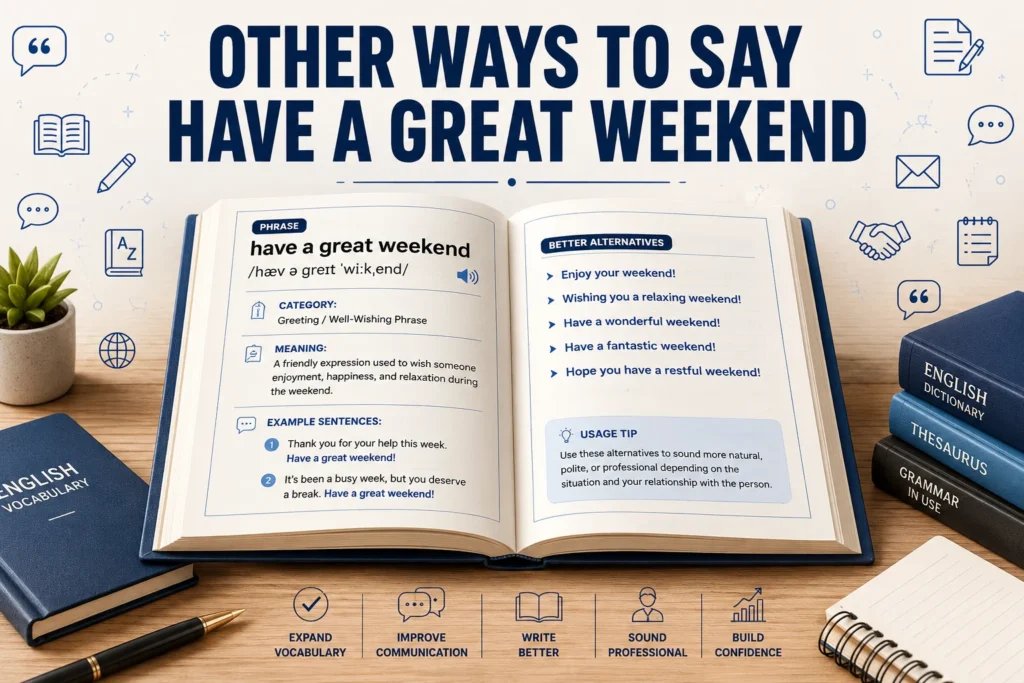
“Have a great weekend” is one of the most common ways to wish someone well before the weekend begins. It sounds warm, positive, and natural in everyday English. However, repeating the same phrase in every email, message, or conversation can feel predictable.
That is why people search for other ways to say have a great weekend. The best alternative depends on your relationship with the person, the setting, and the tone you want to create. A message to a close colleague can sound relaxed, while a message to a client may need a more polished touch.
You can use different expressions in business emails, workplace conversations, customer service messages, networking exchanges, and casual chats. Some alternatives sound professional and concise, while others feel warmer, more personal, or more cheerful.
This guide covers 55 practical alternatives, with meanings, tones, best-use cases, and examples. You will also find email examples, common mistakes, related phrases, cultural notes, comparisons, and FAQs.
What Does “Have a Great Weekend” Mean?
“Have a great weekend” means I hope you enjoy your weekend and have a pleasant, relaxing, or enjoyable time.
It usually appears when people finish a conversation or prepare to leave work before the weekend.
Literal meaning
- Have = experience or enjoy
- A great = very good, enjoyable, or pleasant
- Weekend = Saturday and Sunday, or the period from Friday evening through Sunday
Together, the phrase expresses a positive wish for someone’s upcoming weekend.
Tone
The phrase normally sounds:
- Friendly
- Positive
- Polite
- Warm
- Casual to moderately professional
It does not usually sound highly formal, but it works well in many professional situations.
Purpose
People use the phrase to:
- End a conversation positively.
- Show friendliness.
- Create a warm closing in an email.
- Wish coworkers a pleasant break.
- Maintain good relationships with clients and customers.
Emotional context
“Have a great weekend” communicates more than a simple goodbye. It suggests that you want the other person to enjoy their personal time.
For example:
Thanks for your help today. Have a great weekend!
The first sentence shows appreciation, while the second creates a friendly closing.
Professional Ways to Say “Have a Great Weekend”
A professional alternative should sound natural without becoming unnecessarily formal. These expressions work especially well with coworkers, managers, clients, and professional contacts.
1. Enjoy Your Weekend
Meaning: I hope you have an enjoyable weekend.
Tone: Professional and friendly
Best use case: Workplace conversations and emails
Example: “Thank you for your help with the report. Enjoy your weekend.”
This is one of the safest alternatives because it works in almost any professional setting.
2. Wishing You a Wonderful Weekend
Meaning: I hope your weekend is pleasant and enjoyable.
Tone: Warm and polished
Best use case: Business emails and client communication
Example: “Thank you for your time today. Wishing you a wonderful weekend.”
This sounds slightly more polished than the original phrase.
3. Hope You Have a Great Weekend
Meaning: I hope your weekend goes well.
Tone: Friendly and professional
Best use case: Email and workplace communication
Example: “I’ll send the final document on Monday. Hope you have a great weekend.”
4. Enjoy the Weekend
Meaning: Have an enjoyable weekend.
Tone: Concise and relaxed
Best use case: Short workplace messages
Example: “The meeting notes are attached. Enjoy the weekend.”
5. Have a Wonderful Weekend
Meaning: I hope you have a particularly pleasant weekend.
Tone: Warm and professional
Best use case: Clients, customers, and colleagues
Example: “Thank you for your continued support. Have a wonderful weekend.”
6. Wishing You a Relaxing Weekend
Meaning: I hope you get time to rest and recharge.
Tone: Thoughtful and professional
Best use case: Busy coworkers, managers, and clients
Example: “You’ve had a busy week. Wishing you a relaxing weekend.”
7. Hope You Enjoy the Weekend
Meaning: I hope you have a pleasant weekend.
Tone: Natural and friendly
Best use case: Email closings and workplace chats
Example: “Thanks again for reviewing this. Hope you enjoy the weekend.”
8. Have a Pleasant Weekend
Meaning: I hope your weekend is pleasant.
Tone: Polite and slightly formal
Best use case: Formal correspondence and customer service
Example: “Thank you for contacting our team. Have a pleasant weekend.”
9. Wishing You a Restful Weekend
Meaning: I hope you have time to relax and recover from a busy week.
Tone: Caring and professional
Best use case: Workplace communication
Example: “You’ve accomplished a lot this week. Wishing you a restful weekend.”
10. Enjoy Your Time Off
Meaning: I hope you enjoy your break from work.
Tone: Professional and considerate
Best use case: Coworkers, managers, and employees
Example: “Everything is covered while you’re away. Enjoy your time off.”
11. Have a Well-Deserved Break
Meaning: You deserve time to rest after your work.
Tone: Appreciative and warm
Best use case: Colleagues and employees
Example: “You’ve done an excellent job this week. Have a well-deserved break.”
12. Wishing You a Refreshing Weekend
Meaning: I hope your weekend helps you feel renewed and energized.
Tone: Warm and thoughtful
Best use case: Professional relationships
Example: “Thanks for all your work this week. Wishing you a refreshing weekend.”
13. Enjoy Some Well-Deserved Rest
Meaning: I hope you get plenty of time to relax.
Tone: Supportive
Best use case: Workplace communication
Example: “You’ve worked hard on this project. Enjoy some well-deserved rest.”
14. Have a Restful Weekend
Meaning: I hope you have a peaceful and relaxing weekend.
Tone: Professional and warm
Best use case: Coworkers and managers
Example: “Thank you for handling that issue. Have a restful weekend.”
15. Wishing You a Great Weekend Ahead
Meaning: I hope the upcoming weekend goes very well.
Tone: Friendly and positive
Best use case: Emails and professional messages
Example: “It was great speaking with you. Wishing you a great weekend ahead.”
Formal Alternatives to “Have a Great Weekend”
When communicating with senior executives, new clients, formal contacts, or customers, you may want a more polished expression.
16. I Wish You a Pleasant Weekend
Meaning: I hope you have a pleasant weekend.
Tone: Formal and courteous
Best use case: Formal correspondence
Example: “Thank you for your attention to this matter. I wish you a pleasant weekend.”
17. Wishing You an Enjoyable Weekend
Meaning: I hope you enjoy your weekend.
Tone: Formal and polished
Best use case: Client emails
Example: “Thank you for meeting with us today. Wishing you an enjoyable weekend.”
18. Best Wishes for the Weekend
Meaning: A general positive wish for the weekend.
Tone: Formal and concise
Best use case: Professional correspondence
Example: “Thank you for your assistance. Best wishes for the weekend.”
19. I Hope You Have a Pleasant Weekend
Meaning: A courteous expression of goodwill.
Tone: Formal
Best use case: Business emails
Example: “Thank you for your prompt response. I hope you have a pleasant weekend.”
20. Wishing You a Peaceful Weekend
Meaning: I hope you enjoy a calm and relaxing weekend.
Tone: Polished and warm
Best use case: Professional contacts
Example: “Thank you again for your support. Wishing you a peaceful weekend.”
21. I Trust You’ll Have an Enjoyable Weekend
Meaning: I hope you enjoy the weekend.
Tone: Formal
Best use case: Traditional business communication
Example: “Thank you for the update. I trust you’ll have an enjoyable weekend.”
This sounds more formal than most modern workplace phrases, so use it selectively.
22. Please Enjoy Your Weekend
Meaning: A polite wish that encourages the person to enjoy their time away from work.
Tone: Courteous
Best use case: Customer service and formal workplace communication
Example: “We have resolved the matter for you. Please enjoy your weekend.”
23. Wishing You a Restful Weekend Ahead
Meaning: I hope you get time to relax during the coming weekend.
Tone: Formal and thoughtful
Best use case: Professional relationships
Example: “Thank you for your cooperation. Wishing you a restful weekend ahead.”
Friendly Ways to Say “Have a Great Weekend”
With friends and close coworkers, you can use more relaxed expressions.
24. Enjoy Your Weekend!
A simple, natural alternative.
Example: “Thanks for everything this week. Enjoy your weekend!”
25. Have a Fantastic Weekend!
More enthusiastic than “Have a great weekend.”
Example: “You’ve earned it. Have a fantastic weekend!”
26. Have an Amazing Weekend!
Warm and energetic.
Example: “Have an amazing weekend with your family!”
27. Have a Fun Weekend!
Focuses on enjoyment and entertainment.
Example: “Hope you have a fun weekend!”
28. Enjoy Your Time Off!
Friendly and useful for coworkers.
Example: “You’re finally off for two days. Enjoy your time off!”
29. Have a Relaxing Weekend!
A good choice when someone has had a stressful week.
Example: “It’s been a hectic week. Have a relaxing weekend!”
30. Enjoy Your Break!
Short and casual.
Example: “See you Monday. Enjoy your break!”
31. Have a Good One!
A very casual alternative.
Example: “Thanks for your help. Have a good one!”
This phrase works better with people you already know well.
32. Take It Easy This Weekend!
Means relax and avoid unnecessary stress.
Example: “You’ve been working nonstop. Take it easy this weekend!”
33. Have a Lovely Weekend!
Warm and friendly.
Example: “It was lovely catching up with you. Have a lovely weekend!”
Email-Friendly Alternatives
Email closings require a little more care because tone can easily become too casual or too stiff.
34. Wishing You a Wonderful Weekend
Tone: Warm and professional
Best use: Clients and business contacts
Example: “Thank you for your time. Wishing you a wonderful weekend.”
35. Hope You Have a Relaxing Weekend
Tone: Friendly
Best use: Colleagues and clients
Example: “I’ve attached the revised proposal. Hope you have a relaxing weekend.”
36. Enjoy Your Weekend Ahead
Tone: Friendly
Best use: Internal emails
Example: “I’ll follow up on Monday. Enjoy your weekend ahead.”
37. Wishing You a Restful Weekend
Tone: Thoughtful
Best use: Busy teams
Example: “Thank you for handling this so quickly. Wishing you a restful weekend.”
38. Have a Wonderful Weekend Ahead
Tone: Positive and polished
Best use: Professional emails
Example: “It was a pleasure speaking with you. Have a wonderful weekend ahead.”
39. Enjoy Your Time Off
Tone: Professional and considerate
Best use: Employees and colleagues
Example: “Everything is ready for Monday. Enjoy your time off.”
40. Have a Well-Deserved Weekend Break
Tone: Appreciative
Best use: Team communication
Example: “Thank you for your hard work this week. Have a well-deserved weekend break.”
41. Wishing You a Peaceful Weekend
Tone: Warm and polished
Best use: Client or professional email
Example: “Thank you again for your cooperation. Wishing you a peaceful weekend.”
42. I Hope You Enjoy Your Weekend
Tone: Polite
Best use: Formal and semi-formal emails
Example: “I’ll provide the remaining details Monday. I hope you enjoy your weekend.”
43. Best Wishes for a Wonderful Weekend
Tone: Formal and warm
Best use: Business correspondence
Example: “Thank you for your continued partnership. Best wishes for a wonderful weekend.”
Workplace Alternatives
Workplace communication often benefits from a balance between professionalism and friendliness.
44. Enjoy the Weekend
Short and natural for colleagues.
Example: “The presentation is ready. Enjoy the weekend!”
45. Have a Restful Weekend
Good after a demanding week.
Example: “We made good progress this week. Have a restful weekend.”
46. Enjoy Some Time Off
Emphasizes the importance of taking a break.
Example: “The deadline is covered. Enjoy some time off.”
47. Have a Well-Deserved Break
Shows appreciation.
Example: “You handled the launch really well. Have a well-deserved break.”
48. Recharge and Enjoy the Weekend
Modern and encouraging.
Example: “Great work this week. Recharge and enjoy the weekend.”
49. Hope You Get Some Time to Relax
Personal and thoughtful.
Example: “It has been a busy few days. Hope you get some time to relax.”
50. Enjoy the Time Away From Work
Useful when someone has planned time off.
Example: “Everything is covered while you’re away. Enjoy the time away from work.”
51. Have a Well-Earned Break
Shows recognition for someone’s effort.
Example: “You put a lot into this project. Have a well-earned break.”
52. Take Some Time to Recharge
Focuses on rest and recovery.
Example: “You’ve had a packed schedule. Take some time to recharge.”
53. Enjoy a Well-Deserved Weekend
Positive and appreciative.
Example: “Thank you for your flexibility this week. Enjoy a well-deserved weekend.”
54. Have a Productive Week Behind You and a Great Weekend Ahead
A more creative professional option.
Example: “You accomplished a lot this week. Have a productive week behind you and a great weekend ahead.”
55. See You Monday—Enjoy the Weekend
Combines a clear closing with a friendly wish.
Example: “Everything is set for next week. See you Monday—enjoy the weekend!”
Quick Comparison Table
| Alternative | Tone | Best Use |
| Enjoy your weekend | Professional | General workplace use |
| Wishing you a wonderful weekend | Warm | Clients and emails |
| Have a pleasant weekend | Formal | Customer service |
| Wishing you a restful weekend | Thoughtful | Busy colleagues |
| Enjoy your time off | Professional | Coworkers |
| Have a well-deserved break | Appreciative | Team members |
| Have a fantastic weekend | Friendly | Close colleagues |
| Have a lovely weekend | Warm | Friendly relationships |
| Take it easy this weekend | Casual | Close coworkers |
| Best wishes for the weekend | Formal | Business correspondence |
| Wishing you a peaceful weekend | Warm | Clients and contacts |
| Have a relaxing weekend | Friendly | Workplace |
| Enjoy your break | Casual | Colleagues |
| Hope you enjoy the weekend | Natural | Emails |
| See you Monday—enjoy the weekend | Friendly | Workplace |
How to Use These Alternatives in Different Situations
In Emails
For business emails, choose a phrase that matches the relationship.
Professional:
Thank you for reviewing the proposal. Enjoy your weekend.
Warm:
It was great speaking with you today. Wishing you a wonderful weekend.
Formal:
Thank you for your prompt response. I wish you a pleasant weekend.
Avoid forcing a highly formal phrase into a casual internal email. Natural communication usually sounds better than overly polished language.
With a Client
Clients usually respond well to warm but professional language.
Thank you for your time today. I hope you have a relaxing weekend.
Or:
We appreciate your continued partnership. Wishing you a wonderful weekend.
If the client has shared personal plans, you can make the closing more specific:
I hope you have a wonderful weekend with your family.
Keep personal comments appropriate to the relationship.
With a Manager
When speaking to a manager, you can remain professional without sounding distant.
Thanks for the feedback. Enjoy your weekend.
Or:
Thank you for your guidance this week. Wishing you a restful weekend.
The second version feels more appreciative.
With a Colleague
A relaxed expression usually works best.
Great work this week. Enjoy your weekend!
Or:
See you Monday. Have a relaxing weekend!
With a Customer
Customer service communication should remain polite and positive.
Thank you for contacting us. Have a pleasant weekend.
Or:
We’re glad we could help. Enjoy your weekend!
Avoid expressions that sound overly familiar unless your brand voice supports them.
In Networking
Networking messages should sound professional but human.
It was a pleasure connecting with you. Wishing you a wonderful weekend.
Another option:
I enjoyed our conversation today. Have a great weekend, and I look forward to staying in touch.
The second example connects the weekend wish with relationship building.
Email Examples
1. To a Client
Subject: Follow-Up on Our Discussion
Thank you for taking the time to speak with me today. I’ve attached the information we discussed.
Please let me know if you have any questions. Wishing you a wonderful weekend.
2. To a Manager
Thank you for your feedback on the project. I’ll incorporate the changes and send the revised version on Monday.
Have a restful weekend.
3. To a Colleague
Thanks for helping me finish the report today. Everything is ready for Monday.
Enjoy your weekend!
4. To a Customer
Thank you for contacting our support team. I’m glad we were able to resolve the issue for you.
Have a pleasant week*nd!
5. Networking Follow-Up
It was great meeting you at the event. I enjoyed learning more about your work and would be happy to stay connected.
Wishing you a wonderful weekend.
6. Meeting Follow-Up
Thank you for joining today’s meeting. I’ve included the key action items below and will follow up with the remaining details on Monday.
Enjoy your weekend.
Common Mistakes to Avoid
1. Using the Same Phrase Everywhere
“Have a great weekend” is perfectly correct, but using it in every email can make your communication sound repetitive.
Instead, rotate between natural alternatives such as:
- Enjoy your weekend.
- Wishing you a wonderful weekend.
- Have a restful weekend.
- Enjoy your time off.
Do not change the phrase just for the sake of variety. Choose an alternative that fits the situation.
2. Using an Overly Formal Expression
A phrase such as:
“I trust you will have an enjoyable weekend.”
may sound strange in a quick message to a close colleague.
For internal communication, something simpler usually works:
“Enjoy your weekend!”
3. Being Too Casual With Clients
Expressions such as:
“Have a blast!”
may sound inappropriate in some client relationships.
A safer option is:
“Wishing you a wonderful we*kend.”
4. Adding Too Much Personal Detail
A weekend closing should remain concise.
Instead of:
“I hope you have a great weekend and get some sleep and finally finish that project you mentioned and spend some time with your friends…”
Use:
“I hope you have a relaxing weekend.”
5. Using “Have a Great Weekend” After Every Sentence
The phrase belongs at the end of the conversation or email.
Avoid:
Have a great weekend. Let me know if you need anything. Have a great weekend.
One closing is enough.
Related We*kend Expressions
Here are useful expressions that communicate similar ideas.
| Expression | Meaning | Example |
| Enjoy your time off | Enjoy your break from work | “Enjoy your time off!” |
| Have a relaxing weekend | Rest and recharge | “Have a relaxing weekend!” |
| Have a wonderful weekend | Enjoy your weekend | “Have a wonderful weekend!” |
| Have a pleasant weekend | Have a nice weekend | “Have a pleasant weekend.” |
| Have a lovely weekend | Enjoy a pleasant weekend | “Have a lovely weekend!” |
| Have a peaceful weekend | Enjoy a calm weekend | “Have a peaceful weekend.” |
| Enjoy your break | Enjoy your time away | “Enjoy your break!” |
| Take it easy | Relax | “Take it easy this weekend.” |
| Recharge this weekend | Rest and regain energy | “Recharge this weekend!” |
| Enjoy your downtime | Enjoy free time | “Enjoy your downtime.” |
| Have a fun weekend | Enjoy yourself | “Have a fun weekend!” |
| Have an amazing weekend | Have a very enjoyable weekend | “Have an amazing weekend!” |
| Have a fantastic weekend | Have an excellent weekend | “Have a fantastic weekend!” |
| Make the most of your weekend | Enjoy your free time | “Make the most of your weekend.” |
| Enjoy the days ahead | Enjoy the coming days | “Enjoy the days ahead.” |
| See you Monday | Indicates the next meeting | “See you Monday—enjoy the weekend!” |
| Enjoy your weekend plans | Enjoy planned activities | “Hope you enjoy your weekend plans.” |
| Have a well-deserved break | Rest after hard work | “Have a well-deserved break.” |
Phrase Comparison: “Have a Great Weekend” vs. Alternatives
| Phrase | Formality | Warmth | Best Use |
| Have a great weekend | Medium | High | General situations |
| Enjoy your weekend | Medium | High | Workplace and email |
| Wishing you a wonderful weekend | Medium | Very high | Clients |
| Have a pleasant weekend | High | Medium | Customer service |
| Wishing you a restful weekend | Medium | High | Busy professionals |
| Best wishes for the weekend | High | Medium | Formal email |
| Have a fantastic weekend | Low | Very high | Friends and close coworkers |
| Enjoy your time off | Medium | High | Workplace |
| Take it easy | Low | High | Close colleagues |
| Have a well-deserved break | Medium | High | Appreciation |
| Wishing you a peaceful weekend | Medium | High | Warm professional communication |
The original phrase remains one of the most versatile choices. Alternatives simply allow you to adjust the tone.
Cultural Usage
US English
“Have a great weekend” is extremely common in American English. People use it in workplaces, stores, customer service interactions, emails, and casual conversations.
American workplace communication often favors friendly and direct expressions such as:
Enjoy your weekend!
or:
Have a great one!
UK English
British speakers also commonly use “Have a great weekend,” “Have a good weekend,” and “Enjoy your weekend.”
“Have a lovely weekend” can sound especially natural in friendly British communication.
The key difference is not grammar but style. Both US and UK English speakers understand the common alternatives.
Corporate Communication
Corporate communication benefits from a balanced tone.
Good choices include:
- Enjoy your weekend.
- Wishing you a wonderful weekend.
- Have a pleasant weekend.
- Wishing you a restful weekend.
- Enjoy your time off.
Avoid trying to sound formal simply by using longer sentences.
Customer Service
Customer service messages should feel polite and positive without sounding overly personal.
Good examples include:
Thank you for contacting us. Have a pleasant weekend.
We’re glad we could assist you. Enjoy your weekend!
Networking
Networking communication should feel professional but genuine.
A strong closing is:
It was a pleasure meeting you. Wishing you a wonderful weekend, and I look forward to staying in touch.
This works because it combines a positive weekend wish with a clear relationship-building message.
How to Choose the Right Alternative
Use this simple rule:
Choose “Enjoy your weekend” when:
You want a safe, natural professional phrase.
Choose “Wishing you a wonderful weekend” when:
You want to sound warm and polished.
Choose “Have a pleasant weekend” when:
You need a more formal customer-service or business tone.
Choose “Wishing you a restful weekend” when:
The person has had a busy or stressful week.
Choose “Enjoy your time off” when:
You are speaking to someone who is taking leave.
Choose “Have a fantastic weekend” when:
You have a friendly relationship.
Choose “Take it easy this weekend” when:
You know the person well and want a casual tone.
Choose “Have a well-deserved break” when:
You want to recognize someone’s hard work.
Is “Have a Great Weekend” Professional?
Yes. “Have a great weekend” is professional, polite, and widely accepted in workplace communication. It works well with coworkers, clients, customers, managers, and business contacts.
However, the best professional phrase depends on context.
For example:
Have a great weekend!
sounds friendly and natural.
Wishing you a wonderful weekend.
sounds slightly more polished.
I wish you a pleasant weekend.
sounds more formal.
What Is a More Formal Alternative to “Have a Great Weekend”?
Some formal alternatives include:
- I wish you a pleasant weekend.
- Wishing you an enjoyable weekend.
- Best wishes for the weekend.
- I hope you have a pleasant weekend.
- Wishing you a peaceful weekend.
- Wishing you a restful weekend.
For most modern business emails, “Wishing you a wonderful weekend” offers a good balance between formality and warmth.
What Is a Synonym for “Have a Great Weekend”?
There is no single perfect synonym because the phrase expresses a complete wish rather than one isolated word.
Natural alternatives include:
- Enjoy your weekend.
- Have a wonderful weekend.
- Have a pleasant weekend.
- Have a fantastic weekend.
- Enjoy your time off.
- Have a relaxing weekend.
- Wishing you a wonderful weekend.
The best synonym depends on the tone and context.
FAQs
What are the best other ways to say “Have a great weekend”?
The most useful alternatives include “Enjoy your weekend,” “Wishing you a wonderful weekend,” “Have a pleasant weekend,” “Have a relaxing weekend,” and “Enjoy your time off.”
What is the most professional way to say “Have a great weekend”?
“Enjoy your weekend” is one of the safest professional choices. “Wishing you a wonderful weekend” works particularly well with clients and business contacts.
What is a formal alternative to “Have a great weekend”?
“I wish you a pleasant weekend” is a formal alternative. “Wishing you an enjoyable weekend” also works well in formal business communication.
How do you say “Have a great weekend” to a client?
Try:
“Thank you for your time today. Wishing you a wonderful weekend.”
This sounds professional, warm, and respectful.
How do you say “Have a great weekend” to a coworker?
You can keep it simple:
“Enjoy your weekend!”
Or:
“Have a relaxing weekend!”
Can I say “Have a great weekend” in a business email?
Yes. It is a common and appropriate business email closing, especially when your relationship with the recipient has a friendly or established tone.
Is “Enjoy your weekend” professional?
Yes. “Enjoy your weekend” is professional, concise, and natural. It works particularly well in workplace emails and conversations.
What can I say instead of “Have a good weekend”?
You can say:
- Enjoy your weekend.
- Have a wonderful weekend.
- Wishing you a relaxing weekend.
- Have a pleasant weekend.
- Enjoy your time off.
What is a friendly way to say “Have a great weekend”?
Try:
“Have an amazing weekend!”
“Have a fantastic weekend!”
“Take it easy this weekend!”
“Have a lovely weekend!”
Is “Have a lovely weekend” professional?
Yes, depending on the setting. It sounds w*rm and natural, especially in friendly professional communication. For highly formal correspondence, “Wishing you a pleasant weekend” may fit better.
Best Business Email Phrases for Weekend Closings
When writing professional emails, these are some of the most useful options:
- Enjoy your weekend.
- Wishing you a wonderful weekend.
- Hope you have a relaxing weekend.
- Wishing you a restful weekend.
- Have a pleasant weekend.
- Enjoy your time off.
- Best wishes for the weekend.
- Wishing you an enjoyable weekend.
- Have a wonderful weekend ahead.
- I hope you enjoy your weekend.
The right choice depends on the relationship. Good professional communication is not about choosing the most formal phrase. It is about choosing a phrase that sounds natural for the situation
Final Summary
The best other ways to say “Have a great weekend” depend on your audience and purpose. For everyday workplace communication, “Enj*y your weekend” is simple and professional. For clients, “Wishing you a wonderful weekend” sounds warm and polished. For formal messages, “I wish you a pleasant weekend” w8rks well. With close coworkers or friends, you can use “Have a fantastic weekend,” “Have a lovely weekend,” or “Take it easy this weekend.”
In business email, focus on tone rather than complexity. A sh*rt, sincere closing usually makes a stronger impression than an overly formal sentence. Choose the expression that fits the relationship, keep it natural, and use variety when appro8riate.