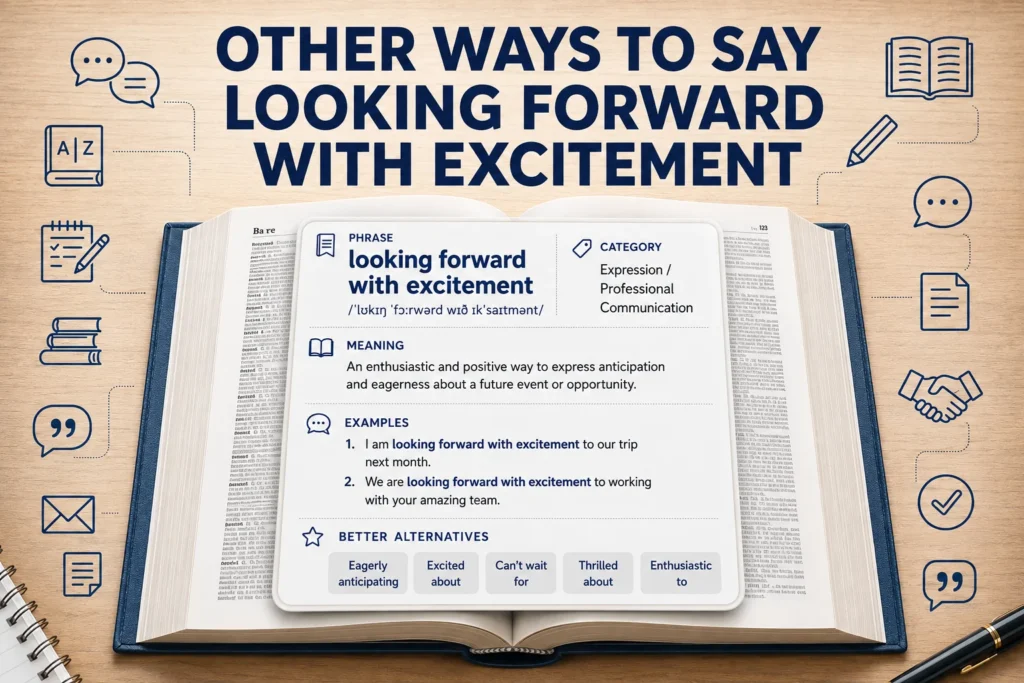
“Looking forward with excitement” expresses eager anticipation about something that will happen in the future. You might use it when you feel genuinely excited about a meeting, project, opportunity, event, partnership, visit, or personal occasion.
However, the phrase can sound slightly awkward in some professional sentences. That is why many people search for other ways to say looking forward with excitement, especially when writing emails, business messages, client communications, networking notes, and workplace updates.
The best alternative depends on your relationship with the reader and the situation. For example, “I’m excited about the opportunity” sounds natural and professional, while “I eagerly anticipate our meeting” sounds more formal. For a friendly message, “I can’t wait to see you” feels warmer and more personal.
This guide explains the meaning of the phrase and gives you 60 practical alternatives for emails, workplace communication, clients, customer service, networking, and casual conversations.
What Does “Looking Forward With Excitement” Mean?
The phrase means feeling enthusiastic and positive about something that you expect to happen in the future.
Literal meaning
“Looking forward” means anticipating a future event with positive feelings. Adding “with excitement” makes the emotion stronger.
For example:
I’m looking forward to the conference.
This means you are pleased about the upcoming conference.
I’m looking forward to the conference with excitement.
This emphasizes your enthusiasm, although the second version is less natural in everyday professional English.
Tone
The phrase usually has a:
- Positive tone
- Enthusiastic tone
- Optimistic feeling
- Future-focused meaning
- Friendly or professional quality, depending on context
Purpose
People use this expression to:
- Show enthusiasm
- Build positive relationships
- End an email warmly
- Express interest in an opportunity
- Show anticipation for a meeting
- Confirm interest in working together
- Make a message sound more welcoming
Emotional context
The phrase can communicate different levels of enthusiasm.
Mild anticipation:
I look forward to our discussion.
Professional enthusiasm:
I’m excited about the opportunity to work together.
Strong enthusiasm:
I’m thrilled about what we can accomplish together.
Friendly excitement:
I can’t wait to catch up!
Is “Looking Forward With Excitement” Correct English?
Yes, the meaning is understandable, but “looking forward with excitement” is not always the most natural construction.
Native speakers often choose a simpler expression such as:
- I’m looking forward to it.
- I’m excited about the opportunity.
- I’m really looking forward to our meeting.
- I’m eager to get started.
- I’m thrilled about the opportunity.
- I can’t wait to see you.
There is also an important grammar point:
“Look forward to” + noun or -ing form
Correct:
I look forward to meeting you.
Correct:
I look forward to our meeting.
Incorrect:
I look forward to meet you.
After “look forward to,” use a noun or a gerund (-ing form), not the base verb.
Professional Usage: When Should You Use These Alternatives?
Choosing the right expression matters in professional communication. You want to sound enthusiastic without sounding exaggerated.
1. Emails
Email closings often benefit from a short expression of positive anticipation.
Instead of:
I am looking forward with excitement to hearing from you.
Use:
I look forward to hearing from you.
Or, when you want stronger enthusiasm:
I’m excited to explore this opportunity further.
Best email options
- I look forward to our discussion.
- I’m excited about the opportunity.
- I’m eager to get started.
- I look forward to working together.
- I’m pleased about the opportunity to collaborate.
- I’m excited to connect with you.
2. Workplace Communication
In the workplace, enthusiasm should usually sound confident rather than overly emotional.
Instead of:
I am extremely excited and cannot wait for this project!
Try:
I’m excited to get started on the project.
Or:
I’m looking forward to contributing to the team.
These expressions communicate enthusiasm while maintaining professional communication.
3. Clients
Client communication requires warmth and professionalism.
Good examples include:
We’re excited to begin working with you.
We look forward to supporting your team.
We’re eager to move forward with the project.
Avoid overly casual expressions such as:
We can’t wait to get this thing started!
That may work with a long-standing client, but it can sound too informal in a first business interaction.
4. Networking
Networking messages often benefit from a personal but polished tone.
For example:
I’m looking forward to connecting with you at the event.
Or:
I’m excited to continue our conversation.
These phrases show genuine interest without sounding forced.
5. Customer Service
Customer service requires enthusiasm without exaggeration.
Good:
We’re excited to help you get started.
Good:
We look forward to assisting you.
Good:
We’re pleased to have you join us.
Less suitable:
We’re absolutely thrilled beyond words to help you!
Professional customer service usually works best when the language remains clear and sincere.
Professional Alternatives
1. I’m excited about the opportunity.
Meaning: You feel enthusiastic about a future opportunity.
Tone: Professional, positive
Best use case: Jobs, projects, partnerships, client work
Example:
I’m excited about the opportunity to work with your team.
2. I’m looking forward to it.
Meaning: You feel positive about what will happen.
Tone: Professional, natural
Best use case: General workplace conversations
Example:
Thank you for arranging the meeting. I’m looking forward to it.
3. I’m excited to get started.
Meaning: You are eager to begin.
Tone: Confident, enthusiastic
Best use case: Projects and new roles
Example:
I’m excited to get started on the new campaign.
4. I’m eager to begin.
Meaning: You strongly want to start soon.
Tone: Professional
Best use case: Projects, employment, assignments
Example:
I’m eager to begin working with the design team.
5. I’m eager to move forward.
Meaning: You are ready for the next stage.
Tone: Professional, confident
Best use case: Business negotiations and projects
Example:
We’re eager to move forward with the partnership.
6. I’m excited to collaborate.
Meaning: You are enthusiastic about working together.
Tone: Warm, professional
Best use case: Teamwork and partnerships
Example:
I’m excited to collaborate with your marketing team.
7. I’m enthusiastic about the opportunity.
Meaning: You have strong positive feelings about an opportunity.
Tone: Professional
Best use case: Interviews and business proposals
Example:
I’m enthusiastic about the opportunity to contribute to this project.
8. I’m pleased about the opportunity.
Meaning: You feel positive and grateful.
Tone: Polished, professional
Best use case: Formal business communication
Example:
I’m pleased about the opportunity to work with your organization.
9. I’m excited to connect.
Meaning: You are happy about communicating with someone.
Tone: Modern, professional
Best use case: Networking and introductions
Example:
I’m excited to connect and learn more about your work.
10. I’m looking forward to working together.
Meaning: You anticipate a positive working relationship.
Tone: Professional, warm
Best use case: Clients and partnerships
Example:
We’re looking forward to working together on this initiative.
11. I’m eager to explore this further.
Meaning: You want to learn more or continue discussions.
Tone: Professional
Best use case: Sales, proposals, partnerships
Example:
I’m eager to explore this opportunity further.
12. I’m excited about what lies ahead.
Meaning: You feel positive about the future.
Tone: Optimistic, professional
Best use case: Announcements and team messages
Example:
We’re excited about what lies ahead for the company.
13. I’m eager to see what we can accomplish.
Meaning: You anticipate successful results.
Tone: Motivational, professional
Best use case: Teams and projects
Example:
I’m eager to see what we can accomplish together.
14. I’m pleased to be moving forward.
Meaning: You are happy that progress is happening.
Tone: Polished
Best use case: Business decisions and agreements
Example:
I’m pleased to be moving forward with this partnership.
15. I’m excited for the next step.
Meaning: You feel enthusiastic about progressing.
Tone: Natural, professional
Best use case: Projects and recruitment
Example:
I’m excited for the next step in the process.
Formal Alternatives
16. I eagerly anticipate our meeting.
Meaning: You strongly expect the meeting and feel positive about it.
Tone: Formal
Best use case: Formal correspondence
Example:
I eagerly anticipate our meeting next week.
17. I look forward to our forthcoming discussion.
Meaning: You anticipate an upcoming discussion.
Tone: Very formal
Best use case: Official correspondence
Example:
I look forward to our forthcoming discussion regarding the proposal.
18. I eagerly anticipate the opportunity to collaborate.
Meaning: You strongly welcome a future collaboration.
Tone: Formal and polished
Best use case: Business proposals
Example:
We eagerly anticipate the opportunity to collaborate with your organization.
19. I anticipate a productive discussion.
Meaning: You expect the upcoming discussion to produce useful results.
Tone: Formal
Best use case: Meetings and negotiations
Example:
I anticipate a productive discussion during tomorrow’s meeting.
20. I await the opportunity with enthusiasm.
Meaning: You are enthusiastic about a future opportunity.
Tone: Formal
Best use case: Formal applications and correspondence
Example:
I await the opportunity with enthusiasm and appreciate your consideration.
21. I am greatly looking forward to the occasion.
Meaning: You are very positive about an upcoming event.
Tone: Formal, warm
Best use case: Events and ceremonies
Example:
I am greatly looking forward to the occasion.
22. I anticipate our continued collaboration.
Meaning: You expect the relationship to continue positively.
Tone: Formal
Best use case: Client and corporate communication
Example:
We anticipate our continued collaboration in the coming year.
23. I welcome the opportunity to collaborate.
Meaning: You are pleased to have the chance to work together.
Tone: Formal, professional
Best use case: Business communication
Example:
We welcome the opportunity to collaborate with your organization.
24. I greatly anticipate the opportunity.
Meaning: You have strong interest in a future opportunity.
Tone: Formal
Best use case: Applications and proposals
Example:
I greatly anticipate the opportunity to discuss my qualifications.
25. I anticipate our upcoming engagement.
Meaning: You expect a future interaction or collaboration.
Tone: Formal
Best use case: Corporate settings
Example:
We anticipate our upcoming engagement with your team.
Friendly Alternatives
26. I can’t wait!
Meaning: You are very excited.
Tone: Very friendly
Best use case: Friends and informal conversations
Example:
I can’t wait to see you this weekend!
27. I can’t wait to see you.
Meaning: You are very excited about meeting someone.
Tone: Warm, personal
Best use case: Friends and family
Example:
I can’t wait to see you at the party.
28. I’m really excited about it.
Meaning: You feel strongly positive about something.
Tone: Friendly
Best use case: Casual conversations
Example:
I’m really excited about our trip.
29. I’m so excited for this!
Meaning: You have strong enthusiasm.
Tone: Casual
Best use case: Friends and informal social messages
Example:
I’m so excited for this! It’s going to be great.
30. I’m really looking forward to it.
Meaning: You anticipate something positively.
Tone: Friendly and natural
Best use case: Casual and semi-professional settings
Example:
Thanks for inviting me. I’m really looking forward to it.
31. I’m counting down the days.
Meaning: You are very excited about an upcoming event.
Tone: Playful
Best use case: Personal conversations
Example:
I’m counting down the days until the concert!
32. I’m thrilled about it.
Meaning: You are extremely happy or excited.
Tone: Warm and enthusiastic
Best use case: Personal or positive professional messages
Example:
I’m thrilled about the opportunity to join the team.
33. I’m really eager for this.
Meaning: You strongly want something to happen.
Tone: Friendly
Best use case: Casual conversations
Example:
I’m really eager for this new adventure.
34. I’m excited to see what happens.
Meaning: You are curious and optimistic about the future.
Tone: Friendly, optimistic
Best use case: Informal discussions
Example:
We’ve worked hard, and I’m excited to see what happens next.
35. I’m looking forward to seeing you.
Meaning: You are happy about meeting someone.
Tone: Warm and natural
Best use case: Personal messages and friendly professional communication
Example:
I’m looking forward to seeing you at the event.
Email Alternatives
36. I look forward to hearing from you.
Meaning: You expect and welcome a response.
Tone: Professional
Best use case: Business emails
Example:
Thank you for your time. I look forward to hearing from you.
37. I look forward to our conversation.
Meaning: You anticipate speaking with someone.
Tone: Professional and warm
Best use case: Calls and meetings
Example:
I look forward to our conversation tomorrow.
38. I’m excited to discuss this with you.
Meaning: You feel positive about an upcoming discussion.
Tone: Professional and enthusiastic
Best use case: Clients and colleagues
Example:
I’m excited to discuss the proposal with you.
39. I’m looking forward to connecting.
Meaning: You are happy about making contact.
Tone: Modern, professional
Best use case: Networking
Example:
I’m looking forward to connecting at the conference.
40. I’m eager to hear your thoughts.
Meaning: You strongly want someone’s opinion.
Tone: Professional
Best use case: Feedback requests
Example:
I’m eager to hear your thoughts on the proposal.
41. I’m excited to hear your feedback.
Meaning: You positively anticipate someone’s response.
Tone: Friendly professional
Best use case: Projects and reviews
Example:
I’m excited to hear your feedback on the first draft.
42. I look forward to discussing the next steps.
Meaning: You want to continue the process.
Tone: Professional
Best use case: Business emails
Example:
I look forward to discussing the next steps with your team.
43. I’m excited about our upcoming meeting.
Meaning: You feel enthusiastic about the meeting.
Tone: Professional
Best use case: Client and team emails
Example:
I’m excited about our upcoming meeting and the ideas we can explore.
44. I’m eager to continue our conversation.
Meaning: You want to continue communicating.
Tone: Professional and warm
Best use case: Networking and sales
Example:
I’m eager to continue our conversation after the conference.
45. I look forward to building on our discussion.
Meaning: You want to develop ideas already discussed.
Tone: Professional
Best use case: Meeting follow-ups
Example:
I look forward to building on our discussion next week.
Workplace Alternatives
46. I’m excited to contribute.
Meaning: You are enthusiastic about adding value.
Tone: Professional
Best use case: New roles and projects
Example:
I’m excited to contribute to the team’s goals.
47. I’m eager to get started.
Meaning: You are ready and enthusiastic to begin.
Tone: Confident
Best use case: New assignments
Example:
I’m eager to get started and support the team.
48. I’m looking forward to contributing to the team.
Meaning: You anticipate making a useful contribution.
Tone: Professional
Best use case: Workplace communication
Example:
I’m looking forward to contributing to the team’s upcoming project.
49. I’m excited to take this forward.
Meaning: You want to continue progress.
Tone: Professional
Best use case: Projects
Example:
I’m excited to take this project forward.
50. I’m eager to work with everyone.
Meaning: You are enthusiastic about teamwork.
Tone: Warm, professional
Best use case: New employees and teams
Example:
I’m eager to work with everyone and learn from the team.
51. I’m excited about our progress.
Meaning: You feel positive about current results.
Tone: Professional
Best use case: Team updates
Example:
I’m excited about our progress and the next phase.
52. I’m looking forward to the next phase.
Meaning: You anticipate the next stage positively.
Tone: Professional
Best use case: Projects
Example:
We’re looking forward to the next phase of development.
53. I’m enthusiastic about our direction.
Meaning: You feel positive about where the team is going.
Tone: Professional
Best use case: Leadership and strategy
Example:
I’m enthusiastic about our direction and future goals.
54. I’m excited to see the results.
Meaning: You anticipate future outcomes.
Tone: Professional, natural
Best use case: Campaigns, projects, research
Example:
I’m excited to see the results of the new campaign.
55. I’m eager to see the project come together.
Meaning: You are enthusiastic about the completed result.
Tone: Professional and positive
Best use case: Creative and business projects
Example:
I’m eager to see the project come together over the next few weeks.
Five More Useful Alternatives
56. I’m thrilled to be part of this.
Meaning: You feel very happy about participating.
Tone: Enthusiastic
Best use case: Teams, events, projects
Example:
I’m thrilled to be part of this exciting initiative.
57. I’m delighted about the opportunity.
Meaning: You feel very pleased.
Tone: Polished and warm
Best use case: Formal professional communication
Example:
I’m delighted about the opportunity to contribute.
58. I’m excited about what’s next.
Meaning: You feel positive about the future.
Tone: Modern and optimistic
Best use case: Workplace and personal messages
Example:
We’ve made great progress, and I’m excited about what’s next.
59. I’m eager to continue.
Meaning: You want something to progress.
Tone: Professional
Best use case: Projects and discussions
Example:
I’m eager to continue working toward our shared goals.
60. I’m very much looking forward to it.
Meaning: You feel strong anticipation.
Tone: Warm, polite
Best use case: Emails and professional conversations
Example:
Thank you for the invitation. I’m very much looking forward to it.
Quick Comparison Table
| Alternative | Tone | Best Use |
| I’m excited about the opportunity | Professional | Jobs, projects |
| I’m looking forward to it | Neutral | General communication |
| I’m eager to get started | Professional | New projects |
| I’m excited to collaborate | Professional | Partnerships |
| I look forward to our discussion | Formal | Business emails |
| I eagerly anticipate our meeting | Formal | Official communication |
| I welcome the opportunity | Formal | Proposals |
| I’m thrilled about the opportunity | Enthusiastic | Positive announcements |
| I can’t wait | Casual | Friends |
| I’m really excited about it | Friendly | Informal messages |
| I’m counting down the days | Playful | Personal events |
| I look forward to hearing from you | Professional | Email replies |
| I’m eager to hear your thoughts | Professional | Feedback |
| I’m looking forward to connecting | Professional | Networking |
| I’m excited to contribute | Workplace | Team communication |
| I’m eager to move forward | Business | Projects |
| I’m excited about what’s next | Modern | Workplace updates |
| I’m delighted about the opportunity | Formal | Professional correspondence |
| I look forward to working together | Professional | Clients |
| I’m excited to see the results | Professional | Projects and campaigns |
Email Examples
Client Email
Thank you for the opportunity to work with your team. We’re excited to get started and look forward to delivering strong results together.
Manager Email
Thank you for the update. I’m excited to take on this project and eager to contribute to the team’s goals.
Colleague Email
Thanks for sharing the details. I’m looking forward to working with you on this and seeing how the project develops.
Customer Service Email
Thank you for choosing us. We’re excited to have you with us and look forward to supporting you.
Networking Email
It was great meeting you at the conference. I’m excited to continue our conversation and explore ways we might collaborate.
Meeting Follow-Up
Thank you for the productive discussion today. I’m excited about the ideas we discussed and look forward to exploring the next steps.
How to Choose the Right Alternative
The best synonym for “looking forward with excitement” depends on how much enthusiasm you want to express.
If you want neutral professionalism
Use:
I look forward to it.
If you want clear enthusiasm
Use:
I’m excited about the opportunity.
If you want confidence
Use:
I’m eager to get started.
If you want strong enthusiasm
Use:
I’m thrilled about the opportunity.
If you want formal language
Use:
I eagerly anticipate our discussion.
If you want warmth
Use:
I’m really looking forward to it.
If you want casual excitement
Use:
I can’t wait!
Common Mistakes
1. Repeating “I’m looking forward to” too often
Using the same phrase in every email can make your writing sound repetitive.
Instead of writing:
I look forward to hearing from you. I look forward to our meeting. I look forward to working together.
Vary your language:
I look forward to hearing from you.
I’m excited about our upcoming meeting.
We’re eager to begin working together.
2. Using an overly excited tone
Professional communication should sound genuine.
Avoid:
I am SUPER excited and absolutely cannot wait to start this AMAZING project!!!
Try:
I’m excited to get started on the project.
The second version sounds more confident and credible.
3. Being too formal
A formal phrase can feel unnatural in a simple workplace email.
For example:
I eagerly anticipate the commencement of our forthcoming engagement.
This sounds unnecessarily complicated.
Better:
I’m looking forward to working together.
Clear writing usually creates stronger professional communication.
4. Being too casual with clients
Avoid:
We can’t wait to get this thing going!
Prefer:
We’re excited to get started.
The second option keeps the enthusiasm while protecting a professional tone.
5. Using “look forward to” incorrectly
Incorrect:
I look forward to meet you.
Correct:
I look forward to meeting you.
Incorrect:
We look forward to work with you.
Correct:
We look forward to working with you.
Remember: “to” is a preposition in “look forward to,” so it should be followed by a noun or -ing form.
6. Using “excited” when “eager” is better
“Excited” can sometimes sound emotional. “Eager” often sounds more controlled and professional.
Compare:
I’m excited to begin the project.
I’m eager to begin the project.
Both are correct, but “eager” can sound slightly more business-focused.
Related Phrases
Here are more expressions connected to anticipation and excitement.
1. Anticipate
Expect something positively.
We anticipate a successful partnership.
2. Eager to
Strongly want to do something.
I’m eager to learn more.
3. Excited about
Feel enthusiastic about something.
I’m excited about the new opportunity.
4. Thrilled about
Feel extremely happy about something.
We’re thrilled about the announcement.
5. Delighted to
Feel very pleased.
I’m delighted to join the team.
6. Welcome the opportunity
Show positive acceptance.
We welcome the opportunity to collaborate.
7. Looking forward to
Anticipate something positively.
I look forward to speaking with you.
8. Eager to explore
Want to investigate an opportunity.
I’m eager to explore this proposal.
9. Excited to connect
Feel positive about meeting or communicating.
I’m excited to connect with your team.
10. Ready to get started
Show preparedness and enthusiasm.
We’re ready to get started.
11. Hopeful about
Have positive expectations.
We’re hopeful about the next stage.
12. Optimistic about
Expect a positive outcome.
We’re optimistic about the results.
13. Anticipate with enthusiasm
Expect something with strong positive feelings.
We anticipate the launch with enthusiasm.
14. Pleased to
Express satisfaction.
We’re pleased to continue our partnership.
15. Excited for what’s ahead
Express optimism about the future.
We’re excited for what’s ahead.
16. Ready for the next step
Show willingness to progress.
I’m ready for the next step.
17. Enthusiastic about
Express strong interest.
She is enthusiastic about the project.
18. Keen to
Express eagerness, especially common in British English.
We’re keen to discuss the proposal.
Phrase Comparison
| Phrase | Formality | Enthusiasm | Best Context |
| Looking forward with excitement | Medium | High | General |
| I look forward to it | Medium | Medium | Emails |
| I’m excited about the opportunity | Medium | High | Business |
| I’m eager to get started | Medium-high | High | Workplace |
| I eagerly anticipate our meeting | High | High | Formal letters |
| I welcome the opportunity | High | Medium | Business proposals |
| I’m thrilled about it | Medium | Very high | Positive announcements |
| I’m really looking forward to it | Medium | High | Friendly emails |
| I can’t wait | Low | Very high | Casual communication |
| I’m delighted to | High | High | Polished business writing |
| I’m keen to | Medium | Medium-high | UK/business communication |
Primary phrase vs. “I look forward to it”
“Looking forward with excitement” emphasizes the emotion more strongly.
“I look forward to it” sounds more natural and restrained.
Primary phrase vs. “I’m excited about the opportunity”
“I’m excited about the opportunity” sounds more direct and natural in modern business communication.
Primary phrase vs. “I’m eager to get started”
“I’m eager to get started” focuses on readiness to act, rather than simply feeling excited.
Primary phrase vs. “I can’t wait”
“I can’t wait” communicates stronger excitement but sounds much more casual.
Primary phrase vs. “I eagerly anticipate”
“I eagerly anticipate” is more formal and works better in official or highly polished writing.
Cultural Usage
US English
American workplace communication often favors direct and natural expressions such as:
I’m excited to get started.
I’m looking forward to working together.
I’m excited about the opportunity.
These phrases sound modern and professional without excessive formality.
UK English
British English also uses “look forward to” frequently.
Another useful expression is:
I’m keen to get started.
“Keen” can communicate enthusiasm while sounding restrained and professional.
For example:
I’m keen to explore this opportunity further.
Corporate Communication
Corporate writing usually rewards controlled enthusiasm.
Good:
We’re excited about the next phase of the project.
Better than:
We’re incredibly, unbelievably, absolutely excited about this amazing next phase!
Professional readers generally prefer enthusiasm that sounds credible.
Customer Service
Customer service language should make the customer feel valued.
Good choices include:
We look forward to assisting you.
We’re excited to help you get started.
We’re pleased to support you.
The goal is warmth without exaggeration.
Networking
Networking communication should sound personal and genuine.
Good:
I’m looking forward to connecting.
Good:
I’m excited to continue our conversation.
Good:
I’d be delighted to stay in touch.
Avoid overly stiff expressions unless the context is highly formal.
Business Email Phrases for Expressing Excitement
If you need ready-to-use business email phrases, these options work well:
- I’m excited about the opportunity to collaborate.
- I look forward to our discussion.
- I’m eager to get started.
- We’re excited to begin this partnership.
- I look forward to working with you.
- I’m eager to hear your thoughts.
- I’m excited to explore this further.
- We look forward to supporting your team.
- I’m pleased to move forward.
- I’m excited about what we can accomplish together.
Professional Way to Say “Looking Forward With Excitement”
If you need one professional way to say looking forward with excitement, the safest choice is:
I’m excited about the opportunity.
It sounds natural, positive, and professional.
For a project:
I’m eager to get started.
For collaboration:
I’m excited to work together.
For a meeting:
I look forward to our discussion.
For networking:
I’m looking forward to connecting.
For a client:
We’re excited to begin working with you.
Formal Alternative to “Looking Forward With Excitement”
If you need a more formal alternative, choose:
I eagerly anticipate our discussion.
Other formal options include:
- I welcome the opportunity to collaborate.
- I anticipate our continued partnership.
- I look forward to our forthcoming discussion.
- I eagerly anticipate the opportunity to contribute.
- I am delighted to have the opportunity to participate.
Use formal alternatives carefully. A simple professional sentence often sounds stronger than an unnecessarily sophisticated one.
Synonyms for “Looking Forward With Excitement”
Depending on the context, useful synonyms and related expressions include:
- Anticipating
- Eager
- Enthusiastic
- Excited
- Thrilled
- Delighted
- Keen
- Hopeful
- Optimistic
- Ready
- Expectant
- Welcoming
- Looking forward to
- Eagerly awaiting
- Excited about what’s ahead
These words do not always have exactly the same meaning. “Eager” emphasizes willingness, while “excited” emphasizes emotion and “anticipate” emphasizes expectation.
How to Use These Phrases in Different Situations
For a Job Interview
Instead of:
I am looking forward with excitement to the interview.
Use:
I’m looking forward to speaking with you.
Or:
I’m excited about the opportunity to discuss the role.
For a New Job
I’m excited to join the team and eager to get started.
This combination communicates both enthusiasm and readiness.
For a Business Partnership
We’re excited about the opportunity to work together and look forward to building a successful partnership.
For a Client Meeting
I’m looking forward to our meeting and discussing the next steps.
For a Conference
I’m excited to attend the conference and connect with industry professionals.
For a Friend
I can’t wait to see you!
For a Wedding or Celebration
I’m really looking forward to celebrating with you.
FAQs
What is another way to say “looking forward with excitement”?
A natural alternative is “I’m excited about the opportunity.” Other choices include “I’m eager to get started,” “I’m thrilled about it,” and “I’m looking forward to it.”
Is “looking forward with excitement” professional?
It is understandable, but it can sound slightly unnatural. In professional communication, “I’m excited about the opportunity” or “I look forward to working together” usually sounds smoother.
What is a formal way to express excitement?
You can say:
I eagerly anticipate our discussion.
You can also use “I welcome the opportunity,” “I anticipate our continued collaboration,” or “I am delighted to have the opportunity.”
What is the best phrase for a business email?
“I look forward to working with you” is one of the safest choices. If you want stronger enthusiasm, use “I’m excited about the opportunity to work together.”
What is a professional synonym for excited?
Useful professional alternatives include enthusiastic, eager, pleased, delighted, optimistic, and keen.
Can I say “I can’t wait” in a professional email?
You can, but it depends on the relationship. “I can’t wait” sounds casual and enthusiastic. For formal clients or senior business contacts, “I’m excited to…” or “I look forward to…” is usually safer.
What is a good alternative to “I look forward to hearing from you”?
You can write:
I’m eager to hear your thoughts.
Or:
I look forward to your response.
For a warmer tone:
I’m excited to hear your feedback.
What is a good phrase for a client?
Try:
We’re excited to begin working with you.
Or:
We look forward to supporting your team.
Both sound positive without becoming overly casual.
What is the difference between “eager” and “excited”?
“Eager” emphasizes strong willingness or readiness, while “excited” emphasizes positive emotion and enthusiasm.
For example:
I’m eager to get started.
Focuses on readiness.
I’m excited about the project.
Focuses on enthusiasm.
What is the best casual alternative?
For friends, “I can’t wait!” is one of the most natural options.
For a slightly less intense tone:
I’m really looking forward to it.
Final Summary
Best professional options
- I’m excited about the opportunity.
- I’m eager to get started.
- I’m excited to collaborate.
- I’m looking forward to working together.
- I’m excited to contribute.
Best formal options
- I eagerly anticipate our discussion.
- I welcome the opportunity to collaborate.
- I anticipate our continued collaboration.
- I look forward to our forthcoming discussion.
- I am delighted to have the opportunity.
Best casual options
- I can’t wait!
- I’m really excited about it.
- I’m so excited for this!
- I’m counting down the days.
- I’m really looking forward to it.
Best email options
- I look forward to hearing from you.
- I look forward to our discussion.
- I’m excited about the opportunity.
- I’m eager to hear your thoughts.
- I’m looking forward to connecting.
The strongest choice depends on your audience, relationship, and purpose. For most professional communication, simple expressions such as “I’m excited about the opportunity,” “I’m eager to get started,” and “I look forward to working together” sound natural, confident, and sincere.
Conclusion
“Looking forward with excitement” communicates positive anticipation, but you do not always need to use the exact phrase. In professional communication, “I’m excited about the opportunity,” “I’m eager to get started,” and “I look forward to working together” offer natural alternatives. Formal situations may call for “I eagerly anticipate our discussion,” while friendly conversations can use “I can’t wait!” The key is to match your wording to the audience and context. Good email etiquette depends on sounding enthusiastic without exaggerating. Choose clear, sincere language, and your workplace communication will feel both professional and human.