Introduction
Finding other ways to say I know you are busy is harder than it looks. The original phrase feels polite, but it shows up in inboxes so often that it starts to sound automatic. Worse, it can read like a hidden apology, as if you feel guilty for simply sending an email.
The good news is that small wording changes fix this fast. A phrase like “I realize you have a lot on your plate” says the same thing but feels warmer and more thoughtful. A line like “I will keep this brief” respects their time without sounding nervous. These tiny shifts change how people respond to you.
This guide gives you 40 tested alternatives, sorted by tone and situation. You will learn what the phrase really means, when professionals use it, the mistakes that make it sound rude, and how to use it in real emails. You will also find a quick comparison table, cultural notes, and answers to the most common questions people ask about this phrase.
By the end, you will never stare at a blank email again when you need to ask a busy person for something. Whether you are writing to a client, a manager, or a new contact, you will have the right words ready. Just like I am reaching out to you sounds better with the right setup, acknowledging someone’s busy schedule lands better when you choose your words with care.
Meaning
“I know you are busy” means “I understand you have a lot to do, and I respect your time.” People use it to soften a request, show respect, and signal that they will not waste the other person’s time. At its heart, the phrase is a small act of empathy before you ask for something.
Use it when you need someone’s attention, input, or help, and you want to show you are aware of their workload. It works best at the start of an email or message, right before the actual request. It also works in meetings when you need to take up someone’s time unexpectedly.
The phrase can backfire if it sounds like a complaint or a guilt trip. Saying “I know you are busy” right after someone ignored your email can feel passive-aggressive. Saying it ten times in one message makes you sound unsure of yourself. Like please be patient, it works best when you say it once, mean it, and move on to your point.
Professional usage
In professional life, this phrase opens doors. It tells the other person that you are not blind to their workload, and that you will be brief and clear. Managers respect it because it shows self-awareness. Clients like it because it shows you value their time as much as your own.
The trick is to match the phrase to the relationship. With a senior executive, use formal wording like “I am mindful of your pressing commitments.” With a friendly colleague, “I know things are hectic on your end” feels natural and warm. With a new client, something in the middle, such as “I realize you have a lot on your plate,” hits the right note.
Timing matters too. Use the phrase once at the start of your message, then get to the point quickly. Following it with a short, clear request proves you meant what you said. If your email is long and rambling after saying “I know you are busy,” the reader will notice the gap between your words and your behavior.
When you need to ask for real help, pair the phrase with a direct request instead of hiding behind soft language. A sentence like “I know this is a busy period for you, and I need your help finalizing the report” is honest and effective. It shows respect and states the ask clearly in the same breath. Vague hints like “whenever you might possibly find a moment” only slow things down.
Alternatives
Below are 40 alternatives to “I know you are busy,” grouped by tone. Pick the group that matches your relationship with the reader and the situation you are in.
Professional email alternatives
These fit emails to clients, managers, and anyone you want to impress with calm, confident language.
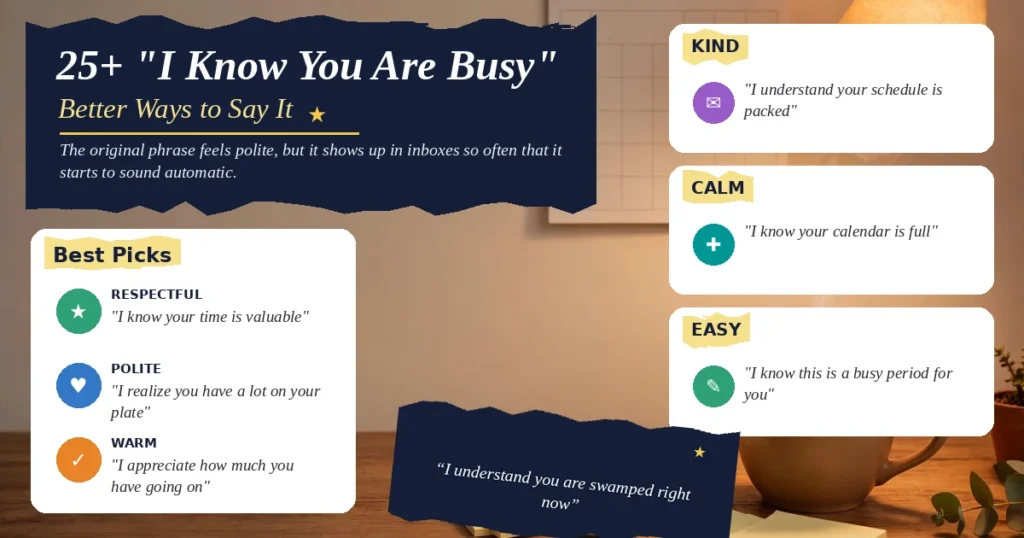
I realize you have a lot on your plate — warm and professional; ideal for client emails. I realize you have a lot on your plate, so I have kept this proposal to two pages.
I understand your schedule is packed — respectful and direct; great for meeting requests. I understand your schedule is packed, so I will keep our call to fifteen minutes.
I know your time is valuable — confident and courteous; works in sales and networking emails. I know your time is valuable, so here are the three key points upfront.
I understand you are swamped right now — honest and human; good for colleagues you know well. I understand you are swamped right now, but I need your quick input on this draft.
I know this is a busy period for you — empathetic and neutral; fits seasonal rushes like quarter-end. I know this is a busy period for you, so feel free to reply next week.
I appreciate how much you have going on — appreciative and warm; strong opening for thank-you emails. I appreciate how much you have going on, and I am grateful you reviewed this so fast.
I realize you are juggling a lot — friendly yet professional; good for ongoing projects. I realize you are juggling a lot, so I flagged only the items that need your eyes.
I know your calendar is full — specific and practical; natural before asking for a meeting slot. I know your calendar is full, so I sent three times you can pick from.
Formal alternatives
Use these with senior leaders, officials, or in formal business writing where every word carries weight.
I recognize this is a demanding time for you — formal and dignified; suits executive communication. I recognize this is a demanding time for you, and I appreciate your consideration of this request.
I am mindful of your pressing commitments — polished and respectful; excellent for first contact with senior people. I am mindful of your pressing commitments, so I will be brief.
I understand your time is in high demand — flattering without sounding fake; works in partnership proposals. I understand your time is in high demand, which is why I have prepared a one-page summary.
I respect how stretched you are right now — honest and formal; good for internal leadership emails. I respect how stretched you are right now, so I have highlighted the decision needed.
I am aware of your considerable workload — serious and precise; fits legal, academic, or government contexts. I am aware of your considerable workload and have kept this memo short.
I know you have many competing priorities — businesslike and mature; ideal for cross-team requests. I know you have many competing priorities, so I have ranked these by urgency.
I understand you have a full agenda — neutral and formal; natural before board or committee asks. I understand you have a full agenda, so I will limit my remarks to two minutes.
I do not want to take up too much of your time — courteous and direct; strong closer before a question. I do not want to take up too much of your time, but I do need your sign-off on one line.
Friendly alternatives
These work with colleagues, clients you know well, and anyone who appreciates a human tone.
I know things are hectic on your end — warm and conversational; great for check-in emails. I know things are hectic on your end, so no worries if this waits until Monday.
I know life is crazy busy for you right now — empathetic and personal; suits longer working relationships. I know life is crazy busy for you right now, so I am sending the short version first.
I can imagine how busy things are for you — gentle and thoughtful; softens a follow-up nudge. I can imagine how busy things are for you, so I am circling back on last week’s note.
I know you have got a ton going on — casual and caring; natural in team chats and messages. I know you have got a ton going on, but could you glance at this slide when you get a sec?
I see you are running on all cylinders — upbeat and encouraging; adds energy instead of gloom. I see you are running on all cylinders, so I will make this quick.
I know you are up to your ears in work — vivid and friendly; best with people who enjoy plain speech. I know you are up to your ears in work, so I grouped my questions into one list.
I get that your week is slammed — modern and relaxed; fits startups and creative teams. I get that your week is slammed, so just reply with a yes or no for now.
I know you barely have a minute to breathe — expressive and empathetic; good when someone is clearly overwhelmed. I know you barely have a minute to breathe, so I handled the small stuff myself.
Short and casual alternatives
Perfect for quick messages, chat apps, and texts where long phrases feel out of place.
I will keep this brief — clean and confident; the safest short option. I will keep this brief: we need your approval by Thursday.
Quick one for you — light and direct; great subject line or chat opener. Quick one for you: can you confirm the meeting room?
I will not keep you long — reassuring and polite; natural in calls and voice notes. I will not keep you long; I just need your view on the headline.
Just a quick note — simple and low-pressure; good email opener. Just a quick note to say the files are ready for your review.
I know you are slammed — casual and honest; best with close coworkers. I know you are slammed, so one-line answer is fine.
I know, crazy week — very informal; only for people you know well. I know, crazy week. Can you still sign the form today?
In and out, I promise — playful and reassuring; works in person or on calls. In and out, I promise. Two questions and I am gone.
Busy day? — extremely casual; use as a chat opener with friends at work. Busy day? Want me to send the notes so you can skip the meeting?
Email-ready softeners
These pair well with a request. They acknowledge the workload and give the reader room to reply later.
I will keep this short given your schedule — considerate and efficient; strong email opener. I will keep this short given your schedule: three questions below, one-line answers are fine.
No rush on this — calm and pressure-free; perfect for low-priority items. No rush on this; next week is completely fine.
Whenever you get a moment — patient and polite; classic for non-urgent follow-ups. Whenever you get a moment, could you share the final numbers?
At your earliest convenience — formal and standard; suits official requests. Please review the contract at your earliest convenience.
I will not take much of your time — direct and respectful; good before a clear ask. I will not take much of your time; I just need your answer on the budget line.
Just flagging this for when you have a moment — gentle and useful; ideal for FYI emails. Just flagging this for when you have a moment: the new policy is attached.
I know this lands at a busy time — honest and disarming; works for unexpected requests. I know this lands at a busy time, but this one cannot wait until Friday.
Feel free to reply when things calm down — generous and low-pressure; great for favors. Feel free to reply when things calm down; nothing here is urgent.
Quick comparison
Use this table to pick the right alternative in seconds. It shows only the top picks from each tone group.
| Alternative | Tone | Best use |
|---|---|---|
| I realize you have a lot on your plate | Professional | Client and vendor emails |
| I know your time is valuable | Professional | Sales and networking outreach |
| I am mindful of your pressing commitments | Formal | First contact with executives |
| I know you have many competing priorities | Formal | Cross-team project requests |
| I know things are hectic on your end | Friendly | Check-ins with known colleagues |
| I know you are up to your ears in work | Friendly | Casual chats with close coworkers |
| I will keep this brief | Casual | Quick messages and meeting openers |
| Quick one for you | Casual | Chat apps and short texts |
| No rush on this | Email-ready | Low-priority follow-ups |
| At your earliest convenience | Email-ready | Official or formal requests |
Email examples
For a client
Subject: Two quick questions on the proposal
Hi Sarah,
I realize you have a lot on your plate, so I will keep this short. Could you confirm the launch date and approve the revised budget? One-line answers work fine.
Thank you for your time.
Best,
James
For a manager
Subject: Approval needed by Thursday
Hi Mark,
I understand your schedule is packed, so here is the short version: the vendor needs your sign-off on page 4 of the attached contract. Everything else is already approved.
Thanks,
Priya
For a colleague
Subject: Can you glance at this?
Hi Tom,
I know things are hectic on your end, so no pressure. When you get five minutes, could you check the second paragraph of the draft? I want to make sure the numbers are right.
Cheers,
Anna
For a follow-up
Subject: Circling back on last week’s note
Hi David,
I can imagine how busy things are for you, so I am keeping this to one line: are you still able to join the review call on Friday? I am looking forward to your call and will send the agenda in advance.
Best,
Nina
For cold outreach
Subject: Fifteen minutes next week?
Hi Ms. Carter,
I am mindful of your pressing commitments, so I will be brief. We help marketing teams cut reporting time in half. Would you be open to a fifteen-minute call next Tuesday to see if it fits your team?
Kind regards,
Omar
Common mistakes
1. Repeating the phrase in one email
Saying “I know you are busy” twice or more sounds nervous and fills space. Say it once at the start, then move on to your point.
2. Using it as a guilt trip
Adding it after someone ignored you, like “I know you are busy, but this is the third email,” feels passive-aggressive. Send a clean follow-up instead.
3. Saying it and then writing a long email
A long, rambling message after “I will keep this brief” breaks trust. If you promise brevity, deliver brevity.
4. Using it as your whole opening line
“I know you are busy” alone gives the reader nothing. Pair it with the reason for your message so they can respond fast.
5. Apologizing too many times
Stacking it with “sorry to bother you” and “sorry for the trouble” makes you sound unsure. One polite line is enough.
6. Using casual versions with senior people
“Busy day?” or “I know, crazy week” can sound careless to executives you barely know. Match your tone to the relationship.
7. Forgetting to say what you actually need
Some people acknowledge the workload and never state the request. Always include one clear ask, like thank you for the clarification pairs naturally with a specific question.
8. Using it when you are actually the slow one
If you missed your own deadline, opening with “I know you are busy” shifts the focus unfairly. Own the delay first, then make your request.
Related phrases
These expressions live in the same family as “I know you are busy.” They help you show respect for someone’s time in different ways.
I will keep this brief — a promise to stay short. I will keep this brief: the meeting moved to 3 p.m.
No rush — tells the reader there is no deadline pressure. No rush; send it over whenever it is ready.
Whenever you get a chance — a patient, open-ended ask. Whenever you get a chance, could you look at the invoice?
I value your time — a direct statement of respect. I value your time, so I have attached a one-page summary.
Your plate is full — a vivid way to describe a heavy workload. I know your plate is full, so I asked Lisa to cover the call.
Time is tight — a short way to name a busy period. Time is tight this week, so let us handle this by email.
I respect your time — a firm, polite promise. I respect your time, so I will not ask for a second meeting.
Take your time — removes all pressure from a reply. Take your time with the review; the deadline moved to Friday.
No pressure at all — a warm way to make a request optional. No pressure at all, but we would love your feedback.
I do not want to be a bother — a humble softener before a favor. I do not want to be a bother, but could you introduce us?
Please do not feel rushed — an explicit permission to reply late. Please do not feel rushed; this can wait until next month.
I will work around your schedule — a flexible, cooperative offer. I will work around your schedule, so pick any time that suits you.
Spread thin — describes someone handling too many tasks. She is spread thin this quarter, so expect slow replies.
Swamped — a casual word for being extremely busy. He is swamped with the audit, so I kept my email to three lines.
Burning the candle at both ends — working too hard for too long. She has been burning the candle at both ends, so let us not add to her load.
Up to your ears — deeply involved in heavy work. He is up to his ears in the launch, so I asked someone else.
Keep in mind that even small phrases shape how people feel about your message. A single line like “at the end of the day, your time matters most” can fall flat if the rest of the email is long and vague, so pair at the end of the day style confidence with genuinely short, clear writing.
Phrase comparison
“I know you are busy” is the plainest version of this idea, and that is both its strength and its weakness. It is clear and honest, which is why millions of people use it every day. But because it appears in so many emails, it can sound flat or even doubtful, as if the writer is not sure their message deserves attention.
“I realize you have a lot on your plate” raises the tone a notch. It paints a picture of the reader’s workload instead of just naming it. This version feels more observant and more caring. Use it when you want to stand out in a client’s inbox and show real attention rather than a copied opener.
“I am mindful of your pressing commitments” moves fully into formal territory. It suits executives, officials, and first-time contacts where respect matters most. The trade-off is distance. It can sound stiff with a friendly colleague, so save it for relationships that are still new or clearly hierarchical.
“I will keep this brief” takes a different path entirely. Instead of describing their workload, it promises something about yours. Readers often prefer it because it respects their time through action, not just words. It is the best choice when the real goal is speed: short requests, quick questions, and meeting openers.
“I appreciate it” style closers, like saying thanks in advance, work best at the end of a message rather than the start. They reward the reader for their effort instead of apologizing for taking it. I appreciate it and similar phrases pair well with a busy opener, giving your email a respectful start and a grateful finish.
The rule is simple. When the relationship is new or formal, describe their workload with care. When the relationship is warm, promise brevity and keep your message short. When in doubt, combine one honest opener with one clear request, and your email will land well.
Cultural usage
US English
Americans use these phrases freely and often in business email. Direct lines like “I will keep this brief” and “Quick one for you” are normal and even expected. The tone tends to be upbeat and action-focused. Over-apologizing can read as weakness in US corporate culture, so one polite line followed by a clear ask works best.
UK English
British professionals often prefer slightly softer wording with a touch of understatement. “I know this lands at a busy time” and “Whenever you get a moment” feel natural in UK inboxes. Humor is welcome between colleagues, but stay formal with people you do not know well. A brief “sorry” is common in Britain and does not carry the same weight as in the US.
Corporate communication
Large companies expect polished, consistent language. Formal versions like “I am mindful of your pressing commitments” fit official memos and executive emails. Avoid slang like “slammed” in company-wide messages. Keep the opener to one sentence, state the request, and close with a clear next step. In big organizations, clarity beats charm.
Customer service
Support teams use these phrases to calm frustrated customers. “I understand you are swamped right now” rarely fits here; instead, agents say things like “I know your time is valuable” before asking for details. Pairing these lines with please be patient style reassurance keeps the tone kind. Never use the phrase to excuse slow service. Own the delay, then offer the next step.
Frequently asked questions
Is it rude to say “I know you are busy”?
No, it is not rude on its own. It becomes rude only when it sounds like a guilt trip, such as after someone ignored your message. It also weakens when you repeat it or stack it with too many apologies. Say it once, sincerely, and follow it with a short, clear request.
What is a more professional way to say “I know you are busy”?
“I realize you have a lot on your plate” is a strong professional upgrade. It sounds observant and warm without being casual. For formal settings, use “I am mindful of your pressing commitments.” Both say the same thing with more polish.
How do I start an email when someone is busy?
Open with one polite line about their schedule, then state your reason right away. For example: “I understand your schedule is packed, so here is the short version.” Follow with the key facts or questions in as few lines as possible. Close with a clear next step so they can reply fast.
Should I apologize for bothering someone at work?
A light acknowledgment is fine, but heavy apologizing hurts you. Saying “sorry to bother you” three times makes you sound unsure of your own request. One polite line like “I know your time is valuable” shows respect without lowering your standing. If your request is reasonable, you have nothing to apologize for.
What is the difference between “I know you are busy” and “I appreciate your time”?
The first looks at their workload; the second thanks them for sharing it. “I know you are busy” opens a message and sets a respectful tone. “I appreciate your time” usually closes a message as a thank-you. Many strong emails use one at the start and the other at the end.
Can I say “I know you are busy” to my boss?
Yes, but choose a slightly more formal version. “I understand you have a full agenda” or “I know you have many competing priorities” show respect for their level. Keep your message short after the opener. Bosses notice when you say they are busy and then send five long paragraphs.
What should I say instead of “sorry to bother you”?
Try “I will keep this brief” or “Quick one for you.” These lines respect the reader’s time without apologizing for your existence. They also sound more confident, which makes people more likely to help you. Save apologies for real mistakes, not for normal requests.
How do I follow up without sounding pushy?
Acknowledge their workload first, then restate your one question. A line like “I can imagine how busy things are for you, so I am circling back on last week’s note” is gentle and effective. Add a soft deadline only if there is a real one. Never guilt-trip someone for a slow reply.
Is “I will keep this brief” better than “I know you are busy”?
Often, yes. “I will keep this brief” makes a promise about your own behavior, which readers trust more than a comment about theirs. It also forces you to actually be brief. Use “I know you are busy” when you want to show empathy, and “I will keep this brief” when you want to show efficiency.
What tone should I use in a cold email to a busy person?
Stay professional, warm, and short. Open with “I am mindful of your pressing commitments” or “I realize you have a lot on your plate.” State your value in two or three sentences. End with one easy next step, like a fifteen-minute call. Never open a cold email with casual slang.
How do British people say “I know you are busy”?
British professionals often use softer lines like “I know this lands at a busy time” or “Whenever you get a moment.” A brief “sorry” at the start is common and sounds natural in the UK. Keep the tone understated and polite, and avoid overly direct American-style openers with people you do not know.
Can I use these phrases in text messages?
Yes, but shorten them. “Quick one for you” and “I will not keep you long” work well in texts and chat apps. Longer formal versions feel strange in a text thread. Match your wording to the channel: short and casual for messages, polished for email.
What is a polite way to ask for a quick reply?
Be honest about the timeline and keep pressure low. Try “Could you reply by Thursday? One line is fine.” If there is no real deadline, say “No rush on this” and mean it. Fake urgency destroys trust fast, so only name a deadline when one truly exists.
How do I acknowledge someone’s workload in a meeting?
Say it once at the start and keep it genuine. “I know everyone is juggling a lot, so I will keep this to ten minutes” sets the right tone. Then actually keep it short. In meetings, respecting time through action matters more than any single phrase.
Are there times I should skip the phrase entirely?
Yes. Skip it when the other person expects your message, such as a scheduled report or a routine update. Skip it in very short messages where it would double the length. And skip it when you have already said it in the same thread. Unnecessary softeners slow down normal, healthy communication.
Conclusion
Best picks by tone: for professional emails, use “I realize you have a lot on your plate” and “I know this is a busy period for you.” For formal writing, use “I am mindful of your pressing commitments” and “I respect how stretched you are right now.” For friendly messages, use “I know things are hectic on your end” and “I will keep this brief.” For email-ready softeners, use “I will keep this short given your schedule” and “No rush on this.” For casual chats, use “I will not keep you long” and “Quick one for you.”
One small phrase, used well, can change how busy people respond to you. Choose the version that fits your reader, say it once, and then get straight to your point. Respect their time in words and in action, and your emails will stand out for the right reasons. And if you ever want the exact definition, Cambridge Dictionary defines “busy” as having a lot to do — a simple reminder of why this little phrase carries so much weight.