“Sorry for the inconvenience.”
What Does “Sorry for the Inconvenience” Mean?
Literal Meaning
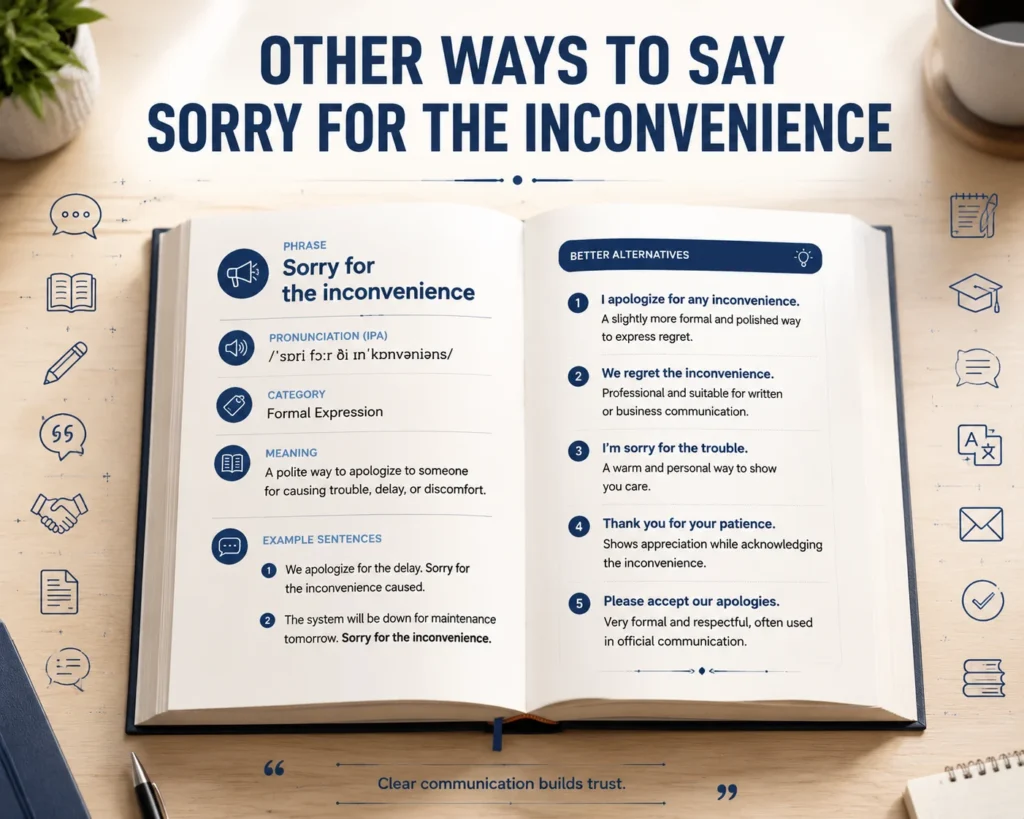
“Sorry for the inconvenience” is an apology for causing someone difficulty, disruption, trouble, delay, or extra effort.
For example:
“Sorry for the inconvenience. Our website will be unavailable for two hours.”
The speaker acknowledges that the situation may cause problems for the other person.
Another example:
“We’re sorry for the inconvenience caused by the delayed delivery.”
Here, the company recognizes that the delay affected the customer.
What Tone Does “Sorry for the Inconvenience” Have?
The phrase normally has a polite and professional tone.
However, its impact depends on the situation.
It can sound:
- Courteous
- Neutral
- Professional
- Formal
- Routine
- Sincere
- Generic
The main weakness is that “Sorry for the inconvenience” can sound automatic when you use it repeatedly.
Compare:
“Sorry for the inconvenience.”
with:
“We understand that the delay has affected your plans, and we apologize for the disruption.”
The second version sounds more specific because it recognizes the actual effect of the problem.
What Is the Purpose of This Phrase?
People usually use “sorry for the inconvenience” to do one or more of the following:
- Acknowledge a problem.
- Show consideration for another person’s time.
- Accept some responsibility.
- Maintain a professional relationship.
- Reduce frustration.
- Close an apology politely.
- Show that the situation matters.
However, a strong professional apology often does more than apologize.
A useful structure is:
Acknowledge → Apologize → Explain briefly → Give a solution → Thank the person
For example:
“We apologize for the delay. An unexpected system issue affected processing this morning. Our team has resolved the problem, and your order is now being prepared. Thank you for your patience.”
That sounds more useful than simply saying:
“Sorry for the inconvenience.”
When Should You Use an Alternative?
In Emails
Use alternatives when you want your email to sound more personal or specific.
Instead of:
“Sorry for the inconvenience.”
Try:
“I apologize for the delay and appreciate your patience.”
This works especially well in business emails because it combines an apology with appreciation.
In the Workplace
If a problem affects colleagues, avoid sounding overly formal for a small issue.
Instead of:
“Please accept my sincerest apologies for the inconvenience caused.”
try:
“Thanks for your patience while I sort this out.”
The second sentence sounds natural between coworkers.
With Clients
Clients usually expect both accountability and reassurance.
Instead of:
“Sorry for the inconvenience.”
try:
“I apologize for the delay and appreciate your understanding. I’m working to resolve this as quickly as possible.”
In Customer Service
Customer service apologies should recognize the customer’s experience and move toward a solution.
Instead of:
“Sorry for the inconvenience.”
try:
“We apologize for the delay and appreciate your patience. Your order is now being processed.”
In Networking
Networking usually requires a lighter tone.
If you missed a meeting or replied late, try:
“Thanks for your patience, and I apologize for the delayed response.”
This sounds professional without being excessively formal.
Alternatives to “Sorry for the Inconvenience”
The following alternatives are organized by use case. Some can fit more than one category, but each has a slightly different purpose.
Professional Alternatives
1. I Apologize for the Inconvenience
Meaning: A direct and professional apology.
Tone: Professional and neutral.
Best Use Case: Business emails, clients, workplace communication.
Example:
“I apologize for the inconvenience caused by the schedule change.”
Why use it?
This is probably the closest professional alternative to the original phrase. It sounds slightly more polished and direct.
2. I Apologize for the Disruption
Meaning: You are apologizing because something interrupted normal plans or operations.
Tone: Professional and specific.
Best Use Case: Workplace announcements, service interruptions, project changes.
Example:
“I apologize for the disruption to your schedule.”
This works better than “inconvenience” when an event actually interrupted someone’s work or plans.
3. I’m Sorry for the Delay
Meaning: You apologize specifically for something taking longer than expected.
Tone: Professional and straightforward.
Best Use Case: Emails, deliveries, projects, customer service.
Example:
“I’m sorry for the delay in getting back to you.”
This is more specific than the general phrase.
4. I Apologize for the Delay
Meaning: A formal apology for delayed action or communication.
Tone: Professional and formal.
Best Use Case: Client emails and business communication.
Example:
“I apologize for the delay in responding to your request.”
5. Thank You for Your Patience
Meaning: You recognize that the other person waited and show appreciation.
Tone: Positive and professional.
Best Use Case: Customer service, delays, technical problems, workplace communication.
Example:
“Thank you for your patience while we work to resolve the issue.”
Why it works
Sometimes appreciation sounds better than another apology. It shifts the focus from the problem to the customer’s or colleague’s cooperation.
6. Thank You for Your Understanding
Meaning: You appreciate the other person’s willingness to accept the situation.
Tone: Polite and professional.
Best Use Case: Policy changes, delays, service interruptions.
Example:
“Thank you for your understanding while we complete the necessary updates.”
7. We Appreciate Your Patience
Meaning: The company recognizes that customers or employees are waiting.
Tone: Professional and warm.
Best Use Case: Customer service and corporate communication.
Example:
“We appreciate your patience while our team resolves the issue.”
8. We Regret the Disruption
Meaning: A formal expression of regret about a problem.
Tone: Formal and corporate.
Best Use Case: Service announcements, business notices.
Example:
“We regret the disruption caused by the scheduled maintenance.”
9. We’re Sorry for the Delay and Any Trouble It Has Caused
Meaning: You acknowledge both the delay and its effect.
Tone: Warm and professional.
Best Use Case: Client and customer communication.
Example:
“We’re sorry for the delay and any trouble it has caused.”
10. I’m Sorry This Caused a Problem
Meaning: You recognize that the situation created difficulty.
Tone: Personal and sincere.
Best Use Case: Workplace or client communication.
Example:
“I’m sorry this caused a problem for your team.”
11. I Apologize for Any Disruption This May Have Caused
Meaning: A formal apology for possible effects.
Tone: Professional.
Best Use Case: Business emails and announcements.
Example:
“I apologize for any disruption this may have caused to your schedule.”
12. Thank You for Bearing With Us
Meaning: You thank people for remaining patient during a difficult or delayed process.
Tone: Friendly-professional.
Best Use Case: Customer service and workplace communication.
Example:
“Thank you for bearing with us while we complete the system upgrade.”
13. We Appreciate Your Understanding During This Process
Meaning: You acknowledge that the situation may require patience.
Tone: Professional and positive.
Best Use Case: Ongoing projects, changes, and service issues.
Example:
“We appreciate your understanding during this transition.”
14. I Understand This May Have Caused Some Difficulty
Meaning: You recognize the impact of the problem.
Tone: Empathetic and professional.
Best Use Case: Client and workplace communication.
Example:
“I understand this may have caused some difficulty for your team.”
15. I’m Sorry for Any Disruption to Your Plans
Meaning: You apologize for affecting someone’s schedule or plans.
Tone: Warm and considerate.
Best Use Case: Meetings, events, travel, appointments.
Example:
“I’m sorry for any disruption to your plans caused by the schedule change.”
Formal Alternatives
Formal wording works best for official notices, senior stakeholders, important clients, corporate communication, and serious service issues.
16. Please Accept My Apologies for the Inconvenience
Meaning: A formal request for the recipient to accept your apology.
Tone: Formal and respectful.
Best Use Case: Formal letters and business correspondence.
Example:
“Please accept my apologies for the inconvenience caused by the change in schedule.”
17. Please Accept Our Sincere Apologies
Meaning: The organization expresses a serious apology.
Tone: Very formal and sincere.
Best Use Case: Customer complaints, service failures, corporate notices.
Example:
“Please accept our sincere apologies for the disruption to your service.”
18. We Sincerely Apologize for the Disruption
Meaning: A strong formal apology.
Tone: Formal and serious.
Best Use Case: Major service interruptions or business problems.
Example:
“We sincerely apologize for the disruption and are working to restore normal service.”
19. We Regret Any Difficulty This May Have Caused
Meaning: The organization expresses regret about the impact.
Tone: Formal.
Best Use Case: Official communication.
Example:
“We regret any difficulty this may have caused and appreciate your patience.”
20. We Regret the Impact This Has Had on Your Plans
Meaning: You recognize the consequences of an issue.
Tone: Formal and empathetic.
Best Use Case: Events, travel, client communication, corporate notices.
Example:
“We regret the impact this change has had on your plans.”
21. We Apologize for Any Disruption to Your Operations
Meaning: You apologize for affecting someone’s business activities.
Tone: Formal and corporate.
Best Use Case: B2B communication.
Example:
“We apologize for any disruption to your operations during the maintenance period.”
22. We Acknowledge the Inconvenience Caused
Meaning: You formally recognize that the situation created difficulty.
Tone: Formal.
Best Use Case: Official responses and corporate communication.
Example:
“We acknowledge the inconvenience caused and are taking steps to prevent a recurrence.”
23. We Regret That This Situation Has Caused Difficulty
Meaning: You express regret about the consequences of the situation.
Tone: Formal and measured.
Best Use Case: Formal complaints and customer communication.
Example:
“We regret that this situation has caused difficulty and appreciate your understanding.”
24. Please Accept Our Apologies for the Disruption
Meaning: A formal corporate apology.
Tone: Formal.
Best Use Case: Official notices and customer communication.
Example:
“Please accept our apologies for the disruption to your service.”
25. We Apologize for the Service Interruption
Meaning: A direct apology for interrupted service.
Tone: Formal and specific.
Best Use Case: Technology, utilities, customer service, websites, and operations.
Example:
“We apologize for the service interruption and expect normal operations to resume shortly.”
Friendly Alternatives
Friendly alternatives work better when you want to sound human rather than corporate.
26. Thanks for Your Patience
Meaning: You appreciate the person’s patience.
Tone: Friendly and professional.
Best Use Case: Colleagues, clients, customers.
Example:
“Thanks for your patience while I sorted this out.”
27. Thanks for Bearing With Me
Meaning: You thank someone for tolerating a delay or problem.
Tone: Friendly.
Best Use Case: Coworkers, acquaintances, informal business communication.
Example:
“Thanks for bearing with me while I worked through the issue.”
28. I’m Sorry About the Delay
Meaning: A simple, natural apology.
Tone: Friendly and direct.
Best Use Case: Colleagues, networking contacts, everyday professional communication.
Example:
“I’m sorry about the delay. I’ve attached the updated file.”
29. Thanks for Understanding
Meaning: You appreciate the person’s acceptance of the situation.
Tone: Friendly and polite.
Best Use Case: Short emails and workplace messages.
Example:
“I need another day to finish this. Thanks for understanding.”
30. I Appreciate Your Patience
Meaning: You recognize someone’s patience.
Tone: Warm and professional.
Best Use Case: Clients, colleagues, customers.
Example:
“I appreciate your patience while we work through this.”
31. Sorry About the Mix-Up
Meaning: You apologize for a mistake or misunderstanding.
Tone: Casual and friendly.
Best Use Case: Colleagues, informal client conversations.
Example:
“Sorry about the mix-up. I’ve sent the correct document now.”
32. Sorry About the Confusion
Meaning: You apologize because unclear information caused misunderstanding.
Tone: Friendly and natural.
Best Use Case: Emails, meetings, workplace communication.
Example:
“Sorry about the confusion. Here’s the correct timeline.”
33. Thanks for Your Flexibility
Meaning: You appreciate someone adapting to a change.
Tone: Positive and professional.
Best Use Case: Schedule changes and workplace situations.
Example:
“Thanks for your flexibility with the revised meeting time.”
34. Thanks for Working With Us on This
Meaning: You recognize someone’s cooperation.
Tone: Warm and collaborative.
Best Use Case: Clients, customers, colleagues.
Example:
“Thanks for working with us while we resolve this issue.”
35. I Appreciate You Working With Me on This
Meaning: You value the person’s cooperation.
Tone: Friendly and professional.
Best Use Case: One-to-one workplace or client communication.
Example:
“I appreciate you working with me on this while we get everything sorted.”
Email Alternatives
These phrases work especially well in business emails.
36. Thank You for Your Patience While We Resolve This
Tone: Professional and positive.
Best Use: Customer or client emails.
Example:
“Thank you for your patience while we resolve this issue.”
37. I Apologize for the Delay in Responding
Tone: Professional.
Best Use: Late email responses.
Example:
“I apologize for the delay in responding to your message.”
38. Thank You for Bringing This to Our Attention
Tone: Professional and constructive.
Best Use: Complaints and reported problems.
Example:
“Thank you for bringing this issue to our attention. We’re reviewing it now.”
39. I’m Sorry for the Disruption to Your Schedule
Tone: Polite and specific.
Best Use: Meetings and appointments.
Example:
“I’m sorry for the disruption to your schedule. Could we move our meeting to Thursday?”
40. I Appreciate Your Understanding
Tone: Professional and concise.
Best Use: Policies, delays, changes.
Example:
“We appreciate your understanding as we complete the necessary maintenance.”
41. Thank You for Your Cooperation
Tone: Professional.
Best Use: Requests, changes, and procedures.
Example:
“Thank you for your cooperation while we complete the update.”
42. We Appreciate Your Continued Patience
Tone: Professional and empathetic.
Best Use: Long-running issues.
Example:
“We appreciate your continued patience as our team works toward a permanent solution.”
43. We’re Working to Resolve This as Quickly as Possible
Tone: Reassuring.
Best Use: Customer service and urgent problems.
Example:
“We’re working to resolve this as quickly as possible and will provide an update by Friday.”
44. We Understand the Impact This May Have Caused
Tone: Empathetic and professional.
Best Use: Client complaints and service problems.
Example:
“We understand the impact this delay may have caused and are taking steps to address it.”
45. Thank You for Your Understanding and Patience
Tone: Warm and professional.
Best Use: Customer service, corporate emails, announcements.
Example:
“Thank you for your understanding and patience during this temporary interruption.”
Workplace Alternatives
46. Thanks for Your Patience While I Sort This Out
Meaning: You appreciate patience while resolving an issue.
Tone: Friendly-professional.
Best Use: Colleagues.
Example:
“Thanks for your patience while I sort this out.”
47. I Appreciate Your Flexibility
Meaning: You appreciate someone’s willingness to adapt.
Tone: Professional and positive.
Best Use: Schedule or process changes.
Example:
“I appreciate your flexibility with the revised deadline.”
48. Thanks for Working Around the Issue
Meaning: You recognize that someone had to adapt because of a problem.
Tone: Friendly and collaborative.
Best Use: Teams and colleagues.
Example:
“Thanks for working around the issue while we fixed the system.”
49. I’m Sorry for the Disruption to the Team
Meaning: You acknowledge an effect on coworkers.
Tone: Professional and accountable.
Best Use: Workplace communication.
Example:
“I’m sorry for the disruption to the team. I’ve put a new process in place to prevent this happening again.”
50. Thanks for Your Understanding While We Work Through This
Meaning: You recognize the team’s patience during a problem.
Tone: Collaborative.
Best Use: Teams and internal communication.
Example:
“Thanks for your understanding while we work through this.”
Quick Comparison Table
| Alternative | Tone | Best Use |
| I apologize for the inconvenience. | Professional | General business |
| I apologize for the disruption. | Professional | Service/work disruption |
| I’m sorry for the delay. | Neutral | Late responses |
| Thank you for your patience. | Positive | Delays |
| Thank you for your understanding. | Professional | Changes |
| We appreciate your patience. | Warm | Customers |
| I’m sorry this caused a problem. | Sincere | Personal/client issues |
| Please accept my apologies. | Formal | Official communication |
| We sincerely apologize. | Very formal | Serious problems |
| We regret the disruption. | Formal | Corporate notices |
| Thanks for bearing with us. | Friendly | Informal professional |
| Sorry about the mix-up. | Casual | Mistakes |
| Sorry about the confusion. | Friendly | Miscommunication |
| Thanks for your flexibility. | Positive | Schedule changes |
| I apologize for the delay in responding. | Professional | |
| Thank you for bringing this to our attention. | Constructive | Complaints |
| I appreciate your understanding. | Professional | Business emails |
| Thank you for your cooperation. | Formal | Procedures |
| We’re working to resolve this quickly. | Reassuring | Customer service |
| We understand the impact this may have caused. | Empathetic | Client complaints |
| I appreciate your flexibility. | Professional | Workplace |
| Thanks for working around the issue. | Friendly | Colleagues |
| I’m sorry for the disruption to the team. | Accountable | Workplace |
| Thanks for your understanding while we work through this. | Collaborative | Teams |
How to Use These Alternatives in Real Emails
A good apology should match the situation. Here are the six most common professional situations.
Client
“I apologize for the delay in completing your request. We have now resolved the issue and expect to provide the final documents by Friday. Thank you for your patience.”
Manager
“I apologize for the delay in sending the report. I’ve completed the final review and will send it by 3 p.m. today.”
Colleague
“Sorry about the mix-up. I’ve corrected the file and uploaded the latest version.”
Customer
“We apologize for the delay with your order. Your shipment has now been processed. Thank you for your patience.”
Networking Contact
“I apologize for the delayed response, and I appreciate your patience. I’d be glad to continue our conversation about the project.”
Meeting Follow-Up
“Thank you for your flexibility with today’s schedule change. I appreciate everyone’s patience while we worked through the issue.”
The Most Important Difference: Apology vs. Appreciation
One of the best ways to improve professional communication is to understand when to apologize and when to show appreciation.
Use an apology when:
- You made a mistake.
- You caused a delay.
- You missed a deadline.
- Your action caused disruption.
- Your company failed to meet expectations.
Example:
“I apologize for missing the deadline.”
Use appreciation when:
- The other person waited.
- They showed patience.
- They adapted to a change.
- They cooperated with your team.
Example:
“Thank you for your patience.”
Use both when appropriate:
“I apologize for the delay, and thank you for your patience while we resolve the issue.”
This often creates a stronger business message than repeating “sorry.”
Email Example: Client
Subject: Update on Your Request
Dear [Name],
I apologize for the delay in processing your request. We experienced an unexpected issue that affected our normal processing time.
The issue has now been resolved, and our team is completing the remaining steps.
Thank you for your patience and understanding.
Best regards,
[Name]
Why this works
It includes:
- A clear apology
- A short explanation
- A solution
- Appreciation
It does not make excuses.
Email Example: Manager
Hi [Name],
I apologize for the delay in sending the report. I needed to verify a few figures before submitting the final version.
I’ll send the completed report by 3 p.m. today.
Thank you for your patience.
This version accepts responsibility and gives a clear deadline.
Email Example: Colleague
Hi [Name],
Sorry about the mix-up with the schedule. I’ve updated the calendar and sent the corrected meeting invitation.
Thanks for your flexibility.
This sounds natural without becoming overly formal.
Email Example: Customer
Dear [Customer Name],
We apologize for the delay with your order. We understand that timely delivery is important, and we’re sorry that we did not meet the expected delivery date.
Your order has now been processed and is scheduled for shipment.
Thank you for your patience and understanding.
This is better than simply:
“Sorry for the inconvenience.”
because it recognizes the actual problem.
Email Example: Networking
Hi [Name],
I apologize for the delayed response. I appreciate your patience and would be happy to continue our conversation.
I’m available Thursday afternoon if you’d like to connect.
Best,
[Name]
This combines an apology with a practical next step.
Email Example: Meeting Follow-Up
Hi everyone,
Thank you for your flexibility with today’s schedule change. I apologize for the disruption and appreciate everyone’s patience.
We’ll continue with the original agenda at our next meeting.
Best,
[Name]
Common Mistakes
1. Using the Same Apology Every Time
If every email contains:
“Sorry for the inconvenience.”
the phrase can lose its impact.
Instead, match the wording to the actual problem:
Delay:
“I apologize for the delay.”
Confusion:
“I’m sorry for the confusion.”
Mistake:
“I apologize for the error.”
Schedule change:
“I’m sorry for the disruption to your schedule.”
Waiting:
“Thank you for your patience.”
Specific language sounds more sincere.
2. Apologizing Without Fixing Anything
An apology alone may not satisfy someone who needs a solution.
Weak:
“Sorry for the inconvenience.”
Better:
“I apologize for the delay. I’ve escalated your request and will update you by 4 p.m.”
The second response gives the person something useful.
3. Using “Any Inconvenience” Too Often
Some businesses write:
“We apologize for any inconvenience this may have caused.”
This is grammatically acceptable, but it can sound distant when the inconvenience is obvious.
For example, if a customer’s order arrived five days late, say:
“We apologize for the five-day delay with your order.”
Specific language usually sounds more accountable.
4. Over-Apologizing
Do not write:
“I’m extremely, terribly, deeply, sincerely sorry for this unfortunate inconvenience.”
That sounds unnatural.
A clear sentence is stronger:
“I apologize for the delay and understand the impact it caused.”
5. Using a Formal Phrase in a Casual Situation
A colleague may find this unnecessarily stiff:
“Please accept my sincerest apologies for the inconvenience caused.”
A more natural option:
“Sorry about the delay, and thanks for your patience.”
6. Using Casual Language With a Client
Avoid:
“Oops, sorry about that!”
with an important client.
Use:
“I apologize for the error and have attached the corrected document.”
Related Phrases
Here are useful expressions related to “sorry for the inconvenience.”
| Phrase | Meaning | Example |
| I apologize for the delay. | Sorry something took too long. | “I apologize for the delay in responding.” |
| I apologize for the error. | Accept responsibility for a mistake. | “I apologize for the error in the invoice.” |
| I’m sorry for the confusion. | Apologize for unclear information. | “I’m sorry for the confusion regarding the deadline.” |
| I regret the disruption. | Formal expression of regret. | “We regret the disruption to your service.” |
| Thank you for your patience. | Appreciate someone’s waiting. | “Thank you for your patience during the outage.” |
| Thank you for your understanding. | Appreciate acceptance of a situation. | “Thank you for your understanding.” |
| Thanks for your flexibility. | Appreciate adaptation to change. | “Thanks for your flexibility with the new time.” |
| Thanks for bearing with us. | Thank someone for tolerating difficulty. | “Thanks for bearing with us during the upgrade.” |
| We appreciate your cooperation. | Recognize helpful participation. | “We appreciate your cooperation during the transition.” |
| I understand your frustration. | Recognize someone’s feelings. | “I understand your frustration with the delay.” |
| We understand the impact. | Recognize consequences. | “We understand the impact this may have caused.” |
| I’ll make sure this is resolved. | Promise action. | “I’ll make sure this is resolved today.” |
| We’re working on it. | Confirm active action. | “Our team is working on it now.” |
| We’re looking into the issue. | Confirm investigation. | “We’re looking into the issue now.” |
| We’ll keep you updated. | Promise future communication. | “We’ll keep you updated on progress.” |
| Thank you for bringing this to our attention. | Appreciate a reported problem. | “Thank you for bringing this to our attention.” |
| We appreciate your patience during this process. | Recognize patience. | “We appreciate your patience during this process.” |
| We’re sorry this happened. | Direct personal apology. | “We’re sorry this happened.” |
Cultural Usage
US English
“Sorry for the inconvenience” is common in American business communication, especially in customer service.
However, modern business writing often favors more specific language.
Instead of:
“Sorry for the inconvenience.”
American business communication may use:
“We apologize for the delay and appreciate your patience.”
The second version explains what happened and recognizes the customer’s patience.
UK English
The phrase is also common in British English. British professional communication often uses polite, indirect wording.
For example:
“We’re sorry for any disruption this may have caused.”
or:
“Thank you for your patience while we resolve the issue.”
The appropriate choice depends more on the organization and situation than on nationality alone.
Corporate Communication
Companies should avoid apologies that sound like empty templates.
Compare:
“We apologize for any inconvenience caused.”
with:
“We apologize for the service interruption. Our team has restored access and is monitoring the system.”
The second version demonstrates action.
A useful corporate formula is:
Problem + impact + action + appreciation
Example:
“We apologize for the service interruption. We understand that this affected your operations. Our technical team has restored the service and is monitoring performance. Thank you for your patience.”
Customer Service
Customer service requires empathy and action.
A strong response often follows this structure:
Acknowledge → Apologize → Solve → Reassure
Example:
“I understand how frustrating this delay must be. I apologize for the inconvenience. I’ve escalated your order to our shipping team, and we expect an update within 24 hours. I’ll contact you as soon as I have more information.”
Networking
Networking messages should stay professional but human.
Instead of:
“Please accept my sincere apologies for the inconvenience caused by my delayed response.”
try:
“Sorry for the delayed response, and thanks for your patience.”
For a senior contact, you can make it slightly more formal:
“I apologize for the delayed response and appreciate your patience.”
Phrase Comparison
| Situation | Recommended Phrase | Why |
| General inconvenience | I apologize for the inconvenience. | Direct and professional |
| Delay | I apologize for the delay. | Specific |
| Mistake | I apologize for the error. | Accepts responsibility |
| Confusion | I’m sorry for the confusion. | Addresses the actual problem |
| Customer waiting | Thank you for your patience. | Positive and appreciative |
| Schedule change | I’m sorry for the disruption to your schedule. | Recognizes the impact |
| Serious service failure | We sincerely apologize for the disruption. | Appropriate for major problems |
| Formal letter | Please accept my apologies. | Formal |
| Coworker | Sorry about the mix-up. | Natural |
| Client | I apologize for the delay and appreciate your patience. | Professional and warm |
| Customer complaint | We understand the impact and apologize for the delay. | Empathetic |
| Workplace change | I appreciate your flexibility. | Positive |
| Long-running issue | We appreciate your continued patience. | Recognizes ongoing difficulty |
| Technical problem | We’re working to resolve this as quickly as possible. | Reassuring |
| Email response | I apologize for the delayed response. | Specific |
FREQUENTLY ASKED QUESTIONS
What is a professional way to say “sorry for the inconvenience”?
A strong professional option is:
“I apologize for the inconvenience and appreciate your patience.”
For greater impact, explain the actual problem and what you are doing to fix it.
What is a formal alternative to “sorry for the inconvenience”?
Use:
“Please accept my apologies for the inconvenience caused.”
For a company:
“Please accept our sincere apologies for the disruption.”
What is another way to say “sorry for the inconvenience” in an email?
Try:
“I apologize for the delay and appreciate your understanding.”
Or:
“Thank you for your patience while we resolve this issue.”
What is a better phrase than “sorry for the inconvenience”?
There is no single best replacement. Choose language that describes the actual problem.
For a delay:
“I apologize for the delay.”
For a mistake:
“I apologize for the error.”
For waiting:
“Thank you for your patience.”
For disruption:
“I apologize for the disruption.”
Is “sorry for the inconvenience” professional?
Yes. It is polite and widely accepted in professional communication.
However, it can sound generic if you use it repeatedly. A more specific apology often sounds more sincere.
How do you apologize professionally without saying sorry?
Use an appreciation phrase:
“Thank you for your patience while we resolve this.”
You can also acknowledge the problem:
“We understand the disruption this has caused and are taking steps to resolve it.”
What is a polite way to apologize for a delay?
Try:
“I apologize for the delay and appreciate your patience.”
This is suitable for clients, managers, colleagues, and business contacts.
What can I say instead of “sorry for the inconvenience” to a customer?
Try:
“We apologize for the delay and appreciate your patience while we work to resolve the issue.”
If the problem is already fixed:
“Thank you for your patience. The issue has now been resolved.”
How do I apologize to a client for an inconvenience?
Be specific.
“I apologize for the delay in processing your request. I understand this may have affected your schedule. We have now completed the review and will send the final documents today.”
What is a friendly alternative to “sorry for the inconvenience”?
Try:
“Sorry about the delay, and thanks for your patience.”
Or:
“Thanks for bearing with me while I sorted this out.”
What is a formal way to apologize for a mistake?
Use:
“Please accept my sincere apologies for the error.”
For a company:
“We sincerely apologize for the error and are taking steps to prevent it from happening again.”
Should I say “sorry” or “thank you” in a professional email?
Use “sorry” when you need to accept responsibility.
Use “thank you” when you want to recognize the person’s patience, flexibility, or cooperation.
Often, the strongest email uses both:
“I apologize for the delay, and thank you for your patience.”
How can I sound sincere instead of using a generic apology?
Mention the specific problem and your action.
Instead of:
“Sorry for the inconvenience.”
write:
“I apologize for the missed deadline. I’ve completed the remaining work and will send the final report by 2 p.m.”
Specificity makes the apology more credible.
Is “we regret the inconvenience” more formal?
Yes. “We regret” generally sounds more formal and corporate than “we’re sorry.”
Example:
“We regret the disruption caused by the scheduled maintenance.”
Use it for formal notices rather than casual messages.
What is the best alternative to “sorry for the inconvenience” at work?
For a colleague:
“Thanks for your patience while I sort this out.”
For a manager:
“I apologize for the delay and will have this completed by [time].”
For a team:
“I appreciate everyone’s flexibility while we work through this.”
Final Summary
Best Professional Options
- I apologize for the inconvenience.
- I apologize for the delay.
- I apologize for the disruption.
- I appreciate your patience.
- Thank you for your understanding.
Best Formal Options
- Please accept my apologies for the inconvenience.
- Please accept our sincere apologies.
- We sincerely apologize for the disruption.
- We regret the disruption caused.
- We apologize for any disruption to your operations.
Best Casual Options
- Sorry about the delay.
- Sorry about the mix-up.
- Sorry about the confusion.
- Thanks for bearing with me.
- Thanks for your patience.
Best Email Options
- I apologize for the delay and appreciate your patience.
- Thank you for your understanding while we resolve this.
- I apologize for the disruption to your schedule.
- Thank you for bringing this to our attention.
- We appreciate your continued patience.
Best Customer Service Options
- We apologize for the delay and appreciate your patience.
- We understand the impact this may have caused.
- Thank you for your patience while we resolve this.
- We’re working to resolve this as quickly as possible.
- We appreciate your understanding.
Conclusion
“Sorry for the inconvenience” remains a professional and useful phrase, but stronger communication often comes from being specific. Apologize for the actual problem, such as a delay, error, disruption, or confusion, and explain what you are doing to fix it. When someone has shown patience or flexibility, thank them instead of repeating an apology. For clients and customers, combine empathy with a clear solution. For coworkers, keep the tone natural. For formal communication, choose respectful language without sounding robotic. The best professional communication acknowledges the problem, respects the reader, and moves the conversation toward a solution.
Related: Other Ways to Say I’m Sorry and Other Ways to Say Sorry for Your Loss