
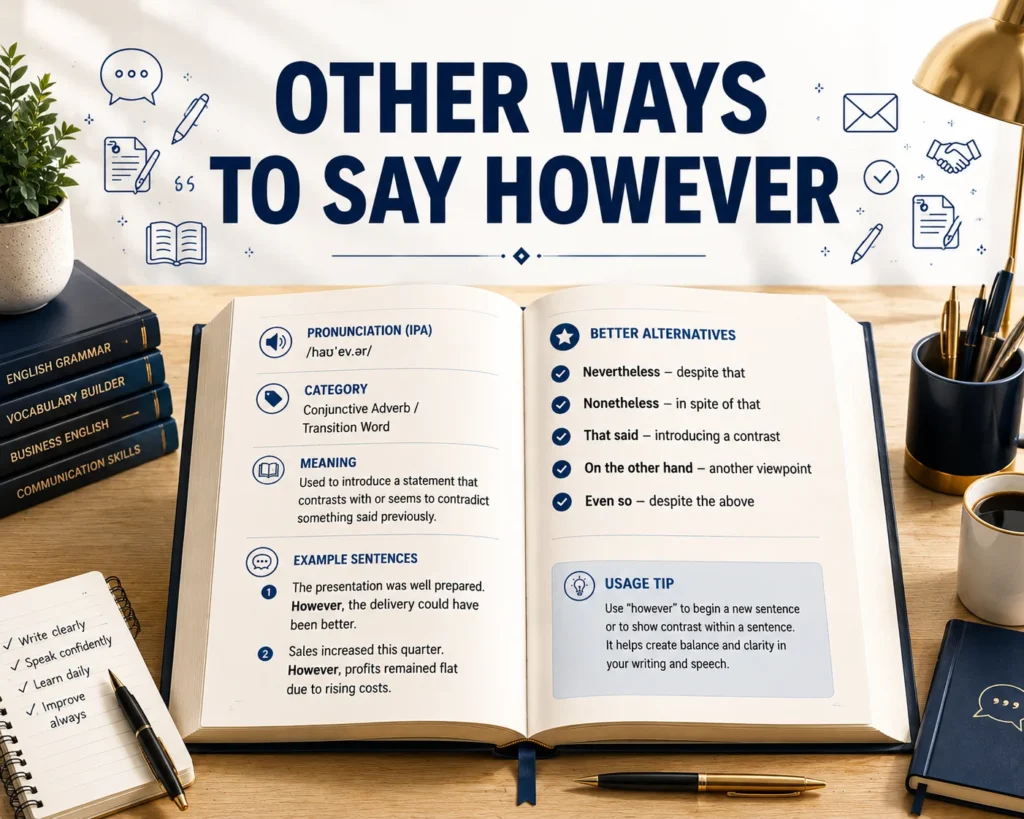
Knowing other ways to say however can make your writing more varied, natural, and professional. The word however is one of the most useful transition words in English because it introduces contrast, disagreement, a limitation, or an unexpected point.
For example:
“The proposal looks promising. However, it requires additional funding.”
The sentence is clear and professional, but repeating however throughout an email, report, or presentation can make your writing feel repetitive. That is why writers often look for alternatives that fit different situations.
Depending on your audience, you might use nevertheless, nonetheless, that said, on the other hand, in contrast, although, even so, or despite this.
The important point is that these expressions are not always interchangeable. Some work best at the start of a sentence, some connect two ideas, and others introduce a contrasting condition.
This guide explains the meaning, grammar, tone, and practical use of more than 50 alternatives to however, including professional business email phrases, formal writing, workplace communication, client messages, networking, and everyday English.
What Does “However” Mean?
Literal Meaning
However is commonly used as a conjunctive adverb or transition word to show contrast between two ideas.
For example:
“The product is affordable. However, it has limited features.”
The first sentence presents one fact. The second introduces information that contrasts with it.
However can also mean “to whatever degree” or “in whatever way” in certain structures:
“However carefully we plan, unexpected problems can occur.”
This article mainly focuses on the contrast meaning.
Tone of “However”
“However” usually sounds:
- Neutral
- Professional
- Clear
- Moderately formal
- Suitable for written communication
It works in academic writing, business emails, reports, presentations, and everyday conversation.
Purpose of “However”
You can use however to:
- Show contrast
- Introduce a limitation
- Present an opposing point
- Correct or qualify an earlier statement
- Shift the direction of an argument
- Add balance to an opinion
For example:
“The project is progressing well. However, we still need approval from the finance team.”
The word signals that the second point limits the positive statement.
Why Look for Alternatives to “However”?
There is nothing wrong with using however. In fact, it is often the best choice.
But repetition can weaken your writing:
“The product is affordable. However, it has limited features. However, the design is attractive. However, delivery takes longer.”
A better version varies the transitions:
“The product is affordable. However, it has limited features. That said, the design is attractive. On the other hand, delivery takes longer.”
Alternatives also let you control tone.
For example:
- Nevertheless → formal
- That said → conversational but professional
- On the other hand → balanced comparison
- Even so → acknowledges a previous point
- In contrast → direct comparison
- Despite this → concise and formal
- Although → useful for combining clauses
Professional Usage of “However”
1. Emails
However works well in professional emails when you need to introduce a limitation or contrasting point.
“Thank you for your proposal. However, we need additional information before making a decision.”
You can also use:
“That said, we remain interested in moving forward.”
2. Workplace Communication
In workplace discussions, contrast words help employees disagree without sounding confrontational.
Instead of:
“Your plan will not work.”
Try:
“The plan has several strengths. However, we may need to address the staffing issue first.”
This acknowledges the other person’s point before introducing a concern.
3. Clients
Client communication benefits from diplomatic transitions.
Instead of:
“We can meet the deadline. However, you need to provide the materials today.”
Try:
“We can meet the deadline. That said, we would need the remaining materials today.”
The second version sounds collaborative.
4. Networking
Networking conversations tend to use more natural transitions:
“The industry has changed significantly. That said, there are still many opportunities for new businesses.”
5. Customer Service
Customer-facing communication should remain clear and polite.
“We understand your concern. However, our current policy does not allow refunds after the stated period.”
A softer version might be:
“We understand your concern. Unfortunately, our current policy does not allow refunds after the stated period.”
Professional Alternatives
1. Nevertheless
Meaning: Despite what was just stated.
Tone: Formal and professional.
Best use: Reports, business writing, presentations.
Example:
“The initial results were disappointing. Nevertheless, the team decided to continue testing.”
2. Nonetheless
Meaning: Despite that or even so.
Tone: Formal and polished.
Best use: Reports, professional writing.
Example:
“The project faces several challenges. Nonetheless, we remain confident in its potential.”
3. That said
Meaning: Introduces a point that qualifies or contrasts with what came before.
Tone: Professional but conversational.
Best use: Emails, meetings, client communication.
Example:
“The current process works well. That said, we could make it more efficient.”
4. On the other hand
Meaning: Introduces a contrasting viewpoint or option.
Tone: Neutral and professional.
Best use: Comparisons and discussions.
Example:
“The first option is cheaper. On the other hand, the second option offers greater flexibility.”
5. In contrast
Meaning: Shows a clear difference between two things.
Tone: Professional and analytical.
Best use: Reports, presentations, comparisons.
Example:
“The first quarter showed strong growth. In contrast, the second quarter remained flat.”
6. By contrast
Meaning: Highlights a difference between two situations.
Tone: Formal and analytical.
Best use: Business reports and analytical writing.
Example:
“Online sales increased significantly. By contrast, in-store sales declined.”
7. Even so
Meaning: Despite the previous point.
Tone: Neutral and natural.
Best use: Emails, conversations, general writing.
Example:
“The deadline is tight. Even so, we believe the project can be completed.”
8. Despite this
Meaning: In spite of the situation just mentioned.
Tone: Professional.
Best use: Reports, emails, formal writing.
Example:
“The market remains uncertain. Despite this, demand continues to grow.”
9. In spite of this
Meaning: Despite the previous fact.
Tone: Neutral to formal.
Best use: General professional writing.
Example:
“The process is complex. In spite of this, the team has made steady progress.”
10. Still
Meaning: Despite that.
Tone: Concise and conversational.
Best use: Everyday business communication.
Example:
“The proposal needs some changes. Still, it offers a useful starting point.”
11. Yet
Meaning: Despite that or nevertheless.
Tone: Concise and natural.
Best use: General writing.
Example:
“The task was difficult, yet the team completed it on time.”
12. All the same
Meaning: Despite what has been said.
Tone: Conversational.
Best use: Informal discussions and friendly writing.
Example:
“The journey was tiring. All the same, we enjoyed it.”
13. Even then
Meaning: Despite that particular condition.
Tone: Neutral.
Best use: Explanations and discussions.
Example:
“The schedule is demanding. Even then, we should be able to meet the deadline.”
14. At the same time
Meaning: Introduces another point that exists alongside the first.
Tone: Professional and balanced.
Best use: Business discussions and reports.
Example:
“The proposal offers clear benefits. At the same time, it creates additional costs.”
15. Having said that
Meaning: Introduces a qualification or contrasting thought.
Tone: Professional and conversational.
Best use: Emails, presentations, meetings.
Example:
“The first option is attractive. Having said that, the second option has fewer risks.”
Formal Alternatives
16. Nevertheless
“The evidence remains limited. Nevertheless, the findings are significant.”
17. Nonetheless
“The process requires improvement. Nonetheless, it has produced acceptable results.”
18. Notwithstanding this
Meaning: Despite the point just mentioned.
Tone: Very formal.
Best use: Legal, official, or highly formal writing.
Example:
“The agreement contains several limitations. Notwithstanding this, both parties agreed to proceed.”
19. Conversely
Meaning: Introduces an opposite or reversed situation.
Tone: Formal and analytical.
Best use: Reports and academic writing.
Example:
“Higher prices may reduce demand. Conversely, lower prices may increase sales.”
20. Alternatively
Meaning: Introduces another possible choice rather than directly contradicting the previous one.
Tone: Formal and professional.
Best use: Proposals and decision-making.
Example:
“We could extend the deadline. Alternatively, we could reduce the project’s scope.”
Important: “Alternatively” is not always a direct synonym for “however.”
21. In comparison
Meaning: Shows how one thing differs from another.
Tone: Formal and analytical.
Best use: Reports and comparisons.
Example:
“The first supplier offers lower prices. In comparison, the second provides faster delivery.”
22. In opposition
Meaning: Introduces a contrasting position.
Tone: Formal.
Best use: Academic or analytical writing.
Example:
“The first theory emphasizes cost. In opposition, the second emphasizes quality.”
23. Despite the foregoing
Meaning: Despite everything previously stated.
Tone: Very formal.
Best use: Legal and official documents.
Example:
“Despite the foregoing, the parties agreed to continue negotiations.”
24. Conversely speaking
This expression is sometimes used to introduce an opposite point, although conversely alone sounds more natural.
Better:
“Conversely, smaller companies may benefit from greater flexibility.”
25. On the contrary
Meaning: Directly contradicts a previous statement.
Tone: Formal and strong.
Best use: Correcting a misunderstanding.
Example:
“The policy does not reduce flexibility. On the contrary, it gives employees more options.”
Important: Do not use “on the contrary” merely to introduce any different idea. It works best when the second point directly rejects the first.
Friendly Alternatives
26. That said
“I like the first option. That said, the second one is more affordable.”
27. Still
“It may take longer. Still, I think it is worth doing.”
28. Even so
“The job is challenging. Even so, it could be a great opportunity.”
29. Having said that
“The plan looks good. Having said that, we should check the budget.”
30. On the other hand
“The apartment is smaller. On the other hand, the location is excellent.”
31. At the same time
“I understand your concern. At the same time, we need to follow the policy.”
32. Then again
Meaning: Introduces another thought that changes or balances the previous point.
Tone: Casual.
Example:
“We could leave early. Then again, traffic might be lighter later.”
33. Still, though
Tone: Very conversational.
Example:
“It was expensive. Still, though, we had a great experience.”
34. Even if so
Meaning: Acknowledges a possible condition while continuing the argument.
Example:
“Even if so, we should consider the long-term benefits.”
35. But at the same time
Tone: Friendly and conversational.
Example:
“I understand the concern, but at the same time, we need to move forward.”
Email-Friendly Alternatives
36. That said
“The proposal is strong. That said, we recommend reviewing the pricing section.”
37. Nevertheless
“The timeline is tight. Nevertheless, we remain confident in our ability to deliver.”
38. Nonetheless
“There are several outstanding questions. Nonetheless, we can proceed with the initial planning.”
39. With that in mind
Meaning: Moves from a previous point toward a related decision or action.
Tone: Professional and polished.
Example:
“The current process creates delays. With that in mind, I recommend simplifying the approval steps.”
40. Despite this
“The response rate was lower than expected. Despite this, the campaign generated several qualified leads.”
41. Even so
“The initial results were mixed. Even so, we believe the project has potential.”
42. At the same time
“We recognize the urgency. At the same time, we want to ensure the work meets our quality standards.”
43. Having said that
“The proposed schedule is workable. Having said that, we may need additional support.”
44. On the other hand
“The first option is less expensive. On the other hand, the second option offers better long-term value.”
45. From another perspective
Meaning: Introduces another way of viewing the issue.
Tone: Professional and diplomatic.
Example:
“The change may increase short-term costs. From another perspective, it could reduce operating expenses over time.”
Workplace Alternatives
46. In contrast
“The first department exceeded its target. In contrast, the second department fell slightly below target.”
47. That said
“The team has made excellent progress. That said, we still need to resolve the testing issue.”
48. Nevertheless
“The workload remains high. Nevertheless, the team has maintained strong performance.”
49. Even so
“The deadline is challenging. Even so, I believe we can meet it.”
50. At the same time
“We need to reduce costs. At the same time, we must maintain service quality.”
51. From another perspective
“The new process requires training. From another perspective, it should reduce errors.”
52. Despite this
“The initial rollout had some problems. Despite this, customer feedback remains positive.”
53. Having said that
“The proposal is promising. Having said that, we need stronger cost estimates.”
54. On the other hand
“The current system is familiar to employees. On the other hand, it requires significant manual work.”
55. Still
“The solution is not perfect. Still, it represents a significant improvement.”
Quick Comparison Table
| Alternative | Tone | Best Use |
| However | Neutral/professional | General contrast |
| Nevertheless | Formal | Reports |
| Nonetheless | Formal | Business writing |
| That said | Professional/conversational | Emails |
| On the other hand | Neutral | Comparing options |
| In contrast | Formal | Analysis |
| By contrast | Formal | Reports |
| Even so | Neutral | General writing |
| Despite this | Professional | Emails/reports |
| In spite of this | Neutral/formal | General writing |
| Still | Conversational | Everyday business |
| Yet | Concise | General writing |
| Having said that | Conversational/professional | Meetings |
| At the same time | Professional | Balanced arguments |
| Conversely | Formal | Analytical writing |
| On the contrary | Formal/strong | Direct contradiction |
| Notwithstanding this | Very formal | Legal/official writing |
| Alternatively | Formal | Different option |
| With that in mind | Professional | Recommendations |
| From another perspective | Professional | Diplomatic discussion |
How to Choose the Right Alternative
The biggest mistake is treating every transition word as a perfect synonym for however.
Use “nevertheless” when…
You want to say that something remains true despite a previous problem.
“The project was delayed. Nevertheless, we completed it successfully.”
Use “nonetheless” when…
You want a similar formal effect.
“The evidence is limited. Nonetheless, the results are useful.”
Use “that said” when…
You want to sound natural and professional.
“The proposal has several strengths. That said, we should review the costs.”
Use “on the other hand” when…
You are comparing two sides or options.
“Option A is cheaper. On the other hand, Option B is faster.”
Use “in contrast” when…
You want to highlight a clear difference.
“Sales increased in urban areas. In contrast, rural sales declined.”
Use “despite this” when…
You want to connect a contrasting result directly to a previous situation.
“The campaign had a limited budget. Despite this, it generated strong engagement.”
Use “conversely” when…
You want to introduce an opposite relationship.
“Higher prices may reduce demand. Conversely, lower prices may increase demand.”
Email Examples
Client Email
Thank you for reviewing the proposal. The current version addresses the main requirements. That said, we recommend reviewing the delivery schedule before approval.
This sounds professional without being overly formal.
Manager Email
The team has completed most of the work. However, we still need the final data before we can complete the report.
Alternative:
The team has completed most of the work. Nevertheless, we still need the final data before completing the report.
Colleague Email
I agree that the first option is easier to implement. On the other hand, the second option may provide better long-term results.
Customer Email
We understand your concern about the delivery delay. However, the order has already been dispatched and is currently with the carrier.
Softer:
We understand your concern about the delivery delay. That said, the order has already been dispatched and is currently with the carrier.
Networking Email
Your approach offers several interesting ideas. At the same time, I think there may be an opportunity to simplify the process further.
Meeting Follow-Up
We agreed that the new process could reduce delays. That said, we also identified a need for additional staff training.
Common Mistakes
1. Using “However” Too Often
Repeated transitions make writing feel predictable.
Instead of:
“However… However… However…”
Mix different structures based on meaning.
2. Using “On the Contrary” Incorrectly
On the contrary means that the second statement directly contradicts the first.
Incorrect:
“The product is expensive. On the contrary, the delivery is fast.”
There is no direct contradiction.
Better:
“The product is expensive. However, the delivery is fast.”
3. Confusing “Conversely” With “However”
Conversely introduces an opposite relationship.
“Large companies may have more resources. Conversely, smaller companies may be more flexible.”
It does not simply mean “but.”
4. Overusing Formal Words
Words such as notwithstanding can sound unnecessarily legal or stiff in ordinary emails.
Instead of:
“Notwithstanding this, we will proceed.”
Use:
“That said, we will proceed.”
5. Using “Although” Incorrectly
“Although” normally introduces a dependent clause.
Correct:
“Although the project is challenging, we can complete it.”
Incorrect:
“The project is challenging. Although, we can complete it.”
6. Forgetting Punctuation
When however acts as a sentence transition, punctuation matters.
Correct:
“The proposal is strong. However, it needs further review.”
It can also appear inside a sentence:
“The proposal, however, needs further review.”
Avoid joining two complete sentences with only a comma:
“The proposal is strong, however it needs review.”
Better:
“The proposal is strong; however, it needs review.”
Related Phrases
1. Although
Introduces a contrasting dependent clause.
“Although the cost is high, the quality is excellent.”
2. Even though
Introduces a stronger contrast.
“Even though the deadline was short, the team succeeded.”
3. Though
A more conversational form.
“The plan is expensive, though it may be worthwhile.”
4. Despite
Introduces a noun or gerund.
“Despite the delay, we completed the project.”
5. In spite of
Similar to “despite.”
“In spite of the challenges, sales increased.”
6. Whereas
Compares two contrasting situations.
“The first plan focuses on speed, whereas the second focuses on quality.”
7. While
Can introduce contrast depending on context.
“While the proposal has benefits, it also carries risks.”
8. Even so
Means despite that.
“The task is difficult. Even so, we should continue.”
9. Nevertheless
Means despite what has been said.
“The risks are significant. Nevertheless, the opportunity remains attractive.”
10. Nonetheless
Similar to nevertheless.
“The process is complex. Nonetheless, it is manageable.”
11. That said
Adds a qualification.
“The system works well. That said, it could be faster.”
12. On the other hand
Introduces another side.
“The first option is cheaper. On the other hand, the second is more reliable.”
13. In contrast
Shows a difference.
“The first product is compact. In contrast, the second is much larger.”
14. Conversely
Introduces an opposite relationship.
“Demand increased in summer. Conversely, demand fell in winter.”
15. Still
Means despite that.
“The plan is ambitious. Still, it is achievable.”
16. Yet
Introduces contrast concisely.
“The task was difficult, yet the team succeeded.”
17. Instead
Introduces an alternative.
“We did not reduce quality. Instead, we adjusted the timeline.”
18. Rather
Can correct or replace an earlier idea.
“The issue is not cost but, rather, timing.”
19. Despite this
Links a previous fact to a contrasting outcome.
“The market was uncertain. Despite this, sales increased.”
20. With that in mind
Connects a previous point to an action.
“The deadline is approaching. With that in mind, we should finalize the plan today.”
“However” vs. “But”
Both words express contrast, but their style differs.
However
More formal:
“The proposal is attractive. However, it requires additional funding.”
But
More conversational:
“The proposal is attractive, but it requires additional funding.”
In most professional emails, both can work. However often sounds more polished in formal writing, while but often sounds more natural in conversation.
“However” vs. “Nevertheless”
These are very close.
“The task was difficult. However, we completed it.”
“The task was difficult. Nevertheless, we completed it.”
Nevertheless emphasizes that the second action happened despite the difficulty.
“However” vs. “Nonetheless”
These words are almost interchangeable in many formal contexts.
“The results were mixed. However, the project continued.”
“The results were mixed. Nonetheless, the project continued.”
Both are professional.
“However” vs. “That Said”
That said sounds more conversational.
“The plan has some weaknesses. That said, it is still worth considering.”
Use it when you want a friendly professional tone.
“However” vs. “On the Other Hand”
These are not always interchangeable.
However introduces a contrast:
“The product is affordable. However, it has fewer features.”
On the other hand usually presents another side or option:
“The first product is affordable. On the other hand, the second offers more features.”
“However” vs. “Although”
These have different grammar.
However can connect separate sentences:
“The proposal is strong. However, it needs more detail.”
Although normally connects clauses:
“Although the proposal is strong, it needs more detail.”
Cultural Usage
US English
American professional English commonly uses:
- However
- But
- That said
- On the other hand
- Nevertheless
- Still
- At the same time
Business communication often favors clear and direct transitions.
UK English
British professional English uses many of the same expressions.
Words such as:
- Nevertheless
- Nonetheless
- That said
- Having said that
- On the other hand
are common in formal and semi-formal communication.
Corporate Communication
Corporate writing should make contrast easy to understand.
Instead of choosing an impressive word simply because it sounds formal, choose the transition that accurately shows the relationship between the ideas.
For example:
“The investment requires significant funding. Nevertheless, the expected return makes it attractive.”
This gives the reader a clear logical relationship.
Customer Service
Customer service communication needs a balance between empathy and policy.
Instead of:
“We cannot refund your purchase. However, we can offer store credit.”
You could write:
“We understand your concern. While we cannot issue a refund under the current policy, we can offer store credit.”
This structure sounds more considerate.
Networking
Networking language should sound natural rather than overly academic.
Good choices include:
- That said
- On the other hand
- At the same time
- From another perspective
- I understand your point, but…
How to Sound More Professional Without Saying “However”
Instead of simply replacing however, improve the entire sentence.
Basic
“The project is expensive. However, it has strong potential.”
Professional
“The project requires a significant investment. That said, its long-term potential is strong.”
Evidence-based
“Although the project requires a significant investment, the projected returns justify further consideration.”
Diplomatic
“The investment is substantial. At the same time, the projected benefits may make it worthwhile.”
These versions sound more natural because they communicate the relationship between the ideas rather than simply swapping one transition for another.
Best Alternatives by Situation
Best for professional emails
- That said
- Nevertheless
- Nonetheless
- At the same time
- Despite this
Best for formal reports
- Nevertheless
- Nonetheless
- In contrast
- By contrast
- Conversely
Best for workplace conversations
- That said
- Even so
- At the same time
- On the other hand
- Still
Best for client communication
- That said
- At the same time
- Despite this
- Having said that
- From another perspective
Best for casual conversations
- But
- Still
- Even so
- Though
- That said
Faqs
What are other ways to say “however”?
Common alternatives include nevertheless, nonetheless, that said, on the other hand, in contrast, by contrast, even so, despite this, still, yet, and at the same time.
What is a professional way to say “however”?
Nevertheless, nonetheless, that said, and at the same time are strong professional alternatives.
What is a formal alternative to “however”?
Use nevertheless, nonetheless, notwithstanding this, conversely, or in contrast, depending on the meaning.
What is the best synonym for “however”?
Nevertheless and nonetheless are among the closest synonyms when “however” means “despite that.”
Can I use “but” instead of “however”?
Yes. “But” is usually more conversational, while “however” often sounds more formal.
Is “nevertheless” more formal than “however”?
Usually, yes. “Nevertheless” has a more formal or literary tone.
Is “that said” professional?
Yes. “That said” is widely useful in professional emails, meetings, and business discussions.
What can I use instead of “however” in an email?
Try that said, nevertheless, nonetheless, despite this, at the same time, or having said that.
What is a polite way to disagree?
Try:
“I understand your point. That said, I see some potential risks.”
This acknowledges the other person’s view before introducing your concern.
What is another word for “however” in academic writing?
Nevertheless, nonetheless, in contrast, by contrast, and conversely can work, depending on the relationship between the ideas.
Is “on the other hand” the same as “however”?
Not always. “On the other hand” usually introduces another side, option, or viewpoint. “However” simply signals contrast.
Is “although” a synonym for “however”?
Not exactly. Both express contrast, but they have different grammatical structures.
What is a casual alternative to “however”?
But, still, though, even so, and that said can sound more conversational.
What is the best alternative to “however” in a formal letter?
Nevertheless or nonetheless usually works well. However, choose based on the exact relationship between your sentences.
How can I avoid repeating “however”?
Change both your transition words and your sentence structure. Use although, that said, nevertheless, in contrast, despite this, and at the same time where appropriate.
Final Summary
The best alternative to “however” depends on what kind of contrast you want to express. For professional emails, “that said,” “nevertheless,” “nonetheless,” and “at the same time” work especially well. For formal reports, choose “nevertheless,” “nonetheless,” “in contrast,” or “conversely.” For friendly communication, “still,” “even so,” “though,” and “but” sound natural. Use “on the other hand” when comparing two sides or options, and “despite this” when linking a previous condition to an unexpected result. Good workplace communication depends on meaning first and formality second.
Conclusion
“However” is a reliable transition, but effective writers do not rely on it for every contrast. The best replacement depends on the relationship between your ideas, your audience, and the level of formality you need. Choose “that said” for polished business emails, “nevertheless” or “nonetheless” for formal writing, “on the other hand” for comparisons, and “in contrast” for clear differences. In casual conversation, “but,” “still,” or “even so” often sounds more natural. When you choose transitions based on meaning rather than simply looking for synonyms, your professional communication becomes clearer, smoother, and more persuasive.